
Naughty or Neurodivergent
Why some labels are more useful than others
Naughty, neurodivergent, or just normal childhood behaviour?
Yeah, I’m gonna need you to stop pathologizing childhood while refusing to actually identify and accept divergent neurotypes.
Apparently a certain television celebrity thinks that labelling a child as ADHD, Autistic, or “ABCD” (their words) is worse than labelling them as naughty.
I’m going to clear a few things up for them.
Firstly, it’s a diagnosis (not label) in medical terminology. I prefer to say identity because I see my Autism and ADHD as a neurotype and a unique way of thinking and being in the world, not an illness.
An accurate diagnosis may open the door to education, understanding, support, and acceptance. The label “naughty” gives zero opportunity for the adults to be taught better ways to respond to a child and meet that child’s needs.
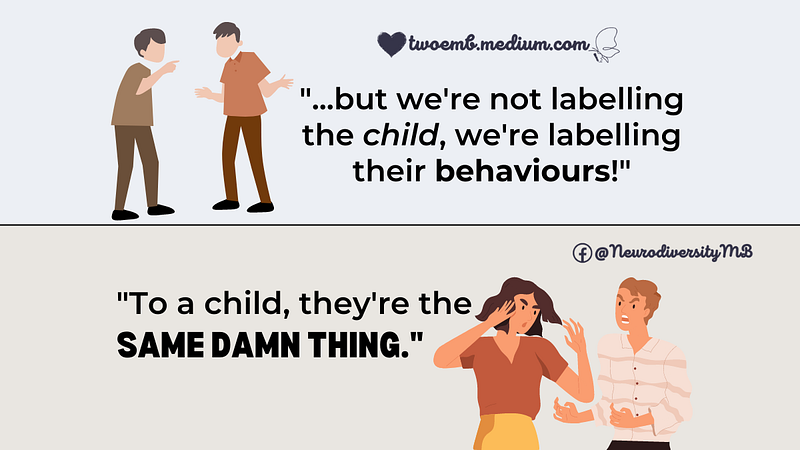
In defense, some might say they are labelling the behaviour and not the child. They are simply teaching the child their behaviour is “unacceptable” or “inappropriate”.
That’s almost worse. A child who is acting out is actually experiencing stress, and we’re telling them their body’s natural way of responding to stress is unacceptable.
Young children cannot yet mentally separate themselves — nor anyone else — from their behaviour.
Children only begin to develop Theory of Mind (ToM) between the ages of approximately 4–7 years. This is when children can begin to theorize about what other people might think, and begin to learn perspective-taking.
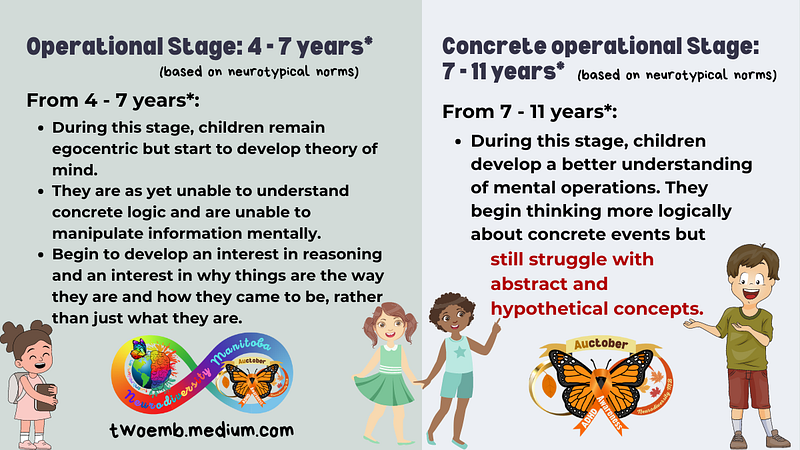
Note: I recognize there is technically no “operational” stage in Piaget’s theory of development. I felt the age range (2–7 years) for the pre-operational stage was too broad for this particular subject, and many current developmental texts use 4–7 years or “early elementary” ages as a separate developmental stage.
Children are still quite egocentric at that age. Egocentricity is the developmentally-appropriate tendency for young children to see everything that happens as it relates to themselves.
This means if someone is angry, the child believes it has something to with them, even when it doesn’t.
At this age, children also have very concrete thinking, meaning they do not yet have the neurological development to think about things in the in abstract and hypothetical.
To the child’s mind, if someone’s behaviour is “naughty”, this means they are naughty.
Reasonable expectations
We often have expectations of children which are developmentally inappropriate — we’re asking a child to do something which they are neurologically not yet ready to do.
This is especially true for neurodivergent and disabled kids. Adults often assume they are being intentionally disobedient, when this is usually not the case.
When a child truly can’t meet our unfair expectations, we label them “stubborn”, “defiant”, “willful”, and (apparently) “naughty”.
Telling a child their behaviour was naughty and sending them to the “naughty step” punishes them for not having the skills to better manage their big feelings.
Sending a child to the “naughty step” certainly does not teach them how to better manage themselves next time. It teaches them to suppress their emotions to avoid punishment, rather than find healthier ways to express them.
Behaviours we see as naughty are often STRESS behaviours. A child feels overwhelmed, lacking the skills or emotional resources to handle a situation, and becomes dysregulated.
Here are the offending remarks which incited this article:
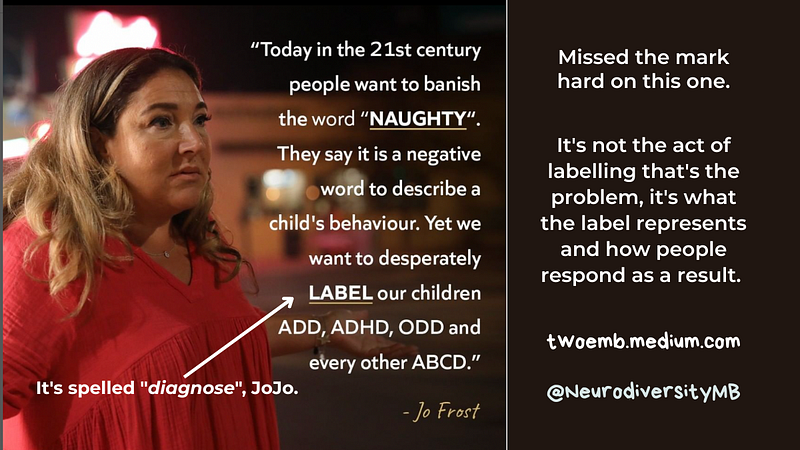
Apparently the concept of diagnosis is lost on the “Super Nanny”
So here is the rest of my response
Dear Jojo,
By “desperately want to label”, do you mean obtain a legitimate psychological diagnosis for a neurodevelopmental disorder, therefore opening the door to appropriate supports, accommodations, and education? Because that sounds a lot better than a naughty step to me.
The label “naughty” gives zero opportunity for the adults in a child’s life to be taught better ways to respond to a child and meet that child’s needs.
An appropriate, accurate diagnosis may open the door to education, understanding, support, and acceptance.
I am so proud and happy to “label” both myself and my child as ADHD and Autistic. Those labels have significantly improved the quality of our lives. They have led to better self-understanding and acceptance. Those “labels” led us to community, to celebrating neurodiversity.
By the way, Jojo: Yes, some parents are absolutely desperate (as you say) to “label” their children because it’s their only hope of getting any recognition, accommodation, or support.
What do you propose they do instead? Take their “naughty step” to their student centre, school administrator, employer, or health insurance provider as proof of their need for supports?
I’d much rather identify myself and my child as Autistic than “naughty”. Calling dysregulation or stress behaviour “naughty” causes parents and other adults to respond with consequences and punishment rather than support, empathy, and co-regulation.
That harms relationships.
…worse, it harms children.
These kinds of messages are damaging, Jojo. You need to educate yourself, posthaste, before causing further trauma to children and their families.
This is not me clutching my pearls, it’s me clutching more than twenty years’ worth of scientific text books and peer-reviewed journal articles that back up my personal and professional opinion.
Signed,
A Super-Naughty Neurodivergent (Just try to put me on your naughty step). (Also, behaviourism is dead, do try to keep up dear).
Just to be painstakingly clear…
When I talk about neurodivergent people having “behaviour issues”, I’m referring to the fact that we frequently get into trouble (especially as kids in school) because we usually don’t (either can’t or won’t — probably a bit of both) conform to majority expectations.
We’re often less concerned with social approval, therefore less interested in being compliant — something those in authority find irksome and inconvenient.
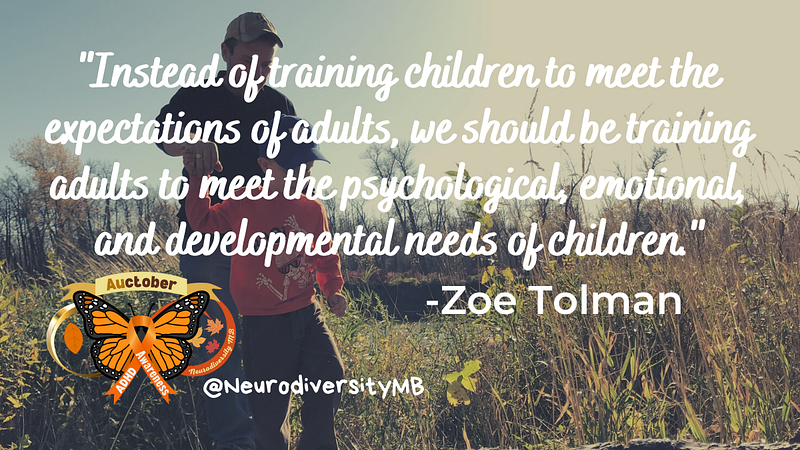
When I talk about Autistic and ADHD kids having “behaviour issues”, I’m not actually saying that ADHD or Autism cause behaviour issues.
Autism and ADHD are not behaviour disorders, nor do they, in fact, directly cause behaviour problems.
Executive functioning challenges may cause difficulties with things like emotional regulation and impulse control, which can get us into trouble, BUT…
Executive functioning difficulties can be supported and accommodated in a way that is respectful to the individual and reduces unhelpful behaviours.
It’s usually the fact that we operate outside the statistical norm, and many of us have no interest in conforming to the status quo, which makes us “problems”. Our behaviours are seen as difficult, mostly from the neurotypical perspective.
If the neurotypical majority were more accepting, welcoming and appreciative of differences, then our differences wouldn’t be seen as problems. Many of our unique traits would instead be viewed as assets.
Think about it…
The traits we exhibit which are most often seen as “problem behaviours” are:
- Being independent-minded
- Thinking critically
- Questioning authority
- Expressing our opinions and feelings
- Communicating in an honest and direct manner
- Refusing to comply simply for the sake of compliance
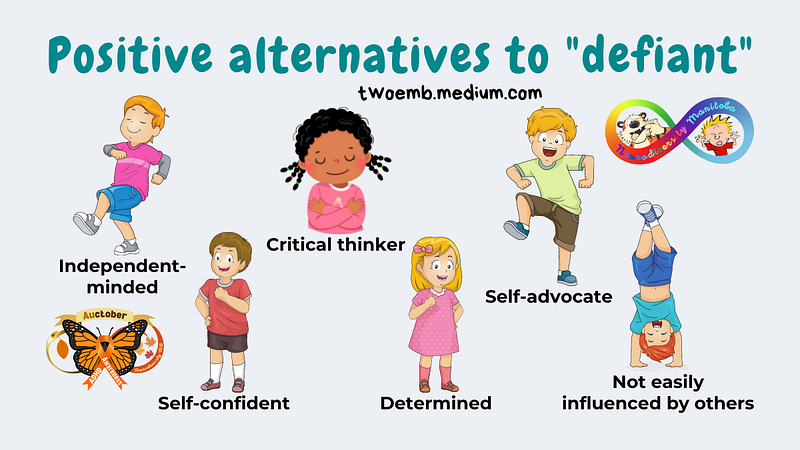
Either that, or they’re behaviours associated with being in an environment that is not at all considerate of divergent neurotypes.
Last but not least: A compliant child is not necessarily a healthy or happy child, nor are they learning well because they’re so focused on following the rules and not getting into trouble.
So, in conclusion… please allow me to make this important message abundantly clear:
Autism and ADHD are not behaviour disorders, nor do they, in fact, directly cause behaviour problems.
Thank you for coming to my ted talk.
© Jillian Enright, Neurodiversity MB
When you join medium, as a member you’ll have access to unlimited reads for only $5 per month. If you use my referral link, I’ll earn a small commission, and you’ll earn my undying gratitude.
If you’d prefer give a one-time tip, you can support my writing on Ko-Fi — also, it’s free to follow me on Facebook!
Related Articles
References
Astington, J.W., & Dack, L.A. (2008). Theory of Mind. In Marshall M. Haith, Janette B. Benson (eds), Encyclopedia of Infant and Early Childhood Development (pp 343–356). Academic Press. https://doi.org/10.1016/B978-012370877-9.00163-8
Lefa, B. (2014). The Piaget Theory of Cognitive Development: Educational Implications. Educational Psychology, 1(9). ResearchGate.


