
Knowledge Discovery: The “Methods — Guides” Mapping
Turning a framework into a method

This article is part of the Slow Cognition Project which focuses on Developing Tacit Knowledge with Thematic Space Canvas. The Knowledge Discovery Canvas is an application of the Thematic Space Canvas.
The Knowledge Discovery Canvas has two nested squares which divide the thematic space into two sub-spaces: inner space and outer space. For Developing Tacit Knowledge, the inner space is all about personal knowing activities while the outer space is related to social interactions.
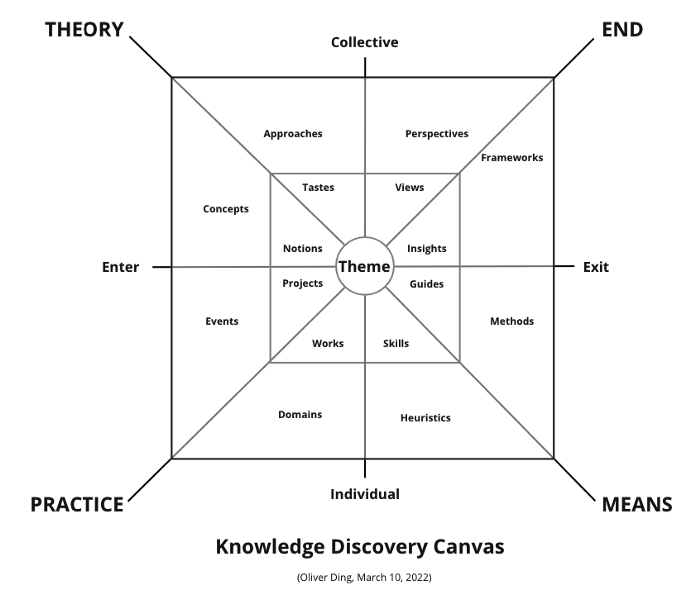
Based on the above settings, I generated a series of mapping between outer space and inner space:
- Approaches — Tastes
- Concepts — Notions
- Events — Projects
- Domains — Works
- Perspectives — Views
- Frameworks — Insights
- Methods — Guides
- Heuristics — Skills
Today I’ll focus on the Methods — Guides mapping and share some of my stories. Part 1 introduces a typology of methods while Part 2 shares an example of turning a framework into a method.
Contents
Part 1: Knowledge Discovery and Methods
1.1 Theory, Practice, and Means 1.2 A Typology of Methods 1.3 From Frameworks to Methods
Part 2: The Creative Action Analysis Method
2.1 The Creativity U Project 2.2 The Creative Action Analysis Method 2.3 The Prototype of the 3i Model 2.4 The notion of “Quasi-social Interaction” 2.5 React as Double Selectivity 2.6 React to Gibson’s Creative Writing 2.7 React to My Kids’ Creative Play 2.8 Act, React, and Opportunity
Part 3: Guides for Operations
Part 1: Knowledge Discovery and Methods
Part 1 offers some background about the Knowledge Discovery Activity and the concept of Methods.
1.1 Theory, Practice, and Means
The goal of the Knowledge Discovery Activity is to develop tacit knowledge around particular themes in order to make new knowledge or use knowledge for practice.
The Knowledge Discovery Canvas is designed with four areas: the THEORY area, the PRACTICE area, the END area, and the MEANS area. The “Methods — Guides” mapping is related to both the THEORY area and the PRACTICE area.
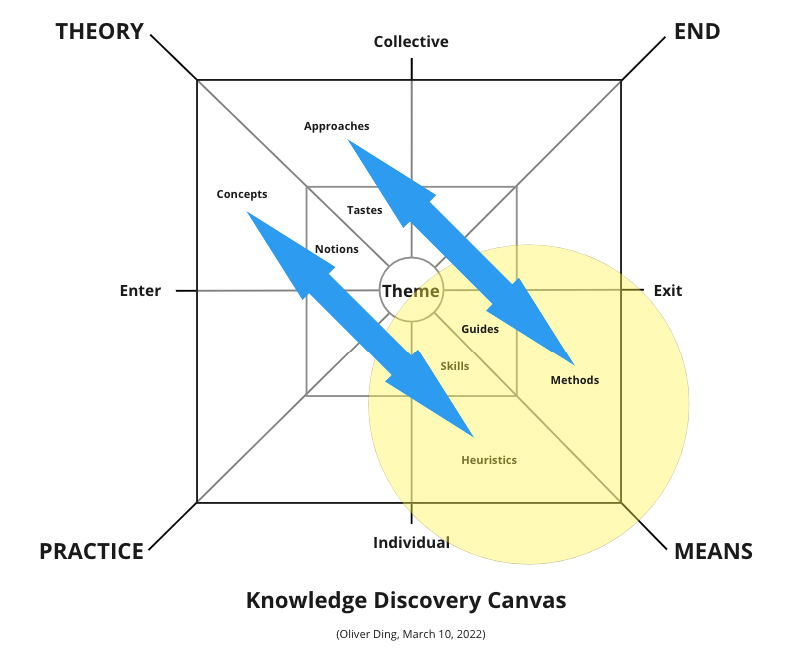
The above diagram shows two connections between the THEORY area and the MEANS area. While the Heuristics — Skills mapping echoes the Concepts — Notions mapping, the Methods — Guides mapping echoes the Approaches — Tastes mapping.
Also, we can roughly understand Methods as using a set of Heuristics while Approaches as grouping a set of Concepts.
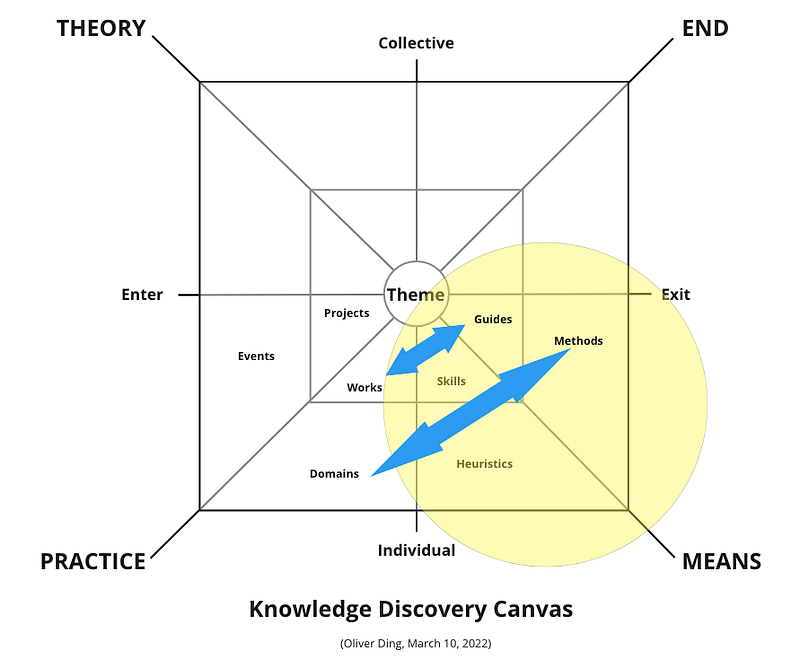
We also have to notice that the MEANS area is connecting to the PRACTICE area. We can see a connection between the Methods — Guides mapping and the Domains — Works mapping.
Usually, a particular method is a shared knowledge of a particular domain. The work of a domain always requires a particular guide for workers. If a person can’t find existing methods for guiding his work, he might develop some methods as means for himself.
1.2 A Typology of Methods
The American sociologist and social theorist Andrew Abbott wrote a great book titled Methods of Discovery: Heuristics for the Social Sciences in 2004. In Chapter 1, he developed a typology of methods with the following essential- questions(pp.13–26):
- How to propose a question?
- How to design a study?
- How to draw inferences?
- How to acquire and analyze data?
Each question could lead to a typology of methods. For example, if we pay attention to the type of data gathering, then we can find four basic social science methods:
- Ethnography: gathering data by personal interaction
- Survey: gathering data by submitting questionnaires to respondents or formally interviewing them
- Record-based analysis: gathering data from formal organizational records (censuses, accounts, publications, and so on)
- History: using old records, surveys, and even ethnographies
If we start with how one analyzes data, we have three choices:
- Direct Interpretation: analysis by an individual’s reflection and synthesis (for example, narration)
- Quantitative Analysis: analysis using one of the standard methods of statistics to reason about causes
- Formal Modeling: analysis by creating a formal system mimicking the world and then using it to simulate reality.
Andrew Abbott also pointed out that we can begin with how one poses a question, we might note the important issue of how many cases we consider. This leads to the following three methods:
- Case-study analysis: studying a unique example in great detail
- Small-N analysis: seeking similarities and contrasts in a small number of cases
- Large-N analysis: emphasizing generalizability by studying large numbers of cases, usually randomly selected
Moreover, if we put these together, we can get 4*3*3=36 subtypes. This is an amazing typology of methods! Finally, he selected five successful methodological traditions and offered more details about them to his readers.
What are these Big Five?
- Ethnography
- Historical narration
- Standard causal analysis
- Small-N comparison
- Formalization
You can find more details in his book.
In Slow Cognition: The Curated Mind, I also mentioned the diagram below and the “Flow — Story — Model” metaphor.
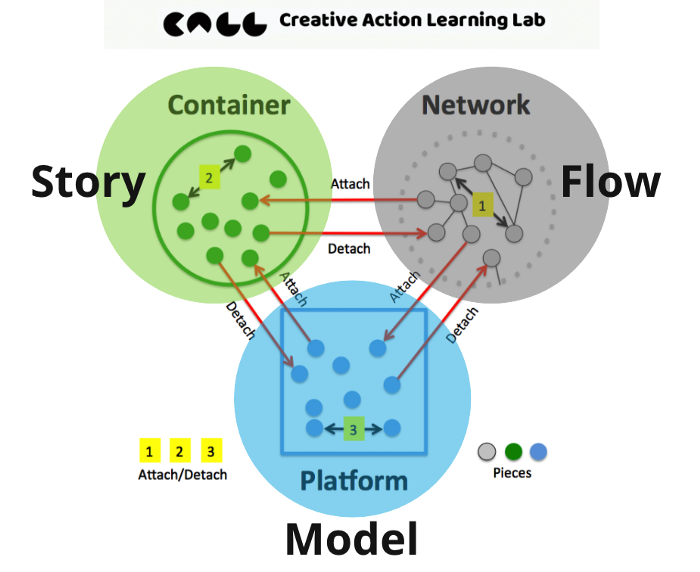
The “Flow — Story — Model” metaphor is also inspired by James G. March (1928–2018) who was an American political scientist, sociologist, and a pioneer of organizational decision making. He mentioned that there are three types of wisdom in his 2010 book The Ambiguities of Experience.
What are the three types of wisdom?
- Models: a model is an abstract cognitive representation.
- Stories: a story is a model too, but it is easy to understand.
- Actions: you just do it, then you get it.
What March suggested roughly echoes three types of social sciences.
- Models: Explanation (such as Systems and Rational Choices)
- Stories: Understanding (such as Culture and Subjective meanings)
- Actions: Intervention (Such as Critical theory and Action Science)
The difference between Andrew Abbott and James March is the method of “Actions”. We have to notice that Andrew Abbott only talked about the methods for Explanation.
For the Life Discovery Activity, we should consider both Explanation and Intervention.
1.3 From Frameworks to Methods
In Knowledge Discovery: The “Frameworks — Insights” Mapping, I developed the following typology of Frameworks.
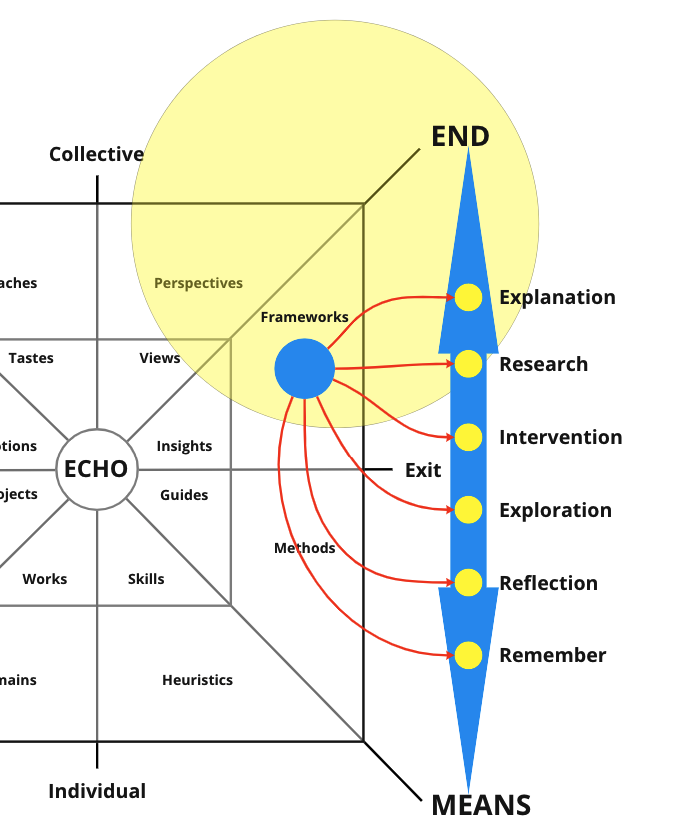
By using the MEANS — END spectrum, I identify six purposes for using and making Knowledge Frameworks.
- Explanation
- Research
- Intervention
- Exploration
- Reflection
- Remember
You can find more details in the original article.
We also should notice that some methods are generated from some frameworks. If a knowledge framework is really unique, the ways of using the framework will lead to a new method. For example, the activity theorist Clay Spinuzzi developed a method for applying Activity Theory in studying, diagnosing, and fixing information flow in organizations. You can find more details in his book Topsight.
Part 2: The Creative Action Analysis Method
Part 2 focuses on the Creative Action Analysis method which was born from the Creativity U Project.
2.1 The Creativity U Project
In 2020, I worked on the Creativity U project and I developed a brand new approach to creativity study. See the diagram below:
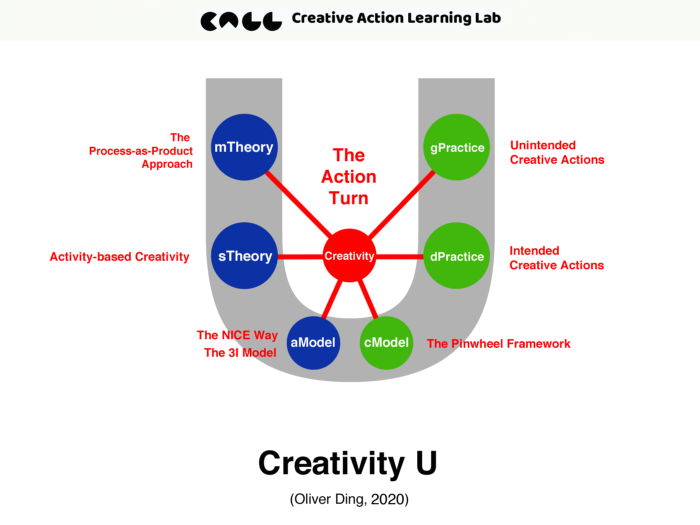
Unintended Creative Actions are general practice (gPractice) and Intended Creative Actions are domain practice (dPractice). The Pinwheel framework is a concrete model (cModel) while the 3I model and the NICE way are abstract models (aModel). Action-based Creativity can be seen as a specific theory (sTheory) and the “Process as Product” approach is a meta-theory (mTheory).
After reviewing creativity studies, I pointed out two critical theoretical issues of creativity research.
First, we need a theoretical approach that puts action first and doesn’t consider actions as the “creating process” of a “creative product”. In other words, what I called Action-based Creativity can be seen as a “Process as Product” approach.
Second, there is a need to develop a new framework that can help us connect the individual daily experiences of Action-based Creativity at the micro level with the dynamic historical development of collective culture at the macro level.
The above statement inspired me to develop the 3i model for the micro-level analysis and the NICE framework for the macro-level analysis.
You can find more details in the original article: The NICE Way and Creative Actions.
2.2 The Creative Action Analysis Method
In order to explain Action-based Creativity, I developed the following framework to connect individual daily experience at the micro-level and collective culture at the macro level. I call it the N.I.C.E. framework. N stands for normal actions, I stands for Imagined actions, C stands for creative actions, and E stands for exemplary actions.
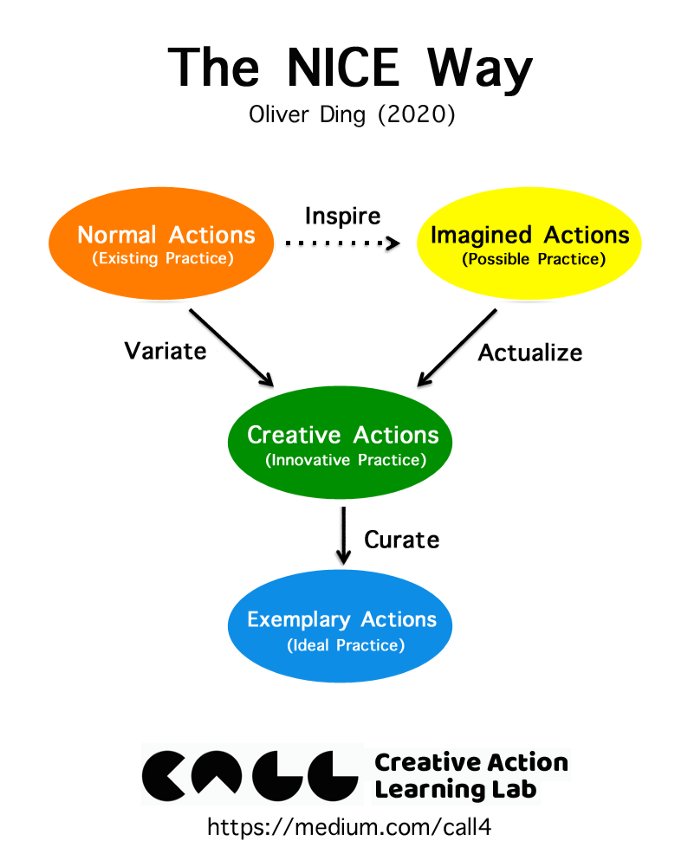
I also identified four types of transformation processes within Action-based creativity.
- Variate: from normal actions to creative actions
- Inspire: from normal actions to imagined actions
- Actualize: from imagined actions to creative actions
- Curate: from creative actions to exemplary actions
At the micro-level, the basic unit of analysis is Creative Action. I use the following 3i model to understand it. As the diagram below shows, the 3I model has three core entities which are idea, initiator, and initiatee. It also considers two types of events: act by the initiator and react by initiatee. Finally, the model considers the platform as the context of entities and events.
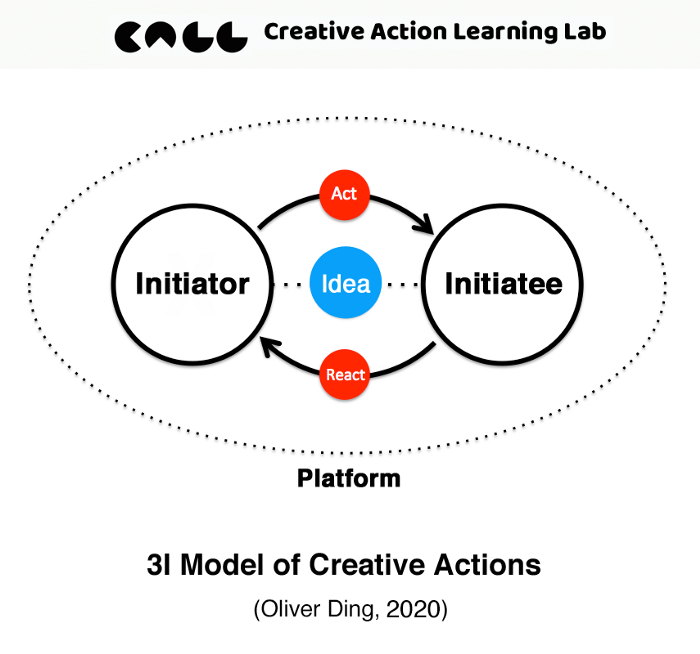
In order to make the “Process as Product” approach possible, I use the term “Idea” to refer to the product aspect of creative actions and use the term “Act/React” to refer to the process aspect. This pair of concepts solve the problem of the disappearance of immediate experience. I further consider the “Idea” has three elements including name, form, and content.
The BED Talk challenge was initiated by the speaker and author David Rendall and Stan Phelps. The idea behind a BED Talk is to share a short, unscripted video sharing something helpful…recorded from your bed since you’re (hopefully) at home. This is an example of Creative Action.

For example, the name of BED Talks is “BED Talks”, its form is “recording a short talk in bed”, and each BED talk has its own unique content.
The name part is very important for communication and distribution. A name can generate a hashtag for people to follow on social media platforms, a name can help people mention a creative action in words, and a name can be a keyword for searching and finding.
Most intended creation actions have a short name and hashtag, sometimes unintended creation actions don’t have a name.
The screenshot below shows an example of an unintended creation action.
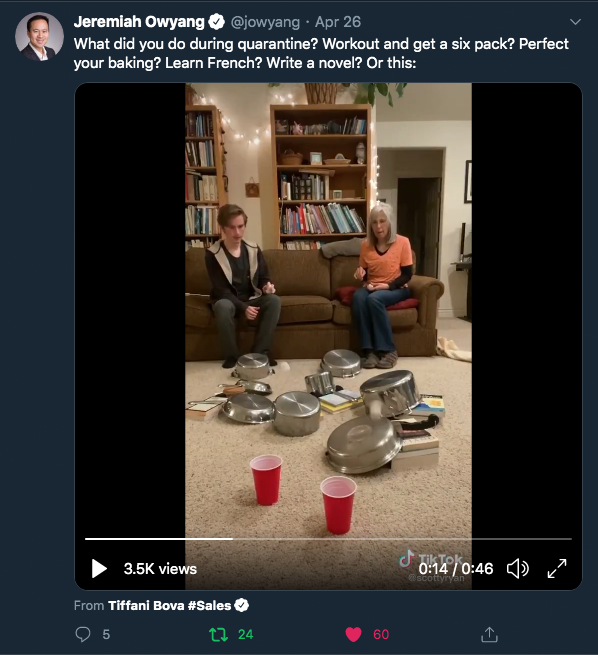
The second pair of concepts are “Initiator” and “Initiatee”. Initiator refers to a person who initiates an act that makes “a grand opening” of a creative action. Initiatee refers to a person who responds to the initiator’s “call-to-action”. For most intended creation actions, it is easy to identify the Initiator and the Initiatee behind a creative action. However, it is not easy to do the same analysis on unintended cases. We leave this challenge for the next section.
The third pair of concepts is “Act” and “React”. It can apply to both Sawyer’s performance creativity and stay-at-home challenges. For performance, the “Act” is performing and the “React” is feedback from the audience. For stay-at-home challenges, the “Act” is the original action and the “React” is the following actions. For intended creation actions, the initiator might specify what initiatees should do while untended creation actions don’t have such strong intentions.
The sociocultural approach to creativity research highlights the importance of context. Researchers have been studying the various contexts of creativity such as classrooms, the local cultural traditions, the performance stages, etc. I suggest “platform” as a new type of context for studying creativity, especially creative actions.
The NICE Framework and the 3i Model were published in July 2020. Later, I named the way of using these two frameworks as the Creative Action Analysis method.
The following sections will share some examples of the Creative Action Analysis method. I didn’t make the method and apply it to these examples.
In fact, these examples created the method.
2.3 The Prototype of the 3i Model
The 3i Model was published on July 8, 2020. The model was inspired by a model about Twitter. On June 19, 2020, I published an article titled #SocialPxD — ReEngagement with Twitterville and introduced the Ecological Physics Method for digital platform studies.
I used the following model to understand the basic structure of the Twitter platform.
There are many ways to describe the structure of Twitter. For example, if you see Twitter as a “Media” platform, you can adopt the model of communication: Sender — Message-Receiver. I see Twitter as a “Social” platform and build a model of interaction: Act — Tweet — React.
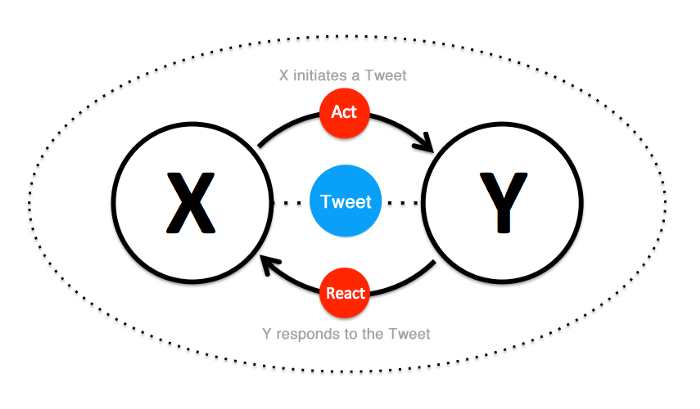
From the perspective of action, I don’t choose Tweet as the basic unit of Twitter, but the interaction based on Tweet as a basic unit of Twitter. User X initiates a tweet (Act), and User Y responds to the tweet User X initiated (React). User X and User Y connect to each other (Connect) through a tweet (Tweet).
The Tweet part, the Act part, the React part, and the Connect part are Invariant Structures of the Twitter platform. This structure defines what the Twitter platform is and it has never changed.
Now, let’s pay attention to the Act part. The way of initiating a tweet had several major changes and minor changes in the history of Twitter. For example, the original tweet is text only with a 140-character limit. In 2011, the platform announced its own integrated photo-sharing service which allows users to upload a photo and attach it to a tweet. In 2013, the platform launched Twitter Cards which allows developers and media to connect their apps, media, products, photos, videos, and galleries to Tweets. These two updates dramatically change the way of initiating a tweet, we should consider these updates as major changes.
While the major updates change the Invariant Properties of the Twitter platform, the minor updates only impact the Variant Properties. Before adding photos to tweets, Text-only was the key Invariant Property of Twitter for many years. Now Visual Card is the key Invariant Property of Twitter.
We can apply the same principle to the React part and the Connect part. The way of Reacting and the way of Connecting point to the Invariant Properties of Twitter. For example, Retweet and Retweet with Comment are major updates of the React part. The Following/follow feature didn’t change.
You can find more details here.
I used the same diagram and structure to develop the 3i model with more abstract terms such as “Idea”, “Initiator”, and “Initiatee”.
2.4 The notion of “Quasi-social Interaction”
On July 21, 2020, I published an article titled Frame Analysis in Context and use the article to develop a method called Ecological Interaction Analysis.
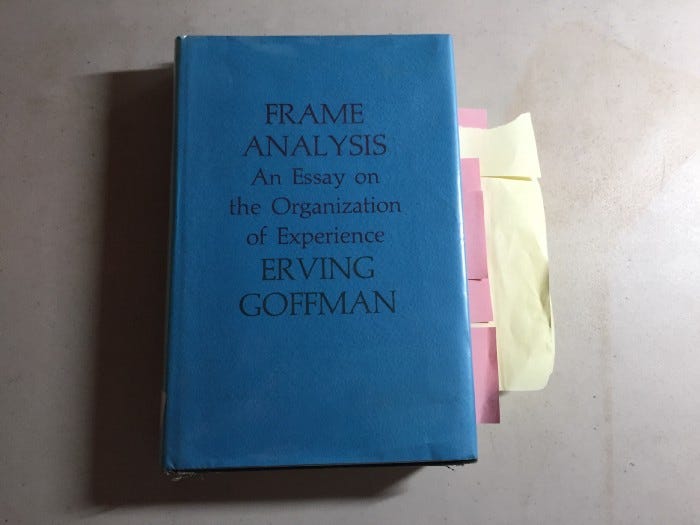
The article recorded my reading experience of a book titled Frame Analysis which was written by the sociologist Erving Goffman in 1974.
Part I used photos to record and presented my reading activity within three days. Part II developed the Ecological Interaction Analysis framework and used it to reflect my reading experience. Part III adopted the 3I model to understand a new idea called Quasi-social Interaction I coined for discussing my reading case.
Why did I coin the term “Quasi-social Interaction”? Because the Ecological Interaction Analysis framework uses the following diagram to visualize six types of context: Physical, Digital, Personal, Social, Figure, and Idea. You can find more details here.
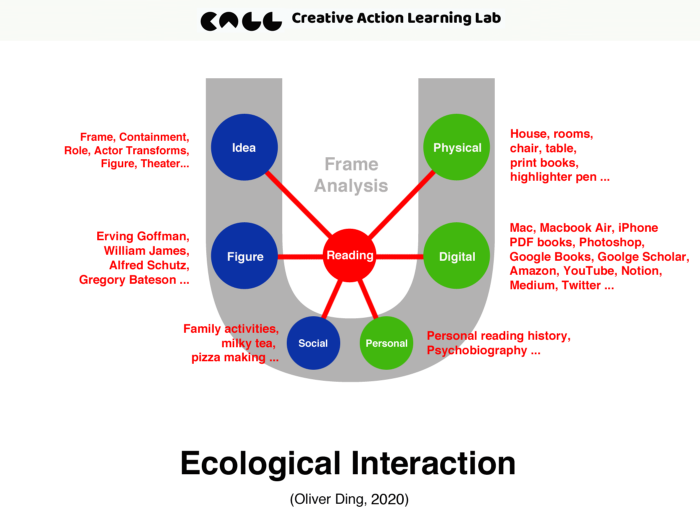
An emergent issue is an interaction between people and their figure ecology. I consider this type of interaction as “Quasi-social Interaction” since historical figures are people too but they can’t respond to us.
The notion of Quasi-social Interaction bypasses the content and media approach for studying reading and raises a challenge for us:
What’s the mechanism of Quasi-social Interaction?
I used this challenge to test the 3I Model of Creative Actions and considered Goffman’s creative wiring as a creative action.
Initiator
Erving Goffman
Initiatee
Oliver Ding
Act:
Erving Goffman wrote the sentence “I try to follow a tradition established by William James in his famous chapter ‘The Perception of Reality,’ first published as an article in Mind in 1869” in 1974.
React:
I found several books about William James at home and found the article and took pictures in 2020.
Idea:
William James on Reality.
Platform:
Harvard University Press can be seen as the platform for Erving Goffman’s creative writing for Frame Analysis.
Initiator refers to a person who initiates an act that makes “a grand opening” of a creative action. Initiatee refers to a person who responds to the initiator’s “call-to-action.” For my reading case, I consider Goffman as an unintended initiator who didn’t have a strong intention on what initiatees should do.
The “Act” is the original action and the “React” is the following actions. The 3I model doesn’t require Act and React should be real-time.
For intended action, the “Idea” has three elements including name, form, and content. For unintended action, these three elements are not required.
I also mentioned some “Ideas” may contain multiple layers and each layer is a creative space. This means we can also understand creative writing in multiple layers. The above example is writing a sentence which is a sub-creative action of writing a whole book.
Though the 3I model was developed for discussing non-content creative action, the above test tells us it can be used as a general model for interpreting creative content from the perspective of Action-based Creativity.
2.5 React as Double Selectivity
On August 12, 2021, I wrote an article titled D as Diagramming: Meta-theory and General Practice and used Curativity Theory to expand the 3i Model, especially the “React” part of the model.
Why did I want to expand the “React” part of the 3i Model? Because the article considers a special case of Creative Actions that requires a special “React” between Meta-theory and General Practice. See the diagram below.
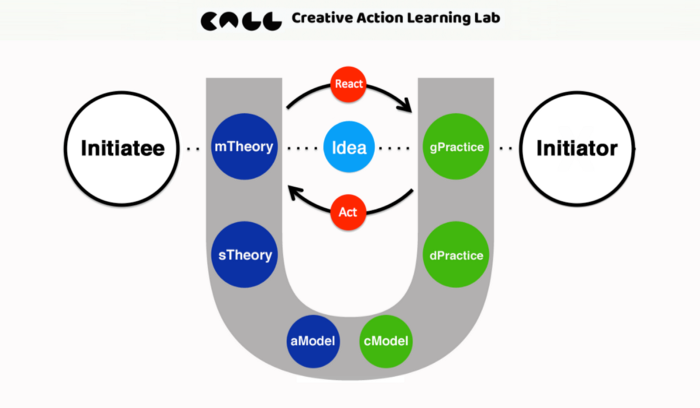
Let’s unpack the diagram from the perspective of the 3i model:
- There is an “idea” behind a “creative action”.
- There are two types of roles: “Initiator” and “Initiatee”.
- An Initiator initiates an act which is a creative action.
- An Initiatee responds to the Act initiated by the Initiator.
Let’s apply the 3I model to understand the connection between Meta-theory and General Practice.
- Idea = Meta-theory
- Actors = Initiator
- Theorists = Initiatee
It means meta-theories are discovered by theorists from real creative actions initiated by actors.
If an actor discovers a meta-theory behind a creative action in his real life. That means the actor becomes a theorist.
Of course, this is a super simple basic model. In real life, the theorist and the actor may work together on several rounds of “act-react” in order to turn a rough idea into a well-crafted theory.
For the connection between Meta-theory and General Practice, I adopted the concept of “Double Selectivity” from Curativity Theory to expand the 3i model.
General Practice is about the daily experience while Meta-theory is about the concept. The process of “React” is about turning daily experience into theoretical concepts.
My approach is inspired by James J. Gibson’s ecological psychology. According to Harry Heft, the theoretical root of Gibson’s ecological psychology is William James’ Radical Empiricism. Inspired by Heft, I adopted the concept of Selectivity from Radical Empiricism.
Heft (2012) pointed out, “…in radical empiricism, knowing refers most fundamentally to a functional relation in experience between a knower and an object known. The defining characteristic of knowing is selectivity. Through knowing processes, structure is selected out of, or differentiated from, immediate experience. It is now time to consider the products of selective processes. To use James’s terminology, two products of the selectivity of knowing processes are percepts and concepts.”(p.37)
In order to develop Curativity Theory, I used “Double Selectivity” to describe the foundation of curating. Now, I will expand it to describe two sub-processes of “React”.
- First sub-process: the Selectivity of Perceiving
- Second sub-process: the Selectivity of Thinking
According to Heft, “Perceiving is an action that entails selection of a flow of immediate experience out of the potential ground that is pure experience. Thinking or conceiving entails, in turn, selecting and fixing particular parts of this perceptual flow. Through this process, concepts are carved out of immediate perceptual experience at a remove from action and are abstracted from it. Abstracting from the immediate flow of experience makes it possible for the knower to isolate, and then to classify or otherwise manipulate, these extracted ‘moments.’ This cognitive capability enlarges the knower’s epistemic potential in incalculable ways. ”(pp.39–40)
For Curativity theory, the orientation of selection is turning pieces into a whole. It requires perceiving and thinking of something as a container for things-in-pieces. For the 3i model, the orientation of selection is turning daily experience into theoretical concepts for developing metatheories.
2.6 React to Gibson’s Creative Writing
In Oct 2020, I coined a term called Supportance and developed it as a new meta-concept that offers a new perspective on social support and other social phenomena. I considered it as a starting point for a new theory of social action. You can find more details in The Concept of Supportance.
How did I develop the concept of Supportance? From the perspective of the 3i model, I was building Supportance Theory by reacting to two creative actions.
- Gibson’s creative writing
- My kids’ creative play
First, I got an idea for the new concept when I was reading Gibson’s book The Ecological Approach to Visual Perception in Oct 2020. I have been reading the book many times. The book has a chapter that presents the theory of Affordance. One day, I found the classical example of Affordance Gibson offered had a new meaning for me.
Initiator
James J. Gibson
Initiatee
Oliver Ding
Act
Gibson wrote a classical example of Affordance in 1979.
If a terrestrial surface is nearly horizontal (instead of slanted), nearly flat (instead of convex or concave), and sufficiently extended (relative to the size of the animal) and if its substance is rigid (relative to the weight of the animal), then the surface affords support. It is a surface of support, and we call it a substratum, ground, or floor. It is stand-on-able, permitting an upright posture for quadrupeds and bipeds. It is therefore walk-on-able and run-over-able. It is not sink-into-able like a surface of water or a swamp, that is, not for heavy terrestrial animals. Support for water bugs is different. (1979/2015, p.119)
Idea
The Surface affords support.
React
Inspired by Gibson’s writing, I coined a new term: Supportance.
The Selectivity of Perceiving
Usually, people use this example for understanding the concept of Affordance. Since I had read the book many times, I didn’t have to do it in this way. I paid attention to one sentence “…the surface affords support…” and the word “support.”
The Selectivity of Thinking
I realized that I could coin a new term Supportance and develop it as a new theoretical concept.
As James G. March mentioned, the evocation of meaning is a natural product of crossing disciplinary, cultural, national, and linguistic boundaries. He says, “Nevertheless, for those who see the creative beauty generated by the wanderings of ideas, the magic and mystery of language is a wonder of intellectual discourse. Scholars celebrate the evocation of new meanings that arise when others discover, not exactly what they thought they meant when they wrote their words or characters but rather what the words or characters themselves might be imagined to mean.” (2008, p.140)
However, the new term is not a real concept even though it has its own word meaning. I need to find its concept from the real-life world. I was lucky because I quickly solved it by reacting to a second creative action initiated by my two sons.
2.7 React to My Kids’ Creative Play
In 2020, I often went to a nearby museum with my two sons. They loved playing a creative game called “Jump-Jump-Jump” in the courtyard of the museum. See the picture below. The ground of the courtyard is covered with gravel, and there are many large stone slabs well-spaced on it.
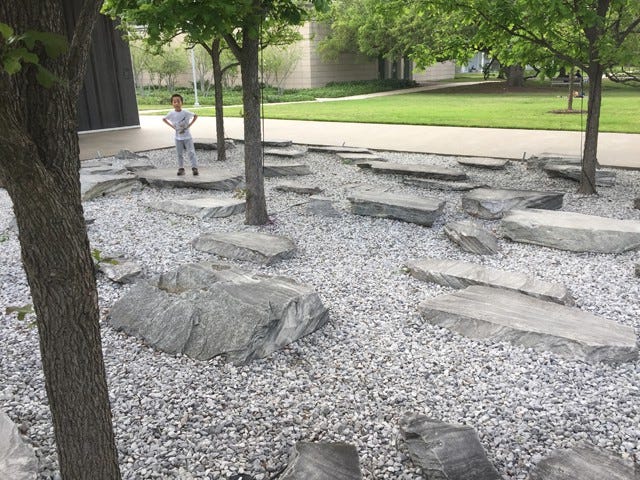
My two sons loved jumping from one stone slab to another one. Eventually, they invented the game “Jump-Jump-Jump”.
The rule of the game is 1) Player A has to jump from one stone slab to another one; 2) Player B has to follow the first player and try to catch him; 3) if Player A is caught by Player B, or steps onto the gravel, he fails. Player B must also be careful not to step onto the gravel; 4) If one play fails, both players have to go to a rock in the corner of the courtyard and restart the game.
Sometimes I joined the game and played with them. They really wanted to play with me. Sometimes, I refused to join the game in order to walk around.
From the perspective of Affordance Theory, these stone slabs (as a physical environment) offer jumping for my sons and me. However, Affordance Theory doesn’t apply to the game of “Jump-Jump-Jump” because it is about social actions.
How about the concept of Supportance? I realized it is suitable to explain the game “Jump-Jump-Jump” because I (as a social environment) offer support for my sons to play the game. The Supportance of support-for-playing “Jump-jump-jump” is offered by me.
Moreover, the combination of “Affordance — Supportane” is a perfect framework for explaining the game of “Jump-Jump-Jump” and similar social actions because we have to pay attention to both physical environments and social environments.
On August 12, 2021, I applied the 3I model to this case.
Initiator
My two sons and me
Initiatee
Oliver Ding
Act
We play the game “Jump-Jump-Jump”.
Idea
While stone slabs afford to jump, I offer support-for-playing for my sons.
React
I use this creative play to test the concept of Supportance.
The Selectivity of Perceiving
I noticed that my behavior has two states: play with them, or not play with them.
The Selectivity of Thinking
I realized that these two states of my behavior mean there is a transformation between potential and actual. Thus, I confirmed the concept of Supportance because it shares the same logic as the concept of Affordance.
2.8 Act, React, and Opportunity
The original 3i model also has an element called “Platform”. Later, I used “Context” to replace “Platform”. On March 5, 2022, I developed the Optimal Context Canvas for the Ecosystem-for-Development approach.
There are many theories and models about ecosystems. The Ecosystem-for-Development approach focuses on the “Individuals — Opportunities — Ecosystems” relationship.
For Ecosystem builders, the Optimal Context Canvas offers a landscape view of an ecosystem with a brand new typology of social contexts.
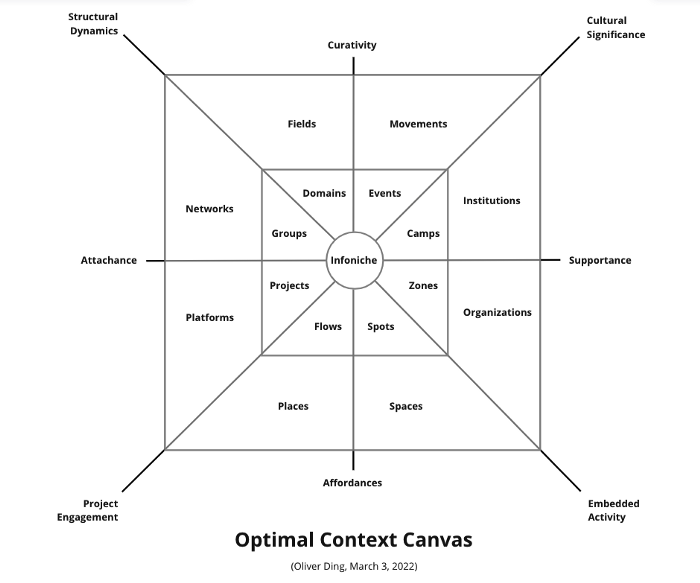
Now we can use the Optimal Context Canvas to expand the 3i Model.
Originally, the Creativity U project and the Ecological Practice approach are two separate projects. Now we can merge them together with the “Methods — Phenomena” connection.
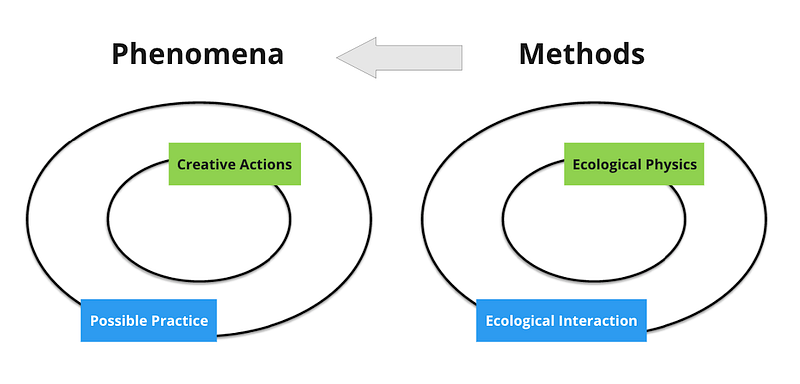
The Creativity U project produced the notion of “Possible Practice (Creative Actions)”. See the above NICE framework.
The Ecological Practice approach produced two methods: Ecological Physics Method and Ecological Interaction Analysis.
They can connect together through the notion of Opportunity. See the diagram below. Now the “Act” part of the 3i model can be understood as “Giving Opportunity” while the “React” part of the 3i model can be understood as “Taking Opportunity”. The “Idea” part of the 3i model refers to “Opportunity”.
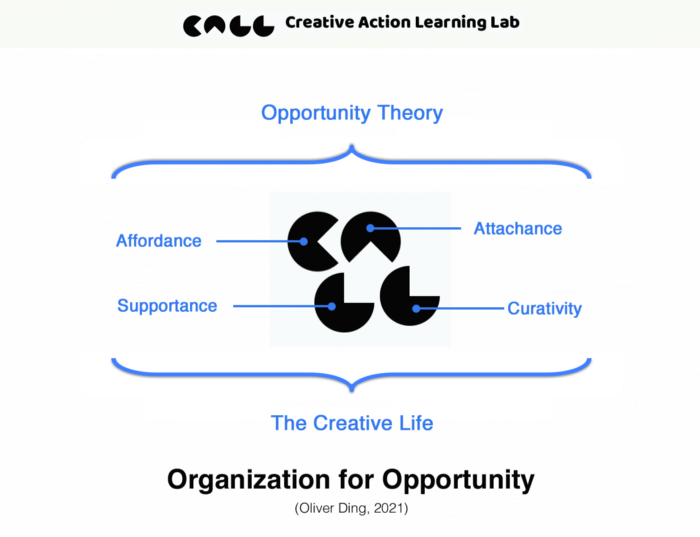
This new perspective goes beyond the original perspective of creativity study, it is more about creative actions for achieving a creative life for an individual and making possible practice for the collective society.
Part 3: Guides for Operations
A unique theoretical approach could lead to a unique framework which could lead to a unique method which could lead to a unique set of guides.
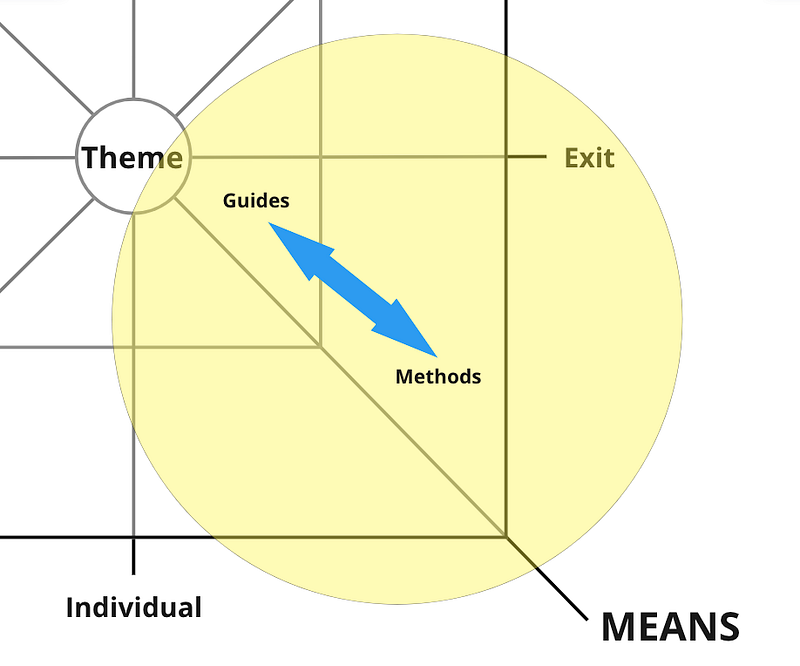
What are the guides of the Creative Action Analysis method?
Based on the above discussion, we can summarize the guides in the following rules:
- The basic structure of ecological interactions is “Context[Initiator (Act) — Idea — Initiate (React)]”.
- The “Act” is the original action and the “React” is the following actions.
- The 3I model doesn’t require the “Act — React” Interaction should be real-time and face-to-face.
- The “Initiator” could be a historical figure.
- The “Act” part can be Intended Actions and Unintended Actions.
- For Intended Actions, the “Idea” has three elements including name, form, and content. For Unintended ActionS, these three elements are not required.
- Some “Ideas” may contain multiple layers and each layer could be a creative space.
- 3i model can be used for both non-content creative actions and content-centered creative actions.
- Both the “Act” part and the “React” part can be understood as creative actions.
- There are two sub-processes behind a creative action: the selectivity of perceiving and the selectivity of thinking.
These rules set a boundary for the Creative Action Analysis method.
Related Articles
- The Slow Cognition Project
- Slow Cognition: A Meta-canvas for Developing Tacit Knowledge
- Knowledge Discovery: Concepts, Notions, and the Concept Dynamics Framework
- Knowledge Discovery: The “Approaches — Tastes” Mapping
- Knowledge Discovery: The “Perspectives — Views” Mapping
- Knowledge Discovery: The “Frameworks — Insights” Mapping
- Knowledge Discovery: The “Events — Projects” Mapping
- Knowledge Discovery: The “Domains — Works” Mapping
- Knowledge Discovery: The “Heuristics — Skills” Mapping
- Knowledge Discovery: The HERO U Canvas
- Knowledge Discovery: The Concept Dynamics Framework
- Knowledge Discovery: The “Double Theme” Strategy
- Knowledge Discovery: The “Middleware” Strategy
- Project-oriented Activity Theory (Book)
- D as Diagramming: The Mind as Play Metaphor
- D as Diagramming: An Integrated Framework for Studying Knowledge Diagrams (Part 1)
- Themes of Practice (2019–2021)
- The Career Theme Canvas
I am also working on building a new website for the Platform Ecology project. You can save the following links:
- PlatformEcology.org
- Twitter: @PlatformEcology
- Linkedin: @PlatformEcology
You are most welcome to connect via the following social platforms:
Linkedin: https://www.linkedin.com/in/oliverding Twitter: https://twitter.com/oliverding Polywork: https://www.polywork.com/oliverding Boardle: https://www.boardle.io/users/oliver-ding


