
Knowledge Discovery: The “Heuristics — Skills” Mapping
Try something new at least three times

This article is part of the Slow Cognition Project which focuses on Developing Tacit Knowledge with Thematic Space Canvas. The Knowledge Discovery Canvas is an application of the Thematic Space Canvas.
The Knowledge Discovery Canvas has two nested squares which divide the thematic space into two sub-spaces: inner space and outer space. For Developing Tacit Knowledge, the inner space is all about personal knowing activities while the outer space is related to social interactions.
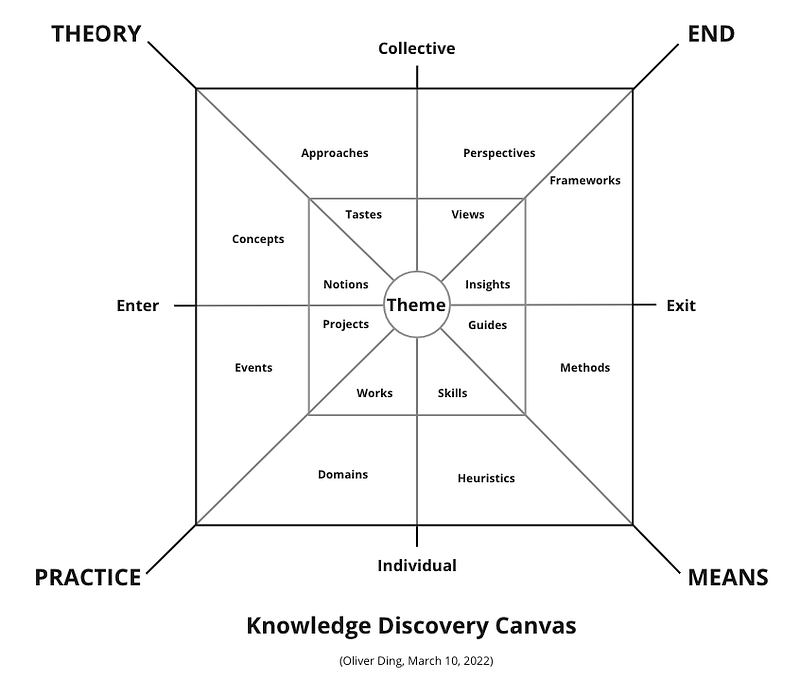
Based on the above settings, I generated a series of mapping between outer space and inner space:
- Approaches — Tastes
- Concepts — Notions
- Events — Projects
- Domains — Works
- Perspectives — Views
- Frameworks — Insights
- Methods — Guides
- Heuristics — Skills
Today I’ll focus on the Heuristics — Skills mapping and share some of my stories. Part 1 introduces a typology of heuristics while Part 2 shares an example of using a theoretical concept as a heuristic tool three times.
Part 3 mentions the issue of knowledge overload, especially heuristics overload.
Contents
Part 1: A Typology of Heuristics
1.1 Heuristics as Means 1.2 Theoretical Knowledge as Heuristics 1.3 Practical Knowledge as Heuristics 1.4 Situational Heuristics
Part 2: The “Deep Analogy” Case Study
2.1 Try Something New Three Times 2.2 The Notion of “Deep Analogy” 2.3 Making 1st Deep Analogy (Dec 2021) 2.4 Making 2nd Deep Analogy (Jan 2022) 2.5 Making 3rd Deep Analogy (April 2022)
Part 3 Reflections
Part 1: A Typology of Heuristics
For the Knowledge Discovery Activity, I develop the following typology of Heuristics for further discussion:
- Theoretical Knowledge as Heuristics
- Practical Knowledge as Heuristics
- Situational Heuristics
1.1 Heuristics as Means
For the Knowledge Discovery Canvas, the “Heuristics — Skills” mapping is located in the MEANS area. It considers individuals’ practical situations as the context of using knowledge as cognitive heuristics for solving problems and producing some outcomes.
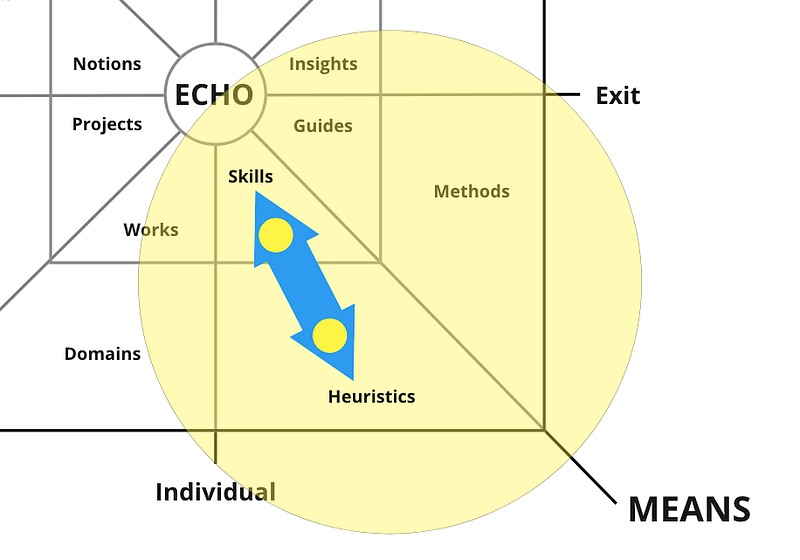
Heuristics are used in various fields such as scientific discovery, professional work, and the tasks of everyday life. Originally, the concept of heuristics was introduced by the Nobel laureate Herbert A. Simon for problem-solving and design science in general.
For the Knowledge Discovery Activity, I develop the following typology of Heuristics for further discussion:
- Theoretical Knowledge as Heuristics
- Practical Knowledge as Heuristics
- Situational Heuristics
This typology is based on the source of heuristics. While Theoretical Knowledge as Heuristics and Practical Knowledge as Heuristics are from Others, the Situational Heuristics are self-made.
1.2 Theoretical Knowledge as Heuristics
For example, the three-level hierarchy of Activity was developed by Activity Theorist A. N. Leontiev. See the diagram below:
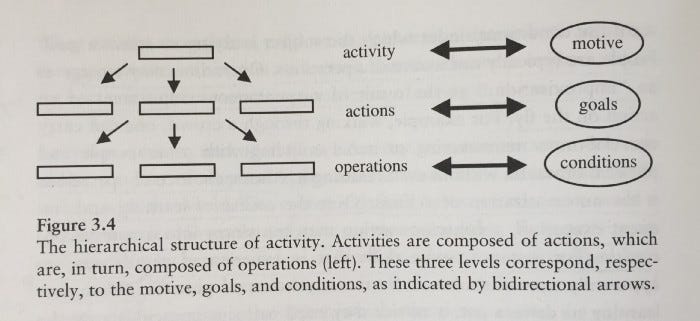
The hierarchical structure of activity was originally conceptualized by A. N. Leontiev (1978). We have to notice that Leontiev was developing a psychological theory at the individual level with the concept of Activity. Thus, we will see three levels of activity correspond to three levels of psychological notions.
The three levels of activity are activity, actions, and operations. The three levels of psychological notions are motive, goals, and conditions.
According to Leontiev, “Separate concrete types of activity may differ among themselves according to various characteristics: according to their form, according to the methods of carrying them out, according to their emotional intensity, according to their time and space requirements, according to their physiological mechanisms, etc. The main thing that distinguishes one activity from another, however, is the difference of their objects. It is exactly the object of an activity that gives it a determined direction.” (1978, p.98)
So, what’s the object of activity?
The answer from Leontiev is the motive of activity. Leontiev claimed, “According to the terminology I have proposed, the object of an activity is its true motive. It is understood that the motive may be either material or ideal, either present in perception or exclusively in the imagination or in thought. The main thing is that behind activity there should always be a need, that it should always answer one need or another.” He also added a note about the term motive, “Such restricted understanding of motive as that object (material or ideal) that evokes and directs activity toward itself differs from the generally accepted understanding”.(1978, p.98)
After defining the “activity — motive” level, Leontiev moved to its sub-level: the “action — purpose” level. He said, “We call a process an action if it is subordinated to the representation of the result that must be attained, that is, if it is subordinated to a conscious purpose. Similarly, just as the concept of motive is related to the concept of activity, the concept of purpose is related to the concept of action.” (1978, p.99)
Leontiev also used “goal-directed processes” and “actions” interchangeably. For example, he said, “We call a process an action if it is subordinated to the representation of the result that must be attained, that is, if it is subordinated to a conscious purpose. Similarly, just as the concept of motive is related to the concept of activity, the concept of purpose is related to the concept of action.”(1978, p.99)
This is a popular theoretical knowledge in the field of Activity Theory. If we use it for discussing some issues, then we use it as a heuristic tool.
1.3 Practical Knowledge as Heuristics
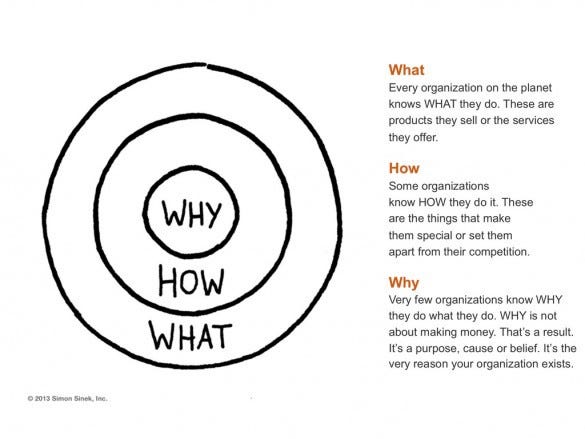
Now let’s look at a similar practical knowledge called Golden Circle. See the diagram below.
In September 2009, Simon Sinek was invited to talk about leadership in TEDxPugetsound which is an independently organized local event. His talk is titled Start with Why: How Great Leaders Inspire Action.
Later, TED selected the talk and published it on the official TED website.
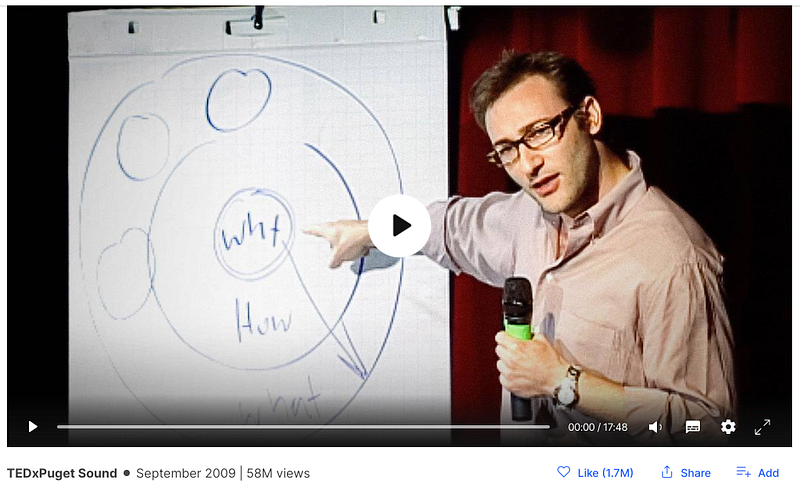
Simon Sinek used a simple diagram to make a business knowledge heuristic tool. After ten years, the Golden Circle diagram is a popular meme and a popular heuristic tool because it is really simple.
If you offer a simple solution to a complex problem, people will intuitively embrace your solution. Simpleness is the essential idea of heuristics. If a thinking tool is too complex, we don’t think about it as a heuristic tool.
How do people use the Gold Circle diagram? Let’s see an example, a UX Designer mentioned it in a 2020 article titled The Gold Circle for Designers.
The Golden Circle is an innovative tool created by Simon Sinek and shared at a TED Talk. This instrument is one of the most effective strategies that I have used in my career as a UX Designer. It has helped me to understand complex tasks, it has led my design decisions, has helped me read behind my own actions and people’s actions, and also has given me support to discover insights about users, and it even has helped me to collaborate more harmoniously with my teams.
Golden Circle Explained
What’s it about? Easy. Identify the Why, How & What about everything you want to understand or learn about.
✦ All of us know WHAT we do, the type of activities we perform.
This is the OUTCOME of things.
✦ Some others know HOW they perform their tasks and what truly differentiate them from the rest.
This is the PROCESS of things.
✦ Not everyone knows WHY do we do what we do. What’s the purpose of our actions? What’s the intention behind everything we do?
This is the PURPOSE of things.
All that we do must start understanding the intention.
Originally, Simon Sinek used the Gold Circle to discuss the issue of leadership. Now the UX designer claims that we can use it for understanding everything.
What’s the point here? It means we can use three words such as Why, How & What as a Heuristic tool.
We can claim that this three-keyword tool is a piece of practical knowledge. It’s not wrong, but too simple. If you only use these three keywords for your whole life, you will ignore the rich knowledge resources from the field of psychological motivation research.
1.4 Situational Heuristics
While Theoretical Knowledge as Heuristics and Practical Knowledge as Heuristics are from Others, the Situational Heuristics are self-made.
Why do we make Situational Heuristics for ourselves? Because there is a gap between others’ knowledge and our situations. Sometimes, we don’t have enough time to search for a thinking tool for a particular situation. Also, it’s easy to make simple heuristics. Moreover, we don’t have to turn every Situational Heuristic into a final product for others.
On Dec 31, 2021, I wrote an article titled The Dynamics of Tacit Knowledge. I developed the following diagram as a heuristic tool for the article.
In order to discuss the dynamics of tacit knowledge, I suggest the following typology of tacit knowledge:
- Actual Knowledge: A present thing known.
- Potential Knowledge: A future thing unknown based on a present thing known.
The diagram below offers a model of the transformation between Potential Knowledge and Actual Knowledge.
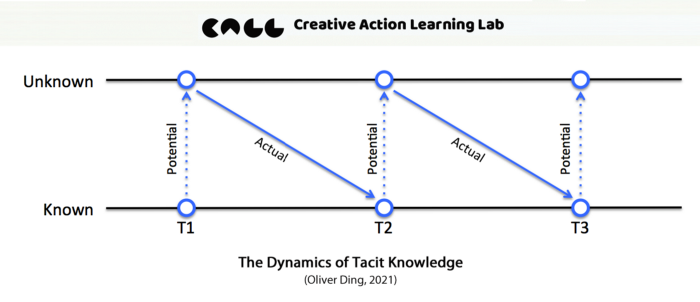
The above typology and the diagram are Situational Heuristics for the article and the Slow Cognition project in general.
Last week, I also turned a diagram into a Situational Heuristic tool by asking some questions. In the past four months, I captured many Significant Insights. In order to conduct a mini-research for the Slow Cognition project, I selected the following 12 significant insights as samples.
To analyze these 12 significant insights, I use the following model called The Relevance of Zone to develop a tool.
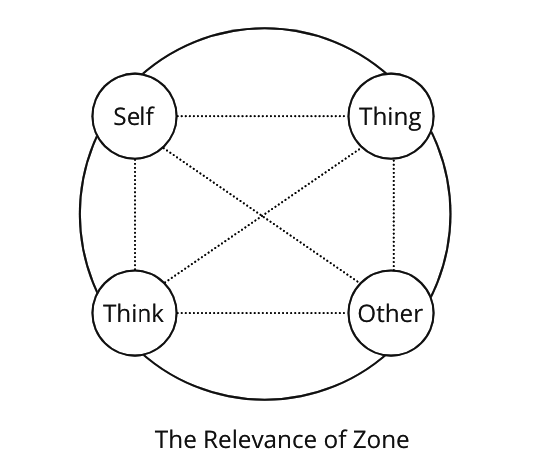
The above model is called the Relevance of Zone which considers Other as an important social context for the long-term development of thoughts. You can find more details here.
Based on the model, I generated the following questions:
- Other: Who is the Significant Other for this insight?
- Thing: What’s the insight about? Why do I pay attention to it?
- Think: How did I get this insight? Is there a technique behind the process?
- Self: Where did I capture this insight?
- Self: When did I capture this insight?
- Activity: Is this insight part of an activity? What’s the activity?
- Activity: Has this insight led to a new action or a new activity?
Then I created a doc on Coda and used the doc to host a sub-project for this task.
There are many heuristic tools for reflections. For example, the Five Ws method answers five questions starting with an interrogative word:
- Who
- What
- When
- Where
- Why
Sometimes people also add how to the list.
Why do I choose the Relevance of Zone for this task? Because it is related to the Anticipatory Activity System (AAS) framework which is my primary project in 2022. In this way, the task contributes to the development of the AAS framework.
Part 2: The “Deep Analogy” Case Study
Part 2 uses my experience of using the theoretical concept of “Deep Analogy” as an example for discussing the “Heuristics — Skills” mapping.
2.1 Try Something New Three Times
The subject of the article is the “Heuristics — Skills” mapping. Now let’s move to the side of skills.
How to acquire new skills? It takes time to practice new knowledge and tools. For the Knowledge Discovery Activity, I suggest the following simple rule:
Try something new at least three times.
This rule can be applied to both Theoretical Knowledge and Practical Knowledge.
The rest of the article will use the concept of “Deep Analogy” as an example of using Theoretical Knowledge as heuristics.
2.2 The Notion of “Deep Analogy”
The notion of “Deep Analogy” is inspired by Arthur L. Stinchcombe who is a leading practitioner of methodology in sociology and related disciplines. The following quote is found from a note about his 1978 book Theoretical Methods in Social History.
But if general concepts consist in the analogies between elements and if they are deeper if the analogies are deeper, then the basic investigatory task of concept formation is the deepening of analogies.
Far from it being the case that the most powerful general theorists ignore details, the precise opposite is true. Social theory without attention to detail is wind; the classes it invents are vacuous, and nothing interesting follows from the fact that A and B belong to the class; “theoretical” research appears as a species of wordy scholasticism, arranging conceptual angels in sixteen fold ranks on the head of a purely conceptual pin.
But if conceptual profundity depends on the deep building of analogies from one case to another, we are likely to find good theory in exactly the opposite place from where we have been taught to expect it. For it is likely to be those scholars who attempt to give a causal interpretation of a particular case who will be led to penetrate deeper analogies between cases.
While Arthur L. Stinchcombe uses the concept of “Deep Analogy” for theoretical innovation in the field of social sciences, I use the notion of “Deep Analogy” as a technique for turning potential knowledge into actual knowledge.
In other words, while Arthur L. Stinchcombe focuses on public knowledge, I pay attention to developing tacit knowledge from the perspective of individuals.
2.3 Making 1st Deep Analogy (Dec 2021)
Some theoretical concepts are very hard to apply to practical situations that differ from the original context of the concepts. Most theoretical concepts are about solving theoretical problems, they can’t directly apply to practical issues.
However, many theoretical concepts about academic creativity are really useful to transfer to practical fields. The notion of “Deep Analogy” is about creativity.
I read Arthur L. Stinchcombe’s 2005 book The Logic of Social Research in early 2021 and knew the concept of “Deep Analogy” in March 2021. However, I made my first Deep Analogy in Dec 2021.
On Nov 6, 2021, I published an article titled D as Diagramming: Hexagram, Symbolic Culture, and Diagram Choices. The diagram below is part of the article.
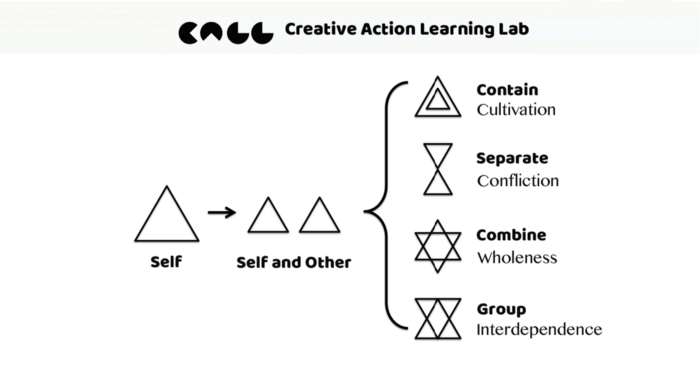
Inspired by a case study of the D as Diagramming project, I designed the above picture to describe four types of “Self — Other” relationships. The idea behind the picture was inspired by the American developmental psychologist Robert Kegan’s writing on the duality of human experience.
On Dec 22, 2022, I used the “Self — Other” diagram to develop a structure for Part One of the book Diagram Blending: Building Diagram Networks (Table of Contents). See the diagram below.
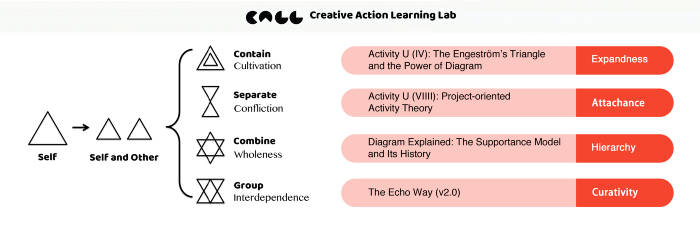
Inspired by the four types of “self — other” relationships, I selected four articles and considered them as four stories of a journey. Each story has a theme. Together, they form a meaningful whole that describes a possible journey from a single diagram to diagram networks.
Though the four articles belong to different projects, if we put them together, they present a journey of moving from one single diagram to a diagram network. The above picture shows a deep analogy between four graphics, four articles, and four themes.
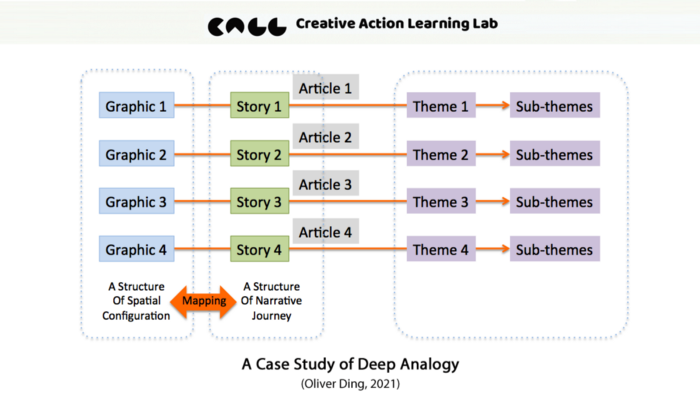
The four types of “Self — Other” relationships diagram was formed by four graphics with a special structure of spatial configuration. Though the original diagram has words such as Contain(Cultivation), Separate(Confliction), Combine(wholeness), and Group (Interdependence), I just ignored these words and considered it as a meta-diagram.
Originally, the four articles are not a whole because they were written for different projects. However, I reconsidered them as four stories with a structure of narrative journey.
The most important key of deep analogy for this case is the mapping between a structure of spatial configuration and a structure of narrative journey.
How is it possible?
I think we can find an answer from the notion of Cognitive Metaphor which is a core theory of cognitive linguistics. From the perspective of Cognitive Metaphor theory, the metaphor behind the journey is the Event-Structure metaphor. According to George Lakoff and Mark Johnson, Journeys are long-term activities:
A journey takes an extended period of time, covers a lot of ground, and usually involves stopping at a number of destinations along the way before one reaches a final destination, if there is one. Given the rest of the Event — Structure metaphor, journeys correspond to long-term activities, usually with a number of intermediate purposes. The intermediate purposes are intermediate destinations, the ultimate purpose is the ultimate destination, the actions performed are movements, progress is movement toward a destination, the initial state is the initial location, and achieving the purpose is reaching the ultimate destination. Every aspect of the source domain of the Event — Structure metaphor may occur in some kind of journey, and hence journeys are very useful for talking about long-term activities of many kinds. (Philosophy in the Flesh, 1999, pp.193–194)
For my case, I use the term “possible journey” to discuss the “narrative journey” because the four original stories are not part of a real journey. A narrative journey gives us the freedom to curate real events into imagined journeys that are different from real journeys in our life.
A possible journey needs a reasonable structure to curate several intermediate purposes into a new meaningful whole. I adopted the structure from the four graphics and I found it matched the four stories I selected.
- I wrote the article Activity U (IV): The Engeström’s Triangle and the Power of Diagram on Sept 3, 2020. This is a complete story of a famous diagram from Activity Theory. It refers to the theme of Expandness: a simple diagram tends to expand to a complex diagram.
- The article Activity U (VIIII): Project-oriented Activity Theory was published on Jan 3, 2021. I introduced Andy Blunden’s Project-oriented theoretical approach to Activity with a series of diagrams. The theme behind this story is Attachance which refers to Attach, Detach, and Opportunities of Attaching and Detaching. Andy Blunden detached from the Activity System model and attached to the Goethe-Hegel-Marx-Vygotsky approach of “Unit of Analysis”. The result is a brand new theoretical approach to Activity Theory. I attached to Andy Blunden’s theoretical approach, then detached from the field of words and attached to the field of diagrams. I use Andy Blunden’s idea of “germ-cell” to develop a diagram system in order to translate his ideas from text to visual.
- The third story is not only an article but a Miro board and a 108-page thesis titled Diagram Explained which was written in 2018. One part of the thesis is a framework for understanding multiple layers of diagrams. Obviously, the theme behind the story is Hierarchy. A meta-diagram can generate new diagrams at different degrees of abstraction.
- The fourth story The ECHO Way (v2.0) was published on June 30. The article introduced a practical framework for Knowledge Curation and Boundary Innovation. The core of the ECHO Way (v2.0) framework is blended from three diagrams. This case inspired me to coin the term Diagram Blending. This story refers to the theme of Curativity which means turning pieces into a meaningful whole.
The above four articles belong to different projects. However, if we put them together, they present a journey of moving from one single diagram to a diagram network. In the process of conceptualization, the second key movement is generating themes from stories.
After selecting the above four stories, I discovered four themes from them: Expandness, Attachance, Hierarchy, and Curativity.
The above description of Deep Analogy seems complicated. It was not an aha moment, but an emergent transformative process. For me, this is a simple intuitive insight, however, I want to share this technique with you.
Once we have a model, then we can design programs of deliberate practice for accelerating the development of tacit knowledge.
2.4 Making 2nd Deep Analogy (Jan 2022)
On Jan 25, 2022, I published a long article about the “Strategy-as-Curation” weekend and I mentioned the challenge of applying the Ecological Practice approach to discuss Life Strategy for Indie Creators.
The challenge was inspired by a 91-minute talk with a friend of mine on Jan 18, 2022. He is a data scientist, a programmer, and a mathematical thinker. He recently moved in the direction of innovative mathematical thinking. This is a big decision for him. He wanted to know more about the journey of independent research and the topic of epistemic development in general.
On Friday (Jan 21), I edited a 57-page document titled Strategy-as-Curation and sent it to my friend. The document started with the Anticipatory Activity System framework and my rough plan for expanding the framework to the Strategy-as-Curation project. However, the plan only takes three pages. The rest of the document collects my emails with other friends and my diagrams.
I reviewed the Strategy-as-Curation document and I realized that I need a new Mandala that could present core theoretical concepts of the Ecological Practice approach with several operational heuristics together. Then, I can develop a new toolkit with the diagram.
Also, I realized that it is possible to use a new method to deal with the “Life” issue. From the perspective of Curativity Theory, I need to find two containers in order to respond to this challenge.
First, I found the series of Mandala diagrams to be pretty good as abstract containers because each Mandala diagram represents a mindset from a professional perspective. The seven Mandala diagrams below were designed with the notion of “Personas”.
- Dec 21, 2021 — The Founder’s Mandala
- Dec 23, 2021 — The Creator’s Mandala
- Dec 24, 2021 — The Curator’s Mandala
- Jan 1, 2022 — The Strategist’s Mandala
- Jan 3, 2022 — The Designer’s Mandala
- Jan 4, 2022 — The Sailor’s Mandala
- Jan 24, 2022 — The Shaman’s Mandala
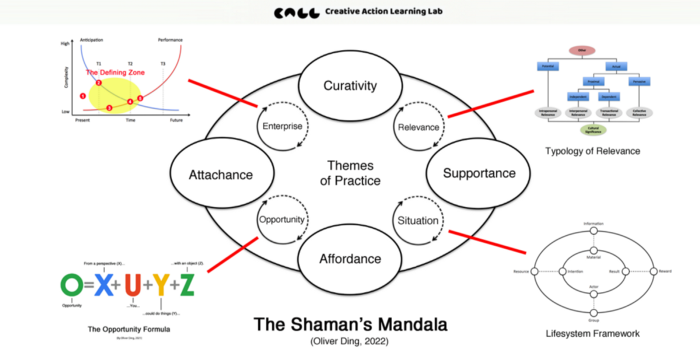
Second, I found the metaphor of Mind as Play could lead to a concrete container. I could design a Psychodrama-like participatory play called the Mandala Club. The play invites several professionals to join the event and each person shares his own version of the Mandala diagram. Then, all participants connect these Mandala diagrams with the primary theme of Life Strategy and related themes. Finally, each participant discovers pairs of themes for their own life strategy and makes a personal mandala diagram.
The most important key of deep analogy is the mapping between two containers. One is a set of Mandala diagrams, and the other one is a Psychodrama-like Participatory Play.
The shared key between the two containers is Personas. The above seven Mandala diagrams were developed by Personas. I selected a persona first, then developed a Mandala diagram for representing the persona’s mental model. A Psychodrama-like Participatory Play requires several actors. Each actor represents a persona.
2.5 Making 3rd Deep Analogy (April 2022)
On April 21, I worked in a room without the Internet. I read a thesis which was written by an activity theorist who is researching design.
In the past three years, I have been reading many papers and books about Activity Theory. I also wrote two books-in-drafts about Activity Theory and built a website called Activity Analysis.
However, I still can capture a significant insight while I was reading a piece about the historical development of Activity Theory in the thesis.
I started working on my notebook and drew a diagram with the “Deep Analogy” technique. On April 22, 2022, I reproduced the diagram on Milanote. You can find more details on this board.
I used “Challenge — Solution” as a deep structure to reflect on the historical development of Activity Theory. Activity Theorists tend to use a dual structure to describe the original challenge and use a new concept to expand the original structure into a triadic structure.
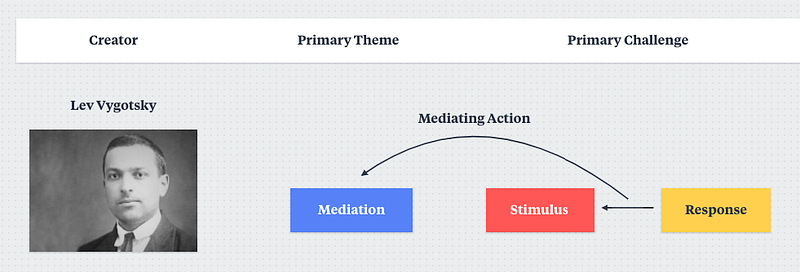
For example, Lev Vygotsky’s challenge is the “Stimulus-Response” dualism which refers to behaviorism. His solution is adding the third element “Mediation” to turn the “S-R” into a triad of “S-X-R”. For Vygotsky, the Mediating Action is a whole that includes Stimulus, Mediation, and Response. In this way, Vygotsky established a new approach to psychological science: Cultural-historical psychology.
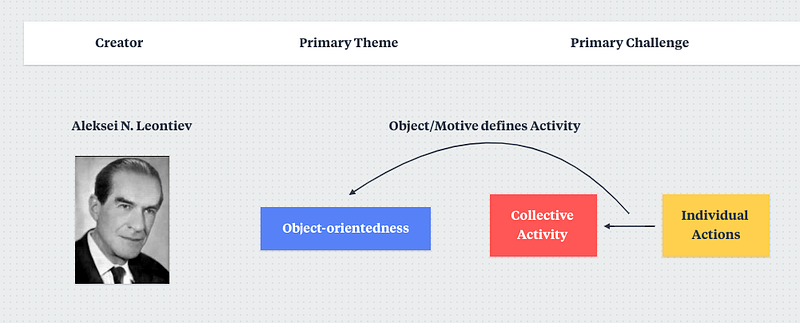
While Vygotsky’s approach focuses on individual actions, Aleksei N. Leontiev’s approach considers Activity as the basic unit of psychology. For Leontiev, his challenge can be described as the “Individual Actions — Collective Activity” dualism. The solution is the concept of Object-orientedness which refers to the source of Activity. Leontiev claimed that the Object of Activity defines the Activity and the Object refers to the Motive which is the social needs of the collective group.
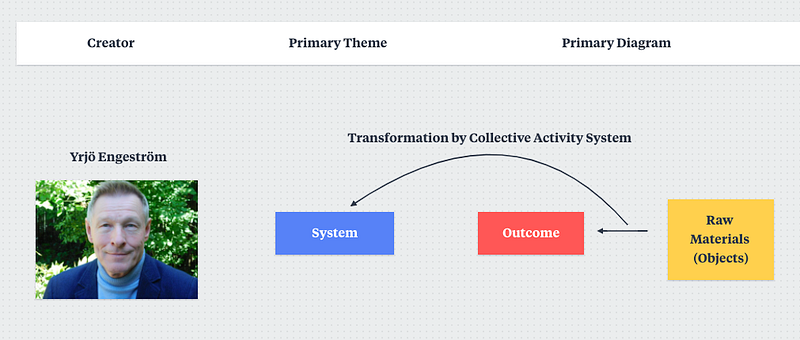
Traditionally, Yrjö Engeström’s Activity System model is understood as “Double Mediation” of the “Subject — Meditation — Object” model. If we follow the above deep analogy, we can have a new perspective on the model. For Engeström, the challenge is the “Object — Outcome” dual structure and the solution is “System” which refers to “transformation by collective activity system”. It means the “Object — System — Outcome” triad is the core of Yrjö Engeström’s approach.
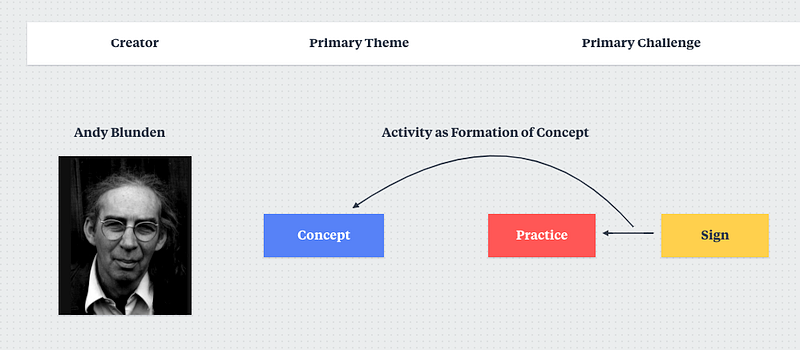
A major development of Activity Theory during the past decade is Andy Blunden’s account “An Interdisciplinary Theory of Activity”. In order to develop the notion of “Project as a unit of Activity” as a theoretical foundation of the new interdisciplinary theory of Activity, Blunden adopts Hegel’s logic and Vygotsky’s theory about “Unit of Analysis” and “Concept” as theoretical resources. The process is documented in four books: An Interdisciplinary Theory of Activity (2010), Concepts: A Critical Approach (2012), Collaborative Projects: An Interdisciplinary Study (2014), and Hegel for Social Movements (2019).
“Project as a unit of activity” and “formation of concept is activity” are combined in Blunden’s 2014 book Collaborative Projects: An Interdisciplinary Study which is a collection of twelve research reports with a common theme. What Blunden suggested are that 1) We can use “Project” as a new unit of analysis for Activity Theory, 2) Project should be understood as formulation of the concept, and 3) The archetypal unit of “Project” is two people working together in a common project.
Following the above deep analogy, I consider Andy Blunden’s challenge is the “Practice — Sign” dual structure and the solution is “Concept” which refers to “Activity as Formation of Concept”.
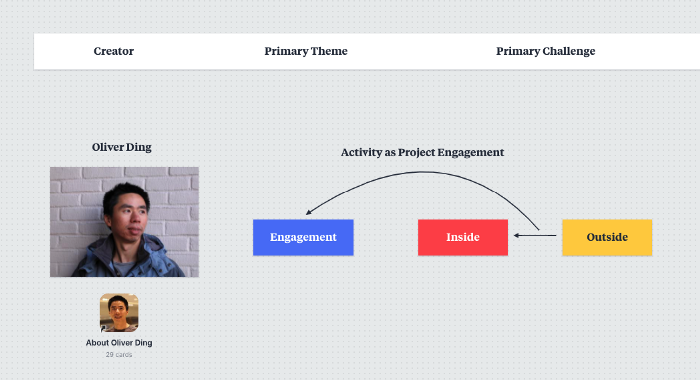
In Jan 2021, I edited a book titled Project-oriented Activity Theory which followed Andy Blunden’s approach and developed “Project Engagement” to expand his initial idea about “Project”.
By using the above deep analogy, I reflected on my work on Project Engagement. I realized that my approach to Activity Theory should be called “Activity as Project Engagement” and my primary theme is “Engagement”, not “Project”.
This is a significant insight because it changes my view on my work: the Project Engagement approach and its toolkit. If you read my 2021 book Project-oriented Activity Theory and will find many diagrams. One set of diagrams looks like the diagram below. I developed these diagrams for the Cultural Projection Analysis method.
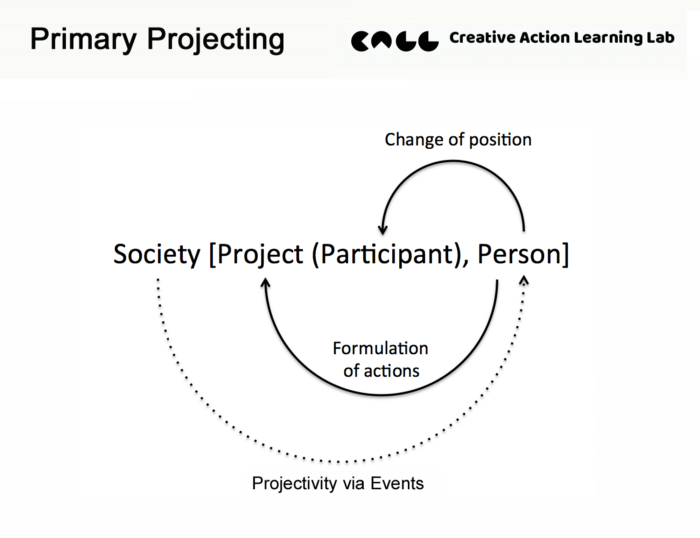
If you visit the page about the Project Engagement Toolkit, you can’t find the above diagram there because I didn’t consider it as a primary diagram for the toolkit and the whole approach.
Thus, I didn’t have a clear idea about the concept of “Engagement” when I used the word to name the Project Engagement approach in 2021.
In the past three months, I developed the “Engagement as Projection” principle for the Life-as-Project approach. You can see more details here.
Now I have a new idea for the concept of “Engagement” and it refers to the notion of “Projectivity — Projecting — Projection”.
A project is a container of cultural themes which will attract a person. By participating in the project, the person could enhance his life themes or expand his life themes.
A person is attracted by a project through its identity and his Identity could be shaped by the project. On the other side, the actions of the person also could shape the Identity of the Project.
Thus, The “Engagement as Projection” Principle echos the “Internalization — externalization” principle of Activity Theory. However, I use “Outside — Inside” to highlight the boundary of social spaces.
For me, the “Outside — Inside” dualism is solved by the third element “Engagement”.
Part 3 Reflections
The “Heuristics — Skills” mapping is about Making as Learning. From the perspective of Activity Theory, learning is not only about acquiring content and understanding concepts, but also about incorporating new knowledge into activities.
By using heuristics in activities, you can test 1) the heuristics, 2) and your understanding of the heuristics. By using a heuristic tool more than once, you build your skills in using the heuristic tool.
The last thing is about knowledge overload, especially heuristics overload. While I encourage people to share their ideas publically, we have to pay attention to the issue of information overload.
The Knowledge Discovery Canvas already offers a solution to the issue of knowledge overload. The structure of the canvas gives people a map to take a landscape view of their knowledge activities.
Moreover, you can also adopt the Life Discovery Canvas for solving this challenge too. The Life Discovery Canvas is designed with four areas. See the diagram below.
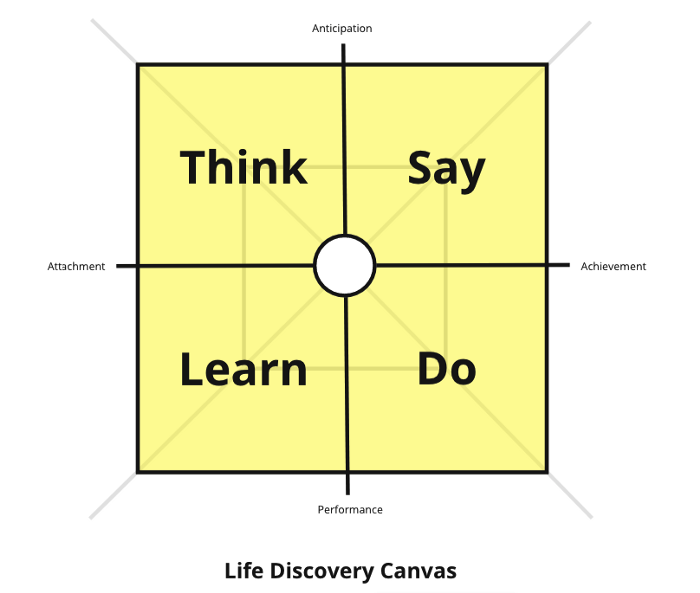
The Life Discovery Activity requires designing and developing individuals that learn and adapt. These individuals can bring about their continuing transformation in the face of growing challenges to their stability. Thus, I consider LEARN to be an important area for Life Discovery.
The LEARN area contains two pairs of themes:
- Skills — Knowledge
- Themes — Contradictions
The pair of themes “Skills — Knowledge” refers to the traditional thinking of adult development. For Life Discovery Activity, it means three things:
- Reflect on your habits and behavior patterns of learning, reading, discussing, reflecting, etc.
- Prepare for future life projects.
- Reflect on personal epistemic development.
If you understand the above three things, you will have a clear solution to deal with the challenge of heuristics overload.
Related Articles
- The Slow Cognition Project
- Slow Cognition: A Meta-canvas for Developing Tacit Knowledge
- Knowledge Discovery: Concepts, Notions, and the Concept Dynamics Framework
- Knowledge Discovery: The “Approaches — Tastes” Mapping
- Knowledge Discovery: The “Perspectives — Views” Mapping
- Knowledge Discovery: The “Frameworks — Insights” Mapping
- Knowledge Discovery: The “Events — Projects” Mapping
- Knowledge Discovery: The “Domains — Works” Mapping
- Knowledge Discovery: The HERO U Canvas
- Knowledge Discovery: The Concept Dynamics Framework
- Knowledge Discovery: The “Double Theme” Strategy
- Knowledge Discovery: The “Middleware” Strategy
- Project-oriented Activity Theory (Book)
- D as Diagramming: The Mind as Play Metaphor
- D as Diagramming: An Integrated Framework for Studying Knowledge Diagrams (Part 1)
- Themes of Practice (2019–2021)
- The Career Theme Canvas
I am also working on building a new website for the Platform Ecology project. You can save the following links:
- PlatformEcology.org
- Twitter: @PlatformEcology
- Linkedin: @PlatformEcology
You are most welcome to connect via the following social platforms:
Linkedin: https://www.linkedin.com/in/oliverding Twitter: https://twitter.com/oliverding Polywork: https://www.polywork.com/oliverding Boardle: https://www.boardle.io/users/oliver-ding


