
Life Discovery: “Formation of Concepts” and “Themes of Practice”
Individual, Particular, and Universal
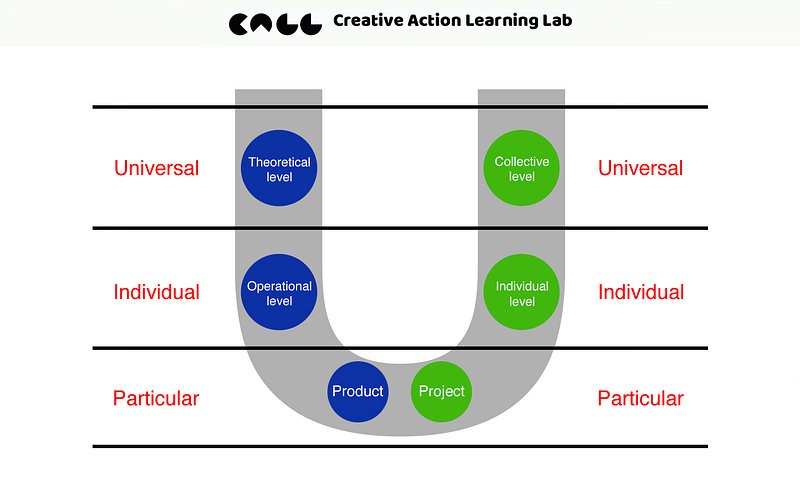
The above diagram is one of the diagrams of the Concept-fit framework which considers Platform Innovation as a process of multiple Concept-fits.
One theoretical resource behind the above diagram and the Concept-fit framework is Project-oriented Activity Theory. The theory adopts a unique perspective to understand “Concepts.” The theory is initiated by Andy Blunden with a special proposal of “Project as a unit of Activity”.
This article will reflect on the Life Discovery Project from the perspective of Project-oriented Activity Theory and discuss the connection between it and “Themes of Practice”.
Hegel’s approach to Concept
In order to develop the theoretical foundation of “Project as a unit of Activity”, Blunden adopts Hegel’s Logic and Vygotsky’s theory about Concepts as theoretical resources. The process is documented in three books: An Interdisciplinary Theory of Activity (2010), Concepts: A Critical Approach (2012), and Collaborative Projects: An Interdisciplinary Study (2014).
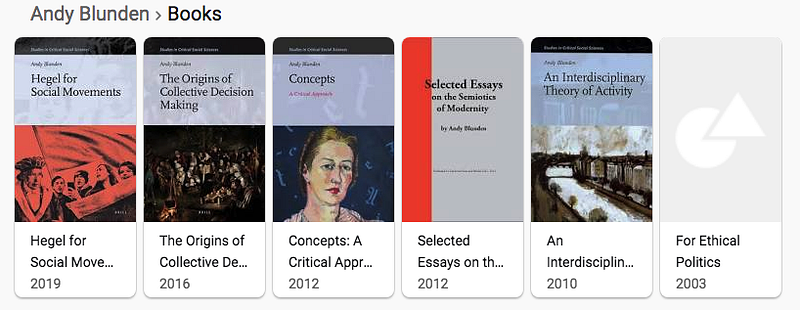
Blunden points out, “As Hegel explained, every concept exists as Individual, Particular and Universal. These three moments of the concept are never completely in accord. There is always a measure of dissonance between them, and this is manifested in the dynamics of the concept. What an individual means when they use the word is never quite the same as the meaning produced in any other context.” (2012, p.295)
The above diagram adopts “Universal,” “Individual,” and “Particular” for Concept-fit. In this way, we can consider “Product” and “Project” as the Particular movement of Concept. In order words, at the theoretical abstract level, Concept-fit means “Universal fit,” “Individual fit,” and “Particular fit”.
The Concept-fit framework is constructed with two Fields and three Forms. Two Fields refer to the Technological Field and the Sociocultural Field. Three Forms refer to three movements of Concept: Universal, Individual, and Particular.
Usually, we consider a concept as a mental object which refers to a bundle of attributes or features. This view is influenced by contemporary psychology and formal logic. We have to notice that Blunden adopts a different view of Concept which is based on Hegel’s philosophy and dialectical logic. According to Blunden (2012, pp.156–157), Hegel uses the following three movements to describe the internal development of the Concept:
- Universal: the Universal Concept is what is represented by a word (or in general, the sign for a concept) taken alone, outside of any determination or context of use. The meaning is entirely ‘in itself’, waiting to be developed, but at the same time is ‘pure’, in that every utterance is identical…Hegel links the Universal Concept to Identity because it is taken to be self-identical.
- Particular: the Particular Concept is a practice which differentiates one kind of the Concept, one genus of the species from another through its inclusion and differentiation in a system of social practice. The Universal Concept can only come to reality through particularity, by determining the Universal…While it is an error to represent the Concept by means of some finite collection of exemplars, the Universal can exist only in and through some exemplars.
- Individual: the Individual Concept is the sole ground of the concept, in and through which alone the Concept can exist. The Individual Concept is the limit case of the Particular Concept, where it is not just some things, but this thing which is the Concept, the ground of all generalisation…Individual, reduces the Concept to a common element linking the individuals. This is an extremely poor representation of a Concept…
For Platform Innovation, the Universal form of concept includes Theoretical level technological concepts and Collective level sociocultural concepts. The Individual form of concept includes Operational level technological concepts and Individual level sociocultural concepts. The Particular form of concept includes Product and Project. Here we can understand Product as Platform and Project as Platform-based activity or practice because Project-oriented Activity Theory uses Project as the unit of analysis of Activity.
Obviously, Hegel’s approach to Concept is more systematic than the approach of “concept-in-text / concept-in-use” I used in some discussions.
Today I will use Hegel’s approach to Concept to discuss Life Discovery Project.
Life Discovery Project
From the perspective of Project-oriented Activity Theory, the first task of Activity Analysis is to identify the primary Concept behind a particular project.
Sometimes, the Concept is the name of the project. For example, the name of Life Discovery Project is a concept.
What’s the Concept of “Life Discovery”?
If we follow contemporary psychology and formal logic, we should give a bundle of attributes or features to the concept of “Life Discovery” and make a definition.
Hegel’s philosophy and dialectical logic focus on the internal development of a concept.
We should ask a new question about the Concept of “Life Discovery”:
What are three movements of the concept of “Life Discovery”?
In the past six months, I worked on the Life Discovery Project which is about developing the concept of “Life Discovery”. I didn’t start the project with a definition of “Life Discovery”, I just used it as a Name which is a sign for a concept. This is the Universal movement.
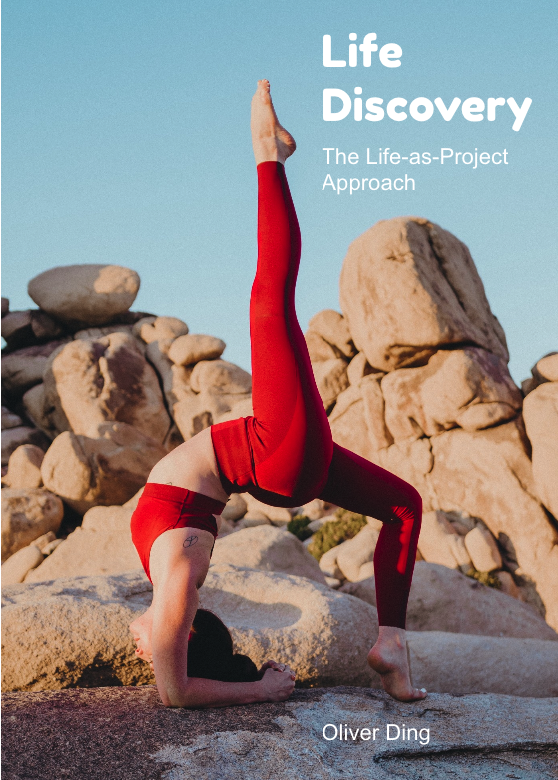
I also worked on three Life Discovery Projects.
- Shaper & Supporter Lab: I am a researcher.
- The AAS Board: I am a coach and a service designer.
- The Slow Cognition Project (Phase I): I am a creator.
Shaper & Supporter Lab (SSL) was founded by a friend of mine in April 2021. The program was designed with three components: 1) Life Purpose Awareness, 2) Personal OKR Practice, 3) Peer Review and Feedback. I joined the SSL program as an advisor and a researcher. The SSL program is a Life Discovery Project because it guides members to discover their life purposes, make life plans, and take real actions.
The AAS Board program is a real 1:1 life coaching program. I started hosting an AAS board on Milanote for a life transition coach program on March 26, 2022. I invited a friend of mine to join the program in order to test it. For her, this is a Life Discovery Project. I am a life coach and a service designer for her Life Discovery Project.
The Slow Cognition Project (Phase I) aims to explore the historical-cognitive approach and the long-term development of thoughts. A sub-project of the project is the Significant Insights Analysis project. From January 2022 to April 2022, I captured many Significant Insights. In order to conduct a mini-research for the Slow Cognition project, I selected the following 12 significant insights as samples.
Is the Slow Cognition Project (the Significant Insights Analysis project) a Life Discovery Project? While the SSL program and the AAS Board program are about Discovery for Life Development, the Slow Cognition Project is not about Discovery for Life Development, it is about Discovery for Knowledge Development.
As mentioned above, I didn’t give a definition to the concept of “Life Discovery”.
It’s can be roughly understood as exploring something new about “my life”.
These three Life Discovery Projects refer to the Individual movement.
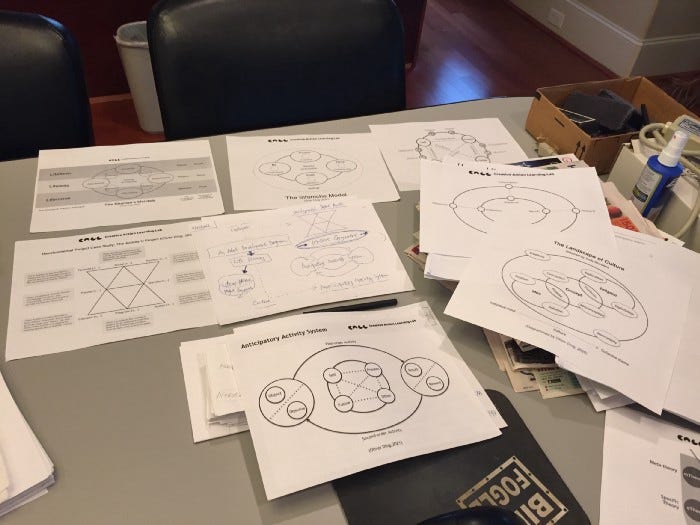
The Life Discovery Project also refers to a set of tools and programs such as the Life Discovery Toolkit (v1.0), the Life Discovery Canvas (v1.0), the AAS Board, the Life Discovery Board (v2.0), and a series of diagrams. This refers to the Particular movement.
According to Andy Blunden, “The relation between the individual and the universal is mediated by the particular, that is by praxis, and is not to be conflated with the subjective-objective relation which is a quite distinct relation. The universal has no separate existence, but exists only in and through its particularization by individuals.” (2014, p.26)
“Life Discovery” v.s. “Life Strategy”
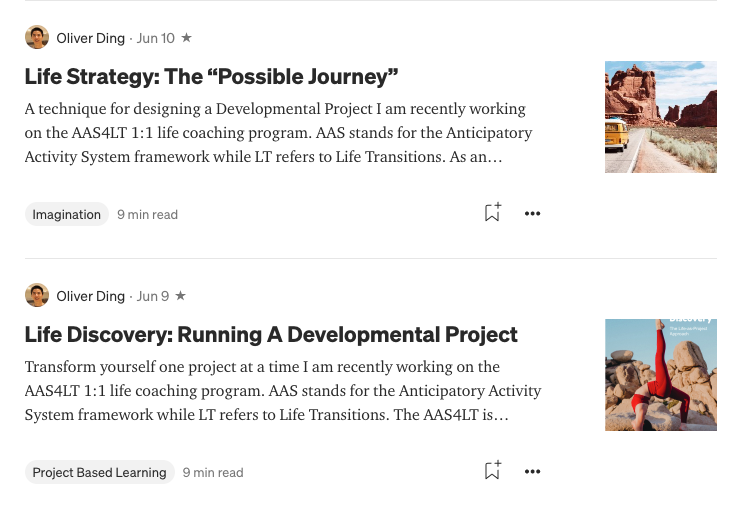
Before June 10, 2022, I tend to add “Life Discovery” as a tag to the titles of articles about the Life Discovery Project. On June 10, 2022, I started using a new tag called “Life Strategy”. See the screenshot below.
Why did I change the tag?
What does this change mean?
It means that I had a new meaning for the concept of “Life Discovery” on June 10, 2022, because I realized that I made a “mistake” with the title “Life Discovery: Running A Developmental Project” on June 9, 2022.
The article about “Running A Developmental Project” refers to the second part of the #AAS4LT 1:1 life coaching program. AAS stands for the Anticipatory Activity System framework while LT refers to Life Transitions.
The AAS4LT is inspired by the following knowledge resources:
- Anticipatory Activity System: The center of the above diagram.
- Life Discovery Activity: It is a Second-order Activity.
- Developmental Project: It is a First-order Activity.
For the AAS4LT program, the concept of “Life Discovery” refers to the first part: the Second-order Activity. However, the article is about the second part: the First-order Activity. This is a “mistake”.
In this individual situation, the concept of “Life Discovery” has a definition that is framed by the AAS framework. This definition is a theoretical concept.
I used the new tag “Life Strategy” to refer to the whole system which covers both the Life Discovery Activity and the Developmental Project.
“Life Discovery” and “Significant Insights”
An important step in developing the concept of “Life Discovery” is the Significant Insights Analysis project.
On April 25, 2022, I shared 12 significant insights I captured from January 2022 to April 2022. It led to the following diagram and the Significant Insights Analysis project.
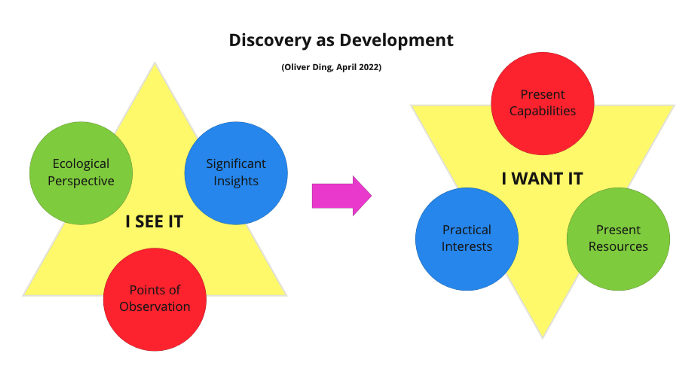
The above diagram uses the “I SEE IT” metaphor to describe “Discovery” and it also defines Significant Insights as the outcome of the Life Discovery Activity.
The “I SEE IT” metaphor uses “Ecological Perspective”, “Points of Observation”, and “Significant Insights” to define an operational method for the Life Discovery Activity.
This method is part of the Particular Movement.
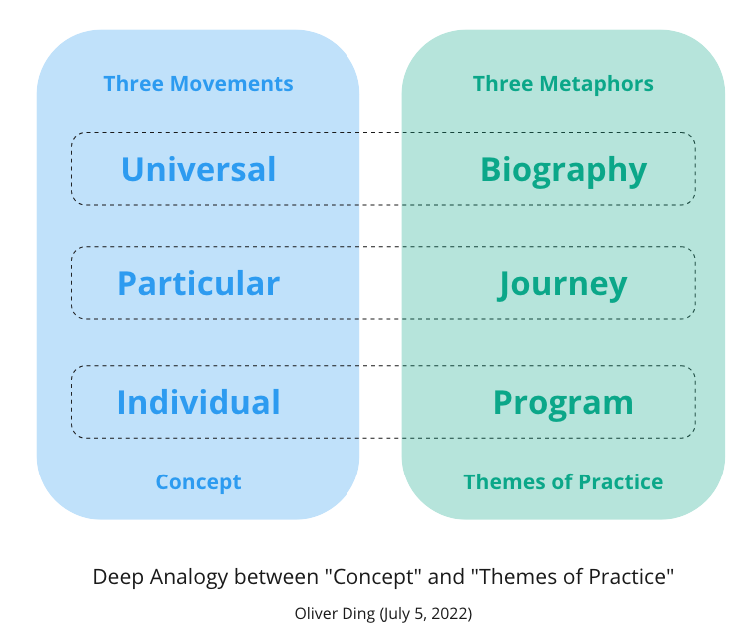
Biography, Journey, and Program
Three days ago, I published two articles reflecting the Life Discovery Project with three metaphors: Biography, Journey, and Program. you can find more details in Part 1 and Part 2.
On July 2, 2022, I just realized that I didn’t mention Project-oriented Activity Theory in the following paragraph. I used the “theme” of “Life Discovery”, not the “concept” of “Life Discovery”.
What I want to edit is a book that could represent my real experience around the theme of “Life Discovery” in the past six months. I want to use my experience to unfold the complexity of the Life Discovery Activity.
Why didn’t I apply Project-oriented Activity Theory to the Life Discovery Project since I am the author of Project-oriented Activity Theory?
Because I intended to develop a new approach called “Project-centered Approach” which detaches from Project-oriented Activity Theory.
However, what I did with the concept of “Life Discovery” is described by Project-oriented Activity Theory.
Now we can find a deep analogy between “Concept” and “Themes of Practice”. See the diagram below.
In fact, the connection between Andy Blunden’s “Formation of Concept” and my “Themes of Practice” is discovered on Dec 26, 2020.
“Formation of Concepts” and “Themes of Practice”
On Dec 26, 2020, I published an article titled Activity U (VIII): Project as a Unit of Activity and introduced Andy Blunden’s project-oriented theoretical approach. In part 4, I reflected on my own works with this approach.
In 2019, I developed the idea of “Themes of Practice” in order to discuss the “meaning” of the meaningful whole for my book Curativity: The Ecological Approach to Curatorial Practice. I realized the notion of “Theme” is a great tool for curating experiences and actions.
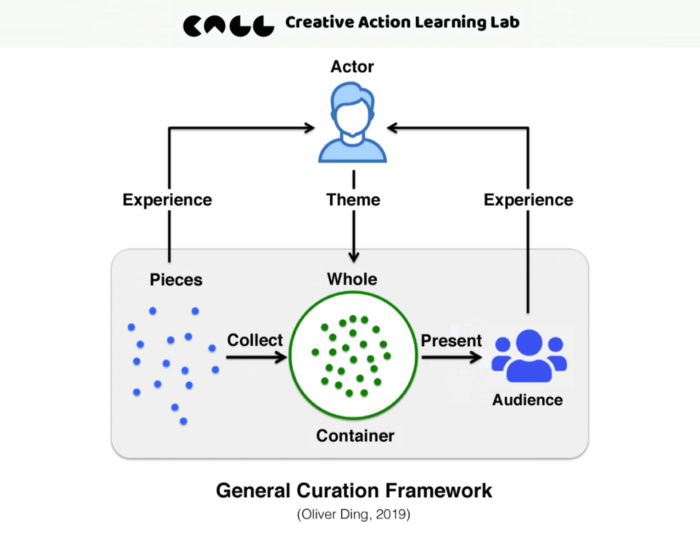
As an application of Curativity Theory, the above General Curation Framework represents the structure and dynamics of curatorial practice. The activity of curatorial practice aims to collect pieces of things into a meaningful whole in order to present a theme to a group audience. There are three immanent contradictions within the activity of curating: “pieces — whole”, “things — themes” and “curator — audience”. For the first dichotomy, I use the concept of “Container” to balance the pieces and whole. For the last dichotomy, I use the notion of “Everyone A Curator” to deconstruct the concept of “Curator” because I want to claim that the activity of curating is a general social practice.
The dichotomy of “things — themes” refers to two classical great debates of social science: “mind — matter” and “individual — collective”. After reviewing the concept of “theme” in various disciplines such as Cultural Anthropology, Counseling Psychology, Cognitive Psychology, and the Philosophy of Science, I developed a new concept “Themes of Practice” to propose a process view of “Theme”.
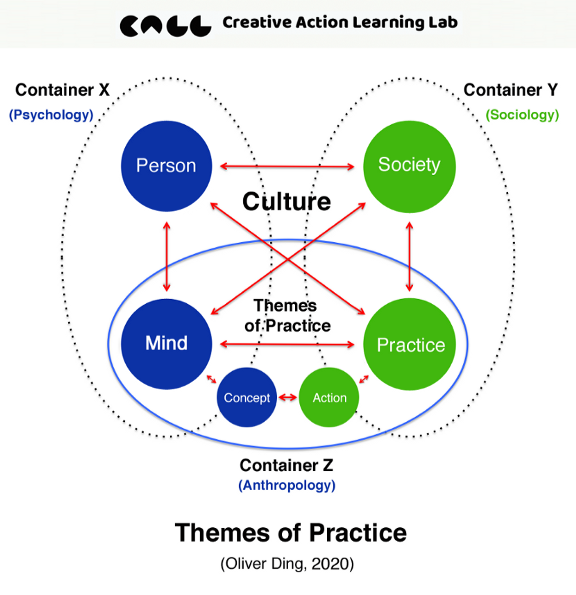
Anthropologist Morris Opler (1945) developed the theoretical concept of “themes” for studying culture. Career counseling therapists and psychologists also developed a theoretical concept called “life theme.” If we put culture themes and life themes together, we see a “great debate” of social science: “individual — collective.” The above diagram visualizes the “concept network” or “idea ecology” of “Themes of Practice”.
I consider the notion of “Themes of Practice” as a “process” type of concept, not a “substance” type of concept. Thus, it is not a new category of themes, but a transformational process between individual life themes and collective culture themes. It refers to both concept and action. It connects mind and practice. It indicates the transformation of both person and society.
After reading Blunden’s book Concepts: A Critical Approach which presents a “Hegel-Marx-Vygotsky” account of “Concept”, I realized this is an essential theoretical resource that can support my idea of “Themes of Practice”. According to Blunden, “Dualism has been around for a long time, and not only in the form of mind/matter dualism. One of the most persistent and debilitating forms of dualism today is the dualism of the individual and society, supported by sciences devoted exclusively to one or the other domain. Since concepts are units both of cultural formations and individuals minds, a theory of concepts confronts this head on…The development of the human sciences along two parallel paths, one concerned with human consciousness, the other concerned with social and political phenomena, can only serve to place barriers in front of people’s efforts to intervene in the affairs determining their own life. By understanding concepts as units of both consciousness and the social formation, I aim to create a counter to this disempowering dogma.” (2012, p.9)
Blunden’s argument on Concept echoes my consideration of the concept of Theme. Since Theme is a particular concept, I can adopt Blunden’s proposal — the “Hegel-Marx-Vygotsky” account of “Concept” — as a theoretical foundation to support the concept of “Themes of Practice”. Furthermore, I can also adopt the Project-oriented Activity Theory to upgrade the General Curation Framework to Cultural Curation Framework.
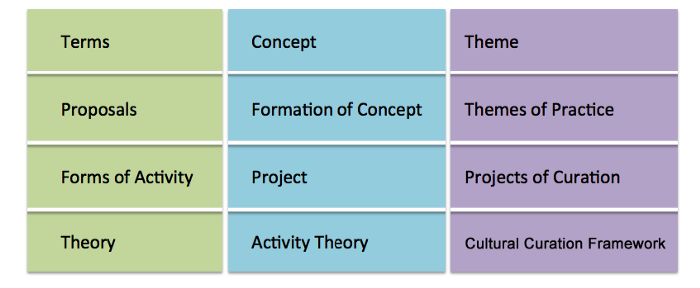
Each curation program can be considered a Project. Each “Theme of Practice” of a curation program can be considered as a Concept of a Project. Thus, the whole process of a curation program can be considered as “Initialization”, “Objectification” and “Institutionalization” of a “Theme of Practice”.
Theme as Space
The concept of “Thematic Space” was developed on Jan 5, 2022.
On May 26, 2022, I wrote the following piece about the notion of “Theme as Space”.
My notion of “Theme” can be understood as “Topic”. Originally, the source of “Topic” is “Topos”. According to the Merriam-webster dictionary, “Latin Topica Topics (work by Aristotle), from Greek Topika, from topika, neuter plural of topikos of a place, of a topos, from topos place, topos”.
According to Aristotle, we need a Topos because we can remember a thing by remembering the Topos in which the thing is placed.
If we use the technique of “Deep Analogy” and use “Etymology” as a perspective, then we can understand “Theme” and “Space” into one thing. Theme (Topos) is Space!
Originally, I read the idea of “Theme (Topos) is Space” from a Chinese scholar‘s book Spatial Narratology. The scholar quoted Christian Norberg-Schulz’s discussion about the topic — topos relationship from Genius Loci: Towards a phenomenology of architecture.
Traditional narratology is about the linear temporal narrative because a story or a text is easy to understand if its structure is organized in a temporal sequence. However, some modern writers use spatial simultaneity as the primary approach to organize their stories. They often use the technique of “Juxtaposition” to create a spatial sense in their writing.
The technique of “Juxtaposition” is a nonlinear spatial narrative approach. I adopt it for Thematic Space Reflection Report. If you read my thematic space reflection reports, you can find there is no linear temporal narrative structure. All notes are just listed without a predefined logic structure.
Though the Structure of Knowledge Discovery Canvas (and Life Discovery Canvas, etc) has its predefined logic structure, it is still a structure of “Juxtaposition”. All 16 blocks are not organized in a linear way.
A person can use Thematic Space Canvas in different ways by perceiving its spatial structure and potential connections between different blocks. The canvas doesn’t control the process of sensemaking but offers a space for sensemaking.
On July 2, 2022, I connected the notion of “Theme as Space”, the concept of “Thematic Space”, and the “Flow — Story — Model” metaphor.
From the perspective of the Slow Cognition project, Life Discovery is a particular type of Knowledge Discovery and the primary theme of Life Discovery is “My Life”.
The objective of the Life Discovery Activity is to Develop Tacit Knowledge about “My Life” and turn Tacit Knowledge into resources for actions.
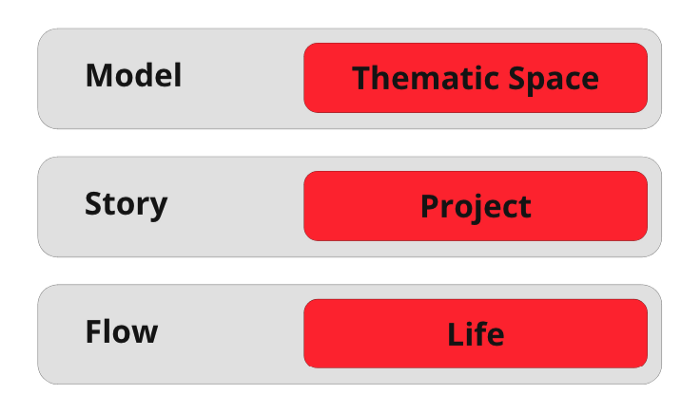
By connecting the Project-centered Approach and the concept of “Thematic Space” together, we can find the following connection:
Life = Project = Thematic Space
While Life is a chain of projects, it can be understood as a journey of moving between various thematic spaces.
Each project has its primary themes and other secondary themes. By joining projects and leaving projects, we are practicing our significant Life Themes. Thus, these projects are Thematic Spaces too.
This insight also echoes the model “Flow — Story — Model”. We can also find more details in Thematic Space: Project as Story.
In this way, I develop the 7th basic principle of the Life-as-Project approach: “Project as Thematic Space”.
Life, History, and Multiverse
Finally, we reach the newest insight about the Project-centered approach.
On June 29, 2022, I adopted the perspective of sociology to reflect on the notion of “Activity as Project Engagement”. I realized that while we can understand Life as a chain of Projects, we can understand History as a chain of Events.
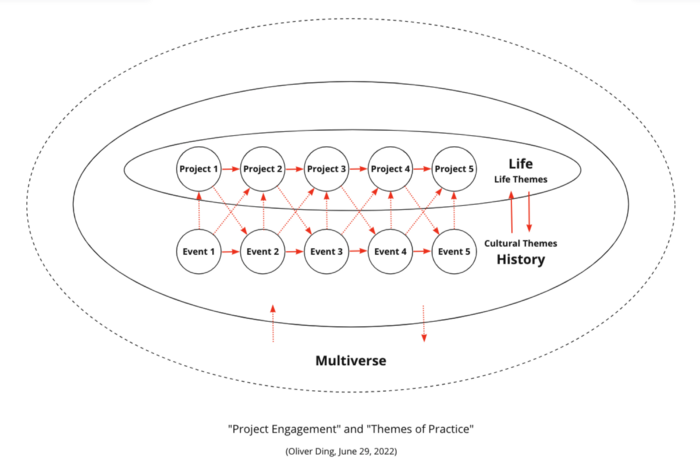
Thus, we connect “Event — Project”, “Life — History”, and “Life Themes — Cultural Themes” together. This notion echoes my idea about “Event — Project” in Life as Activity (v0.3).
The Life-as-Project approach uses “events” and “projects” to present social context and individual biography.
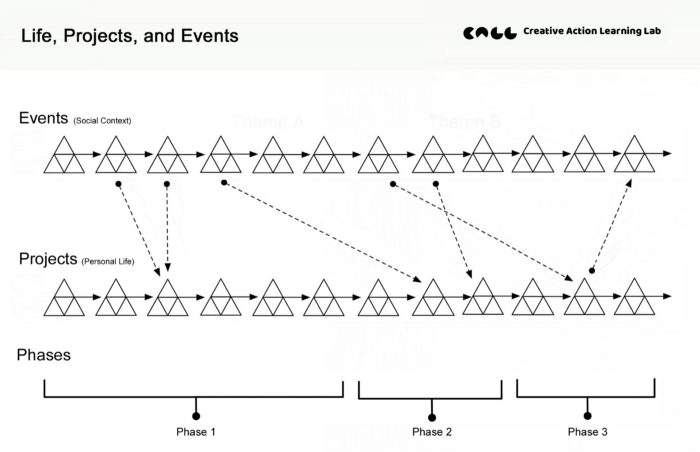
The difference between “events” and “projects” are individual involvement. If the person directly gets involved in an activity — it means she is the subject of the activity or part of the community of the activity — then the activity is a project of her biography. If the person doesn’t directly get involved in the activity, then the activity is an event of her biography.
The newest insight of “Life as moving between Thematic Space” also connects the Project Engagement approach and the Themes of Practice framework.
Finally, we see a simple model of the development of life and history:
Life = Projects = Thematic Spaces = Events = History
In this way, the Life-as-Project approach echoes Andy Blunden’s notion of “a project is a concept of both psychology and sociology” (2014,p.15).
Related articles
- Life Discovery: The AAS Framework
- CALL for LIFE: Anticipatory Activity System for Life Transitions
- CALL for LIFE: Modeling A Developmental Project
- The Project Engagement Toolkit (2022)
- Life Discovery: The Life-as-Project Approach
- The Life Discovery Toolkit (v1)
- The Life Discovery Canvas (v1.0) — Part 1: Theoretical Background
- The Life Discovery Canvas (v1.0) — Part 2: Spatial Structure
- The Life Discovery Canvas (v1.0) — Part 3A: Concepts (THINK and LEARN)
- The Life Discovery Canvas (v1.0) — Part 3B: Concepts (SAY and DO)
- The Life Discovery Canvas (v1.0) — Part 4: Inspirations
- Life Discovery: The “Being by Doing” Principle
- Life Discovery: The “Performance as Experiment” Principle
- Life Discovery: The “Engagement as Projection” Principle
- Life Discovery: The “Discovery as Development” Principle
- CALL for LIFE: Oliver Ding @ 2021 and Second-order Activity
- Life Discovery: Twelve Significant Insights from Four Months
- Life Discovery: “Points of Observation” and “Significant Insights”
- Life Discovery: Significant Insights Analysis
- Life Discovery: The “Tacit” Type of Second-order Activity
- Life Discovery: The Unfoldness of Activity
- Life Discovery: Running A Developmental Project
I am also working on building a new website for the Platform Ecology project. You can save the following links:
- PlatformEcology.org
- Twitter: @PlatformEcology
- Linkedin: @PlatformEcology
You are most welcome to connect via the following social platforms:
Linkedin: https://www.linkedin.com/in/oliverding Twitter: https://twitter.com/oliverding Polywork: https://www.polywork.com/oliverding Boardle: https://www.boardle.io/users/oliver-ding


