Favourite Films From Every Year I’ve Been Alive: Part One (1975–1989)
The Dillon Empire makes an agonisingly difficult selection.
The Dillon Empire generally ignores writing prompts, but Sir Paul Combs (Knight of the Dillon Empire) recently threw down a challenge to list one favourite film from every year I’ve been alive. He also challenged Fanfare editor and pop culture guru Eric Pierce to do the same. Paul’s initial selection can be read here, and Eric’s here. Both urged me to participate, so here I am. May God have mercy on their souls.
Perhaps I should have stayed strong and resisted, but I lingered too closely at the event horizon of possibility, only to get sucked into this black hole with no hope of escape. In preparing this three-part series, I have lost sleep, sanity, and objectivity in my ability to select just one film from each of the years in question. For me, this is like choosing between one’s children.
What follows, after much anguish, is not necessarily a list of what I consider the greatest film, nor even a definitive favourite, from each given year. However, I can safely state all films selected are firm favourites I return to time and time again, all of which also have my highest recommendation as great films. Obviously, this list is subjective, so if you disagree, feel free to say so in the comments, or even write your own list.
To make my life easier, and also to bear in mind you, dear reader, I’ve placed a few restrictions on myself. Since I was born in 1975, I could simply have gone on a shameless nostalgia trip and listed the obvious choices from the golden era of Steven Spielberg and George Lucas. But since those films are so well-known and ubiquitous, I’ve decided to limit myself to only one film per director and one film per series. This led to some agonising omissions, but has also freed up the list to make it more varied, showcasing other gems with an equal claim on my affections.
I should also re-emphasise this is not a list of my favourite films of all time, and any attempt to pass it off as such will be met with the full wrath of the Dillon Empire. My favourite films sprawl over the last one hundred years, with over half of them originating before I was born. My oldest favourite dates back to 1920 (The Cabinet of Dr Caligari), but since I am mercifully under no obligation to pick a favourite film from every year from then to now, I shall say no more on the subject.
One final point of order: When I compile my annual ten-best lists for any given year, to qualify, the films in question have to be released in the UK during that calendar year. US release dates can differ, which creates some overlap, but it is an important rule. Otherwise, I am unable to consider certain films, as I haven’t yet seen them. For example, this year Licorice Pizza may well feature on my ten best films of 2022, as it had a January 2022 release in the UK, despite being released in the US at the end of 2021. However, for this selection, since I have already seen all the films, I am ditching that rule and going by year first shown in cinemas anywhere in the world.
With all of that in mind, let’s take the plunge.
Monty Python and the Holy Grail (1975)
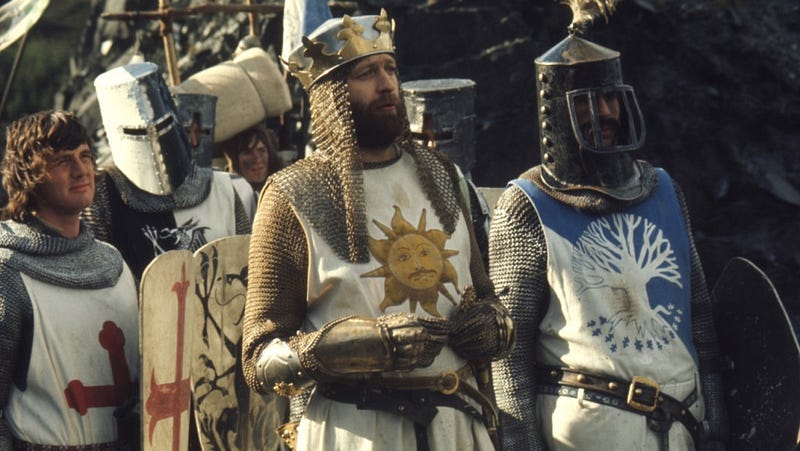
Kicking things off with the funniest film I have ever seen, I actually feared for my life when I first saw this. My life passed in front of my eyes, and I thought I would die laughing. Suffice to say, this sublimely silly send-up of the Arthur legends from the Monty Python gang — John Cleese, Graham Chapman, Eric Idle, Michael Palin, Terry Jones, and of course Terry Gilliam’s surreal animated contributions — is the stuff of comedy legend.
A staggering gag rate yields repeat viewings, and at this point I probably have the script memorised, but even so, I always laugh myself stupid whenever I watch. If for some horrifying reason you are unfamiliar with the knights who say “Ni”, Brave Sir Robin and his minstrels, the Holy Hand Grenade of Antioch, the spanking-obsessed nymphomaniacs of Castle Anthrax, the aptly named Sir-Not-Appearing-In-This-Film, and the minutiae of whether an African or European swallow would be able to carry a coconut, do yourself a favour and watch this film. And remember: “Strange women lying in ponds distributing swords is no basis for a system of government.”
Rocky (1976)
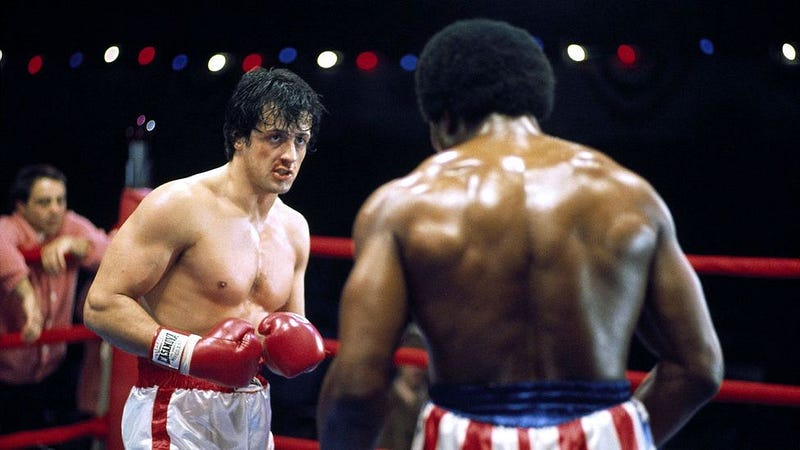
I was tempted to select Carrie, but I’m saving my De Palma slot for later, so I’ve settled on Rocky. Despite umpteen sequels of wildly varying quality, John G Avildsen’s original featuring Sylvester Stallone’s eponymous Philadelphia boxer remains unsurpassed as an irresistible, inspiring underdog story. Given an unprecedented chance to go head-to-head with world heavyweight champion Apollo Creed (Carl Weathers), Rocky’s prospects for winning look decidedly bleak, but… Well, you know the story.
What makes Rocky work so well for me isn’t the gripping boxing finale but the little moments along the way; his poignant relationships with trainer Mickey (Burgess Meredith) and shy lover Adrian (Talia Shire), for instance. Plus, there’s a priceless look Apollo gives Rocky in the aforementioned bruising finale, of such can’t-you-just-quit incredulity, that has even the most cynical viewer punching the air.
Star Wars (1977)
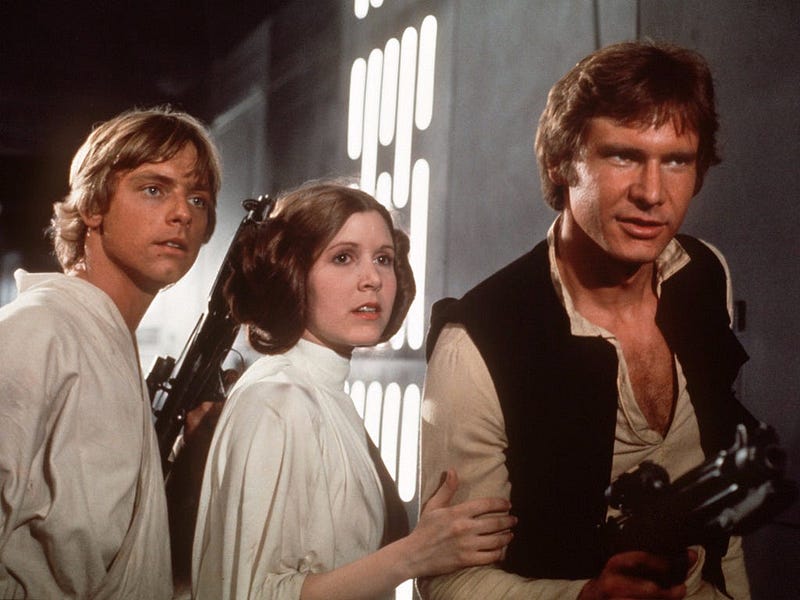
What else could it be? George Lucas changed the course of cinema with his landmark space fantasy saga that provided a quantum leap in visual effects technology, among other things. Harrison Ford provides roguish charm, Carrie Fisher sarcasm-in-peril, Mark Hamill wide-eyed overacting, Peter Mayhew Wookiee roars, Alec Guinness gravitas, Anthony Daniels/Kenny Baker robotic comic relief, and David Prowse/James Earl Jones iconic villainy.
Actually, everything in this film is iconic, from John Barry’s production design to John Mollo’s costumes, and John Williams’s music. That’s a lot of great Johns. Anyway, Star Wars captivated a generation and became a rite of passage for children around the world. No other film so perfectly encapsulates the heroic dreams of childhood.
Coma (1978)
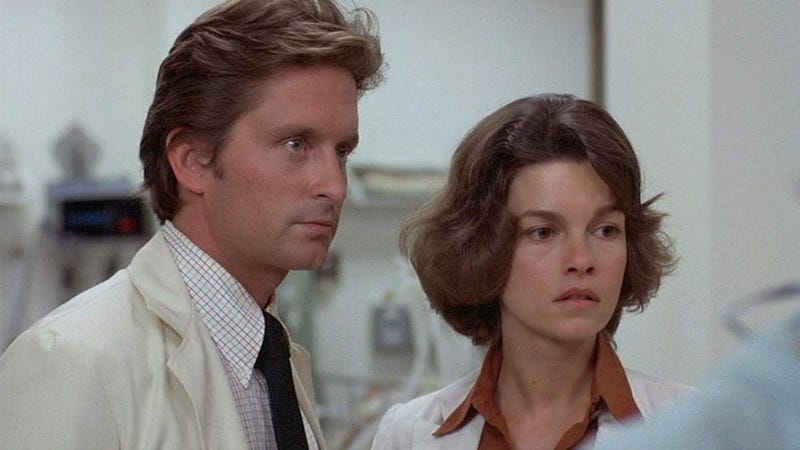
I originally pencilled in Superman or Midnight Express, but this sublime thriller pipped both to the post. Genevieve Bujold plays one of my all-time favourite imperilled heroines as a doctor covertly investigating possible conspiracy in a Boston hospital. Is she paranoid, or are patients being deliberately placed in irreversible comas? If so, why?
Adapting Robin Cook’s novel, Michael Crichton directs the set pieces with Hitchcockian aplomb. There’s also a fine supporting cast of sinister characters, including Michael Douglas as Bujold’s is-he-or-isn’t-he-in-on-it boyfriend. Like all good conspiracies, this goes all-the-way-to-the-top, featuring some edge-of-the-seat moments of gothic suspense. A first-rate nail-biter.
Apocalypse Now (1979)
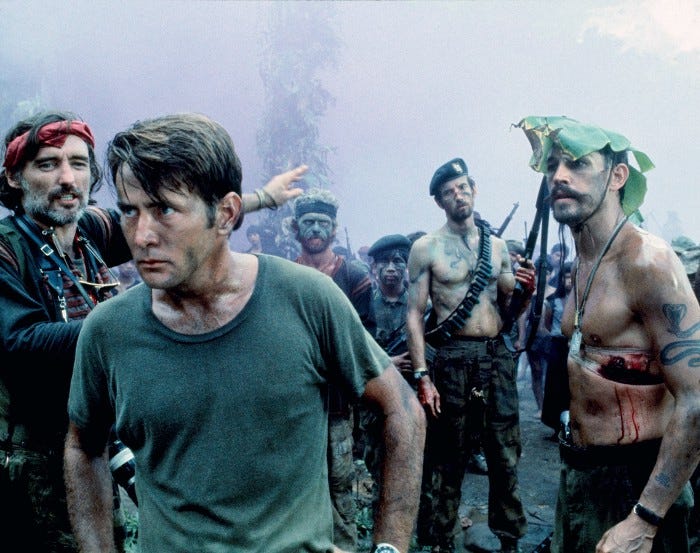
Francis Ford Coppola had his greatest filmmaking decade in the 1970s. He rounded it off with this masterful, must-see-on-the-big-screen loose adaptation of Joseph Conrad’s Heart of Darkness, updated to a Vietnam war setting. Captain Willard (Martin Sheen) is sent on a mission to assassinate Colonel Kurtz (Marlon Brando), who has supposedly gone insane deep in the jungle.
Given the disasters faced during production, one gets the impression Coppola delivered something entirely different from what he set out to make, but it hardly matters. All the film’s flaws dwindle into insignificance in the face of such simultaneously thrilling, disturbing, and satirical spectacle (the helicopter attack on the village, for instance), with what ought to be pretentious being profound (Willard’s ultimate confrontation with Kurtz). As a meditation on the evil in men’s souls, this is spot-on. As a singular slice of pure cinema, it is unsurpassed. It’s also an all-time favourite I can happily watch in any of the various versions (Coppola has tinkered with the material several times).
The Shining (1980)
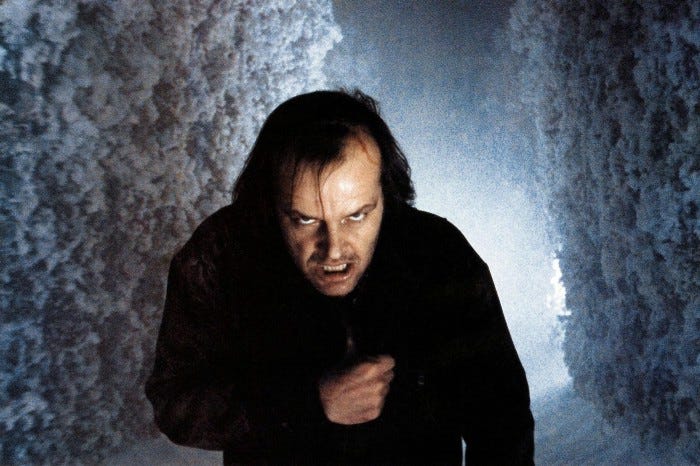
Eric Pierce will wail and gnash his teeth at my exclusion of The Empire Strikes Back. To be honest, it hurts me a little too (see my aforementioned criteria re: only including one film per series), but this way, 1) I get Stanley Kubrick on the list, 2) I annoy The Garrulous Glaswegian, who hates this film (I think she prefers the novel), and 3) I get to have one of my all-time favourite horror films included. At any rate, seeing Jack Nicholson take a job as a remote mountain hotel caretaker and slowly go round the bend remains a perennial favourite.
Notoriously, Kubrick terrorised an astonishing performance from Shelley Duvall, as Nicholson’s distraught wife. Do I condone Kubrick’s actions? No. I‘m sure Duvall could have delivered what was required without bullying. Aside from this inexcusable behind-the-scenes behaviour, Kubrick’s direction is masterful. Even though many Stephen King fans condemned the changes he made (mainly in minimising the supernatural elements and removing any hints of redemption), I think Kubrick did the right thing. Why? Because he made the changes for the best possible reason: To create something of singular brilliance in its own right.
Chariots of Fire (1981)
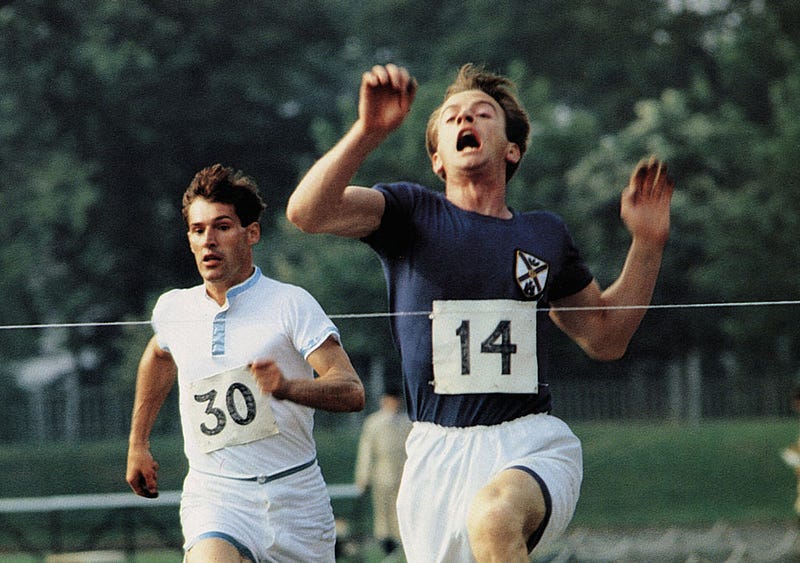
An agonising one as this really ought to be Raiders of the Lost Ark, but I can only choose Spielberg once, so I’m running with this instead (pun intended); the inspiring true story of 1924 Olympic athletes Harold Abrahams (Ben Cross) and Eric Liddell (Ian Charleston). Strict Scottish Presbyterian Liddell runs for the glory of God, whereas Abrahams runs against institutional anti-Semitism. Hugh Hudson’s use of slow-motion has since become cliché, as has the Vangelis score, but despite endless parodies, I still find this film inspiring and moving.
This is actually a much more nuanced film than is generally remembered. For instance, it has an agreeably anti-authoritarian streak, undercutting the shameless sentimentality. Pot shots are taken at everyone from snobby, casually anti-Semitic Cambridge porters and professors to the Prince of Wales. Then there’s Liddell’s agonising over whether he should run on a Sunday. One moment where he reads from Isaiah in church, intercut with fellow Olympian Aubrey Montague’s defeat, and Abrahams’s failures, had a friend of mine moved to tears, even though he is an atheist.
E.T. The Extra-Terrestrial (1982)
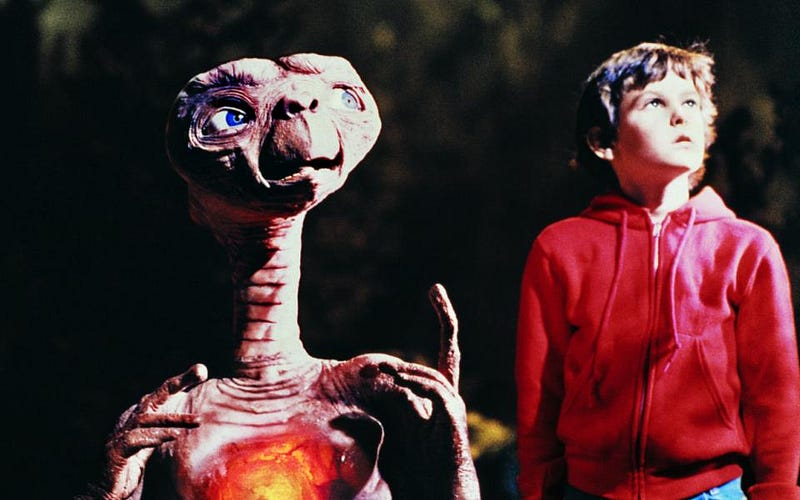
I have some misgivings about not being able to include Blade Runner, but given my deep love for Steven Spielberg’s tear-jerking masterpiece, my selection for this year couldn’t be anything else. This isn’t really sci-fi at all, but a masterful modern fairy tale; a love story of sorts between a lonely boy reeling from the divorce of his parents, and an alien accidentally abandoned on Earth. The central cast — Henry Thomas, Drew Barrymore, and the always underrated Robert MacNaughton — are superb. Melissa Mathison remains criminally unsung in her role as screenwriter, and needless to say, it’s redundant to describe Spielberg’s direction as brilliant.
The film is also greatly enhanced by John Williams’s soaring, Oscar-winning score. In fact, soaring seems an appropriate adjective to describe the emotionally exhilarating experience of watching this film. I’ve spoken at greater length about E.T. elsewhere, concerning the production in general, and about how much this film means to me personally. I won’t reiterate any further here, suffice to say, if you were to put a gun to my head, I’d probably opt for this as my favourite film of all time.
The Man With Two Brains (1983)
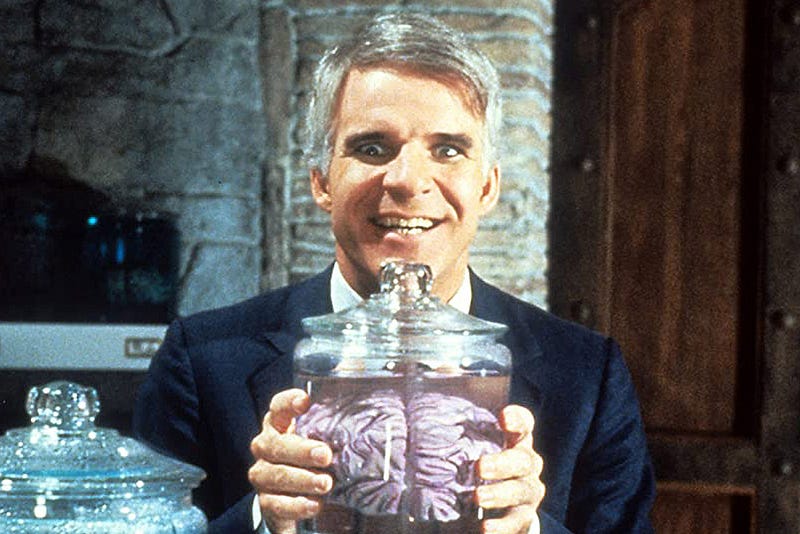
Various titles were considered for this year, including The Right Stuff, The Big Chill, and Under Fire, but in the end, I’ve opted for Carl Reiner’s absolutely hysterical comedy, The Man With Two Brains. Featuring a career-best performance from Steve Martin, the deranged plot involves a brain surgeon who — for reasons too farcical to explain here — falls in love with a telepathic disembodied brain (voiced by Sissy Spacek), much to the chagrin of his femme fatale, gold-digging wife Kathleen Turner.
It’s a masterpiece of silliness, but amid all the lunacy — from impossible drink-driving tests to celebrity serial killers, and David Warner’s hilarious mad scientist declaring if the murder of ten innocent people can save one human life, it will have been worth it — there’s a surprisingly touching message about how true love transcends superficial physical attraction. I never get sick of watching this, and always laugh like a drain. Apart from anything else, the absurd names are priceless (Dr Michael Hfuhruhurr, Anne Uumellmahaye, etc).
Amadeus (1984)
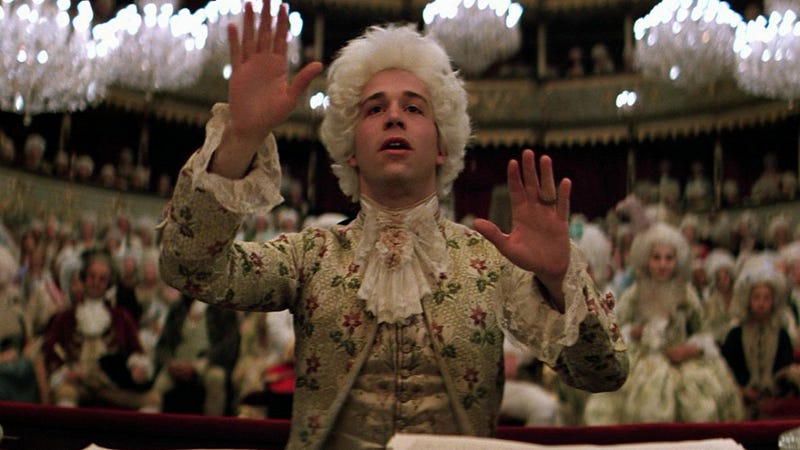
Did jealous court composer Antonio Salieri (F Murray Abraham) murder Wolfgang Amadeus Mozart (Tom Hulce)? That’s the question at the heart of Milos Forman’s masterpiece, featuring a first-rate screenplay from Peter Schaffer (adapting his own play). It’s poor history but brilliant storytelling. Performances are stunning, the drama absorbing, and the music sublime (obviously).
What makes Amadeus such a strong personal favourite for me is the deep, profound study of jealousy, pride, and madness, as experienced through the eyes of Salieri. I suspect all creatives will relate to his fear of being an unremembered mediocrity, and perhaps his anger with God for giving such talents to a man he considers profane and unworthy. Yet at the same time, seeing the progression of Salieri’s obsessive quest to destroy Mozart stands as a riveting, powerful, cautionary tale. A superb film, best seen in its extended cut. Also, did I mention the music? As Mozart says to Emperor Joseph II (Jeffrey Jones): “I am a vulgar man, but I assure you my music is not.”
Back to the Future (1985)
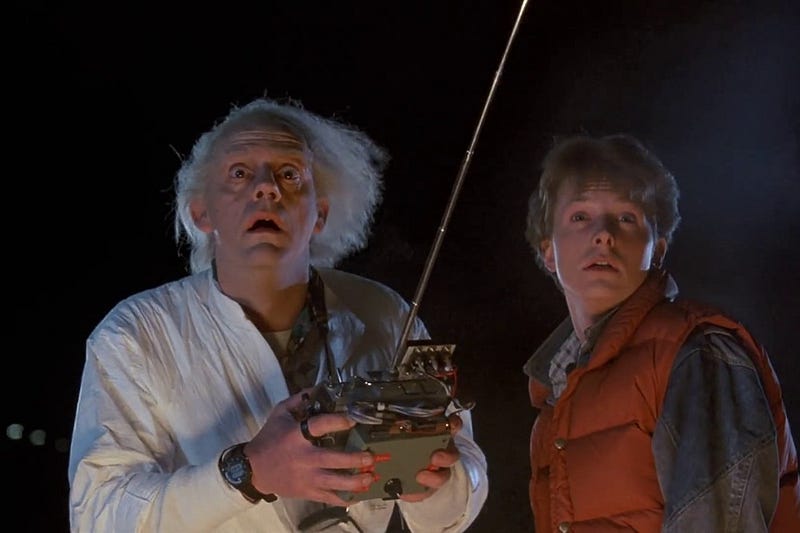
Another hand-wringing dilemma, as Akira Kurosawa’s Ran and Peter Weir’s Witness are both so magnificent. Yet I can’t ignore Back to the Future. I’ve not even been let off the hook by my one-film-per-director rule, as Spielberg, whose influence is keenly felt throughout, is present as executive producer, not director. Robert Zemeckis helmed and co-wrote this masterpiece, alongside Bob Gale. By now, there can’t be a person on the planet unfamiliar with this brilliant story of time-travelling teenager Marty McFly (Michael J Fox), who winds up stuck in 1955 trying to get his bullied father George (Crispin Glover) to stand up to his tormentors, whilst urging him to make a play for his mother Lorraine (Lea Thompson), lest Marty wind up erased from existence. Unfortunately, Lorraine is romantically obsessed with Marty.
Too risqué? Disney thought so, hence why they passed on the screenplay; a decision that cost them a lot of box office dollars. But the genius of Back to the Future is none of this seems salacious, as the story is handled with irresistible charm and wit. The cast contributes winning performances, including Christopher Lloyd as everyone’s favourite mad scientist Doc Brown, tasked with a dangerous plan to get Marty back to 1985, courtesy of a bolt of lightning. I’ve said before there’s no such thing as a perfect film, but if there were, it would look like Back to the Future. Anyone who doesn’t like it should seek urgent medical attention.
Aliens (1986)
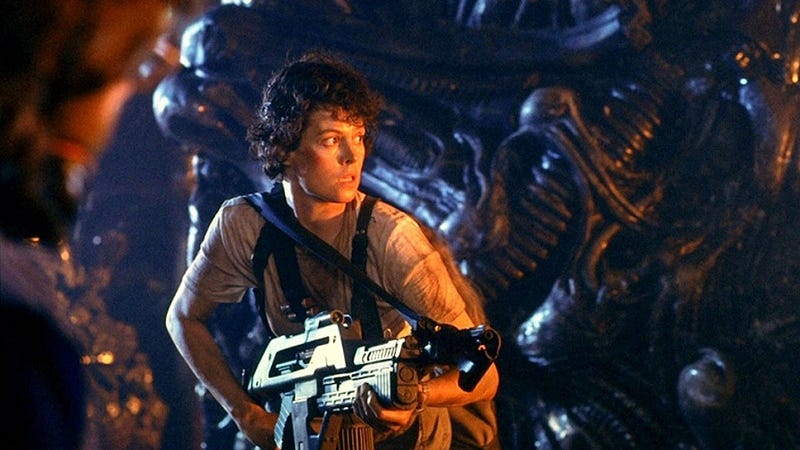
I couldn’t include Alien because of Apocalypse Now, nor The Terminator because of Amadeus. Both omitted films I prefer to Aliens, but not by much. James Cameron’s masterful sequel to Ridley Scott’s horror classic is a stunning movie in its own right. Sigourney Weaver gives arguably the best performance of her career as Ripley, reluctantly returning to the planet where the original xenomorph was discovered that decimated her crew. This time she has a platoon of overconfident marines in tow, sent in to discover why they’ve lost contact with a group of colonists.
The scene is set for a nerve-shredding, pulse-pounding, relentless thrill-ride of suspense and action, with multiple acid-blooded alien foes terrorising the cast. Once it gets going, the film never lets up for a second, and you wind up feeling like you’ve not breathed for two hours. Action aside, the film emphasises maternal themes, specifically in Ripley’s dogged determination to protect a young girl, and there’s a sort-of Vietnam subtext to chew on as well.
The Untouchables (1987)
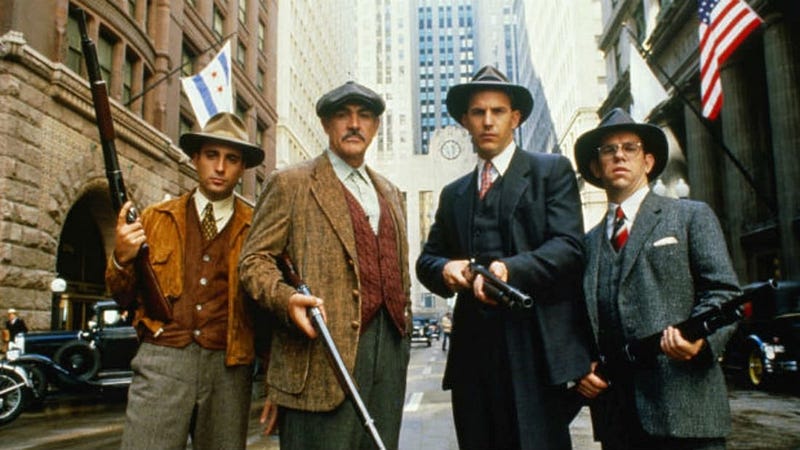
Brian De Palma’s splendid crime thriller, scripted by David Mamet and inspired by real events, is a heavily fictionalised but brilliant piece of filmmaking. Treasury officer Elliot Ness (Kevin Costner) learns the hard way to deal with Al Capone (Robert De Niro), organised crime, and police corruption, circa Chicago 1930. He’s ably assisted by honest cop Malone (Sean Connery), Treasury accountant Oscar Wallace (Charles Martin Smith), and rookie George Stone (Andy Garcia). Together they swear to uphold the law and bring down Capone, latching onto the novel idea of trying a murderer for income tax evasion.
A straightforward tale of good versus evil, this features first-rate performances (Connery won an Oscar for Best Supporting Actor) and superbly directed set pieces. These include a memorable shoot-out at a railway station that pays homage (clumsily or brilliantly, depending on your point of view) to Sergei Eisenstein’s Potemkin. I’ve always found the uncompromising ideals at the heart of the story inspiring, and often hear Connery barking “What are you prepared to do?” in my ears, during times of personal difficulty.
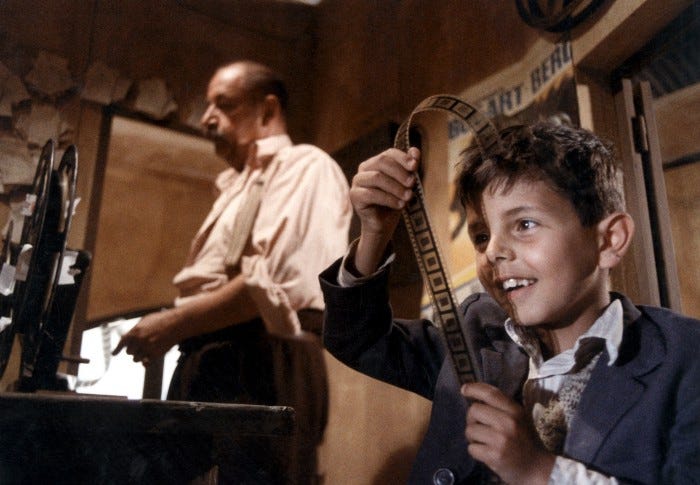
Cinema Paradiso (1988)
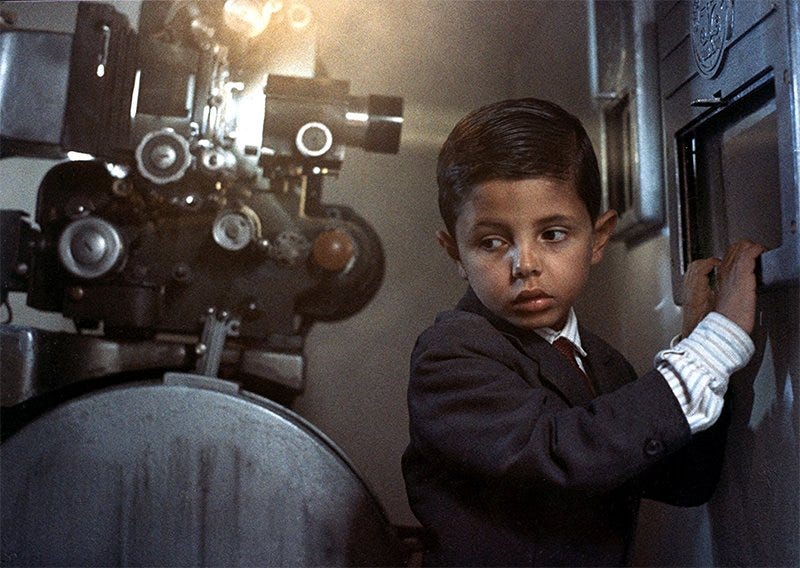
Although it’s tempting to select Die Hard, there’s no way I can ignore a film that touched my soul as deeply as this one. The extended cut in particular, which I now consider essential, added depth and nuance, making an already good film great. Suffice to say, if you’ve never seen Giuseppe Tornatore’s funny and poignant tale about the relationship between a boy and a Sicilian small-town cinema projectionist, you’re in for a treat.
It features first-rate performances from Phillipe Noiret (as Alfredo, the projectionist) as well as Salvatore Cascio, Marco Leonardi, and Jacques Perrin (playing the boy, Toto, at different stages of his life). The drama is enhanced by a great Ennio Morricone score, and the expression “floods of tears” was invented for the final scene. Warm, nostalgic, romantic, and an absolute must for anyone who’s ever fallen in love with the cinema. To add a personal angle, a work acquaintance who found me rather odd saw this film and remarked to me afterwards: “Now I think I understand you.”
When Harry Met Sally (1989)
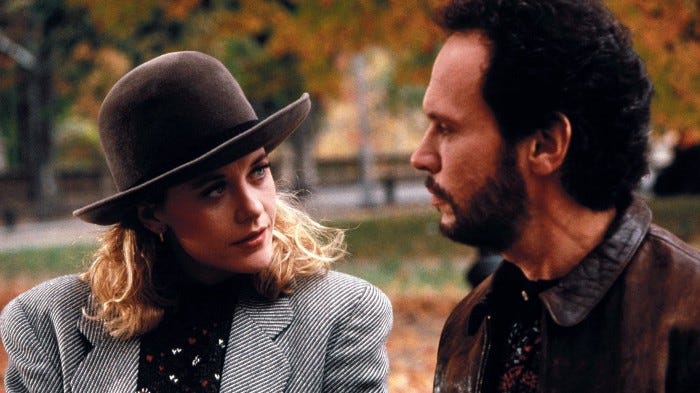
Yes, I know a lot of you are astonished I ignored Glory, Field of Dreams, Born on the Fourth of July, Do the Right Thing, and My Left Foot in favour of this, but dammit, I want a romantic comedy on this list. (And yes, it particularly pains me to leave out Dead Poets Society, but my Peter Weir choice is coming up in the next instalment.) Most of my favourite romantic comedies hail from the 1930s/1940s and invariably star Cary Grant and Katharine Hepburn, but this gem from director Rob Reiner and screenwriter Nora Ephron is a rare exception.
Attempting to answer the perennial question of whether men or women can be friends, or whether sex always gets in the way, Reiner and Ephron introduce us to Sally Albright (Meg Ryan) and Harry Burns (Billy Crystal), charting their friendship and subsequent romance over several years. Their conclusion seems to be an emphatic no, which I disagree with, based on personal experience. But that doesn’t make this film any less charming. Worth revisiting again and again for the hilarious deli orgasm scene, bookshop scene, Carrie Fisher and Bruno Kirby’s split-screen phone call, the Greek chorus of older couples telling their stories, and the poignant New Year’s Eve finale.
That’s it for part one. Click here for part two (1990–2005).
Author’s note: I hope you enjoyed this article. For more about me and my writing on Medium, please click here. For information on my writing outside Medium, please click here. For a list of my published novels and other works, please click here.