E.T. The Extra-Terrestrial: 40 Years On
A celebration of Steven Spielberg’s magical, moving masterpiece.
Warning: Contains spoilers
In May of 1982, at the Cannes Film Festival, the new film from Steven Spielberg was shown out of competition. Those attending, including critics weary from a week of largely lacklustre, pretentious, dull festival offerings, expected nothing special from what had been billed as a small, personal project. As the film ran through the projector over the next two hours, the audience went from indifferent to ecstatic, culminating in a lengthy standing ovation at the finale. Critics wrote rave notices. Buzz from the screening spread far and wide. A cinematic landmark had arrived. The rest is history.
I’ve written at length elsewhere about E.T. The Extra-Terrestrial, from a much more personal angle. Here, however, to celebrate the 40th anniversary of this landmark film from Spielberg’s embarrassment of riches back catalogue, I’m going to delve into a little more of the production history, and why the film deserves its status as a bonafide classic.
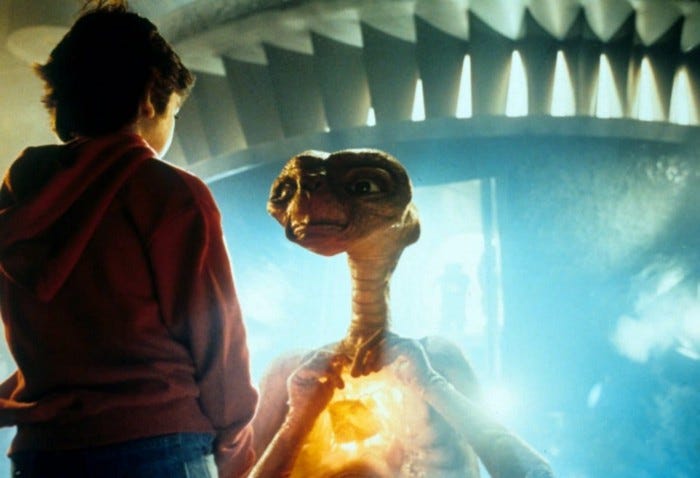
It seems foolish to recap the plot, as there can’t be many people reading this who haven’t seen the film. Suffice to say, if you haven’t, I urge you to stop reading, watch it, then return. The story — about a lonely boy who discovers an alien that’s been accidentally left on Earth by his people — isn’t really science fiction. Rather, it’s a love story of sorts; an unforgettable modern fairy tale about childhood loneliness, kindness, and courage. A fable about love and pain, and how the two are inseparable. A spellbinding, magical, deeply moving cinematic dream.
In 1960, in the aftermath of his parents’ divorce, a lonely young Steven Spielberg imagined an alien companion to take the place of the brother he never had, and the father he no longer felt he had. In 1978, he considered making a film based on this aspect of his childhood entitled Growing Up, but the idea was abandoned (incidentally, this project appears to have been resurrected with Spielberg’s upcoming film, The Fabelmans). At the same time, Spielberg started work on a companion piece to Close Encounters of the Third Kind entitled Night Skies, with writer John Sayles. The plot concerned malevolent aliens terrorising a family under siege.
During the Raiders of the Lost Ark shoot in the summer of 1980, Spielberg began to think about his lonely childhood once more. He spoke with screenwriter Melissa Mathison about Night Skies, and together they fashioned a subplot from the project involving one friendly alien among the other scary aliens developing a bond with an autistic child, ultimately being abandoned on Earth by his contemporaries. This idea led to the concept of E.T. The Extra-Terrestrial.
After Melissa Mathison completed the E.T. screenplay, Spielberg took it to Columbia, who initially optioned it, then put the film into turnaround, failing to see any big commercial potential. Universal proved more receptive and purchased the screenplay in return for a small percentage of profits. According to John Veitch, then president of the studio’s worldwide productions, Columbia ultimately made more on the release of E.T. than they did on any of their own films that year.
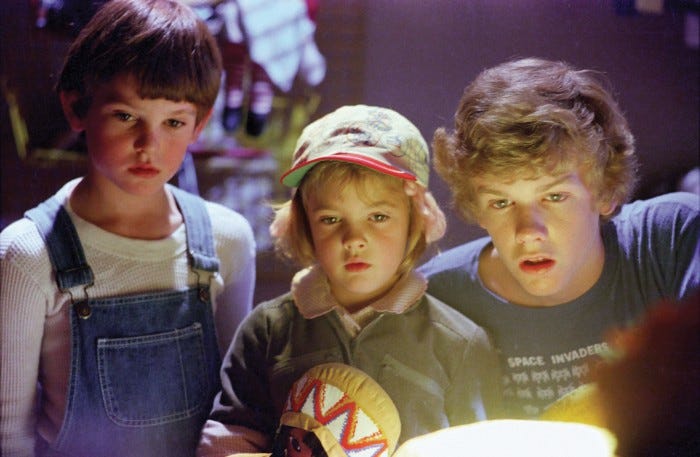
With the project greenlit by Universal, Spielberg went about casting his child leads, settling on Drew Barrymore, Robert MacNaughton, and Henry Thomas as Gertie, Michael, and Elliot respectively. The audition of the latter is now Hollywood legend, with everyone present moved to tears and Spielberg responding “OK kid, you got the job.” Dee Wallace and Peter Coyote were also cast as the children’s mother Mary and mysterious NASA scientist Keys, respectively.
Creature designer Carlo Rambaldi, who had worked on Close Encounters, was hired to create the remarkable E.T. animatronic puppets. His facial designs were based on a combination of Albert Einstein, Ernest Hemingway, and Carl Sandburg, and Debra Winger contributed to his vocal design. Four E.T. puppets were made, with several puppeteers operating them, as well as a costume worn by two small people, Tamara De Treaux and Pat Bilon. In addition, twelve-year-old Matthew DeMeritt, who was born without legs, also wore the costume in some shots.
Working with cinematographer Allen Daviau, the film was shot largely in sequence, to preserve the illusion of the emotional story arc with E.T. for the child actors. Spielberg opted to ditch his usual meticulous storyboarding for once and approach the film more intuitively on a day-to-day basis. This freewheeling approach paid off, leading to innovations including shooting much of the film at a child’s eye level, akin to cartoons where the presence of an adult is suggested by a leg or an arm. Spielberg and Mathison also collaborated with their child cast a great deal, encouraging spontaneity and improvisation. Examples include the speech Elliot gives to E.T. shortly after discovering him, concerning his toys, and the amusing moment when Gertie says: “I don’t like his feet”.
Elsewhere, Mathison’s outstanding screenplay contains a number of other cracking one-liners. “How do you explain school to higher intelligence?” for instance. Or the moment when, after being asked why E.T. can’t just beam up to his spaceship, Elliot replies: “This is reality, Greg.” For me, Mathison is the great unsung hero of this film, and deserves just as much credit as Spielberg for her insightful, compassionate, authentic work.
Spielberg’s fantasy films are what is sometimes called “grounded fantasy”, in that they depict familiar situations and people caught up in extraordinary events. One key scene early in the film, at the dinner table, is an outstanding case in point. Michael, Gertie, and Mary all try to convince Elliot that he imagined seeing an alien. The scene is amusingly plausible, as Michael gently teases his younger brother that he might have seen an elf or a leprechaun, culminating in the hilarious outburst from Elliot: “It was nothing like that, penis breath!”
Amid the embarrassing aftermath of his remark, Elliot says: “Dad would believe me.” The entire scene turns, as Mary suggests Elliot calls his father and talks to him about it. Elliot bluntly replies: “I can’t. He’s in Mexico with Sally.” Mary tearfully excuses herself, muttering how “he hates Mexico.” The scene is brilliant because it shows Elliot’s emotional selfishness, in not considering his mother’s feelings, Michael’s anger at his younger brother for upsetting her, and Gertie’s bemusement, as she tries to make sense of all the emotions around her. It’s an utterly believable, painful, and all too common private family tragedy. But these characters are about to be caught up in something far from common.
Suffice it to say, the performances from the entire cast are magnificent. I don’t think I’ve ever seen better child performers. The trauma of the moment when the masked NASA scientists arrive to commandeer the sick E.T., turning the home into an eerie, unsettling, plastic sheeted quarantine nightmare, is a stroke of psychological genius on Spielberg’s part, as was his decision to shoot in sequence. Therefore, the tearful performances in this scene, as E.T. lies dying, aren’t really acting (as can be seen in behind-the-scenes footage at around 34:30). No wonder it has upset generations of children (including yours truly, aged seven when I first saw this during the original run).
Following the shoot, post-production work began on the film in earnest, with George Lucas’s Industrial Light and Magic providing eye-popping, ultimately Oscar-winning visual effects. Another Oscar went to John Williams, for his soaring score. Alas, Spielberg was not rewarded with the Best Director and Best Picture Oscars he so richly deserved, with E.T. losing out to the admirable but conventional Gandhi.
On the other hand, the film was adored by audiences and critics, and became a cultural phenomenon. For over a decade it was the highest-grossing movie of all time. That is until Spielberg knocked himself off the top spot with Jurassic Park. Adjusted for inflation (the only sensible way to truly calculate the most successful films of all time), E.T. currently sits at number seven on the list, behind the likes of Gone with the Wind and The Sound of Music. A remarkable achievement.
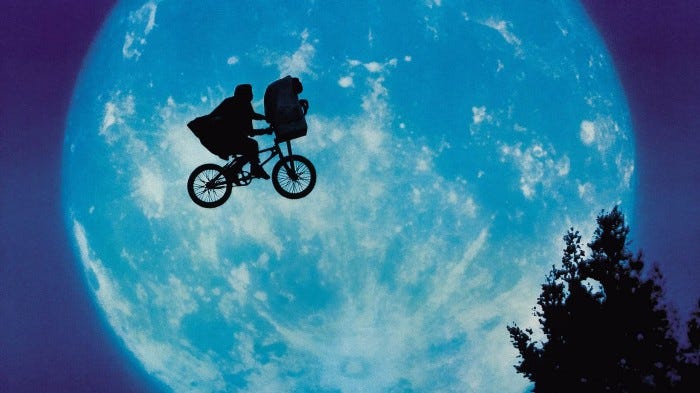
E.T. The Extra-Terrestrial constitutes one of seven times Steven Spielberg changed the course of cinema. It is filled with iconic imagery; the mysterious spaceship in the forest, the glowing healing finger, the moon bicycle fly-by, the flower coming back to life, and so forth. Inevitably, there were a glut of imitators; some dreadful (Mac and Me) some rather more entertaining (DARYL for instance). But none come close to the perfect fusion of the commercial and the personal embodied in Spielberg’s flawless gem. Well, perhaps not flawless, as no film can be that, but as close as is humanly possible to get. Posthumous digital tinkering in the 2002 reissue to remove guns from the chase finale and tweak already exemplary puppet work with CGI was criticised as absurd political correctness and cultural vandalism, rightly in my view. Thankfully, Spielberg later admitted he’d made a mistake, and reissued the original cut.
Ultimately, the credentials of E.T. as a landmark film for all ages are best demonstrated in the way it continues to capture the imagination of subsequent generations. Over the years, I’ve seen the film at the cinema seven times in total. Most recently, I caught a screening last October. On either side of where I sat were families with young children. The children’s reactions made abundantly clear why this film has endured. From fear in the masterful, edge-of-the-seat opening where E.T. is left behind, to laughter at the slapstick comedy, wonder at E.T.’s powers of healing, inconsolable grief at his passing, joy at his resurrection, and cheers of triumph as the bicycles fly off into the sky, there could be no doubt this film would prove one of the defining moments of their cinematic childhoods. The look on their tear-stained but happy faces as the credits rolled was priceless. I was reminded both of my own children’s response to first seeing this film when they were younger (during a previous cinematic reissue), and my own response, during the original 1982 release.
For that alone, E.T. The Extra-Terrestrial deserves to be richly celebrated on its 40th anniversary. All these years later, after that first screening at Cannes, it remains every bit as gripping, funny, frightening, joyful, heartfelt, and emotionally exhilarating. A timeless masterpiece to be treasured for all time.
Author’s note: I hope you enjoyed this article. For more about me and my writing on Medium, please click here. For information on my writing outside Medium, please click here. For a list of my published novels and other works, please click here.