Retro Rewind
How ‘E.T. The Extra-Terrestrial’ Changed My Life
Steven Spielberg’s masterpiece was the Damascus Road moment that converted me to cinema.
Retro Rewind is a weekly series that reconsiders pre-2000 pop culture. More here.My emotional baggage for E.T. The Extra-Terrestrial is a suitcase so overstuffed with bittersweet nostalgia and melancholy reminiscence that it would incur a hefty excess charge were its physical manifestation to accompany me on a commercial flight. Steven Spielberg’s 1982 smash — the most successful motion picture of all time until Spielberg dethroned himself eleven years later with Jurassic Park — is one of the greatest films ever made, with or without my personal baggage. However, to understand the impact this movie had on me, I have to add a little background information from my largely redacted past.
Up until the age of seven, my parents were part of what I’ll simply describe as a cult. The leader of this cult demanded an isolationist lifestyle, which meant I had vast swathes of family I had never met (because they weren’t a part of the cult). I wasn’t permitted to go on holidays, or school trips, act in school plays, attend friend’s birthday parties, firework displays, aircraft shows, zoos, theatres… you name it. I wasn’t even permitted to listen to any kind of music except that which had been recorded at meetings of the aforementioned cult. Some of my most coveted toys weren’t permitted either, for reasons too ludicrous to get into in this article. However, I would tantalisingly glimpse them in shop windows, or when friends brought them to school, or in catalogues covertly smuggled into our home by my late, much-missed father (whom I later learned bravely stuck it out to keep the family together, despite his profound doubts about what we’d got into). On top of this, we were not permitted a television in our home, and I had never even heard of cinema.
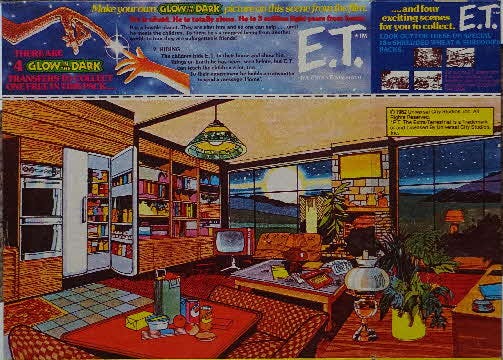
So it was that I first learned of E.T. The Extra-Terrestrial. Not via film posters, trailers, or TV spots, but via a box of cereal. Shreddies had a tie-in, where you could cut out a large illustration from the film on the back of the box, and add the glow-in-the-dark stickers contained inside. I had no idea what any of this meant, but glow-in-the-dark stickers were new to me, and they were exceptionally cool. Somewhere upstairs, I still have that cardboard cut-out with the glow-in-the-dark stickers placed rather ineptly in peculiar places from Elliot’s sitting room.
I should add that this all coincided with the collapse of the cult. Many painful revelations about what had really been going on came to light. Our lives were suddenly turned upside down; obviously for the better, but as anyone who has ever experienced emergence from a cult will tell you, the process is far from straightforward.
However, one of the more wonderful side effects of leaving a cult is the discovery of all you have been missing. One of those things was cinema, and my parents wasted no time introducing me and my younger sister to what was then the ABC Magdalen Street Oxford; a beautiful art-deco single-screen cinema with a balcony and one of those lovely curtains that rose as the lights were dimmed. The first film we went to see was Snow White and the Seven Dwarfs. The second, shortly afterwards, was E.T. The Extra-Terrestrial.
Whilst Snow White showed me the potential of the moving image as a world of magic and wonder, it was E.T. that had the greater impact. I can only describe the experience of seeing that film for the first time as the Damascus Road moment that converted me to cinema. To continue that analogy, if Snow White was John the Baptist, then E.T. was the Messiah. It is telling, for instance, that with Snow White, in addition to the main feature, I can also recall the B-western that played with it, as well as the supporting cartoons. With E.T. I remember nothing but the film itself. It was the first film I ever watched that I immediately wanted to see again; an effect Spielberg was to have on me on a regular basis throughout my childhood.
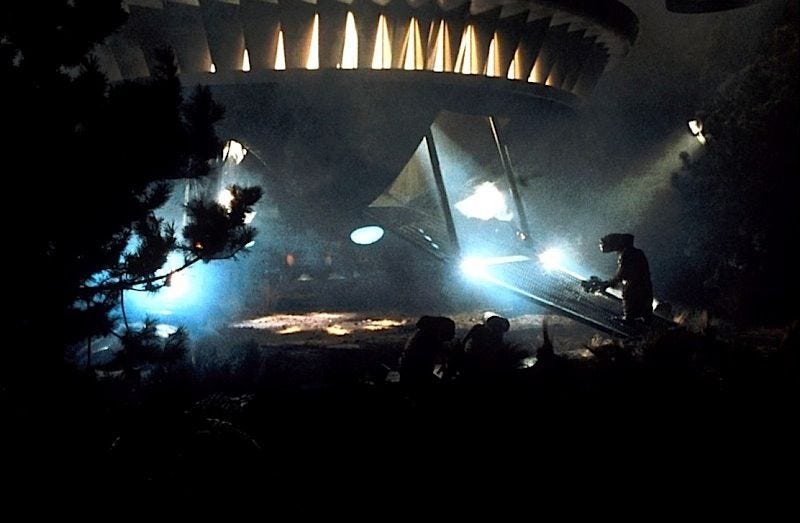
The vivid, wordless opening, as ET and his fellow aliens collect botanic samples from a forest at night, cast an instant spell over me. I was gripped, enchanted, beguiled, and subsequently terrified, as the NASA scientists shattered the silence and chased ET back to his spaceship. I can still remember clutching my armrests, my heart in my mouth, desperately longing for ET to get back before the ship took off. But I knew he wouldn’t get there in time. Otherwise, there would be no film.
At the conclusion of this sequence, I was relieved when the film cut to the comparatively peaceful scene where Elliot watches his older brother Michael playing Dungeons and Dragons with his friends. I instinctively knew the respite would be temporary, but I needed to catch my breath. I also knew, although obviously I didn’t inwardly articulate it in these terms, how hugely impressed I was that Spielberg had devised this opening sequence essentially as silent cinema, with no dialogue. At that moment, my inner film critic was born.
Said critic was also hugely impressed by another key scene early in the film. Elliot’s mother Mary, his younger sister Gertie, and Michael, all disbelieve Elliot when he insists he saw ET. They suggest it might be his imagination playing tricks, or it could be alligators in the sewers, or (as Michael continues to taunt him) it might be an elf or a leprechaun. To which Elliot hilariously retorts: “It was nothing like that, penis breath!”
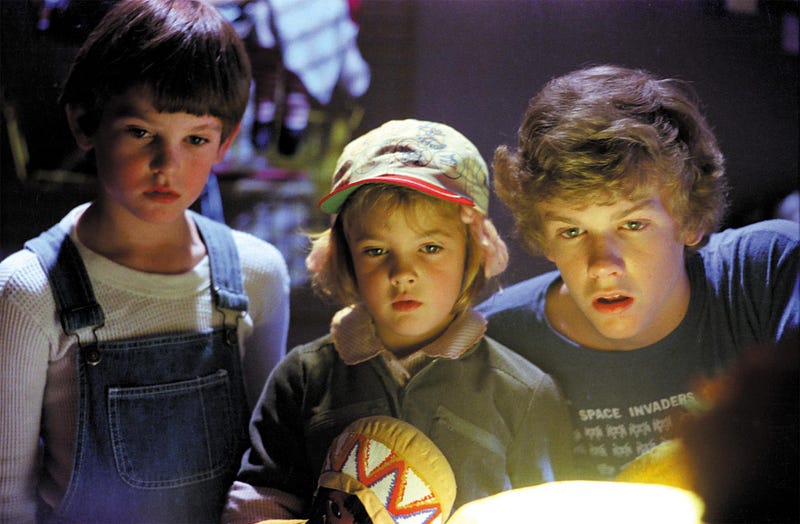
I guffawed, as did everyone around us in the cinema. But then the scene turned on a superb, poignant, deeply upsetting line that cut right to the heart of what the film was really about: “Dad would believe me.” In that moment, I understood. The most important character in the film was the absent one. Elliot’s father had gone off with another woman, to Mexico. The remainder of the scene is brilliantly observed, as the various family members react to Elliot. His remark is honest, but also selfish, paying no mind to the damage it causes. When his mother walks off in tears, Michael angrily berates Elliot, telling him to grow up and think about how other people feel.
I later learned about how this film reflected the pain Spielberg felt around his parents’ divorce. However, at the time, even though my parents were not divorced, I thought about how my father had reacted during some of the more painful times we had experienced in the cult. There were occasions when he had argued with my mother because he had taken my point of view rather than that of the cult leader.
Dad would believe me. And he did.
Of course, I had little time to ponder the deep psychological impact of this scene. As Elliot befriended ET, introducing him to his brother and sister, and keeping him hidden from his mother, I remained utterly captivated. In scene after brilliant scene, I laughed and laughed again, whether as a result of well-timed slapstick gags, or Elliot’s hilarious one-liner: “How do you explain school to higher intelligence?” That’s before I even mention the crying-with-laughter (and also very telling) moment, where Mary is so wrapped up in her grown-up world of dry-cleaning failures and grocery prices that she is literally unable to see a drunken alien staggering around her kitchen.
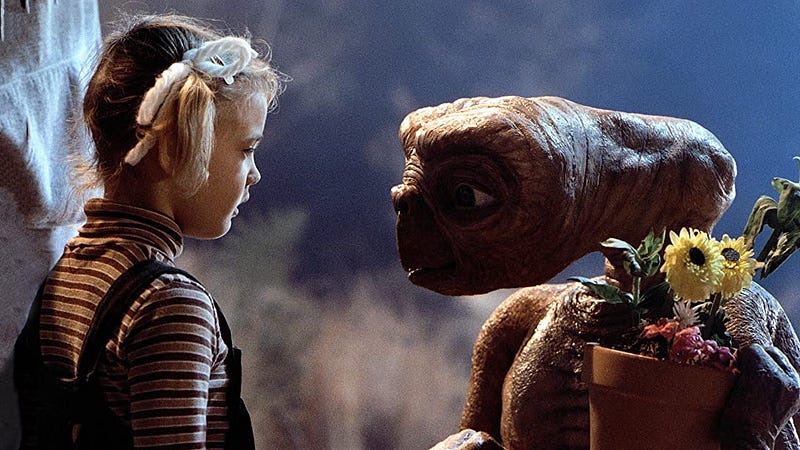
Since everyone reading this will be familiar with the story (and if you aren’t, please stop reading and watch this film immediately), I’ll leave the narrative aside for a moment to discuss the cast. In Henry Thomas, whose turn as Elliot I still rate as the greatest child performance of all time, I found a point of identification. I felt, if you’ll forgive my use of a much-abused term, seen. As Gertie, Drew Barrymore was every bit as mischievous as my own younger sister, and absolutely nailed the part. As for Robert MacNaughton, he is often overlooked by critics, but I’m going to single him out for special praise here. The fact that he is learning to drive in the film echoed what was happening at the time with my adopted older brother, who was also learning to drive.
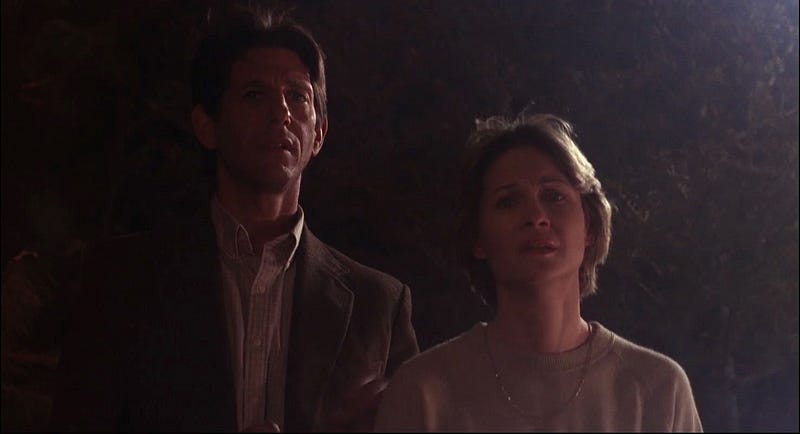
Rounding out the cast, Dee Wallace is superb as Mary, and Peter Coyote is wonderful as NASA scientist Keys. Regarding Keys, we never learn his real name, but presumably he is listed as “Keys” in the cast because for the majority of the film, we only see him from the waist down, the keys on his belt jangling with creeping menace. This is also because of Spielberg’s inspired decision to shoot almost the entire film from a child’s perspective. However, it later transpires Keys isn’t really an antagonist. He reveals to Elliot how he has been longing for an extra-terrestrial visit since he was a boy. In that sense, he develops into an important point of identification for adult viewers, epitomising the reawakening of wide-eyed wonder after years of cynicism and disappointment in the grown-up world.
It’s impossible to discuss the cast without also discussing the mostly unsung hero of the film: the late, great screenwriter Melissa Mathison. What is remarkable about her outstanding screenplay is how closely she worked with the young cast, striking a perfect balance between allowing for improvisation, and for knowing when to stick to what she had written. The collaboration between her, the cast, and Spielberg created a truly authentic and resonant portrayal of childhood innocence, carefully interwoven with the cultural touchstones of the time. For example, in an entirely improvised scene (regarding which Spielberg later revealed all his edit choices were take one), Elliot talks to ET about the various items in his bedroom, including Star Wars figures.
As the 35mm print ran through the projector that evening, E.T. resonated with me on an ever-deepening level. This was a film about so many things; loneliness, courage, frustration, and obviously love. More than any other film, E.T. affirmed to me that love and pain are inseparable. ET wants to return to his spaceship, and Elliot helps him “phone home”, but at the same time, Elliot doesn’t want him to leave. Yet if ET stays on Earth, he will die.
E.T. is also about the universal need for home, something I found particularly relatable, as we were losing ours (as a result of the cult collapsing). On top of that, E.T. is about prejudice. ET (courtesy of Carlo Rambaldi’s brilliant creature design) is deliberately ugly, and at first quite frightening, but when Elliot reaches out to him, the inherent message is subtle but clear: People should not be judged on how they appear but on the content of their character.
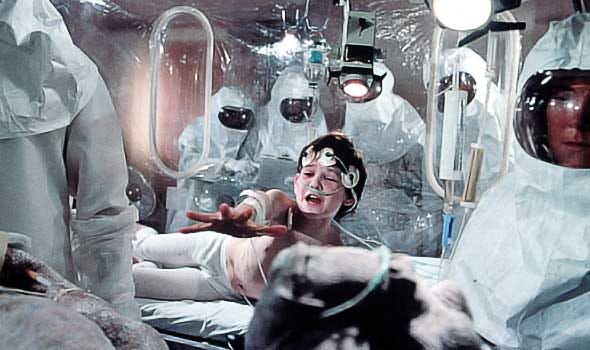
I flippantly remarked earlier in this article about E.T. being the Messiah, but in truth, the film contains a plethora of much-discussed Christ allegories. ET comes down from the heavens, is sheltered in humble surroundings, performs miracles (healings, and later far more spectacular feats), dies, rises again, and ascends. Nowhere is this allegory more apparent than in the almost unbearably upsetting scene where ET gets sick from being on Earth too long and the NASA scientists find him.
Having the safe, familiar atmosphere of one’s home violated and transformed into an antiseptic nightmare of hazmat outfits, plastic sheeting, and invasive scientific equipment proved too much for my child psyche. This truly terrifying idea acts as a deeply traumatic crucifixion metaphor — nothing less than a stroke of genius on Spielberg’s part (who suggested this after the original screenplay had Elliot and ET taken to a hospital). At any rate, it scarred me so much that I actually blocked out the memory of this sequence. I remember everything else about the film, but from the moment where Michael finally tells Mary about ET, to the point where ET returns from the dead, there is a big black hole. Probably because at that point, I was beside myself, inconsolable with grief. There really is no other sequence quite like it in cinema history (except possibly the death of Bambi’s mother). When I rewatched the film years later on VHS, I was astonished that I had no memory of these scenes.
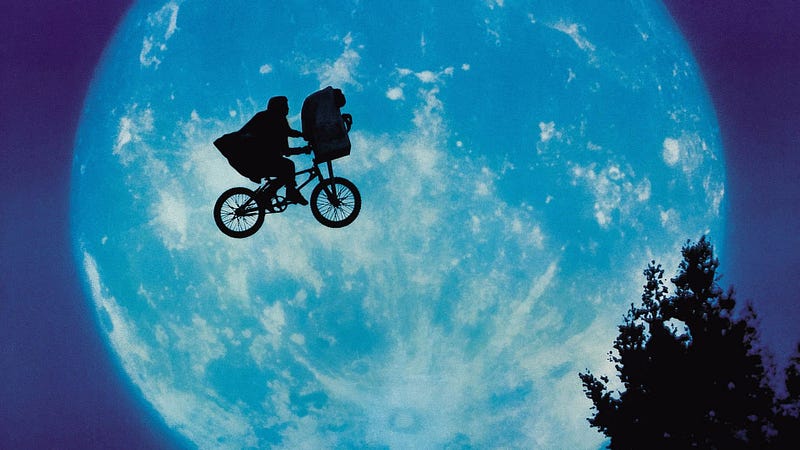
Sometimes Spielberg gets accused of manipulating audiences, and he is definitely guilty as charged. The way he had me crying one minute, at the death of ET, and laughing the next, as Elliot hilariously tries to cover up ET’s resurrection from the scientists, is a directorial feat akin to mass hypnosis. Needless to say, for me, this is Steven Spielberg’s greatest film. If I had to pick a single moment that converted me to cinema which really sealed the deal, I’d have to go with the iconic moon bicycle fly-by.
Speaking of flying bikes, I remember throughout the final chase I desperately needed to pee. My father suggested I nip out, and that I probably wouldn’t miss anything important, if I was quick. But I instinctively knew he was wrong. Again, although I didn’t inwardly articulate it in these words, I knew if the scene was unimportant, the editor, Carol Littleton, would have cut it out. Suffice to say, I remained riveted (whilst jigging up and down a bit), and was proved correct. I’ve said it before, and I’ll say it again: The bit where the bikes fly off into the sunset is, as far as I’m concerned, the single most exhilarating moment in cinema history. Adjectives like soaring and magnificent simply cannot do it justice. Nor are they adequate to describe the monumental brilliance of John Williams’s Oscar-winning music; my personal favourite of his scores (and that is really saying something).
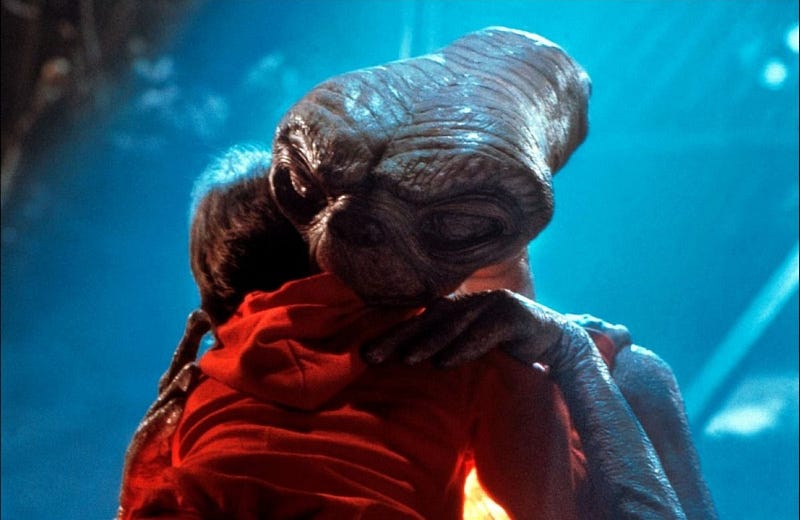
The farewell scene emotionally hit me for six, but by that point, it was definitely an “up-cry”. As I noted earlier, E.T. affirmed to me that love and pain are inseparable. Although sad, Elliot knows ET’s departure is the right thing for both of them, and I knew it too. In addition, the appearance of the rainbow as the spaceship flies off is a beautiful, appropriately hopeful image, indicating that Elliot’s experience has empowered and changed him for the better.
Certainly, that was the case for me. Even today, the seismic impact of that evening at the cinema is still being felt. E.T. proved a deeply cathartic experience that helped me start to come to terms with the trauma of what happened to me in that cult. At the same time, E.T. was the beginning of a love affair with film that continues to this day.
To end on a lighter note, I should add that I insisted on sitting through the entire credits, despite needing to pee, because I didn’t want to miss a note of John Williams’s music. Thankfully, I just made it to the toilet without wetting myself. Another important lesson learned for future cinemagoing: Always empty your bladder first.
The Dillon Empire beyond Medium
For a full list of my published novels, click click here.
For more on my novels and other projects, click here for my blog.
For my Patreon page, click here.