My Favourite John Williams Score: ‘E.T. The Extra-Terrestrial’
My most beloved music score of all time by my favourite film composer.
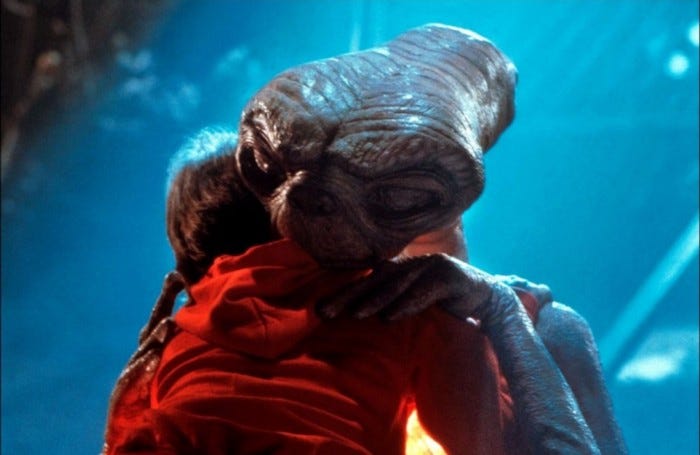
Seeing Steven Spielberg’s masterpiece E.T. The Extra-Terrestrial during the original run in 1982 was the Damascus Road experience that converted my seven-year-old self to cinema. The effect was immediate and permanent, and I have written about the experience here, if you’re interested.
That extraordinary encounter with an extraordinary film also began my lifelong love for the music of John Williams. Over the decades he has written iconic scores for many Spielberg classics, including Jaws, Close Encounters of the Third Kind, Raiders of the Lost Ark, Jurassic Park, and Schindler’s List. He also wrote the landmark scores for Star Wars, Superman, Harry Potter… the list is almost endless. He has won five Oscars, and been nominated more than anyone else in Academy history, an astounding fifty-two times.
The music for E.T. The Extra-Terrestrial — for which he won his fourth Oscar — is, to my mind, Williams’s greatest work, and also the greatest film score of all time. It’s an opinion shared by Spielberg himself, and whilst an equal case could be made for any number of his other works, for me, there is an unashamed personal bias that comes into play here. After all, it isn’t an exaggeration to say that this film — and this music — changed my life.
Here are seven selections from this magnificent score, giving an overview of the film’s main themes.
Three Million Light Years From Home
My favourite music score of all time begins with a single flute, playing a recurring six-note motif that crops up throughout the film, before being joined by strings, and a relatively quiet French horn. An organ then joins the strings, playing an atmospheric, mysterious theme that sets the scene, as the spaceship is seen in the forest at night. Aliens emerge from the craft, collecting botanic samples, and one of their number wanders a little too far.
Pursued and Abandoned
The strings become more urgent, and are joined by heart-in-throat brass and percussion as the alien is chased through the forest by NASA scientists. It is the music that scored the desperation of millions of children, clutching their armrests, hoping E.T. would get back to the spaceship before it takes off. But then, of course, there would be no story. I love the dramatic crescendo as the spaceship ascends (around 2:05).
E.T. and Me
Once the lost E.T. befriends lonely ten-year-old Elliot, this theme begins to appear in the film. Played on harps, with a string accompaniment, it is a beautiful piece, evoking delicate, melancholy, bittersweet feelings of innocence, longing, and loss. Essentially it is a love theme, because E.T. is a love story at heart, albeit a highly unusual one between a boy and an alien.
Frogs
This music accompanies one of the funniest scenes in the film, where due to his telepathic link with E.T., Elliot becomes intoxicated due to E.T. deciding to help himself to beer from the fridge. Meanwhile, in school, Elliot decides, in his drunken stupor to release all the frogs due for dissection in his science class.
Flying
This is a concert arrangement, of what most people would simply call the main theme from E.T. This thrillingly magical piece is primarily used during the two iconic flying bicycle sequences, but Williams cleverly introduces the theme earlier in half a dozen scenes, quoting sections here and there in a minor key, subliminally preparing the audience for the out-of-body-experience effect when it is played in full-on triumphant mode by the entire orchestra. Look up soaring in the dictionary, and it simply says “see Flying, from E.T. The Extra-Terrestrial”.
Over the Moon
Here’s another lovely recurring theme from the film, first appearing when Elliot attempts to lure E.T. back to his house with sweets, and popping up at various other intervals — for instance when a strange van pursues Elliot’s older brother Michael in his search when E.T. goes missing towards the end of act two.
Adventure on Earth
If you listen to just one track in this list, please make it this one. This fifteen-minute piece is a singular, operatic, extraordinarily complex piece of film scoring. So complex, in fact, that when Williams struggled to match his music to the images, Spielberg agreed to recut the film to fit the orchestra’s best take. Such was Spielberg’s respect for the maestro, and his phenomenal composition.
Here Williams gives the orchestra a spectacular work-out, as Elliot and Michael are chased, first by police vehicles, then on bikes, before their triumphant airborne escape. Williams begins by using the Over the Moon theme, then introduces an entirely new chase theme to kick things up a gear (at around 4:27), driving the action to the scene where the bikes take off (6:56). At this point, the Flying theme takes over in what is, for my money, the most exhilarating single moment in cinema history.
The final part of the track deals with the tear-jerking farewells, with shamelessly manipulative but brilliantly deployed, heart-tugging strings, reprising the chase theme from earlier, and of course, one last heartrending play of the Flying theme. The music swells, building to a crescendo, then falls silent for a split second (at around 14:00). I will never forget that second of silence the first time I saw this, because at that moment, I could hear the snuffling — and in some cases sobbing — of the cinema audience around me. Then I realised, I was crying too.
It is also worth noting that the score ends as it began, with the six note motif. But whereas it is played on a single flute at the start, here it is played with the full orchestra as an epic finale.
Author’s note: I hope you enjoyed this article. For more about me and my writing on Medium, please click here. For information on my writing outside Medium, please click here. For a list of my published novels and other works, please click here.


