The Music of Jurassic Park and The Lost World
John Williams’s spectacular dinosaur scores revisited.
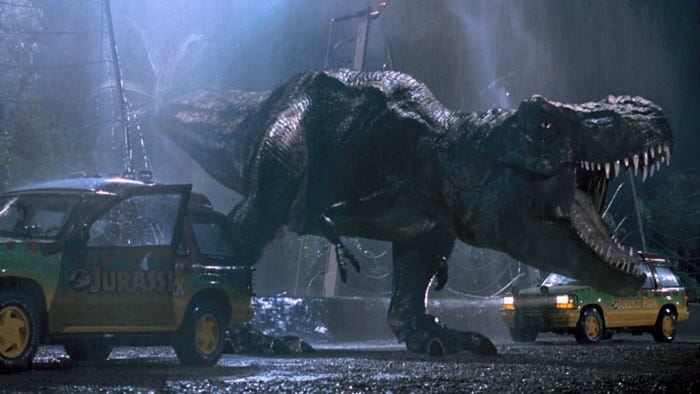
Steven Spielberg changed the course of cinema in 1993, when he unleashed CGI dinosaurs upon the world in his edge-of-the-seat, blockbuster science fiction adventure Jurassic Park. As is almost always the case with Spielberg, he turned to regular collaborator John Williams for the music, and Williams more than delivered. With Jurassic Park, Williams added another extraordinary score to his already extraordinary back catalogue, introducing the world to yet more iconic themes.
The rather underrated Spielberg-directed sequel The Lost World once again reminded us of that all-important scoring truth: The only person who can outdo John Williams is John Williams. This time, Williams excelled himself with an innovative, largely percussive score that often moves away from big hummable themes, and into a more experimental, rhythmic mode. Although it sometimes echoes the thundering, jungle drums of Max Steiner’s King Kong, the music of The Lost World is very much its own beast and stands up to repeated listens. It’s a darker, fuller, more complex, ultimately more accomplished score than the more user-friendly original.
Here then are ten tracks, five from each film, that illustrate how Williams created two scores that, like so many of his creations, seem to have an extra-dimensional element. This simply is dinosaur music.
Opening Titles
The ominous, thrumming opening bars of the score immediately communicate monster movie thrills to a cinema audience primed for an intensely exciting experience. It’s a short opener, playing over the film’s minimal opening titles, but it sets the scene perfectly.
Incident at Isla Nublar
This track plays over the terrifying opening, where the worker gets dragged into the velociraptor pen. I’ll never forget the impact of this scene sitting in the front row of a THX-equipped cinema in the summer of 1993. The sound system was so good I could practically smell the dinosaurs. Here Williams grabs you by the scruff of the neck and jerks you around in your seat, leaving your heart pounding. The second part of the track is music from the aftermath of the T-Rex attack, when Ellie and Muldoon search for survivors. The T-Rex attack itself is an iconic set piece that famously includes no score (the genius of John Williams is also knowing where not to add music).
Journey to the Island
This track plays during the helicopter journey to the island, and also over the scene immediately afterwards, where Dr Alan Grant, Dr Ellie Sattler, Ian Malcolm, et al are shown a huge brachiosaurus by John Hammond. The soaring theme as the helicopter lands is vintage Williams in full-blown exhilaration mode. This leads into the iconic main theme (which kicks in at around 5:05); a magnificent, majestic, awestruck melody. As Spielberg noted, it makes you think, whilst you observe the dinosaurs walk past with tears in your eyes, that God did great work.
Dennis Steals the Embryo
This rhythmic, tension-building piece is a fine accompaniment to the scenes with greedy, traitorous Dennis Nedry stealing the dinosaur embryos. It also anticipates the more percussive score Williams deployed in the subsequent film. I’m fairly sure I can also hear a few synthesiser notes here, which is unusual for a Williams score.
The Raptor Attack
Spielberg described the music composed for the raptors as some of the most original ever written by Williams. He’s not wrong. The eerie, frightening soundscapes generated in this track communicate the presence of these deadly prehistoric pack predators in ways that cannot be explained in words.
The Island Prologue
This track plays out over the opening scene of The Lost World. It begins ominously, and builds in a frenetic manner that echoes the opening of the previous film, but it also deploys more avant-garde orchestral techniques this time, setting the stage for the score as a whole. Williams isn’t interested in merely repeating himself, but in developing something different and complimentary.
I should add that Williams hardly ever quotes from the previous score throughout this soundtrack, and when he does play the main themes from the first film (very briefly in two scenes — one near the start, and one at the very end), said themes are played quickly, almost irritably, in a speeded-up tempo, as though Williams is saying: “Yes, here’s a brief reminder of what I did last time, but check out this new stuff.”
The Hunt
This dynamite track is bursting at the seams with primal, propulsive energy. It’s an adventurous hit of pure adrenaline, and perfectly encapsulates the musical tone of the film as a whole.
The Stegosaurus
The Lost World soundtrack isn’t all pulse-pounding, armrest gripping thrills. There are occasional moments of reflective grandeur, such as this one. Though in the film, Ian Malcolm hilariously undercuts the awe experienced by his companions upon seeing a stegosaurus by muttering: “Yeah. Ohh! Ahh! That’s how it always starts. Then later there’s running and screaming.” It’s a cleverly cynical inversion of the brachiosaurus scene in the first film.
The Raptors Appear
The percussive excitement continues in this superb evolution of the raptor music. Williams truly excels himself with this piece. It not only fits the velociraptor scenes perfectly but stands alone as a textbook example of developing themes, ideas, and motifs in film scoring. Outstanding.
The Lost World Theme
I’ve saved this one for last: The epic main theme for The Lost World, which is heard many times throughout the film. It’s less immediately obvious and showy than the main theme for Jurassic Park, but it’s a slow burner that gets under the skin with repeat listens, until you wind up convinced (as I am) that in many ways, it is the superior piece. The deliriously thrilling multiple crescendo ending gets me every time.
Author’s note: I hope you enjoyed this article. For more about me and my writing on Medium, please click here. For information on my writing outside Medium, please click here. For a list of my published novels and other works, please click here.


