Witness: My Flirtation with Pacifism
How Peter Weir’s 1985 Amish drama challenged my adolescent views on violence.
Warning: Contains spoilers
Australian director Peter Weir is one of my favourite filmmakers. His varied career spans early homegrown gems such as Picnic at Hanging Rock and Gallipoli, to latter-day intelligent Hollywood fare including Green Card and Master and Commander: The Far Side of the Earth. He also has a habit of coaxing career-best performances from his leads; Jim Carrey in The Truman Show, Jeff Bridges in Fearless, Robin Williams in Dead Poets Society… you get the idea.
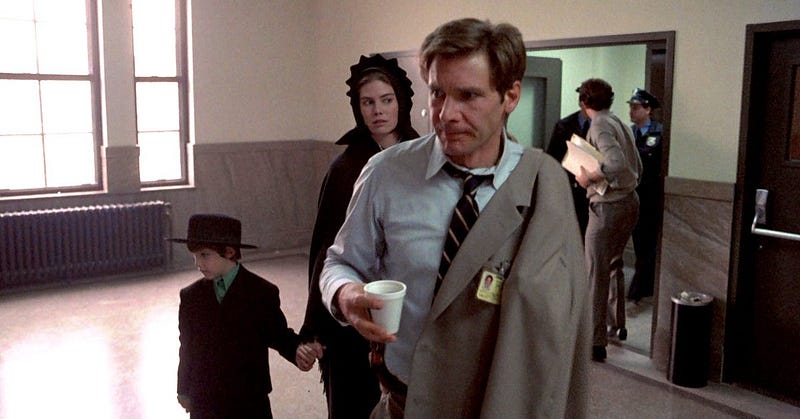
In the case of 1985’s Witness, Weir got a career-best turn from Harrison Ford. He plays John Book, a Philadelphia policeman assigned to investigate a murder accidentally witnessed by Amish boy Samuel Lapp (Lukas Haas). Samuel and his widowed mother Rachel (Kelly McGillis) find themselves caught up in an increasingly dangerous investigation. After John is injured, he is forced to hide out at the Lapp’s Pennsylvania farm. Over time, he is drawn into their peaceful, idyllic way of life — a world without cars, televisions, refrigerators, and other modern conveniences. He is also drawn into romantic yearning for Rachel.
I had wanted to see Witness during the original cinema run, as I knew Harrison Ford from Star Wars and Raiders of the Lost Ark. But in the UK, it had a 15 certificate, and that mandatory prohibition kept it off limits for ten-year-old me. However, a couple of years later, I caught up with the film on VHS.
Most films I’d seen that dealt with violence had, to that point, been of the James Bond variety, with no thought given to extras gunned down in the course of his mission, and no real consequences. However, Witness was emphatically adult in its realistic approach and proved a formative experience in my adolescent years. The brutality of the murder — witnessed by the innocent eyes of young Samuel — was utterly gut-wrenching. It felt, as Weir intended, like an outrage. Unlike James Bond, the ripple effect of that single act of violence is felt throughout the entire film. When John is shot at the end of act one, I was equally shocked. Unlike Indiana Jones, he is properly hurt, ends up in a coma, and nearly dies.
Against all this, my young adolescent mind grappled with Amish theology. A stern lecture delivered to Samuel by his grandfather Eli (Jan Rubes) — regarding guns, and Amish pacifism in general — forced me to think about actions and consequences, physically, morally, and spiritually. On top of that, like John Book, I began to admire the Amish for their sense of community; especially in the extraordinary sequence where they come together to build a barn for newlyweds, without the aid of any modern electrical tools, in a single day.
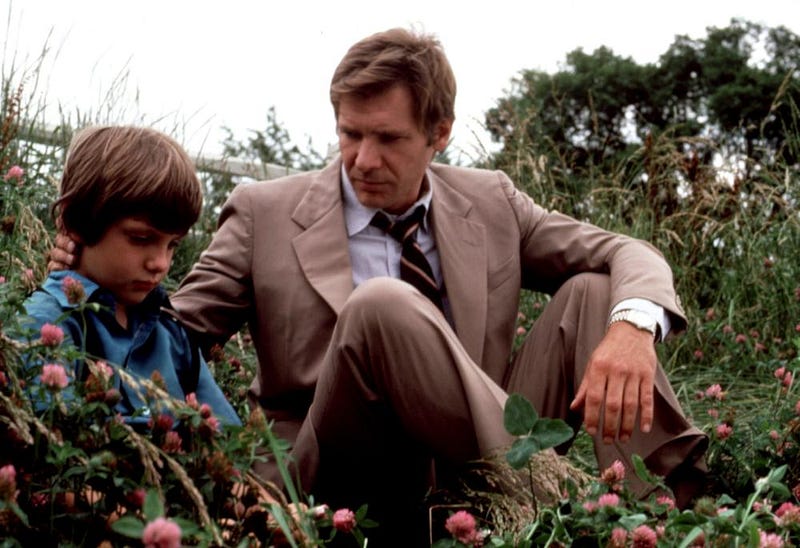
Whilst the film is largely sympathetic to the Amish and respectful of their committed pacifism, it doesn’t gloss over their religious isolationism; a strict dogma that can lead to “shunning” (a form of ex-communication) if violated. Rachel risks shunning as she and John are increasingly attracted to one another. The chemistry between Ford and McGillis is electrifying, particularly in a scene where he introduces her (via the car radio) to Sam Cooke’s Wonderful World, and they steal an illicit dance together. She is giggly at first, but as the dance continues, the desire becomes palpable. They are then interrupted by Eli, who chastises Rachel for listening to sinful music and warns her about the possibility of being shunned.
The love story at the heart of Witness is swooningly romantic. The slow-burn of looks, gestures, and sizzling sexual tension is shot through with longing and heartache. In a later scene, John watches Rachel bathing at night. Aware of his presence, she turns towards him, naked. But still, he won’t sleep with her. It’s almost like David and Bathsheba in reverse.
Such strong emotions were all but overwhelming to my young mind on an initial watch, and they fed directly into Weir’s cleverly considered exploration of the pacifist ideal. After the bathing scene, John tells Rachel if they’d made love, he’d have to stay, or she’d have to leave. At that point, the adolescent who so loved the action-man antics of Han Solo and Indiana Jones, inwardly urged the actor who personified them to put aside his past and go to join the Amish. At one point it even looks as though he will, when the simmering attraction finally boils over, and John and Rachel share a deliriously passionate clinch in the gathering dusk.
But John Book cannot change who he is. His hiding place is ultimately revealed to the villains when he beats up a tourist who is harassing the Amish. Once again, the ripple effect is felt. In this film, no act of violence is without consequence, and no act of violence brings resolution. When the killers attack the farm in the gripping finale, the different worlds of Rachel and John are emphasised more strongly than ever. One brilliant moment has Rachel held hostage with a pistol to her head, whilst John threatens him with a shotgun. John and the villainous Schaeffer (Josef Sommer) scream threats at one another; threats that are utterly incomprehensible to a hysterical Rachel — both literally and in terms of her way of life — with the scene very much playing out from her perspective.
In the end, it is the peaceful solidarity of the Amish community en-masse that triumphs, when Schaeffer realises he is beaten because there are too many witnesses. The wordless, melancholy farewell between John and Rachel is perfect; apparently the result of Weir tearing out pages of dialogue from William Kelley and Earl W. Wallace’s Oscar-winning screenplay. Weir felt if the audience hadn’t bought into their love at that point, no amount of dialogue would persuade them otherwise. He was right. Their final scene is beautiful, achingly sad, and deeply moving.
Needless to say, the impact on my young psyche was huge. I thought about the issues raised by Witness for many years, pondering the heroic pacifism displayed in that film. I eventually concluded that, with great regret, I could not consider myself a pacifist, but at that point in my life, Witness made the prospect very attractive, and it remains one of my favourite films.


