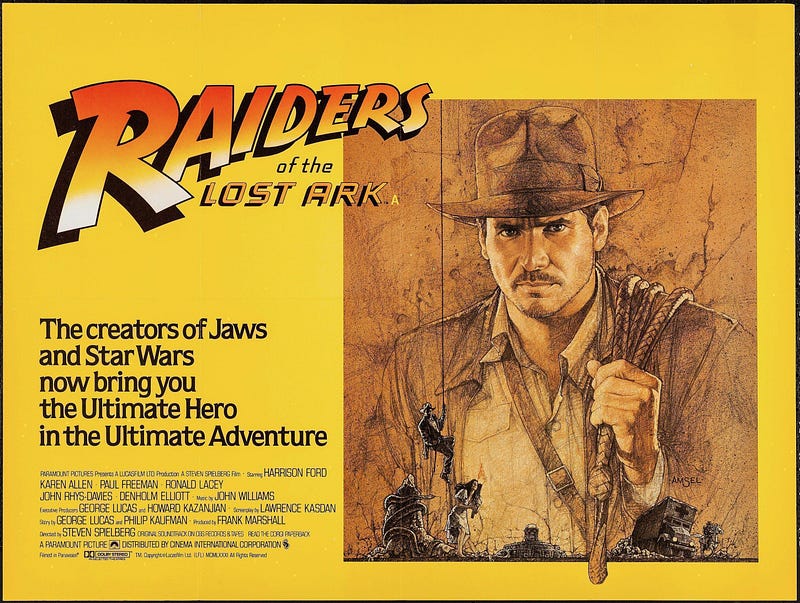
Raiders of the Lost Ark: 40 Years On
Still the greatest adventure film of all time.
Warning: Contains spoilers
In 1977, George Lucas went on holiday in Hawaii to avoid the release of Star Wars, which he was convinced would be a flop. Whilst there, his companion, Steven Spielberg, lamented he wanted to direct a James Bond film, but that the producers wouldn’t let him. Lucas responded: ‘I’ve got something much better,’ and pitched the idea of archaeologist adventurer Indiana Jones.
The rest is history. Fast forward to 1981, and Raiders of the Lost Ark was an instant smash. It outgrossed the James Bond film released that year (For Your Eyes Only), going on to become a hugely influential, much imitated classic that would thrill audiences and define childhoods for decades to come. At forty years old, the film is as fresh and exhilarating as ever, but on paper in 1977, it was by no means a sure thing.
Inspired by the Saturday matinee cliffhanger serials of their youth, Spielberg and Lucas crafted the story with screenwriter Lawrence Kasdan. Their brainstorming sessions were recorded, and audio transcripts reveal a wealth of fascinating detail in how they nailed the nuances and look of their protagonist. The fedora and unshaven features were inspired by Humphrey Bogart’s character in The Treasure of the Sierra Madre, but the whip was an innovation of Lucas’s that Spielberg and Kasdan enthusiastically supported. Discarded ideas included making Indy a compulsive gambler, womaniser, and kung-fu specialist. However, they retained the notion of Indy leading a sort-of double life as a college professor who becomes an adventurer at the drop of a hat.
They also came up with many of the film’s most famous set pieces in these sessions, as well as some that would be used in later sequels (such as the spike chamber and mine car chase sequences in Indiana Jones and the Temple of Doom). It was Kasdan who suggested the Ark of the Covenant as the object of Indy’s quest. The biblical artifact that contained the power of God, carried by the ancient Israelites into battle against their enemies, would prove a hugely significant find for Adolf Hitler, who in real life was obsessed with uncovering religious and occult artifacts. The Ark remains the ultimate McGuffin, unmatched by anything in the sequels.
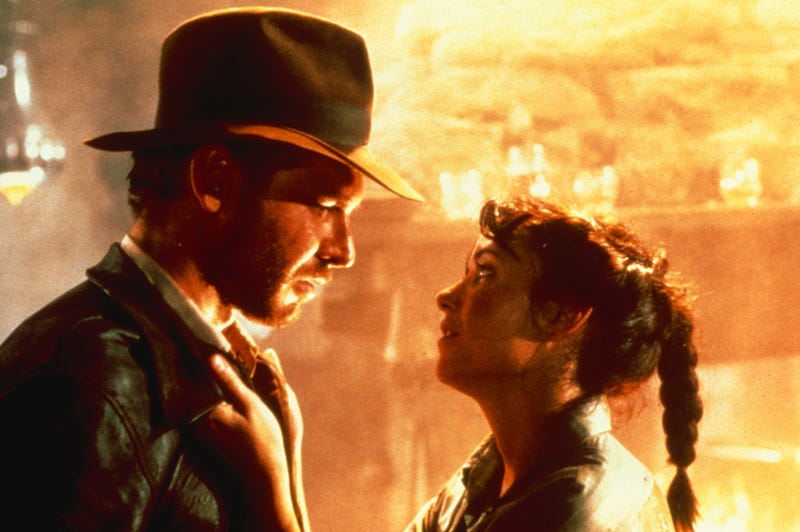
It’s well known that Tom Selleck was originally the top casting choice to play Indiana Jones, but these days it’s impossible to imagine anyone other than Harrison Ford in the iconic lead. Karen Allen more than matches him as spunky love interest Marion, John-Rhys Davies is great as Indy’s friend Sallah, and Paul Freeman is splendid on villain duties, playing rival archaeologist and Nazi collaborator Belloq. Rounding out the key roles in the cast are Ronald Lacey and Wolf Kahler as sadistic Gestapo agent Toht and Nazi Colonel Dietrich, and a small role for Denholm Elliot playing museum curator Marcus Brody (a role that would later be expanded for comedic effect in Indiana Jones and the Last Crusade).
Spielberg and Lucas struck a lucrative deal with Paramount to make the film, with Lucas getting a story/executive producer credit and Spielberg on directing duties. By the time the film went into production, Spielberg needed to rediscover his mojo, having just made an expensive box office flop, 1941. Lucas insisted on a strict, B-movie approach to the shoot, ensuring maximum money on the screen, and minimum time wasted. He and Spielberg had additional motivation to stay on schedule since Paramount had written financial penalties into their contracts if they went over schedule or budget.
As a result, they often improvised when things went wrong, often in hugely memorable ways. The most famous example is the duel between Indy and the Arab swordsman, which was supposed to be the ultimate whip versus sword showdown. When they came to shoot the piece, they were exhausted by the Tunisian heat, and Ford was ill with dysentery. Spielberg decided Indy should simply shoot the swordsman, leading to one of the funniest gags in the film.
The film wrapped ahead of schedule, and, following post-production, was released to great acclaim and audience delight on the 12th of June 1981. Today in an age of CGI, if anything, Raiders of the Lost Ark looks even better, due to its practical stunts and visual effects, and the fact that it already had a period setting. It’s an undisputed classic that stands alongside Star Wars in terms of quality, and in addition to spawning three sequels and a spin-off TV series, influenced everything from Romancing the Stone to High Road to China (which starred original Indiana Jones casting choice Tom Selleck), The Goonies, Young Sherlock Holmes, The Rocketeer, The Mask of Zorro, National Treasure, the 1999 version of The Mummy and a multitude of second-rate imitators.
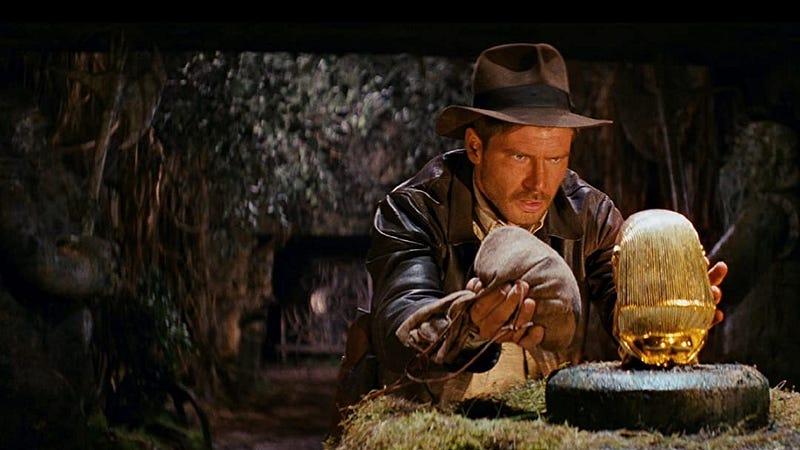
Opening with the finale of a previous adventure, James Bond-style, the initial sequences in South American jungles establishes the atmospheric, adventurous tone, as well as the character of Indy. He isn’t so much a hero as a daredevil grave-robber, flawed by trusting the wrong people. Upon entering a forbidden tomb, a thrilling escalation of spiders, skeletons, deadly spikes, bottomless pits, and poisoned darts ensues, leading to betrayal and near-death by a gigantic boulder. Afterward, he is lucky to get away with his life, following an encounter with Belloq, local tribesmen, and an exhilarating escape via floatplane (punctuated by a hilarious moment involving a python that happens to be in Indy’s seat).
That alone is worth the price of admission, but then we get to the real meat of the film, with Indy hired by US military intelligence to find the Ark of the Covenant before the Nazis. The trail of clues leads to Nepal, and old flame Marion. From that point, there really is no let-up. Spielberg and Lucas’s rattling rollercoaster alternates between gripping scenes of scholarly deduction (the inscription on the medallion, the map room), and rip-roaring action scenes (the fiery bar fight, the fight/chase in Cairo, and the fight by the plane).
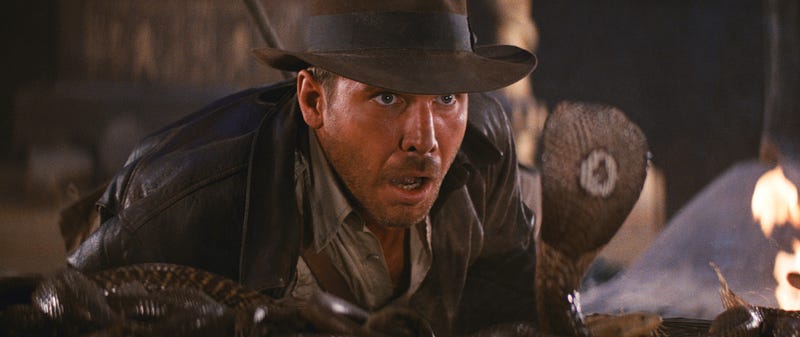
The hair-raising snake pit sequence remains a particular highlight and looks all the more remarkable considering they had to use real snakes, including venomous cobras. Better still, the stunts in the stand-out truck chase are also real, thanks in no small part to the excellent efforts of stunt coordinator Vic Armstrong. It remains one of the single greatest action sequences ever committed to celluloid. These days, both the snake pit and the truck stunts would have been achieved with CGI, but they wouldn’t have the same dirt-under-the-fingernails sense of danger.
There are also more laughs in Raiders of the Lost Ark than many alleged comedies. From one-liner quips (“I’m making this up as I go”) to gags including an unfortunate mirror/head interface on a ship, and a moment involving a Gestapo coat-hanger (which arrives at the back end of a scene where a wily Marion tries to get Belloq drunk). Where else are you going to see a monkey perform a Hitler salute?
Yet Raiders is never spoofy. The quest has a genuine sense of weight and conviction, especially given the supernatural nature of the Ark, and the obsessiveness with which both Indy and Belloq pursue it. “I am a shadowy reflection of you,” Belloq taunts. “It would take only a nudge to make you like me. To push you out of the light.” Indiana Jones has a dark side, and it is explored most memorably in this film. In the sequels, he is a much more straightforward hero, but here he twice abandons Marion in his obsessive pursuit of the Ark.
The finale is another astonishing set-piece and briefly pushes the film into horror territory. The Nazis open the Ark and are struck down by the wrath of God, Old Testament style. No child who saw Raiders of the Lost Ark at the cinema will ever forget the moment when Indy and Marion wisely opt to keep their eyes shut, whilst the villains have their heads shrink, melt, and explode in spectacularly bloody style. Speaking of which, the film pushes the PG certificate right to the limit but gets away with it because the villains are Nazis. That’s why Spielberg and Lucas could have them shot, stabbed, burned, run-over, and chopped up by airplane propellers before God even gets a look-in.
When God finally turns up on the scene, the film is clearly informed by biblical stories such as the coming of the Angel of Death during the Egyptian plagues, the destruction of Sodom and Gomorrah (Indy and Marion not looking is significant), and the moment when after the cataclysm, the ropes binding them have been burned away, yet they are unharmed, echoing the tale of Nebuchadnezzar’s fiery furnace.
It’s worth adding that John Williams’s legendary music score is at the peak of its power in this sequence, not for the instantly recognisable main theme, but for the epic, mystical, choral Ark theme that builds to a stunning crescendo. As Spielberg remarked, nothing is scarier than the Old Testament God. Absolutely fantastic stuff.
The epilogue, as the Ark is secretly hushed up in Area 51, has a satisfying irony, given it will probably remain undiscovered for several thousand more years. Unlike Hitler, perhaps the US authorities weren’t foolish enough to think they could use God as a weapon. Or perhaps they were? The gruesome deaths of the villains do look rather like death by nuclear blast-wave, after all. Could research into the Ark have had a bearing on the Manhattan project? Are nuclear weapons a reverse-engineering of God’s wrath?
Such interpretations would doubtless be discouraged by Spielberg, Lucas, and Kasdan, who never set out to make anything deep. However, they did set out to make something that sent excitement levels through the roof. In that respect, they succeeded admirably. Forty years on, Raiders of the Lost Ark remains the greatest adventure film ever made, and I will brook no argument with that.
Author’s note: I hope you enjoyed this article. For more about me and my writing, please click here.


