Star Wars: The Most Exhilaratingly Heroic Music Score in Cinema History
The heroic dreams of my childhood were scored by the genius of John Williams.
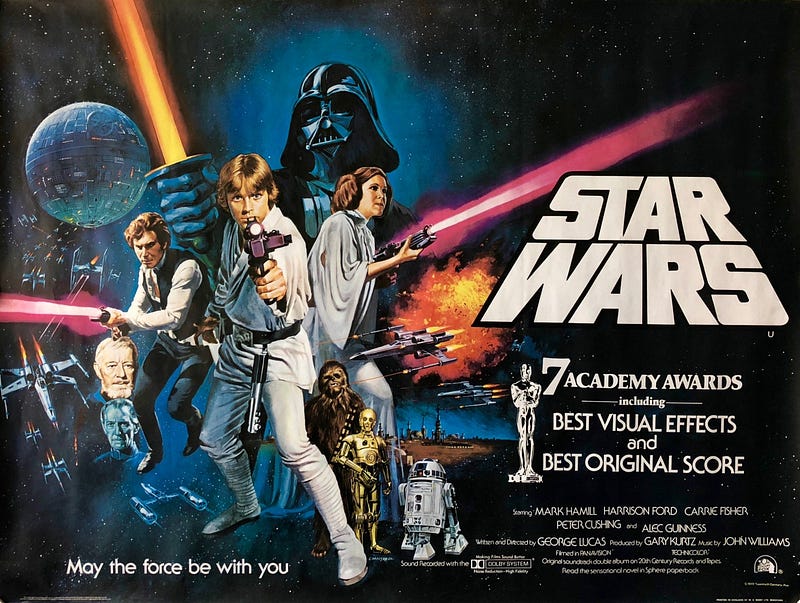
Writing an article on John Williams’s magnificent, Oscar-winning music for Star Wars feels daunting. That’s as it should be, for calling this score beloved or revered is like saying it’s a bit nippy at the north pole. It is also one of the bestselling orchestral soundtracks of all time, and an influential landmark in film scoring so embedded in popular culture that attempts at a fresh perspective seem foolhardy.
Nonetheless, that is what I am attempting in this article, a glance through ten key tracks from the score to the original 1977 film, Star Wars. I still can’t bring myself to call it A New Hope, even though that episode subtitle appeared on all post-1978 prints. Growing up, the Star Wars films meant Star Wars, The Empire Strikes Back, and Return of the Jedi. One didn’t call this Episode IV or A New Hope, despite the inconsistent logic, and I can’t be bothered to start now.
I am assuming everyone reading has seen the film. If not, be warned this article will have no regard for spoilers. For anyone who hasn’t seen it, you have two options: 1) Sell yourself to a museum as an exhibit. “Person who hasn’t seen Star Wars” would draw quite a crowd as an exceptionally rare find. Alternatively, 2) Watch George Lucas’s groundbreaking classic, and discover why this landmark piece of space fantasy exhilaration has captured the imaginations of multiple generations, epitomising the heroic dreams of childhood, set to a thunderingly brilliant score by the peerless John Williams.
Here then are ten splendid selections from this out-of-body-experience brilliant musical extravaganza.
Main Title
At test screenings, audiences cheered the moment the main title blasted from the cinema speakers. Why? How could they possibly have known what they were about to watch? My only theory is that Williams’s main theme — in my opinion, the single most thrillingly heroic anthem in cinema history — has that extra-dimensional magic inherent in all the very best music, as a kind of universal language. It communicated the sheer excitement about to be unleashed. The audience responded at an instinctive level and cheered.
Imperial Attack
This piece begins with an exhilarating recurring motif that peppers this film (and crops up occasionally in subsequent films). It scores the opening Imperial Stormtrooper assault on the Rebel soldiers, as well as the menacing initial appearance of Darth Vader, the capture of Princess Leia, and the escape of the droids, RD-D2, and C-3PO. Just as Lucas throws the audience into the middle of an ongoing story, so Williams wastes no time with his propulsive thrills, underscoring to viewers that they had been dropped into an archetypal, mythical tale of good versus evil.
The Little People Work
A fun, playful piece that scores the capture of the droids by the scavenging Jawas. In some ways it mines territory later returned to with the Ewok theme (in Return of the Jedi) but it also has a slightly sinister and dangerous edge. The Jawas aren’t exactly cute, for one thing.
The Princess Appears
Here the Princess Leia theme is introduced, in the scene where Luke Skywalker discovers her hidden message to Obi-Wan Kenobi inside R2-D2. The track segues into the famous binary sunset music, which features a full orchestral workout for the Force theme, in one of Luke’s most iconic scenes. The music and the scene are so intertwined it is impossible to imagine one without the other.
Cantina Band
John Williams’s father played in a jazz band. Here Williams shows his roots in this clever and amusing detour from the main score with an alien jazz band. It features a number of clever instrumental innovations, including steel drums. Incidentally, indie rock band Ash covered this track as the B-side to their 1995 single Girl from Mars.
Inner City
“That’s no moon. It’s a space station.” Obi-Wan Kenobi’s ominous warning is at first disregarded by a sceptical Han Solo, but the old Jedi Knight is not wrong. Our heroes are caught in a tractor beam and sucked into the gargantuan mechanised planet killer. The thunderous Imperial Attack motif appears again. Excitement levels go through the roof. The second half of this track jumps back to earlier in the film, with Obi-Wan’s first scene, after the attack of the Sand People.
Rescue of the Princess
A blast of pure excitement, featuring various scenes from the Death Star. These include the shootout in the cell block, as well as Luke and Leia’s heroic swing across the chasm. The latter features a dynamite use of the main title, perfectly encapsulating the escapist, swashbuckling, Saturday matinee tone of the entire picture.
Ben’s Death and TIE Fighter Attack
The lightsabre duel between Darth Vader and Obi-Wan Kenobi comes to a tragic climax, as the old Jedi Knight heroically lays down his life so Luke and the others can escape the Death Star. But there’s no time to mourn his loss, as the Millennium Falcon is attacked by a swarm of TIE fighters. This track again emphasises thrills, thrills, thrills, in the way only John Williams can.
Princess Leia’s Theme
This is a fabulous concert arrangement of the Princess Leia theme. It doesn’t feature in the film in this form, but it is superb to listen to, and to my mind, this theme is the heart of the first Star Wars score.
The Last Battle
I’m running out of clever ways to say the music is thrilling. Just listen to it! This piece incorporates some more elements of the Death Star escape, as well as several pieces of the spectacular final Death Star battle. Rebel and Imperial ships slug it out in a war of attrition, with heavy casualties on the Rebel side, until Luke is their only hope. There are many dramatic peaks in the music, with Williams’s music again fitting the images like a glove. All appears lost, but the ghostly voice of Obi-Wan Kenobi urges Luke to “use the Force”. Han Solo returns at the last minute to rescue Luke from Vader. The Death Star is destroyed. Cue thunderous audience cheering and applause.
Bonus: Throne Room and End Title
The finale, as our heroes are rewarded for their bravery in a medal ceremony, features an appropriately triumphant march that segues into the end credits. Millions of children across the world emerged from cinemas having had their minds and imaginations blown, and their lives changed forever. It was simply the beginning, and so is this article. I’ll return soon with my thoughts on John Williams’s score for The Empire Strikes Back.
Author’s note: I hope you enjoyed this article. For more about me and my writing on Medium, please click here. For information on my writing outside Medium, please click here. For a list of my published novels and other works, please click here.


