
My Favorite Films from Every Year I’ve Been Alive (Part One: 1966–1979)
I did it with albums, so why not movies?

I recently completed a series on my favorite albums from every year I’ve been alive. It was a lot of fun, and I’ve especially enjoyed seeing the articles by other writers who took up the prompt. Sadly, no articles have been forthcoming from my good friends Simon Dillon and Eric Pierce, probably because they write about movies far more often than about music. Which got me thinking…
If I could do such an insane, decades-spanning compilation of my favorite albums, why could I not do the same with my favorite movies? Surely that would draw a response from Simon and Eric; it might throw Simon into an existential crisis, having to choose just one favorite from some of these years, but no guts, no glory.
As with that series on my favorite albums, I am breaking this into multiple parts mainly because of the stupid number of years I’ve been wandering this big blue rock. This is also not a list of the “greatest” film from each of these years, but rather my own personal favorite. There will be times the two are the same (1972 comes immediately comes to mind), but usually my favorite will not be the critics’ choice. And you will surely disagree with some of them; that’s half the fun.
As a side note before we go any further, I have to say that I blame my mother for the fact that I was not born three years earlier and am thus unable to include the 1963 Steve McQueen classic The Great Escape here. I will, however, include a picture of the King of Cool from that film regardless. You’re welcome.
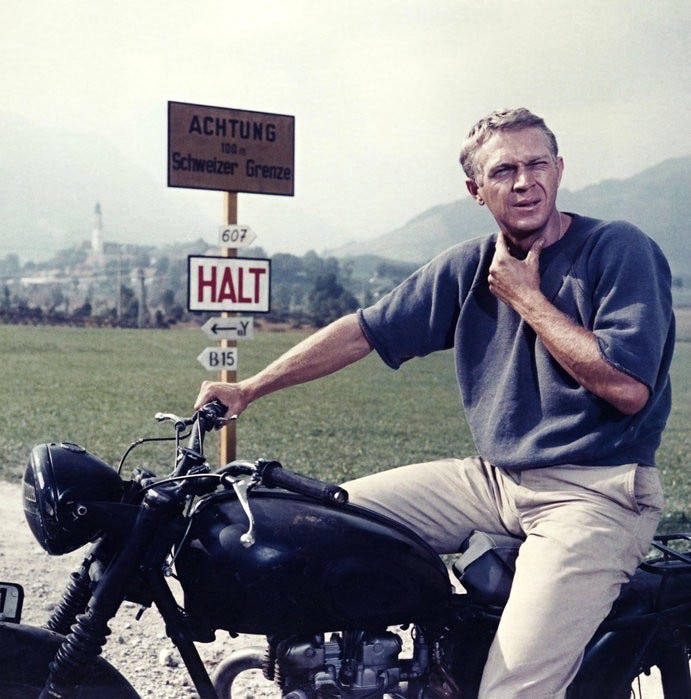
Now on to the list.
1966: A Man for All Seasons. The story of Sir Thomas More’s conscientious stand against England’s King Henry VIII is worth watching for Paul Scofield’s performance alone; he won an Oscar for the film and a Tony award for his portrayal of the same role on the stage, and deservedly so. The supporting cast is stellar as well, with Orson Welles, Susannah York, a young John Hurt, plus a sometimes comically unhinged take on Henry VIII by Robert Shaw. Rarely is a historical drama done so flawlessly.
1967: The Jungle Book. Yes, even 55 years later. Ahead of Cool Hand Luke and Bonnie and Clyde? Again, yes. Do I still cry every time I think Baloo is dead, even though I know he’s not? Of course I do, and if you don’t you are a heartless monster.
1968: Hellfighters. I expected there to be more John Wayne films here, but his best came before I was born and those that didn’t usually get bumped by something superior (as with 1969). This fictionalized account of the life of legendary oil well firefighter Red Adair is classic Wayne, with regular supporting cast members like Bruce Cabot and Edward Falkner and new additions Katharine Ross and the excellent Jim Hutton. Because it came between the better-known The Green Berets (also 1968) and True Grit (1969), this one usually gets overlooked. It shouldn’t.
1969: Butch Cassidy and the Sundance Kid. My undying love for this greatest of all buddy films (and my favorite Western) is well documented; the chemistry between Paul Newman and Robert Redford alone makes this one of the greatest films ever. It’s also got some of the best dialogue ever heard onscreen: “I’ve got vision and the rest of the world wears bifocals,” “You just keep thinking, Butch. It’s what you’re good at,” and my all-time favorite, “Think you used enough dynamite there, Butch?” The cinematography is breathtaking, and the final scene is one of the most iconic in movie history.
1970: Patton. This film is my favorite from 1970 for a reason far beyond its brilliance: it was the first war movie I watched with my grandfather (even before The Longest Day) when I was a kid. Many John Wayne Westerns preceded them, but as for war pictures I will always treasure this one because of its connection to my granddad. That this film features George C. Scott’s most iconic role obviously doesn’t hurt, and Karl Malden often steals the show as Gen. Omar Bradley.
1971: The Abominable Dr. Phibes. I seriously considered Billy Jack for this year, but I haven’t re-watched that one in more than 20 years. Instead, the spot goes to the only horror film in this first installment, and how could I go wrong with Vincent Price? The film deftly chronicles a disfigured organist’s quest for revenge against the surgeons he blames for his wife’s death. That he murders the surgeons with elaborate methods based on the biblical plagues from the Book of Exodus is an added bonus.
1972: The Godfather. This is not just my favorite film of 1972; it’s my favorite of all time. It is also the greatest of all time, and if you disagree you are both wrong and clearly not Italian. It is the greatest gangster film (yes, better than Goodfellas), a slice of Italian-American family (small f) life, and a fine Christmas movie as well. I may just stop writing this and go watch it again, and if so, I will scream at Sonny to stay off the causeway, just like I do every time.
1973: American Graffiti. Four years before he took us to a galaxy far, far way, George Lucas directed one of the best slices of Americana ever committed to film. Over one fateful night in Modesto, California in 1962, we get multiple converging storylines featuring future stars like Richard Dreyfuss, Ron Howard, Cindy Williams, Harrison Ford, Paul Le Mat, Charles Martin Smith, Candy Clark, Mackenzie Phillips, Bo Hopkins, Suzanne Somers, and Kathleen Quinlan. We also get one of the best movie soundtracks ever. And Wolfman Jack (“have a popsicle”).
1974: The Godfather Part II. Many critics consider this a better film than The Godfather, and it’s a reasonable argument given that we get Robert De Niro as a young Vito Corleone. For me, The Godfather is still better by a nose, but this one crushes anything else from 1974. That Al Pacino did not win an Oscar for his portrayal of Michael Corleone is further proof that the Academy is full of idiots.
1975: The Man Who Would Be King. All I really need to say about this film is this: Sean Connery and Michael Caine in their prime in a film directed by John Huston that is an adaptation of a story by Rudyard Kipling. It’s the story of two British soldiers in 1880s India who set off to become kings of Kafiristan (in modern-day Afghanistan) that Huston had been trying to make for 20 years, with potential pairings of Clark Gable and Humphrey Bogart, Kirk Douglas and Burt Lancaster, Richard Burton and Peter O’Toole, and finally Paul Newman and Robert Redford all failing to materialize over the years. Luckily for us, Paul Newman suggested Caine and Connery as the right duo, and Huston agreed. I must admit that I was sorely tempted to list Born to Run as my favorite film of 1975 (it’s that cinematic), but I will show some restraint.
1976: Rocky. The endless (and inferior) sequels have made people forget just how great this film about journeyman boxer Rocky Balboa’s improbable shot at the heavyweight title truly was. Hell, it made me want to learn how to box, a terrible idea both then and now. The only downside is that Bill Conti’s “Gonna Fly Now” has been played non-stop ever since.
1977: Star Wars. Yes, I realize that the official title now is Star Wars Episode IV — A New Hope, but if you were an eleven-year-old kid in 1977 (as I was), it was just Star Wars. And it was mind-blowing. Kids raised on CGI will never understand just how incredible that opening shot of the Imperial Star Destroyer was; we had never seen anything like it before, just as we had never encountered a villain quite like Darth Vader, still the best Star Wars character 45 years later.
1978: National Lampoon’s Animal House. I snuck into this John Belushi classic at 12 years old (I was big for my age and looked older than the guy working the ticket booth), and that move remains the most successful con of my life. I foolishly believed college life would be like this (it wasn’t), but it did give me a line I quote to this day:
1979: Meatballs. I’ve written about this one before, as well as my love for all things Bill Murray. Murray is perfect as a crazy summer camp counselor, the supporting cast is surprisingly solid given the low budget, and the writing is what you would expect from a team that included Harold Ramis. We had seen glimpses of what Murray would become on the early Saturday Night Live skits, but Meatballs truly is the first book in the Bible of Bill. His “It just doesn’t matter” speech is easily the greatest motivational speech I’ve ever heard:
That’s my favorite films from the first decade and a half of my time on this planet; tell me some of yours in the comments, or better yet, take up the challenge and write an article of your own. Next time, we venture into the glorious 1980s, which was almost as good a decade for movies as it was for music. Until then, turn off those cell phones while the feature is playing.
If you enjoyed this story, you can support my writing directly by joining Medium here. You’ll get access to all of my articles (including my weekly rants and numerous Springsteen stories) as well as those of all the other great writers here. You can also get my articles in your inbox by subscribing here.