Blade Runner: 40 Years On
Ridley Scott’s science fiction masterpiece remains intriguing, visually stunning, and emotionally enigmatic.
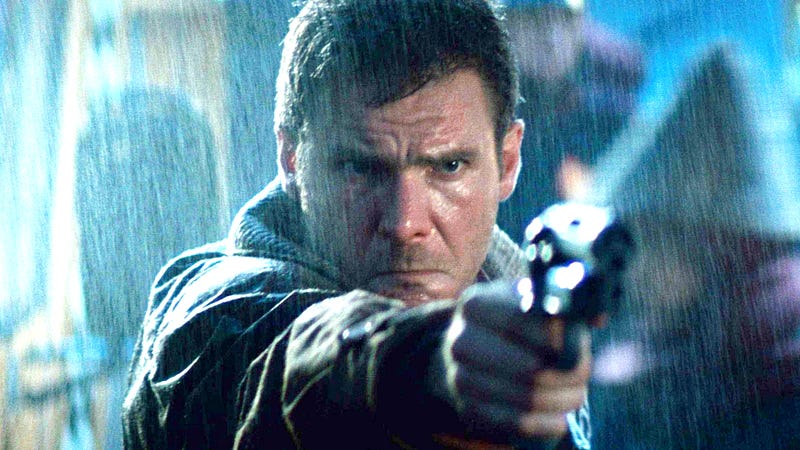
NOTE: Contains spoilers.
This year marks Blade Runner’s 40th anniversary. The question is: What more can I say about it? For decades, I have written regularly of the magnificence of my favourite science fiction film of all time. Can I hope to add fresh perspective to the wealth of essays, reviews, and analysis currently out there?
The answer is probably not. Nonetheless, in view of this anniversary, I feel obliged to say something, if not necessarily anything particularly new, about this truly singular piece of work. Adjectives such as groundbreaking and influential don’t begin to do justice to the shadow Blade Runner casts over the history of science fiction. If for some unfortunate reason you have not seen the film, stop reading now, as this article will have no regard for spoilers.
When Blade Runner, an adaptation of Philip K Dick’s novel Do Androids Dream of Electric Sheep? was first released in 1982, it was not well received. Panicked studio executives baffled by Ridley’s Scott’s extraordinary vision insisted on cutting key scenes, adding an explanatory voiceover, and tacking on a ludicrously inappropriate happy ending. Despite such measures, audiences stayed away in droves and the critics were indifferent at best.
However, throughout the 1980s, Blade Runner acquired a cult following on video. I first saw it in this format, and despite being damaged goods, I could immediately tell the film was a blatant masterpiece. The plot — in the near future, an elite “Blade Runner Unit” policeman tracks down and kills rebellious escaped slave androids called replicants that have developed emotional responses — proved a mere hook on which the lavish visual experience hangs. What most impressed me was the imagery. This is a film to wallow in, to lose oneself in, especially on a big screen (I have since seen it four times at the cinema during various re-releases). Expressions such as visually astonishing seem pathetically inadequate when describing Lawrence G Paull’s rain-drenched noir production design. It practically invented the cinematic dystopian future; or at least popularised it beyond Fritz Lang’s Metropolis, an undoubted influence.
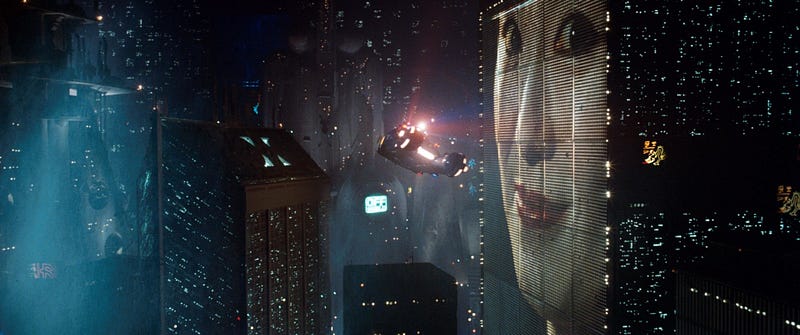
Critical reappraisal finally occurred in the early 1990s, with the release of a director’s cut in 1992 that removed the voiceover and happy ending. More importantly, this cut restored the legendary unicorn dream sequence, which allows for a much more interesting interpretation of the plot. However, Ridley Scott still wasn’t entirely satisfied with this version, so tinkered with it a little more, eventually releasing the so-called “Final Cut” in 2007, which he considered definitive. This version makes a few judicious trims, polishes a few key images with subtle VFX tweaks, and restores some of the bloodier violence that had previously been cut.
Some have accused the performances of being distant and cold, and that is deliberate, but I find that to be a most superficial reading of what is in fact a profoundly emotional film. The way the replicants are overwhelmed by their newfound emotions and try to learn how to respond to them is what gives the film its incredible poignancy and quiet power. It is also perhaps the reason the film has endured the way it has. Consider, for instance, the way Roy (Rutger Hauer) and Pris (Daryl Hannah) awkwardly kiss, mimicking human behaviour.
Blade Runner is a film about loneliness, that most frightening of human conditions. In this world, everyone lives alone except the replicants, who band together trying to find some meaning to life. The hoary old what-does-it-mean-to-be-human quandary lies at the core of all great science fiction, but Blade Runner asks more specific questions. What does it mean to have feelings? To have a soul? Does that give you moral responsibility? What does it mean to meet your maker?
The scene where Roy meets his maker Tyrell (Joe Turkell), lashing out against the irresponsibility of a god that cannot fix his creation, remains a dramatic and gruesome musing on the potential dangers of AI technology. There is something childlike and heartbreaking in the way Roy subsequently weeps over the bloodied corpse of Pris, recently gunned down by Deckard (Harrison Ford) during the finale. Essentially the replicants are children, and the cruelty with which they are dispatched is deliberately designed to leave the viewer reeling and confused. It is, for instance, impossible to imagine even the most morally depraved audience cheering when Deckard shoots Zhora (Joanna Cassidy), as she smashes through endless panes of glass in slow motion. Roy challenges Deckard, and by extension the viewer, when he says: “I thought you were supposed to be good? Aren’t you the good man?”
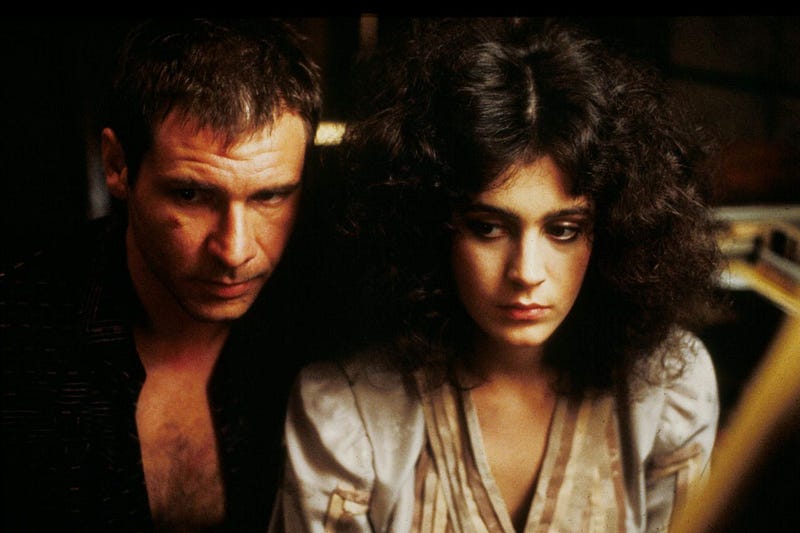
And therein lies the rub. Is Deckard a man at all? Or is he, like Rachel (Sean Young), unknowingly a replicant? I won’t get into that unending debate here (in my opinion, he is), but another thing that makes Blade Runner an endlessly fascinating experience is watching two machines — Deckard and Rachel — developing emotional responses, discovering their implanted memories are false, and nevertheless falling in love. The moment where Deckard seems, for a moment, to force himself on Rachel has been criticised as essentially a rape scene by some. Perhaps, but I think it is slightly more emotionally complicated. Again, that entire scene simply shows two machines overwhelmed by the feelings they have developed, and as such, they aren’t entirely sure how to respond, or if they can even trust said feelings. The scene has a deliberate awkwardness. Framed in that context, it is simultaneously disturbing and oddly poignant.
Then we come to Roy’s justly famous “tears in rain” speech (written by Hauer himself). It’s difficult now, so many viewings later, to recall the initial impact and surprise of Roy deciding to save Deckard’s life at the last minute, but no matter how many times I watch, it remains an incredibly powerful, almost unbearably sad scene. The “I’ve seen things you people wouldn’t believe” speech is celebrated and endlessly quoted, but it is also the visuals that burn so vividly in the memory. The imagery of Roy’s falling head, releasing the dove, scored by Vangelis’s remarkable music, remains one of cinema’s greatest moments.
Blade Runner needs to be seen on the big screen, so if you haven’t, I strongly urge you to make that effort, as there are bound to be anniversary screenings this year. The belated sequel — Denis Villeneuve’s admirable but ultimately superfluous Blade Runner 2049 — feels like fan fiction in comparison, and I doubt it will be considered more than a curiosity four decades from now. By contrast, I suspect Ridley Scott’s peerless original will, if anything, feel even more timeless. Endlessly intriguing, visually staggering, and emotionally enigmatic, Blade Runner is a genuine all-time classic.
NOTE: This is a revised version of an article originally published on Simon Dillon Books.
Author’s note: I hope you enjoyed this article. For more about me and my writing on Medium, please click here. For information on my writing outside Medium, please click here. For a list of my published novels and other works, please click here.