
Every Three Months?
Our dialysis story — chapter 34
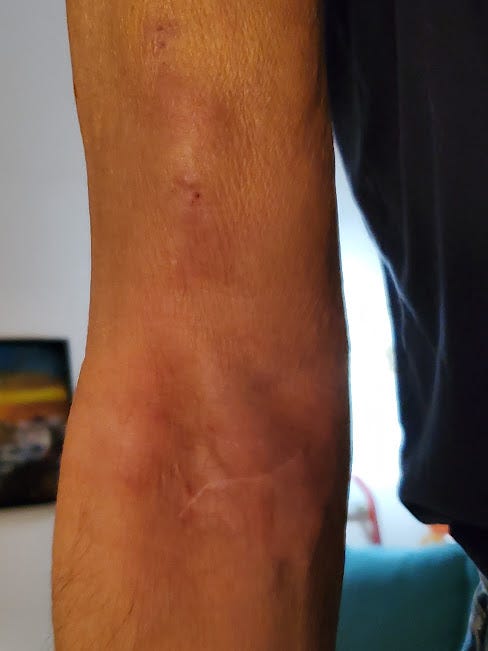
It was happening too often. Ben’s arm wouldn’t stop bleeding after the dialysis needles were removed. He’d lie there for 20 or 30 minutes, holding gauze on the puncture site before his arm could be bandaged.
At home, he’d keep the bandage on until the next morning. Often, when it was removed, the bleeding started again. Not squirts of blood. Not flowing streams. But a steady drip, drip, drip. More gauze, more pressure, more waiting. Once it stopped, a bandaid was sufficient.

After several bleeding issues, the dialysis center sent a referral to the surgeon who treated Ben’s last bleeding issue with angioplasty. That was in August. How could he possibly have another blockage so soon?
This time, it was two blockages, and they were at 80%.
Dr. L:
Most patients experience blockages at some point during their dialysis. Since this is Ben’s second in three months and since it’s a significant blockage and in two places, I expect he’ll continue to have the same problem on a regular basis. Patients like him tend to have blockages every three to eight months.
Not what we wanted to hear.
Dr. L:
Once he has three or more bleeding issues, schedule an appointment for an angiography. Don’t wait for the center to send a referral. The nurses are so busy, they sometimes forget. One quick test and we’ll know if he needs ballooning. I don’t want future blockages to get this bad.
Two hours later, we were home. I removed his post-surgery bandage the next day, and his arm looked good.
Two dialysis sessions later, his arm started bleeding when the bandage was removed the next day, but he hasn’t had an issue since. That counts as one episode; two more and I’ll call the doctor.
One of the nurses recently discussed peritoneal dialysis with him — again — the in-home dialysis I researched back in April — the method we dismissed.
Ben doesn’t remember our discussions or the YouTube videos we watched. In fact, he didn’t remember that peritoneal was the first dialysis offered to him.
The nurse said I can do dialysis at home! Isn’t that great? No more driving to the center. I wonder why no one told us about that before?
He seriously didn’t remember — at all.
I assured him that we knew about PD, that I researched it, and that we discussed it and decided it wasn’t a viable option for our situation.
No, that can’t be. It sounds great.
Luckily, I saved the YouTube videos. I chose one, and within ten minutes of watching, Ben exclaimed:
What?! Are they nuts? Every night? We would have to do all of that every night? Forget about it (said with a thick New Jersey accent layered over an Argentinian accent). That’s much worse than going to the center. Especially for you. I could never do what the guy in the video was doing. It would all be on your shoulders. And no pets in the bedroom? No, absolutely not.
I also mentioned he’d need another operation to insert a tube in his abdomen.
What? No! End of discussion. I’ll tell my nurse that it’s not for us.
I’ve said the same to nurses, doctors, and administrators — multiple times.
After his dialysis yesterday, the center’s administrator came to the lobby to talk to me about moving Ben’s chair time from 11:30 am to 3:30 pm.
It’s about 4.5 hours from the time he arrives until he leaves. A 3:30 chair time means he’d be done about 8 pm. We’d get home around 8:30. I work three evenings a week, and we’re in bed by 9:00 or shortly after. No, a 3:30 chair time isn’t possible. I explained that to the administrator.
She pressed:
We’re trying to move patients to the new third-shift schedule. Can’t you work it out?
I said definitively:
No. As I said, I work evenings. We go to bed early and get up early. A 3:30 chair time will not work for us. I’m sorry, but you’ll have to find someone else to change.

Meanwhile, Ben feels well and walks every day. His toe infection hasn’t returned because he continues wearing the hiking sandals we bought, even though it’s cold and he must wear heavy wool socks with them. Yes, he looks dorky, but that’s okay.
As we age, looking unfashionable is a small price to pay for staying alive.
© Dennett 2023
Our Dialysis Stories: