
Good News — Finally!
Our dialysis story — chapter 26
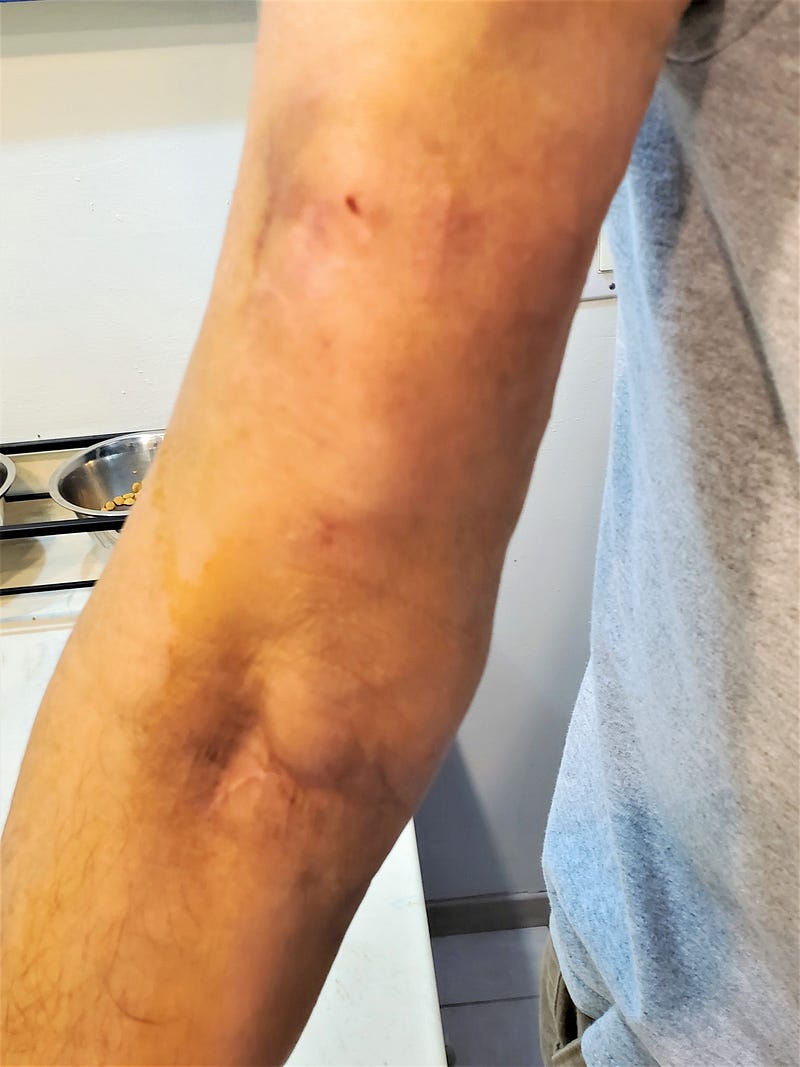
Last Monday, following the angioplasty of Ben’s fistula the week before, the nurses again began using his arm, rather than his external catheter, for dialysis.
He came home with his upper puncture area bulkily wrapped in bandages with instructions to remove the dressing at 8:30 pm. He took the bandaging off at 9:00; immediately, the puncture started to bleed. I cleaned the area and re-bandaged it. The same thing happened at 2 am. When we once again removed the dressing at 9 am, the bleeding had stopped.
I called the doctor who performed the angioplasty. He was out of town. Amy, his nurse, said she’d text him. I didn’t hear back from her or the doctor.
I understand that the external catheter presents a greater risk for infection, but it seems to be a better way to perform dialysis than sticking needles into someone three times a week. When we were first told about the fistula surgery, I imagined a permanent port in his arm. I never thought he’d become a human pin-cushion.
After Monday’s dialysis, the nurse said to leave the bandaging on his arm all night. That worked — no bleeding in the morning.
Hmm, none of that sounds much like good news, does it?
Friday, Ben’s nephrologist visited the clinic, studied all of Ben’s blood work, and instructed the nurses to decrease his dialysis visits from three times a week to two times a week!
That’s not just good news — it’s great news!
Starting today, he goes only on Mondays and Fridays, which will give his arm a much-needed rest, although that’s not the reason for the change. The reason is that Ben’s blood looks very good, partially due to the strict diet I enforce. Also, he does have some kidney function while many patients don’t, requiring them to rely 100% on dialysis.
Dr. E will keep a close eye on Ben’s blood work, but, at least for now, Ben’s results are good enough to spare him four hours of dialysis each week.
While we were at the emergency room in May, waiting for Ben to be admitted to start dialysis, Dr. E came by and met with us. He mentioned the possibility that once Ben started outpatient dialysis, his number of visits per week may decrease. I asked if that happens often. He replied:
No, it’s very uncommon, but not impossible.
I was glad Ben didn’t hear and/or understand Dr. E’s comment. Why give him hope for something that will likely never happen?
Over the last few months, Ben’s asked many times if he will have to do dialysis for the rest of his life. I always reply:
Yes, you will need dialysis for the rest of your life because a kidney transplant isn’t a viable option for you.
I never expected that his dialysis visits would decrease.
After months of stress and problems, it feels so wonderful to receive a bit of good news!

© Dennett 2023
Our Dialysis Stories:


