
It Could Be Worse or Gracious Acceptance?
Our dialysis story — chapter 24
You know those stories — the ones that start with It could be worse. You’re reeling from an accident that totaled your car when a friend says:
It could be worse. My sister’s house was crushed by a falling tree last week. She and her family are living in a motel.
Or, you find out you have breast cancer, and someone says:
It could be worse. Breast cancer is treatable. My cousin has pancreatic cancer. It has the lowest survival rate of all cancers. Doctor gave him three months.
When I was hospitalized after six weeks of constant diarrhea and losing 30 pounds, the diagnosis was food poisoning that led to colitis. A co-worker said:
It could be worse. You could have stomach cancer. My neighbor died of stomach cancer last year.
These people think they are doing/saying something to make you feel better because you aren’t as bad off as their sister/cousin/neighbor. But what sort of callous person would you be if such horrific stories made you feel better?
It could be worse stories only make me feel worse. Now, I not only feel bad about my situation, but I feel bad for your sister/cousin/neighbor or their surviving family and friends.
Thanks, you just doubled my misery.
The story I’m about to tell may seem like another “it could be worse” story, but it’s not. It’s a story of inspiration and encouragement.
Two, maybe three, years ago, a couple moved into a townhome in the circle to the southeast of us. I never met them. Only saw them. They looked to be in their early 50s.
The man would walk to his car around 6:45 am and drive away, presumably to work. He was casually but smartly dressed. An attractive man. Since Syau and I rarely leave the house before 7:30, I only saw him on the mornings when Ben and I had an early appointment requiring us to wake earlier than our normal 7:00.
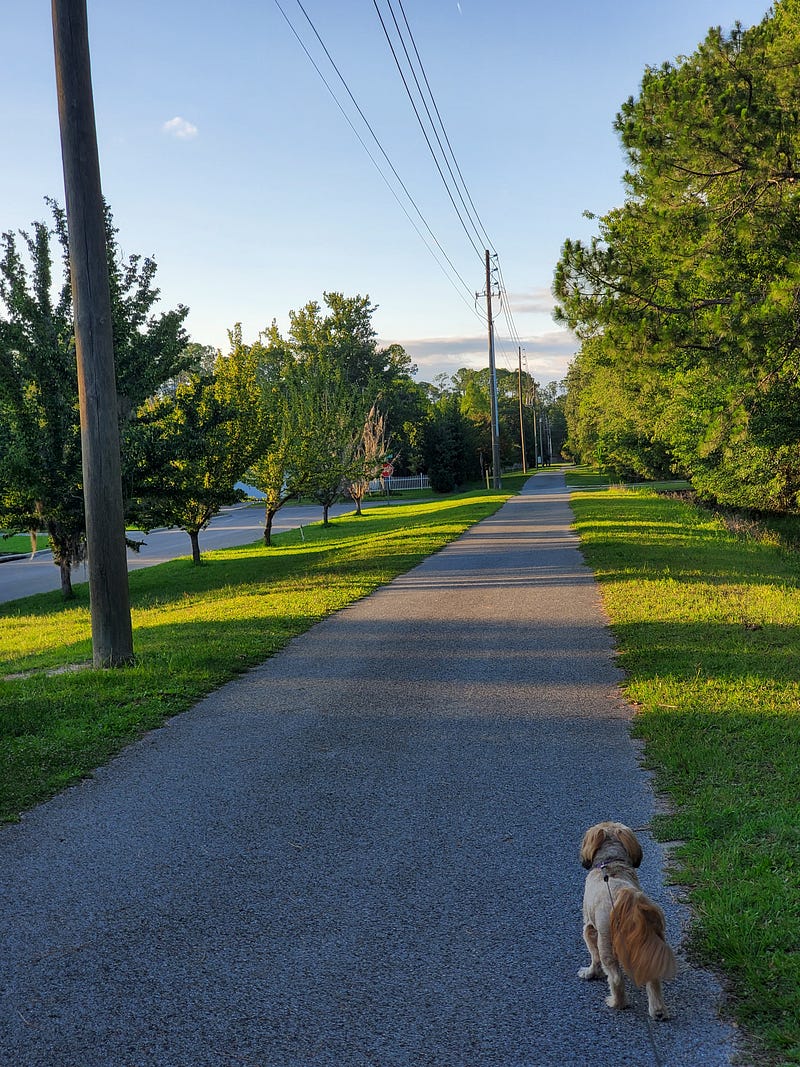
Most mornings, when Syau chose to go in that direction, I would see the wife come out around 7:30, usually wearing a loose-fitting Caftan-style dress. She’d sweep the sidewalk in front of and beside her townhome, often pausing to water her potted plants.
Late last year, I noticed the car wasn’t gone when Syau and I walked at 7:30 am. Then, at the beginning of this year, I started seeing the woman walking to the car dressed in business attire. She’d drive away, sometimes offering us a wave.
I wondered about the man. He seemed too young for retirement. It had been months since we walked early enough to catch him leaving for work. But, come to think of it, hadn’t the car been in the driveway during the day? Did the man move out? Were they divorced, forcing the woman to return to the workplace?
A few weeks later, I saw the man. He was walking with a younger guy who held his elbow. My neighbor’s hand was holding a cane — a mobility cane — the type that blind people use.
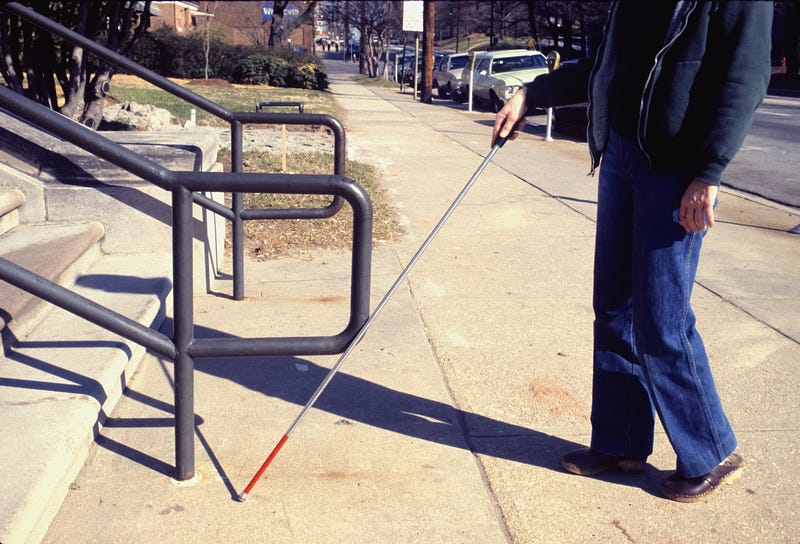
I continued to see the man and the younger guy. At first, they walked up and down the sidewalk along the boulevard. Then, I spotted them walking along streets in nearby subdivisions. Then, on the walking trail. Eventually, the young guy stopped holding the man’s elbow. I watched the man tap-tapping with his cane, learning routes and memorizing turns.
One day they were walking towards me on the trail, and I saw that the man’s eyes were milky white. What happened to his sight? How did this middle-aged man, who appeared to be in excellent physical health, become blind?
I surmised that his walking companion might be his son. Had he come to live with his parents to help his father adjust to being blind? Would he stay?
The answer came a few weeks ago when I began seeing the man walking with just his cane — no young guy with him. Often he was on the walking trail in the morning. Tap-tapping.
It’s easy to ignore a blind person. To pretend they aren’t there. After all, they can’t see us, right? And it’s awkward to encounter someone with a disability. Do you say something or not? What do you say?
I greet everyone I see with a cheery Good morning. People I encounter regularly may warrant a comment about the weather and “Have a good day.”
Why would I treat this man any differently?
I greeted him twice. He seemed surprised but pleased and responded with a warm Good morning.
The third time I hailed him, he paused and turned towards me, saying:
Good morning. Are you the lady with the Lhasa Apso that I sometimes saw walking by my house? You live across the boulevard, correct? Your dog is with you now, isn’t she?
I replied:
Yes, I’m the woman with the Lhasa Apso, and she’s with me now, just as she is every morning.
He smiled:
My name is Michael. Thanks for always greeting me. Most people don’t.
I shared my name and said:
It’s a pleasure to meet you, Michael.
We wished each other a good day and walked in opposite directions.
I didn’t look at Michael and think:
Wow, Ben could be much worse off than he is. He could be blind like this man. I should be grateful that our situation isn’t as bad as what Michael and his wife are experiencing.
No, that’s not what I thought. Instead, this crossed my mind:
What an inspiration Michael is! He doesn’t appear bitter. He and his wife are adapting to their new normal. Michael accepted help until he no longer needed it. Now, he’s out in nature, making the best of a difficult situation.
Michael’s blindness did not make me feel better. How could it? Why should it?
Yes, I have sympathy for what Michael lost, but I also know he’s walking the path of gracious acceptance that we should all walk when our lives take a detour.
That morning, Michael gave me the gift of gracious acceptance.
And that’s much better than another “it could be worse” story that makes me feel worse.
© Dennett 2023
Our Dialysis Story:


