

Packed and Almost Ready
Our dialysis story — chapter 14
As instructed, I prepared an “Evacuation Box” for Ben, although it’s a bag, not a box. It contains a blanket, pillow, change of clothes, and a binder with as much medical and emergency information as I could gather. We also received his medic-alert dog tags that hang on a chain around his neck. He hates them. I wear a necklace 24/7, so I don’t see what the big deal is. I promised him he’ll get used to it.
Packed but not quite ready.
Should a hurricane or tropical storm head our way, I’ll pack another bag with his medications and some food. In the case of a quick evacuation, I may not be able to pack food, but his medications are grab-and-go ready.
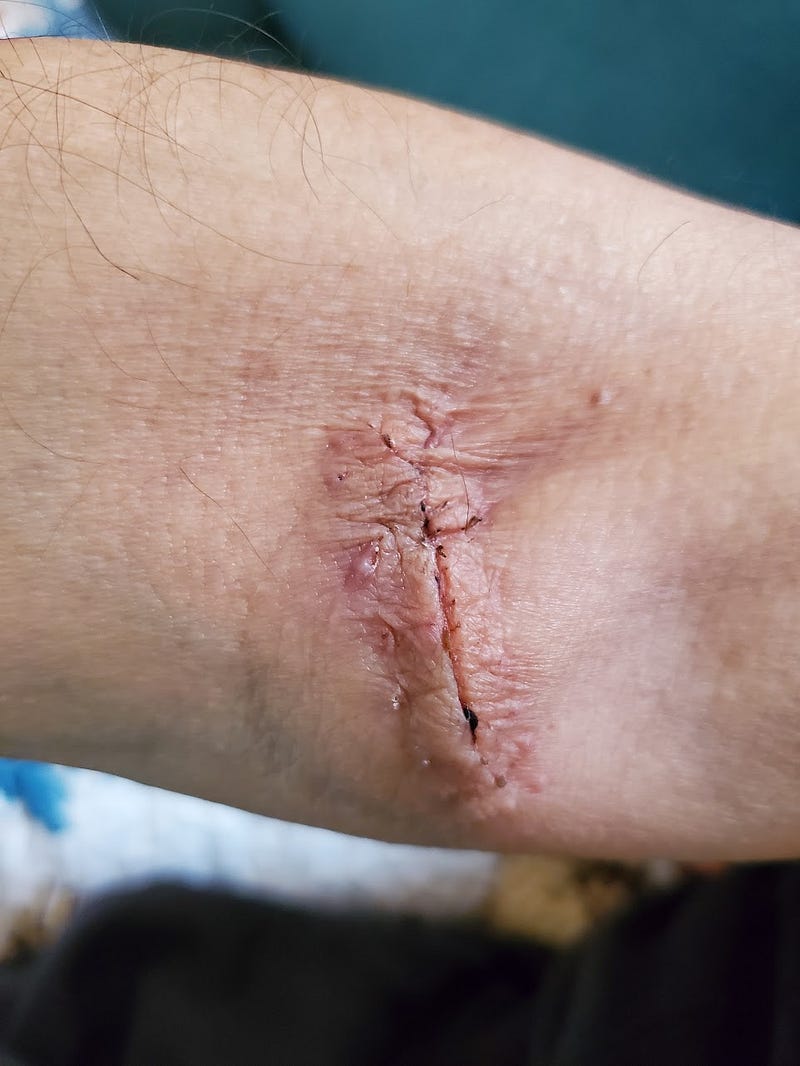
We understood that Ben’s recent surgery was to install a permanent port for his dialysis. His temporary port is a dangling bandage containing dialysis lines inserted below his left shoulder. We knew that the “new port” would be in his arm, but we expected something similar to the temporary port, though smaller, that wouldn’t protrude and hang. We were surprised that all he had was a deep incision in the bend of his elbow, held together with medieval-looking staples. Where was the port?
I thought about taking a photo of the incision and heavy-duty staples for this piece, but I couldn’t bear to look at it. When Ben had an aorta bypass years ago that left a stitched incision stretching down the center of his torso, it didn’t bother me a bit. But I have an aversion to things in arms and hands — needles, IVs, stitches, staples.
When we saw the surgeon to have the staples removed, I asked him about the missing or invisible port. He explained that it was a misnomer to say the operation was to install a permanent port.
There is no port. I joined a vein and an artery to make a strong conduit for dialysis. It’s called an AV fistula, although some incorrectly refer to it as a port.
Horrified, I asked:
So he’ll have to be stuck each time he has dialysis?
The surgeon nodded:
Actually, he’ll be stuck twice. Once for the outgoing blood and once for the incoming blood.
I shuddered. Not what we expected. Fortunately, Ben didn’t hear/understand what we were saying. I said I’d explain later — I didn’t. He’ll learn eventually, and he has no alternative, so why worry him now? He’s far from that point, anyway. He still has more than a month of healing before the AV fistula can be used.
When I picked up Ben from dialysis Wednesday, the nurse said he wanted to disconnect early and thought he might be watching others leaving and feel impatient to leave himself.
He’s usually the last to leave. Maybe it would help to move his chair time to something earlier. Maybe 11:00 instead of 11:45.
I didn’t see how changing his appointment time would matter. His dialysis is for 3.5 hours, no matter when he starts. Besides, I finally have a routine that’s working and a client who allows me to work during Ben’s Friday dialysis rather than on the weekend. She would not be able to accommodate an earlier time.
I don’t see how an earlier start time would matter since he still has to be connected for 3 1/2 hours. We’ve settled into a routine and I have a client on Fridays.
The nurse sighed heavily:
Well, okay, we’ll leave it as is, but he has to understand that he can’t ask to be disconnected early.
In the car, I asked Ben why he asked to disconnect early.
I didn’t! The machine displays the time dialysis is over. Sometimes I get hooked up a little earlier or a little later, so it’s not always the same time. Today the disconnect time was 3:10. At 3:05, the nurses were gathered together, talking and laughing. I was the only patient left, and no one was paying attention to me. The nurse has to get things ready before she disconnects me. She should have been doing those things, so everything would be ready by 3:10. She should have been doing her job! It wasn’t that I wanted to disconnect early. I just wanted to be disconnected at 3:10 so I could leave.
Ah, I saw what was happening — impatience and annoyance that the nurse wasn’t doing what he thought she should do when he thought she should do it. I’d probably feel the same.
I asked if he wanted to change his chair time.
Why? It doesn’t change the amount of time I’m connected. What’s the point?
Exactly.
The nurse thinks you see everyone else leaving and you want to leave, too.
Of course, I want to leave, but I’m not a child being kept in the classroom while everyone else goes to the playground. I know how long I have to be there. What I want is for the nurse to pay attention and be ready to disconnect me on time.
As hard workers ourselves, we both have little patience with those who aren’t as conscientious as we are.
His chair time will remain the same, and he reluctantly promised to be more patient. We’ll see . . . .
© Dennett 2023
Our Dialysis Story:


