
Diagram Explained: Kinds of Cognitive Representation and The FifthWay of Knowing
Creative Diagramming is the fifth way of knowing
In the previous articles, I discussed five themes about knowledge diagrams:
- The theme of “Hierarchy”: The Ecological Formism Approach to Diagrams
- The theme of “Network”: Concept System, Diagram Network, and Knowledge Frameworks
- The theme of “Path”: Activity, Knowledge, and Moving on Diagrams
- The theme of “Concept”: Themes, Concepts, and Situational Diagrams
- The theme of “Space”: Space, Thematic Space, and Activity System +
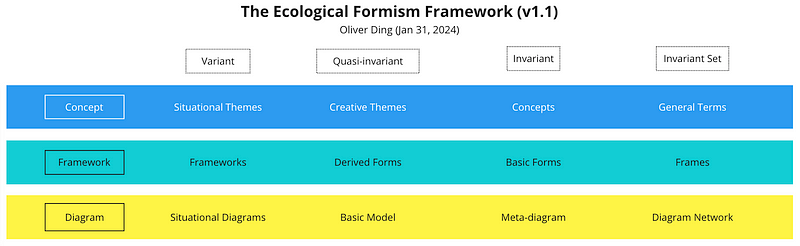
In Diagram Explained: Concept System, Diagram Network, and Knowledge Framework, I used the above diagram to discuss the relationship between the “Concept” level, the “Framework” level, and the “Diagram” level.
What’s the relationship between the “Concept” level and the “Framework” level?
Some “Concept Systems” are developed for understanding some particular activities or social practices, these kinds of “Concept Systems” are called “Knowledge Frameworks”.
All knowledge frameworks are concept systems, but not all concept systems are knowledge frameworks. In other words, Knowledge Frameworks are a sub-set of Concept Systems.
What’s the relationship between the “Framework” level and the “Diagram” level?
Knowledge Diagrams are External Visual Representations of Knowledge Frameworks. There is no strict correspondence between Knowledge Diagrams and Knowledge Frameworks. Some knowledge frameworks can be represented by using tables, not diagrams. Some diagrams such as meta-diagrams are only about spatial structure, not about particular domain knowledge.
This article aims to discuss the theme of “Value” of Knowledge Diagrams.
Why do we use Knowledge Diagrams? What are the unique benefits of using Knowledge Diagrams?
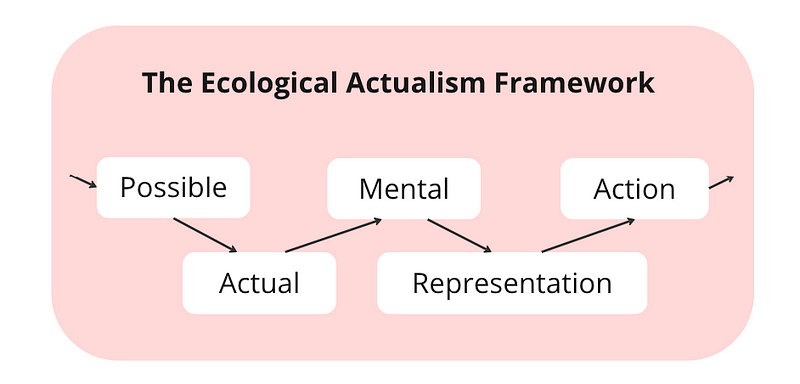
In order to answer this question, I will return to the Ecological Actualism Framework and discuss the value of using Knowledge Diagrams as an Operational External Representation.
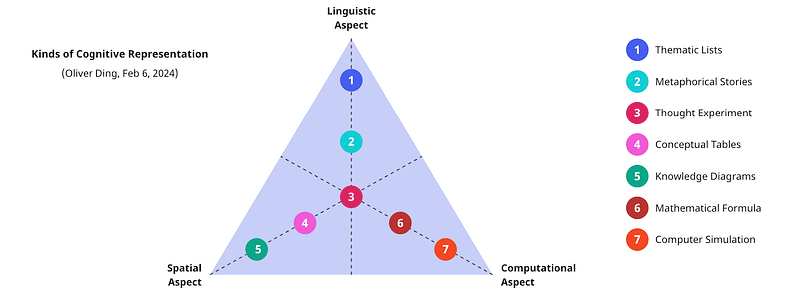
Moreover, I will compare Knowledge Diagrams with other types of cognitive representation.
In this way, I’d like to claim Creative Diagramming is the fifth way of knowing for the Early Discovery of Knowledge Engagement.
Contents
1. The Ecological Actualism Framework
1.1 From Logical to Representation 1.2 From Mental to Action
2. A Typology of Cognitive Representation
2.1 Strategic vs. Operational 2.2 Seven Types of Operational External Representation 2.3 Three Aspects of Cognitive Representation
3. The Fifth Way of Knowing
3.1 The Mediating Instrument Perspective 3.2 The Means-End Spectrum 3.3 A Typology of Knowledge Diagrams 3.4 The D-knowledge 3.5 The Fifth Way of Knowing
1. The Ecological Actualism Framework
I pay attention to two fields: Knowledge Engagement and Product Engagement. Both two fields share the same pattern of developing a concept system. However, they have different complexities in the stage of Continuous Objectification.
For knowledge engagement, a typical objectification of a concept system is a Knowledge Framework or knowledge model. In 2023, I developed the Ecological Actualism Framework to understand knowledge frameworks, knowledge diagrams, and other social practices.
The Ecological Actualism Framework roughly highlights the following moments:
- From Possible to Actual
- From Logical to Representation
- From Mental to Action
- From Make to Use
- From Use to Possible
The Ecological Actualism framework sees a diagram as no longer a static knowledge representation, but a developmental dynamic process.
The process is a dynamic creative territory for exploring, reflecting, and curating.
The core idea of this view is the “Representation — Thematic Space — Perceiver” structure. A user could perceive Graphic Space Affordances of a representation (a diagram) of a knowledge framework, and discover some potential thematic spaces which could lead to new Paths and new Knowledge Frameworks. While we can use it to understand Diagram-in-Use, we can also use it as the theoretical foundation of Creative Diagramming.
You can find more details in Frame for Work: The Ontology of Knowledge Frameworks and Ecological Actualism and Activity, Knowledge, and Moving on Diagrams.
In this article, we will focus on two Representation-related moments.
- From Logical to Representation
- From Mental to Action
1.1 From Logical to Representation
The second moment of the Ecological Actualism framework is the Logical — Representation transformation. We always want to use an external representation to represent our thoughts on a knowledge framework.
Diagrams are a typical external representation of knowledge frameworks. We could also use tables or text-only descriptions to represent knowledge frameworks. The diagram below uses diagrams as an example.
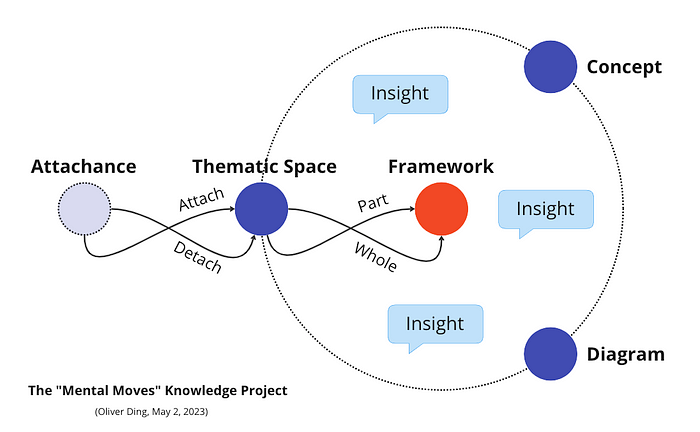
I often associated the concept of “Attachance” with my works of developing knowledge frameworks. I always identified thematic spaces within a particular knowledge framework and emphasized the Attachance of moving between thematic spaces. I also encouraged people to take the attachance of moving between different knowledge frameworks.
Originally, I considered “Concept” and “Diagram” as two significant aspects of knowledge frameworks. I added Thematic Space to the list recently.
This idea only works well for some knowledge frameworks.
You can find more details in Mental Moves #3: Attachance, Thematic Space, and Framework.
1.2 From Mental to Action
The third moment of the Ecological Actualism framework is the Mental — Action transformation. See the diagram below.
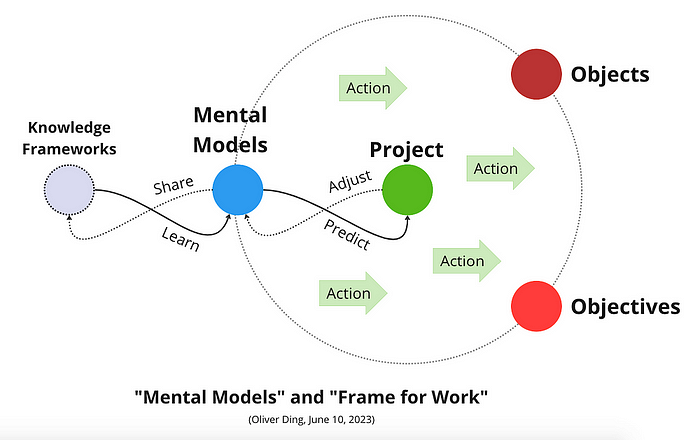
Some authors use “Mental Models” and “Knowledge Frameworks” interchangeably. I didn’t use “Mental Models” in my articles. However, I used “Abstract Models” and “Concrete Models” for the HERO U framework and I used them to describe two types of knowledge frameworks.
In June 2023, I worked on the “Mental Moves” knowledge project and decided to make a distinction between “Knowledge Frameworks” and “Mental Models”:
- Knowledge Frameworks: public objective knowledge
- Mental Models: private subjective knowledge
If we accept this distinction, we see a mediation between Knowledge Frameworks and a Project. See the diagram below.
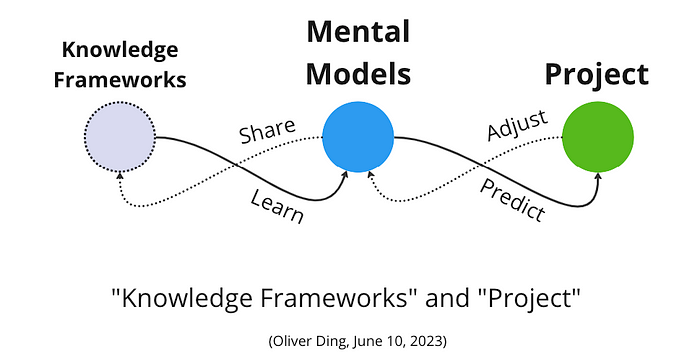
The term “Mediation” can be understood from the perspective of Activity Theory. Lew Vygotsky claimed that human action and psychological functions are mediated by tools which refer to technical tools that work on objects and psychological tools that mediate the mind and environment.
A person has to learn and understand a knowledge framework to use it as a psychological tool for his/her projects. The learned knowledge framework is a mental model which is part of the person’s mind.
Why do we need this distinction? Because we can’t ignore at least the following four facts:
- The learned knowledge framework may not be the actual knowledge framework.
- A person also can curate several learned knowledge frameworks together and turn them into a new mental model.
- A person also can detach several knowledge elements from some knowledge framework and attach them to some mental models.
- A person also can invent his/her mental models without adopting anything from others’ knowledge frameworks.
Since the difference between Knowledge Frameworks and Mental Models is large, I believe the distinction is needed for the Ecological Actualism framework.
You can find more details in Mental Moves #6: Mental Models and the Attachance of Multiple Moves.
2. A Typology of Cognitive Representation
The above discussion made a distinction between “Mental Models”, “Knowledge Frameworks”, and “Knowledge Diagrams”.
In this section, I will offer more details about cognitive representation and develop a typology of representation in the context of using knowledge diagrams. See the diagram below.
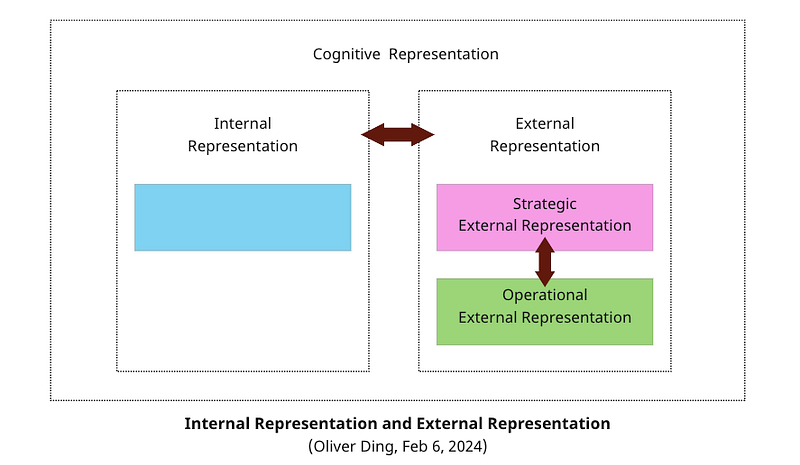
The distinction between “Mental Models” and “Knowledge Frameworks” is guided by the distinction between the category of “Internal Representation” and the category of “External Representation”.
Both “Knowledge Frameworks” and “Knowledge Diagrams” belong to the category of “External Representation”. However, the distinction between “Knowledge Frameworks” and “Knowledge Diagrams” is guided by the distinction between the category of “Strategic External Representation” and “Operational External Representation”.
2.1 Strategic vs. Operational
Why do we need the distinction between the category of “Strategic External Representation” and “Operational External Representation”?
Because one “Strategic External Representation” could be embedded in different types of “Operational External Representation”. Let’s see an example.
In 2020, I developed a knowledge framework called “Infoniche”. See the table below.
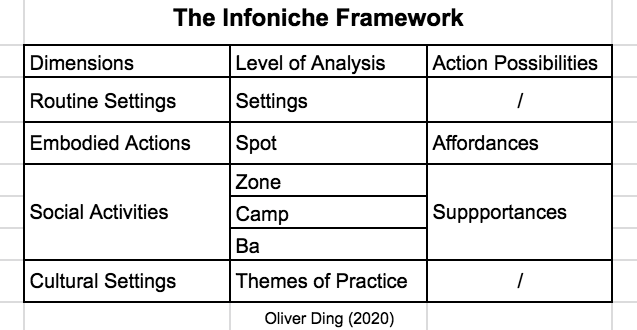
The Infoniche framework is designed with four dimensions and six levels of analysis. I used three steps to develop this framework.
First, I defined two types of dimensions as settings of infoniche. The first one is Routine Settings which refer to various normal settings of material environments (such as houses, tools, cars, mobile phones, etc), individual habits, and institutional norms. The second one is Cultural Settings which refers to ideology, cultural themes, mass media and social media content, etc. These two settings provide a concrete context and an abstract context for a person’s life.
Second, I defined two types of dimensions for understanding a person’s life. The first one is Embodied Actions which refer to individual body scale level actions. The second one is Social Activities which refers to various scales of social activities. The dimension of Embodied Actions corresponds to the analysis of Affordances while the dimension of Social Activities corresponds to the analysis of Supportances.
Third, I defined six levels of analysis based on the four dimensions. For the Routine Settings, I consider it as one level of analysis. For Cultural Settings, I pay attention to one idea called Themes of Practice. The most important part is Embodied Actions and Social Activities because they directly connect to Affordances and Supportances. To conceptualize an analysis framework, I selected a series of terms for this part:
- Spot: the body scale minimal environment.
- Zone: the one-to-one social interactional space.
- Camp: the small group scale of social space.
- Ba: the large scale of social space.
The term Spot refers to a minimal time-space scale environment which is the container of the body-level immediate situational actions. The term Zone refers to a micro social space that contains the dyad, or two-person system of social interactions. The term Camp refers to a connected group of Zones. The term Ba refers to a large scale of social spaces such as a community, a field, a domain, etc.
In 2021, I added a new layer called Project to expand the Infoniche framework. I reorganized Social Activities with a three-level hierarchy:
- Micro level: Zone and Camp
- Mezzo level: Project
- Macro level: Ba
In April 2021, I translated the above table into the diagram below.
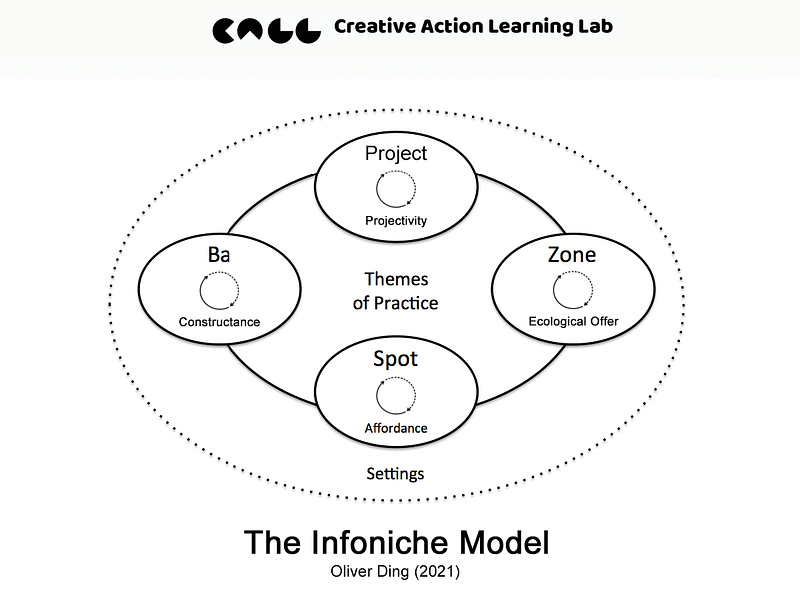
You can find more details in The Infoniche Model.
The above example shows two types of Operational External Representations around the same knowledge framework. The table about Infoniche and the diagram about Infoniche represent the same knowledge framework about the concept of Infoniche.
Table and Diagram are two types of Operational External Representations.
2.2 Seven Types of Operational External Representation
By Separating External Representations into two levels, we can work on more details. See the diagram below.
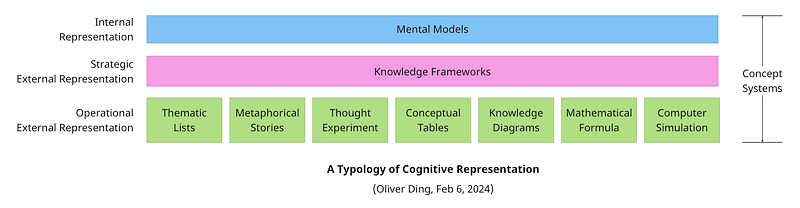
The above typology discovers seven types of Operational External Representation:
- Thematic Lists
- Metaphorical Stories
- Thought Experiment
- Conceptual Tables
- Knowledge Diagrams
- Mathematical Formula
- Computer Simulation
The above discussion shows examples of Conceptual Tables and Knowledge Diagrams. Let’s see other types.
Update: Typology could be the 8th operational representation. However, it could be represented as a Thematic List or a Knowledge Diagram. See some examples in #TalkThree 18: Typology, Typology, and Typology.
Thematic Lists refer to the simplest form of knowledge frameworks without considering the complicated relationship between each theme. For example, I used a list to define seven principles of the Project-centered approach in 2022.
Being by Doing Engagement as Method End as Means Discovery as Development Performance as Experiment Curativity as Creativity Project as Thematic Space
You can find more details in The Life Discovery Canvas (v1.0) — Part 1: Theoretical Background and Life Discovery: Biography, Journey, Program (and a possible book, Part 2)
Metaphorical Stories represent a knowledge framework in a loose structure. In this situation, the knowledge framework is not obvious. We only get a bunch of ideas from a story.
In 2022, I used a metaphor to frame a knowledge framework for modeling a life development program. See the picture below.

I used the above picture to refer to the following metaphor:
Life as Sailing
Life: it is a journey such as sailing at sea.
Boat: social container such as family, team, group, project, company, community, etc.
Sea: social context and social environment.
The model was named Sailor’s Mandala. See the diagram below.
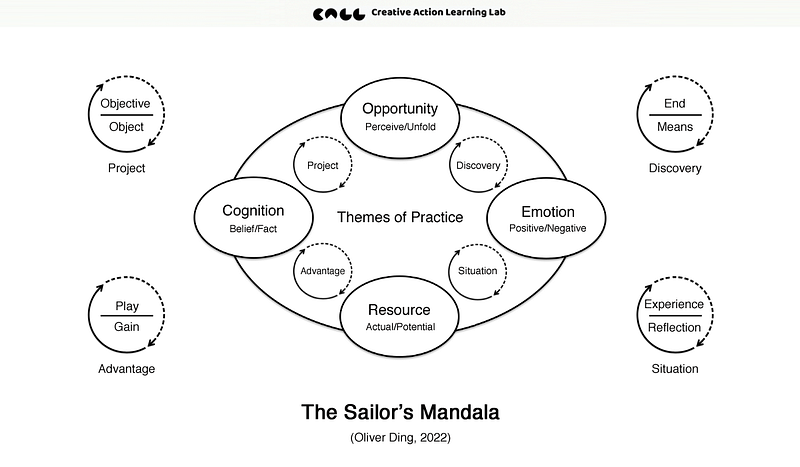
You can find more details in The Sailor’s Mandala: A Life Discovery Framework.
In 2020, I used the “Information as Light” metaphor to translate James J. Gibson’s ecological mechanics into digital settings.
In 2021, I used the “Mind as Play” metaphor to develop a framework for the D as Diagramming project.
Thought Experiments are used by philosophers and other experts. In 2021, I used the picture below to set a thought experiment in order to introduce the concept of Supportance.

Two women are standing on the beach by the sea, carrying a big picture frame. It is a normal sense. How can I use it for theoretical development?
Let’s consider it as a minimal collective activity. There are at least three people here, the two women carrying the frame, and a photographer taking the picture. It is worth noting that any one of these three people is an indispensable component of the activity. Without the photographer, no one comes to take this picture. If there is only one woman, she can’t carry such a big picture frame, thus this shooting activity — taking such a specific photo — can’t be accomplished.
Usually, the story I described could lead readers to the notion of ‘Social Support.’ Traditionally, researchers pay attention to the effect of social support on health, quality of life, and especially mental health. I aim to adopt the ecological practice approach to discuss the notion of ‘social support’ in a broader scope in a general sense.
Suppose there is only one woman and a 3-year-old girl at the scene. The woman can’t hold the picture frame because the little girl doesn’t have enough strength to help her. Thus, the woman should look for potential support from others who could offer such support with corresponding capacities.
The concept of Supportance refers to potential supportive action possibilities offered by a social environment. It is inspired by Ecological psychologist James J. Gibson’s concept of Affordance which refers to potential action possibilities offered by environments. Both two concepts are potential action possibilities. However, the concept of Affordance can be applied to both animals and humans and Gibson uses it for talking about visual perception. In order to discuss potential supportive action possibilities between a person and other people and social environments in general, I coined the term Supportance and developed it as a theoretical concept for the Ecological Practice approach.
You can find more details in The Concept of Supportance.
Mathematical Formulas are used by mathematicians, scientists, engineers, economists, financial experts, and other professionals.
Computer Simulations are computer programs that represent mathematical models to predict a real-world or physical system.
2.3 Three Aspects of Cognitive Representation
We can also compare seven types of cognitive representation. The diagram below uses three aspects to frame a space to discuss the similarities and differences between them.
- Linguistic Aspect
- Spatial Aspect
- Computational Aspect
Both #1 Thematic Lists, #2 Metaphorical Stories, and #3 Thought Experiments rely on words and language in general. While #1 Thematic Lists are more about loose coupling, #3 Thought Experiments are more about precise logic.
Both #5 Knowledge Diagrams, #4 Conceptual Tables, and #3 Thought Experiment emphasize the spatial aspect. While #5 Knowledge Diagrams rely on visual-spatial structure to represent spatial logic, #3 Thought Experiment is more about using language to tell a story.
Both #3 Thought Experiment, #6 Mathematical Formula, and #7 Computer Simulation share precise logic. #6 Mathematical Formula and #7 Computer Simulation require strong mathematical thinking.
This model is not precise. I just want to use it to highlight the differences between these cognitive representations.
3. The Fifth Way of Knowing
In 2021, I developed a framework called the Means — End Spectrum to discuss kinds of diagrams from the perspective of Activity Theory. In 2022, I updated the framework and used it as a typology of knowledge diagrams.
In this section, I will review these frameworks and use a new framework to discuss the value of diagrams and creative diagramming.
3.1 The Mediating Instrument Perspective
Inspired by Activity Theory and the Activity Checklist, I adopt the Mediating Instrument perspective to discuss the diagramming practice and highlight four essential issues for discussion.
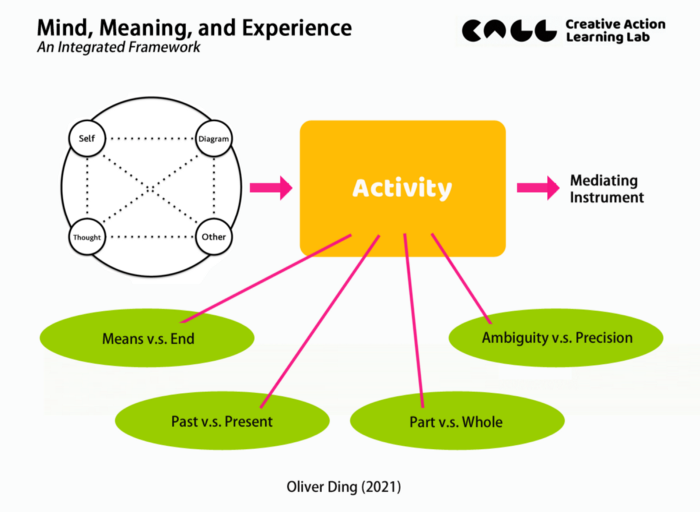
The above diagram shows four issues. Some issues are inspired by Activity Theory, other issues are defined by the “Diagram — Thought” curating practice.
- Means v.s. End: This issue is directly adopted from Activity Theory. However, I am going to discuss a Means-End Spectrum in order to present various instrumental values of diagrams.
- Past v.s. Present: This issue is inspired by the principle of Development, which is an important principle of Activity Theory. I will focus on the evolution of thoughts and diagrams.
- Part v.s. Whole: This issue is inspired by the principle of the Hierarchical structure of activity, which considers a three-level hierarchy: operation — action — activity. I will discuss diagram-in-use as a whole and a particular action of using a diagram.
- Ambiguity v.s. Precision: This issue is inspired by the principle of Object-orientedness, which means any activity has its motive and goals that point to an outcome. I consider the process of thought to be an activity that aims to transform ambiguous ideas into precise ideas.
The above four issues are discovered from the D as Diagramming project. Since I just conducted a few case studies, these issues are not a complete list for studying knowledge diagrams. I consider them a good starting point.
3.2 The Means-End Spectrum
The Means-End issue is complicated in the literature of Activity Theory and Vygotsky’s Cultural-historical theory of psychology because scholars have different interpretations of Vygotsky’s ideas. As mentioned above, the mediated action v.s. mediating activities debate is an example. A second example might be Newman and Holzman’s ideas v.s. Bruner’s ideas. According to Newman and Holzman, “Vygotsky’s tool-and-result method is purposeful in the Marxian sense, not, contrary to Bruner’s formulation, in the instrumentalist sense. Vygotsky’s rejection of the causal and/or functional methodological notion of tool or instrument for a purpose or result in favor of the dialectical notion of tool-and-result in the study of human psychology is new and revolutionary.” (1993, p.40)
From the perspective of Activity Theory, I consider the Means v.s. End issue within concrete activities. For a particular activity, a diagram might be an end, I call it Thought-to-Diagram. For another particular activity, the same diagram might be a means, I call it Diagram-to-Thought. If we combine these two situations, we can develop a Means-End Spectrum and use it to present various instrumental values of diagrams.
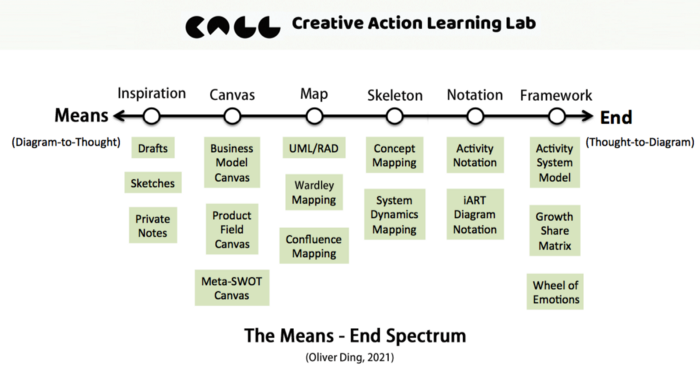
The above diagram offers a spectrum with six types of diagrams. The left side refers to Means (Diagram-to-Thought) and it stands for a weak ontological position of diagrams. We don’t have to require a perfect form of diagrams if we use them as a means for our thinking and private discussions since we don’t make diagrams as final products.
The right side refers to the End (Thought-to-Diagram) and it requires a strong ontological position of diagrams. In order to make diagrams as final products for others to use, we have to work hard to produce ideal diagrams.
Based on the spectrum of ontological positions of diagrams, I identify six types of diagrams:
- Inspiration
- Canvas
- Map
- Skeleton
- Notation
- Framework
The weakest position is Inspiration which refers to drafts, sketches, private notes, etc.
The strong position is Framework which refers to formal knowledge models.
3.3 A Typology of Knowledge Diagrams
On Oct 27, 2022, I modified the above diagram and made a new version. The major change is adding two types of diagrams:
- Semiotic System Diagrams: remove the spatial structure from normal diagrams.
- Meta-diagrams: remove all texts from normal diagrams.
I realized that there is a new dimension for thinking about diagrams and diagramming: the Langue — Space dimension. See the new version below.
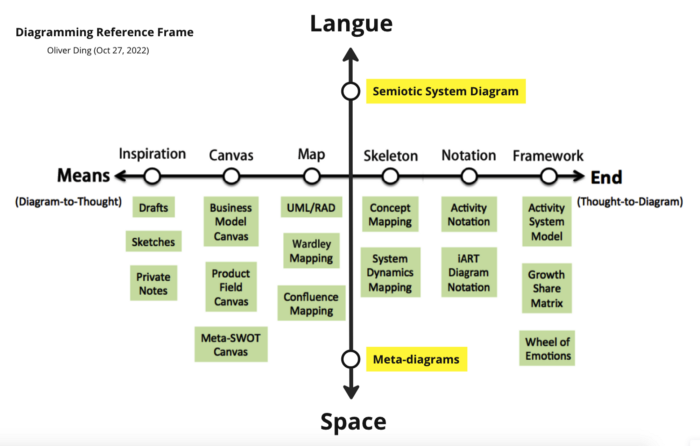
Later, it led to a typology of knowledge diagrams.
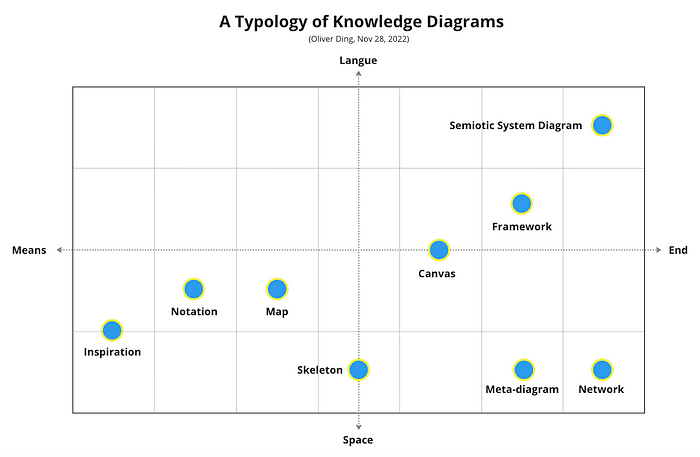
You can find more details in A Typology of Knowledge Diagrams (v2, 2022).
3.4 The D-knowledge
In the context of developing concept systems, I used the model of Self-referential Activity to discuss four types of knowledge on Nov 30, 2023.
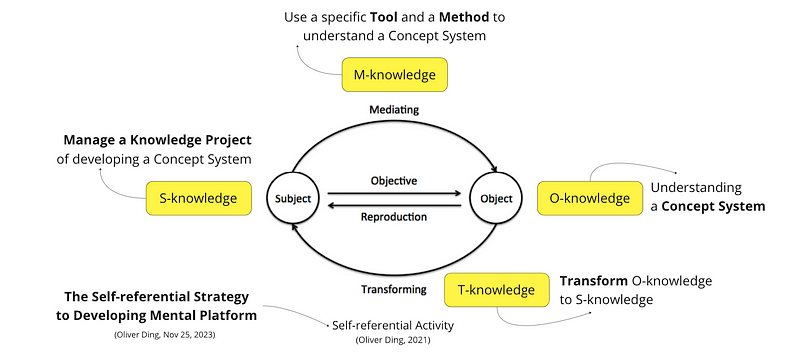
The above diagram defines four types of personal knowledge.
- S-knowledge
- O-knowledge
- M-knowledge
- T-knowledge
S-knowledge refers to knowledge for self-awareness, self-improvement, self-regulation, life discovery, life strategy, etc. For the present discussion, it refers to Manage a Knowledge Project of Developing A Concept System.
O-knowledge refers to knowledge about the work’s object. For example, if the work is building a house, the O-knowledge is about how to build the house. For the present discussion, O-knowledge refers to understanding a Concept System.
M-knowledge refers to knowledge about using tools and methods. For example, the skills of using some tools to build the house. For the present discussion, it means using a specific tool and a method to understand a concept system.
T-knowledge refers to knowledge about transforming O-knowledge to S-knowledge.
How to understand the T-knowledge?
Let’s see an example:
- O-knowledge: I wrote an article about Robert Kegan’s Knowledge Enterprise. My understanding of it is my O-knowledge.
- M-knowledge: I used the Knowledge Discovery Canvas to represent Kegan’s core ideas in a map. My skills in using the canvas are my M-knowledge.
- T-knowledge: I used Kegan’s “Five Orders of Consciousness” framework to reflect on my two knowledge projects: the development of Project Engagement approach and the development of Possible Life Theory (Creative Life Theory). This strategy is my T-knowledge.
- S-knowledge: Now I can use the “Five Orders of Consciousness” framework for my future projects.
You can find more details in Mental Platform: The Evolving Concept System.
Now we can consider using diagrams and creative diagrams as D-knowledge.
What’s the relationship between D-knowledge and the above four types of knowledge?
The know the above four types of knowledge, we need to use some tools and methods. Diagrams are tools for knowing while Creative Diagramming are methods for knowing.
In other words, D-knowledge is a meta-knowledge of these four types of knowledge.
3.5 The Fifth Way of Knowing
Since the above four types of knowledge are about understanding different things, we can claim that there are four ways of knowing behind them.
In this way, we can claim that Creative Diagramming is the fifth way of knowing.
I am going to edit a new possible book about Creative Diagramming and Early Discovery. This post is part of the project.
Related Articles:
- Diagram Explained: The Ecological Formism Approach to Diagrams — Jan 30, 2024
- Diagram Explained: Concept System, Diagram Network, and Knowledge Frameworks — Jan 31, 2024
- Diagram Explained: Activity, Knowledge, and Moving on Diagrams — Feb 1, 2024
- Diagram Explained: Themes, Concepts, and Situational Diagrams — Feb 2, 2024
- Diagram Explained: Space, Thematic Space, and Activity System + Feb 4, 2023
- [Creative Diagramming] Graphic Space Affordances, Thematic Space, and Possible Paths — Oct 31, 2023
- Thematic Space: Place as Container — Jan 14, 2022
- D as Diagramming: An Integrated Framework for Studying Knowledge Diagrams (Part 4B) — Ecological Situation — Dec 11, 2021
- [Slow Cognition] The Development of the Concept of “Thematic Spaces” — July 19, 2022
- TALE: The Theme of “Conceptual Elaboration” — Dec 6, 2023
- Mental Moves #7: Mental Focus and Moving between Thematic Spaces — Jun 17, 2023
- Social Moves: Thematic Zones, Thematic Areas, and Social Territory — Dec 15, 2023
- Frame for Work: The Ontology of Knowledge Frameworks and Ecological Actualism — Dec 13, 2023
- Frame for Work: The Hermeneutics of Knowledge Frameworks and Ecological Formism — Dec 18, 2023


