
Diagram Explained: Space, Thematic Space, and Activity System +
Turning a Model into a Canvas
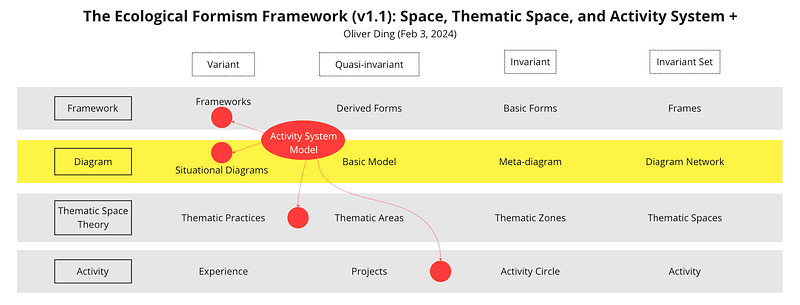
In the previous articles, I discussed four themes about knowledge diagrams:
- The theme of “Hierarchy”: The Ecological Formism Approach to Diagrams
- The theme of “Network”: Concept System, Diagram Network, and Knowledge Frameworks
- The theme of “Path”: Activity, Knowledge, and Moving on Diagrams
- The theme of “Concept”: Themes, Concepts, and Situational Diagrams
This article aims to discuss the theme of “Space” because it is related to Situational Diagrams.
I will use the Activity System Model as an example for our discussion. See the above diagram. Part 1 will tell the story and Part 2 moves on to discuss the theme of “Space” from the perspective of Thematic Space Theory (TST).
Contents
Part 1 The Story
1.1 The Brief of Activity System Model 1.2 Diagramming as Theorizing 1.3 Using the Activity System Model 1.4 Expanding the Activity System Model 1.5 Mindset and Activity 1.6 The Activity System Model + 1.7 The 1+N Approach
Part 2 Discussions
2.1 Point, Line, and Plane 2.2 Theme, Space, and Thematic Space 2.3 Activity, Thematic Space, and Knowledge Framework
Part 1 The Story
Part 1 is about the Activity System Model and my experience of using the model for some projects.
1.1 The Brief of Activity System Model
Activity Theory or the “Cultural-historical activity theory (CHAT)” is an interdisciplinary philosophical framework for studying both individual and social aspects of human behavior. From the perspective of Activity Theory, human activity or ‘what people do’ represents the basic unit of analysis when studying human behavior. The most important aspect of Activity Theory is understanding both individual and collective aspects of human practices from a cultural and historical perspective.
Yrjö Engeström upgraded the activity theory from the individual activity level to the collective activity level with a conceptual “activity system” model to apply activity theory to educational settings, organizational development, and other fields (Engeström,1987).
Yrjö Engeström is Professor of Adult Education and Director of the Center for Research on Activity, Development and Learning (CRADLE) at University of Helsinki and Professor Emeritus of Communication at University of California, San Diego.
In 1987, he published his keystone work titled Learning by Expanding (1987/2014) in which he developed the now-famous Activity System triangle, the concept and model of Expansive Learning, and the early version of the methodology of development work research. Since then, his research has significantly advanced our understanding of development and learning in different work settings and significantly contributed to cultural-historical activity theory.
One major outcome of Learning by Expanding is a diagram that aims to picture Leontiev’s activity system. Now the diagram has a nickname called “Engeström’s Triangle”.
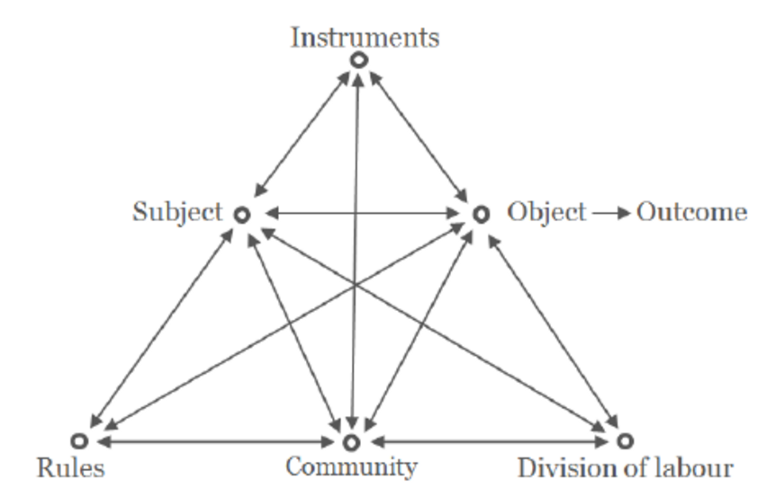
The above Engeström’s triangle is based on the cultural-historical psychologists’ notions of mediation as individual action (subject — instruments — object) at the top of the diagram. Engeström (1987) considered “a human activity system always contains the subsystems of production, distribution, exchange, and consumption.”(p.67), thus, he added the bottom of the triangle to the original individual triangle in order to include other people (community), social rules (rules), and the division of labor between the subject and others.
Some authors see this diagram as a graphical heuristic. For example, Geri Gay and Helene Hembrooke said, “…Building on these principles, Alexei N. Leont’ev (1981) created a formal structure for operationalizing the activity system as a complex, multilayered unit of analysis (figure 1.1). His model is less a representation of reality than a heuristic aid for identifying and exploring the multiple contextual factors that shape or mediate any goal-directed, tool-mediated human activity.” (2004, p.2).
Clay Spinuzzi (2020) also used “graphic heuristic” to review this model, “…Engeström provided a graphical heuristic (the now-famous triangle) for picturing Leontiev’s activity system. This heuristic, which has been derided by some critics (e.g., Miller, 2011)…”. However, Spinuzzi pointed out the positive value of the diagram, “This heuristic…was meant not only as an analytical device for researchers but (critically) also as a way to communicate with — and codesign work with — research participants (e.g., Engeström, 1999; Engeström & Sannino 2010). That is, it served as an interventionist “language game” (Ehn 1989) similar to the prototypes and organizational games that Bødker and other participatory designers used to leverage the tacit expertise of participants. This point has been overlooked by those who have critiqued the triangle heuristic as an oversimplified theoretical tool.”
You can find more details in Activity U (IV): The Engeström’s Triangle and the Power of Diagram.
1.2 Diagramming as Theorizing
Engeström considered the use of graphic models as an important part of his method of theory building. He said, “There are further two specific features of presenting and processing data in this book. The first one is the extensive use of quotations from the theoretical sources discussed and analyzed. The second one is the almost equally extensive use of graphic models.”
He sees graphic models as both representations and instruments that invite readers to build their version of the diagram. He said, “My extensive use of graphic models serves a twofold purpose. For the first thing, it aims at making the central categories found transparent and compact. This is the representation function of the models. But I use the graphic models in a series of successive variations, not just as singular representations. The series of successive variations serve the instrumental or processual function of the models. With the help of such variations, I try to demonstrate how the models can depict movement and change. The reader is invited to formulate and test his own variations.” (1987, p.47)
How many diagrams did he use for chapter 2? The answer is not 1, it is 12.
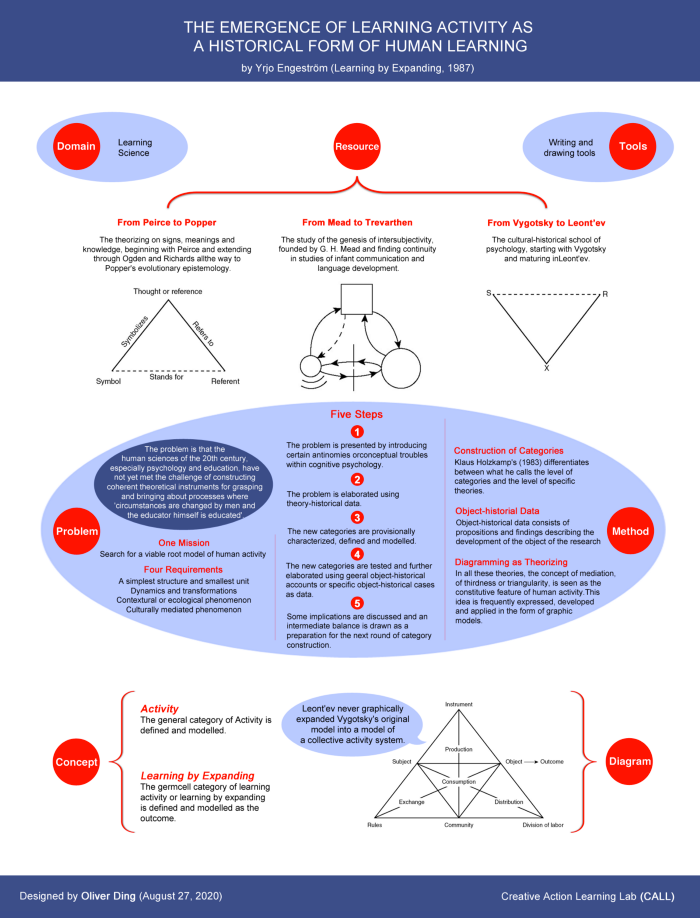
Engeström really understood the power of the diagram and diagramming. I use the noun “diagram” to refer to what Engeström called “representation function of the models” and the gerund “diagramming” to refer to what Engeström called “instrumental or processual function of the models.”
The representation is static, permanent, and bounded while the instrument is dynamic, temporary, and boundaryless. From the perspective of activity theory, a diagram is an instrument of our knowing and understanding. Vygotsky, distinguished between two types of instruments in human activity: tools and signs which also means “psychological tools”. According to Vygotsky, “The following can serve as examples of psychological tools and their complex systems: language; various systems for counting; mnemonic techniques; algebraic symbol systems; works of art; writing; schemes, diagrams, maps, and mechanical drawings; all sorts of conventional signs; etc.” (Vygotsky 1981, 137. cited in Engeström, 1987)
Clay Spinuzzi (2020) reviewed some criticisms of Engeström’s triangle and gave a fair assessment as a response. He said, “Engeström provided a graphical heuristic (the now-famous triangle) for picturing Leontiev’s activity system. This heuristic, which has been derided by some critics (e.g., Miller, 2011), was meant not only as an analytical device for researchers but (critically) also as a way to communicate with — and codesign work with — research participants (e.g., Engeström, 1999; Engeström & Sannino 2010). That is, it served as an interventionist “language game” (Ehn 1989) similar to the prototypes and organizational games that Bødker and other participatory designers used to leverage the tacit expertise of participants. This point has been overlooked by those who have critiqued the triangle heuristic as an oversimplified theoretical tool. (See Sannino 2011 for further elaboration of this point, and see Engeström 2018, pp.23 and 78 for other representations Engeström has developed for local stakeholders.)”
As Engeström mentioned, “I use the graphic models in series of successive variations, not just as singular representations…With the help of such variations, I try to demonstrate how the models can depict movement and change. The reader is invited to formulate and test his own variations.” (1987, p.47) We should remember that the diagram is not a dogma but an action guide.
When we think about thinking, we usually think we are thinking in words. However, linguistic thought is not the only way of the human mind. Cognitive scientist and psychologist Barbara Tversky argued that spatial thought is the foundation of our abstract thinking in her 2019 book Mind in Motion: How action shapes thought.
I want to highlight three ideas I learned from Barbara Tversky. The first is about taxonomy and partonomy, the second is about individual differences in mental rotation, and the third is a story about the Feynman diagram. First, Tversky said, “Spatial hierarchies are partonomies, not taxonomies like the categories of objects, events, and scenes…Partonomies are hierarchies of parts; taxonomies are hierarchies of kinds…categories allow reducing the amount of information in the world…Like taxonomies, partonomies allow inferences, but inferences of containment, not of properties…(p.77–78)”
According to Tversky, “Mental rotation is a distinctly visual-spatial transformation. It has been likened to watching something actually rotate in space…mental rotation task has become one of the major measures of spatial ability.” (p.89–90) She also pointed out the individual differences in mental rotation, “Surgeons, plumbers, electricians, football coaches, mathematicians, fashion designers, urban planners, gardeners, physicists, fire fighters, architects, basketball players, interior designers, dentists, and so many more use mental rotation and other forms of spatial reasoning regularly in their work…lawyers and journalists and historians and accountants and executives and philosophers and poets and translators don’t seem to need mental rotation in their work.” (p.91)
Tversky also directly talked about the diagram in chapter eight of Mind in Action. The title of the chapter is Spaces We Create: Maps, Diagrams, Sketches, Explanations, Comics. She said, “The ease of reasoning from well-designed diagrams has encouraged new fields to blossom, endeavors to make mathematics, logic, physics, and computer science diagrammatic, yet rigorous, in order to capitalize on our extraordinary abilities to see spatial relations and to reason about them. The rationale is the same, that diagrams use the power of spatial-motor reasoning for abstract reasoning.” (2019, p.210)
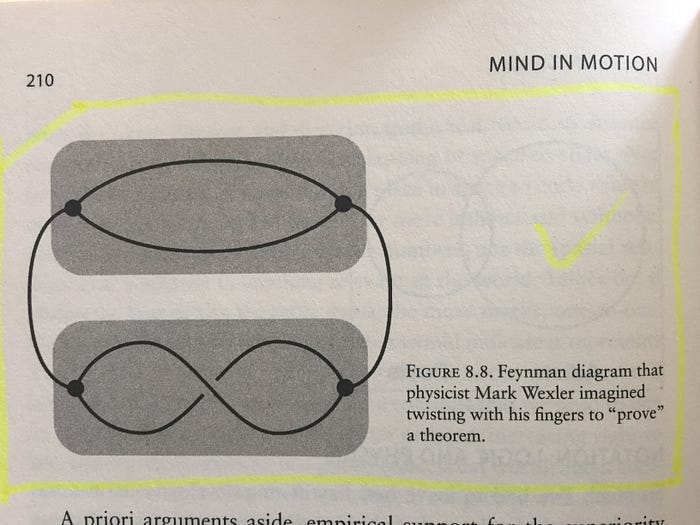
Tversky shared a story about the Feynman diagram with us, “Mark Wexler, now a cognitive scientist working on perception and mental imagery, used to be a physicist. When he was a physicist, he was working with the Feynman diagram in Figure 8.8. Each gray blob represents a separate universe. For the universe to be coordinated, the twist in the lower blob had to be undone. He imagined grabbing each of the lower ellipses with his thumb and index finger and twisting them in opposite directions, a bit like Cat’s Cradle. Doing that made him realize that untwisting the lower one twists the upper. The only way to remove the twist is to cut one of the attachments. This conclusion has implications for spacetime and quantum gravity, but that’s beyond me and thankfully beyond the scope of the book. His intuition turned out to be right, as he later showed in a rigorous line-by-line proof. Feynman diagrams are admittedly abstrute, as is the physics they represent, but once they are learned, like all effective visual spatial representations, they become a powerful thinking tool.” (p.211)
The goal of activity theory is to understand various types of human activities in the real world. Engeström also targeted his audience as both researchers and practitioners. The value of learning activity theory is not only knowing some concepts and ideas but the real transformation in real life with the help of concepts and methods of activity theory. I want to claim that Engeström’s triangle and his graphical approach to theory building is a great case of “diagramming as theorizing”.
Since Barbara Tversky claimed the sixth law of cognition as “Spatial thinking is the foundation of abstract thought” (p.72), we should change our minds on theory development and knowledge building. It is time to switch from “language-based theorizing” to “spatial thinking-based theorizing”. Diagrams and Diagramming are great approaches for visualizing complex structural relationships such as “activity” and other social phenomena.
1.3 Using the Activity System Model
How do we use the Activity System Model?
There are many ways to use a knowledge framework. Some researchers and scholars use it to guide a formal research project.
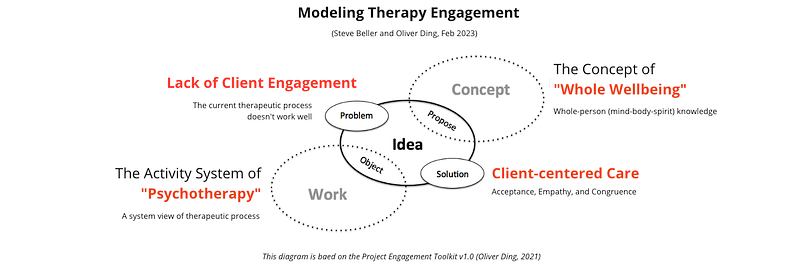
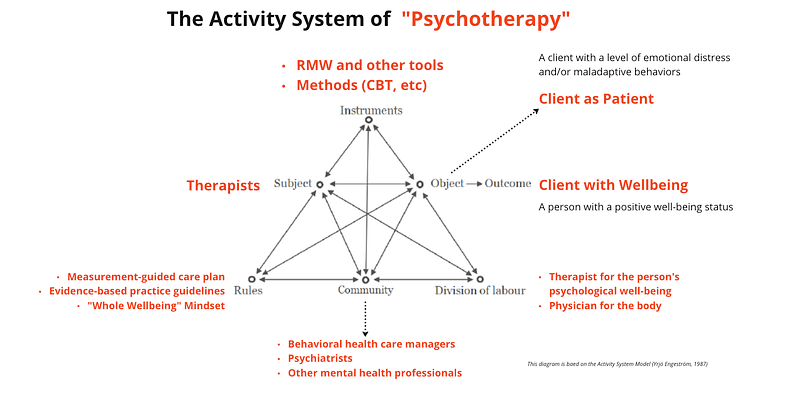
I tend to use it as a heuristic tool in strategic design projects. In 2023, I worked on a project about psychotherapy and used the Activity System Model and other related frameworks for the project.
I started with the based model of the Project Engagement toolkit (v1.0).
Then I moved to the Activity System of “Psychotherapy”.
I also applied the Activity Network model to the project. See the diagram below.
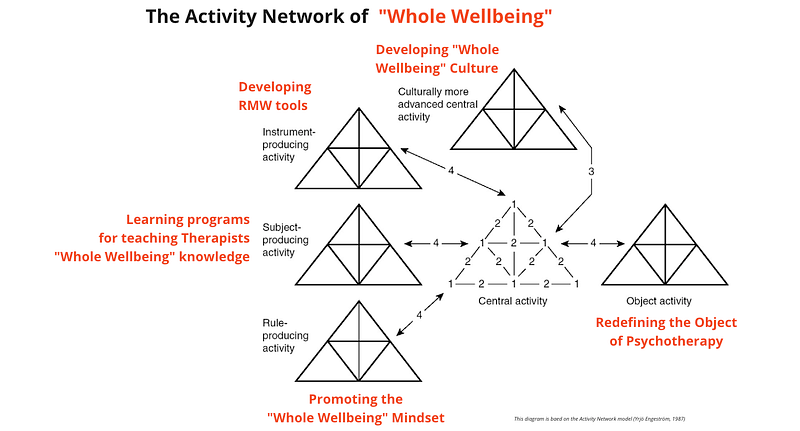
The above three diagrams offer me a systematic framework for understanding the complexity of the client’s “Whole Wellbeing” project. I used it to curate concrete materials and host strategic discussions.
1.4 Expanding the Activity System Model
In the past several years, I have used the Activity System Model for my knowledge projects many times. I faced the challenge that the ideal form of the diagram doesn’t give creative spaces for emerging theoretical concepts or situational themes.
For example, the Activity System model doesn’t have the concept of “Environment” and the concept of “Resource”.
So, I made the “Activity System Plus” to expand the original model with the concept of “Resource”.
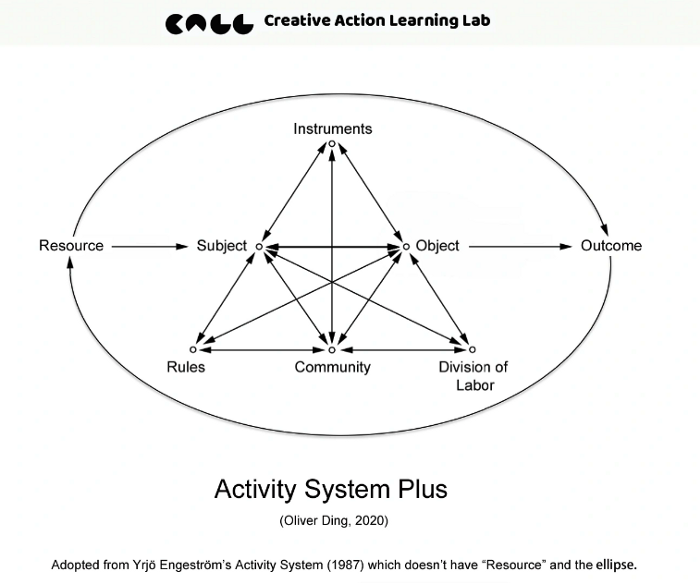
I also added an ellipse to connect “Outcome” and “Resource”. This connection refers to the notion of “Reproduction of Activity” which means an outcome of one activity could be a resource of another activity.
The concept of “Resource” is also inspired by the following diagram which is a model of TRIZ. I found the diagram from Kalevi Rantanen and Ellen Domb’s 2007 book Simplified TRIZ: New Problem Solving Applications for Engineers and Manufacturing Professionals.
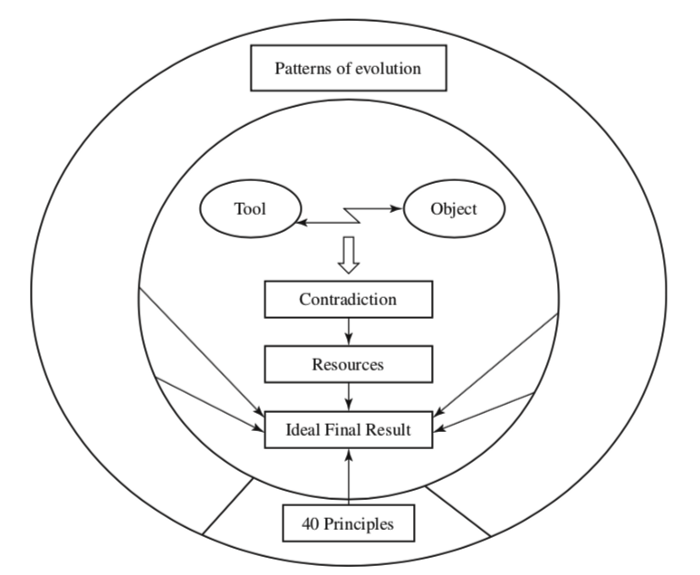
The book uses one chapter titled Mapping Invisible Resources to discuss the topic of Resources.
Each diagram only can display several concepts. Knowledge creators have to make a distinction between primary concepts and secondary concepts.
For the Activity System Model, “Mediation” is a primary concept. “Resources” and “Environments” are secondary concepts. If you want to deal with “Resources” and “Environments” in your research projects, you can understand them as “Mediation”. Some types of Resources can be understood as “Raw Materials” which are part of “Object”.
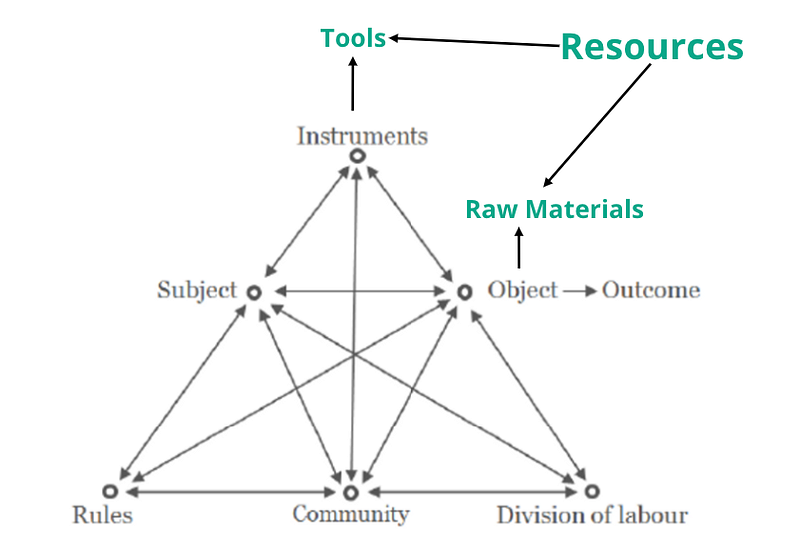
If you want to use “Resources” and “Environments” as primary concepts in a knowledge framework, you have to explore other options or make something for yourself.
In 2019, I developed a framework called Life Curation which contains a module called the “Resources — Results” Analysis. The framework suggests that a person could build his or her creative containers to curate pieces of resources into meaningful results.
Later, I used the concept of “Resource” for the Lifesystem framework because it is an application of the Ecological Practice approach which emphasizes the ecological meaning of objects and environments. It is very useful for rethinking Resources and Opportunities.
1.5 Mindset and Activity
In 2023, I worked on a project about Mindset. In this project, I used a creative way to use the Activity System Model.
My client worked on developing a typology of mindsets. I used the Activity System Model to test the typology.
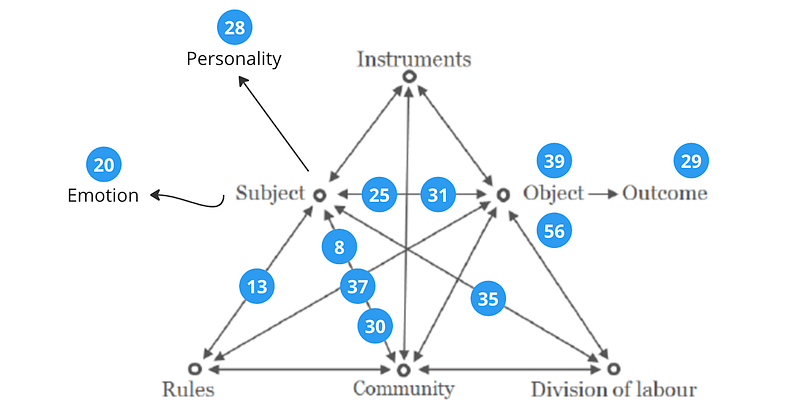
The numbers on the above diagram refer to different types of mindsets in my client’s work.
By placing them on the Activity System model, we see the relationship between these types.
In this way, we turn a typology into a systematic framework.
I also used the Activity System model to discuss the Entrepreneurial Activity and related mindsets. See the diagram below.
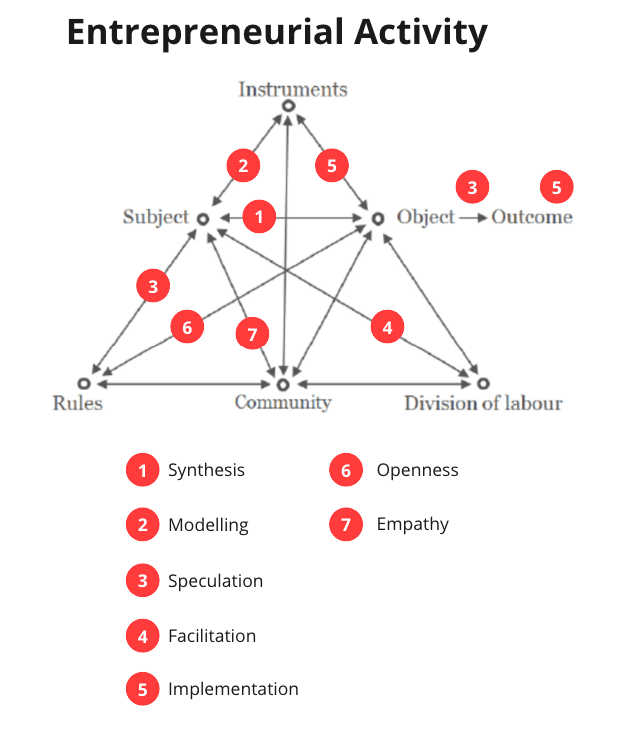
What can we learn from these examples?
The Activity System Model is a great tool for understanding abstract concepts and creative themes in a systematic approach because it offers a meaningful context.
1.6 The Activity System Model +
In the past several months, I worked on discovering potential thematic spaces from knowledge frameworks and canvases.
For example, The picture below is an example of “Explore Potential Thematic Spaces of a diagram or a knowledge framework”. You can find more details in Creative Life Curation: Discover Thematic Spaces of Creative Life.
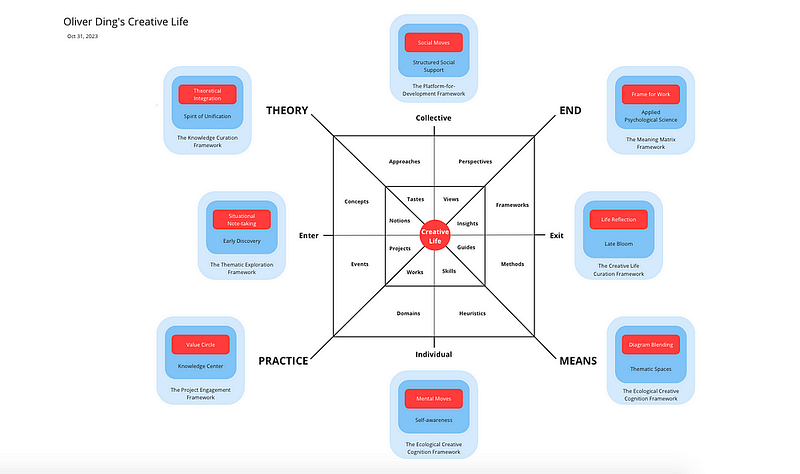
From Oct 2023 to Dec 2023, I worked discovering potential thematic spaces of the Developmental Project Model.
I used three themes to name a potential thematic space of the Developmental Project Model. I also adopt a related knowledge framework to understand the potential thematic space. The diagram below is an example: The “Identity — Program — Action” Thematic Space and the “SET” Projects.
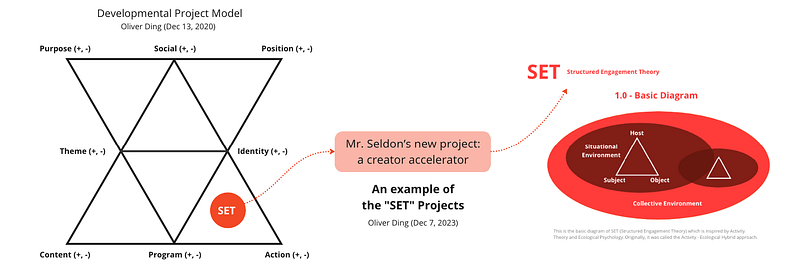
Eventually, I developed the “Developmental Project Model +” to name the diagram network and a toolkit.
If one diagram is not enough, we can use one diagram network! In this way, we have a “1+N” model for understanding the concept of Developmental Projects.
- The “1” refers to the concept of “Developmental Projects” and the basic model of the Developmental Project Model. It is an independent theoretical concept and a knowledge model.
- The “N” refers to various theoretical approaches and knowledge frameworks.
Let’s use the short name DPM (which stands for Developmental Project Model) to replace the “1” and use some knowledge frameworks to replace the “N”. See the examples below.
- DPM+Activity Theory
- DPM+Attachance Theory
- DPM+Knowledge Center
- DPM+ECHO (The ECHO Way)
- DPM+Value Circle
- DPM+AAS (Anticipatory Activity System)
- DPM+PDF (Persona Dynamics Framework)
- DPM+CLC (Creative Life Curation)
This is a fantastic model!
This is a new model of building knowledge frameworks!
The outcome is amazing. I edited a possible book titled Mapping Developmental Projects: Life, Stories, and Thematic Spaces.
Later, I applied the same method to the Meaning Discovery Canvas and the Life Discovery Canvas.
Now let’s apply this method to the Activity System Model. See the diagram below.
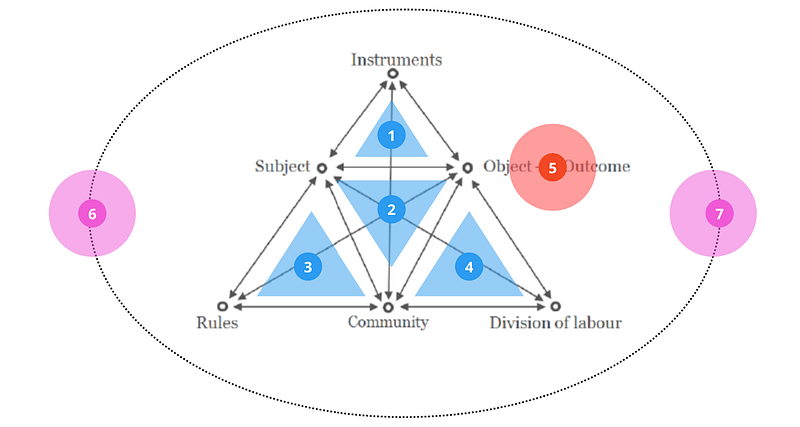
I discover 7 potential thematic spaces in the above diagram.
#1 The “Subject — Instruments — Object” Thematic Space #2 The “Subject — Community — Object” Thematic Space #3 The “Subject — Rules — Community” Thematic Space #4 The “Community — Object — Division of Labour” Thematic Space #5 The “Object — Outcome” Thematic Space #6 The “Resource” Thematic Space #7 The “Reward” Thematic Space
Some of these thematic spaces were identified by Engeström without using the term “Thematic Space”.
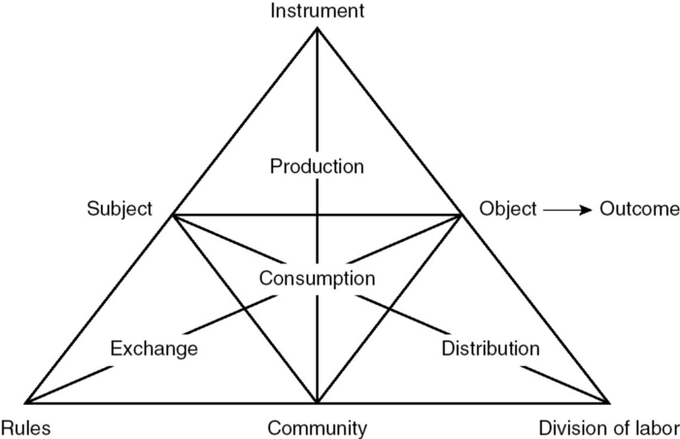
The above diagram appeared in Engeström’s 1987 book. Engeström pointed out, Karl Marx provided an essential analysis in the introduction to Grundrisse, “Production creates the objects which correspond to the given needs; distribution divides them up according to social laws; exchange further parcels out the already divided shares in accord with individual needs; and finally, in consumption, the product steps outside this social movement and becomes a direct object and servant of individual need, and satisfies it in being consumed. Thus production appears to be the point of departure, consumption as the conclusion, distribution and exchange as the middle (…).” (Marx 1973, 89. cited in Engeström, 1987, p.94)
These aspects of human activity are called sub-systems of the Activity System model. Now let’s use them to name four thematic spaces.
#1 = Production #2 = Consumption #3 = Exchange #4 = Distribution
In 2008, Engeström published a short paper and responded to Gonzalez’s suggestion of adding a new level to activity theory. He agreed that it is useful and necessary to identify an intermediate unit between collective activity and individual action within activity theory. However, he pointed out that the notion of working sphere (engagement) doesn’t match the theoretical tradition of activity theory because Gonzalez’s concept stands from the subjectivist position. He said, “Activities are oriented to and driven by objects and motives. Actions are oriented to and driven by goals…recurring working spheres/engagements…are also outcomes…they are historically built into the object, division of labor and rules of the work activity.” He placed the work spheres/engagement between object and outcome, see the left part of the above diagram.
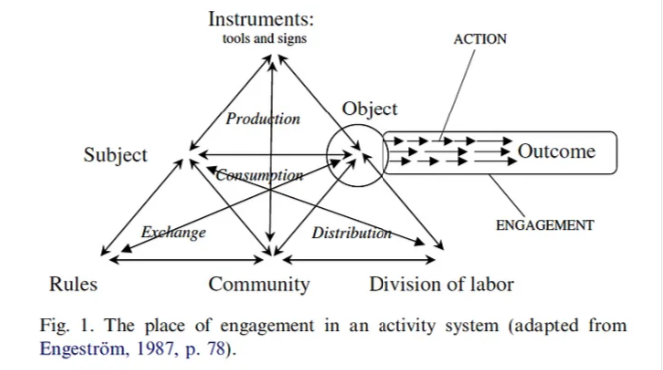
The above diagram is not a normal form of Engeström’s Triangle. However, this example shows the power of a simple triangle and its flexibility in servicing theoretical discussion. It also reminds us that the “object-outcome” part is a critical component of the activity system model.
The term “work spheres/engagement” was suggested by Gonzalez. I’d like to use “Development” as the primary theme of the thematic space.
#5 = Development = The “Object — Outcome” Thematic Space
#6 and #7 are inspired by my Activity System + (2020 version).
Now we have 7 thematic spaces and 7 concepts.
#1 = Production #2 = Consumption #3 = Exchange #4 = Distribution #5 = Development #6 = Resource #7 = Reward
In order to develop the Activity System Model +, we can adopt some knowledge frameworks to help us understand these thematic spaces. For example, we can use the Achievement Chain (see the diagram below) to understand the #5 = Development (The “Object — Outcome” Thematic Space).
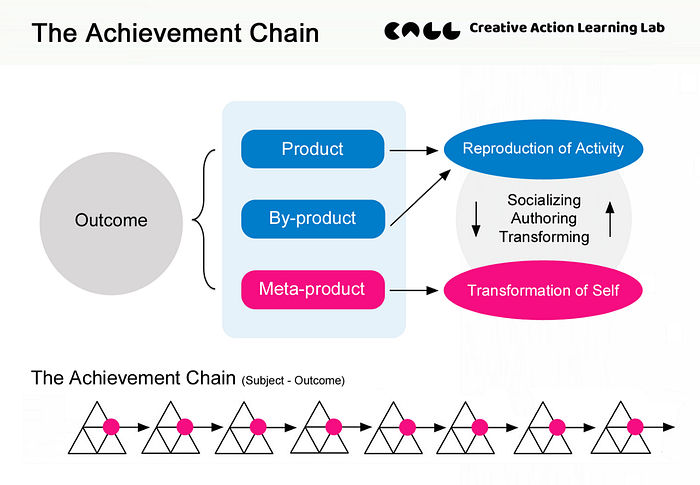
The Achievement Chain is inspired by the following theoretical resources:
- The Activity System Model(Yrjö Engeström,1987): Subject — Outcome.
- The evolving systems approach to the study of creative work (Howard E. Gruber, 1974,1989): By-product.
- The constructive — developmental approach (Robert Kegan, 1982, 2009): The Evolving Self.
You can find more details in Life-to-be-Owned: The Achievement Chain.
1.7 The 1+N Approach
The above section applied the 1+N approach to the Activity System Model.
Is it an innovative approach to using knowledge frameworks and diagrams?
We can compare the Activity System Model + with Activity-Oriented Design Method (AODM).
Noticing the lack of a standard and specified method for applying Activity Theory within HCI, Mwanza developed an Activity-Oriented Design Method (AODM) with four methodological tools. One of the tools is called Activity Notation which breaks down the situation’s whole activity system into smaller manageable sub-activity triangles (see the diagram below).
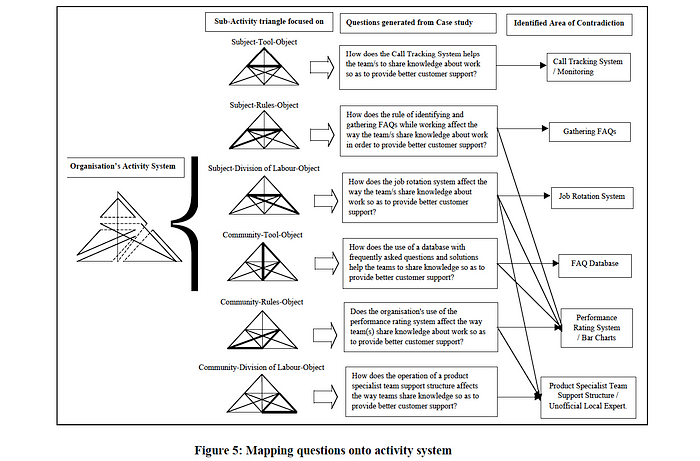
She also developed a set of general research questions that are specific to a particular combination within the activity notation. Mwanza said, “These questions are used as pointers to what to look for during observational studies, also in questionnaires and interviews as triggers to help decide on what questions to ask.” Finally, researchers and designers can analyze and interpret data they gathered with a key concept of activity theory: contradictions.
She discovered several sub-triangles without using the term “Thematic Space”.
How many thematic spaces can we discover from the Activity System Model?
- Each concept refers to a thematic space
- Each sub-triangle refers to a thematic space
- The “Object — Outcome” transformation refers to a thematic space
- The “Resource — Reward” container refers to two thematic spaces
Mwanza didn’t adopt other knowledge frameworks to explain these sub-triangles. The Activity System Model + allows people to adopt other knowledge frameworks to explain thematic spaces and make a situational toolkit.
In this way, the 1+N approach gives people a flexible way to use a theoretical knowledge framework.
Part 2 Discussions
Part 2 discusses the theme of “Space” from the perspective of Thematic Space Theory (TST).
2.1 Point, Line, and Plane
In Part 1, we see three types of creative diagramming with the Activity System model.
- Point: each concept refers to a Point.
- Line: each connection between two concepts refers to a Line.
- Plane: each thematic space refers to a Plane.
The Activity System of “Psychotherapy” only touched Points because I only used concepts of the diagram
However, the diagram below is different. I placed numbers on Lines.
Finally, I moved to the thematic spaces of the model. Each thematic space is a Plane.
This is the basic geometry of Thematic Space Theory (TST) and Creative Diagramming.
2.2 Theme, Space, and Thematic Space
To develop a theoretical concept, I coined the term “Thematic Space”.
My notion of “Theme” can be understood as “Topic”. Originally, the source of “Topic” was “Topos”. According to the Merriam-webster dictionary, “Latin Topica Topics (work by Aristotle), from Greek Topika, from topika, neuter plural of topikos of a place, of a topos, from topos place, topos”.
According to Aristotle, we need a Topos because we can remember a thing by remembering the Topos in which the thing is placed.
If we use the technique of “Deep Analogy” and “Etymology” as a perspective, then we can understand “Theme” and “Space” into one thing. Theme (Topos) is Space!
The concept of “Thematic Space” doesn’t refer to a physical space, but a cognitive container about one particular theme. It is an abstract entity.
In the Ecological Formism framework, “Thematic Space Theory” is placed as an independent unit of analysis. See the diagram below.
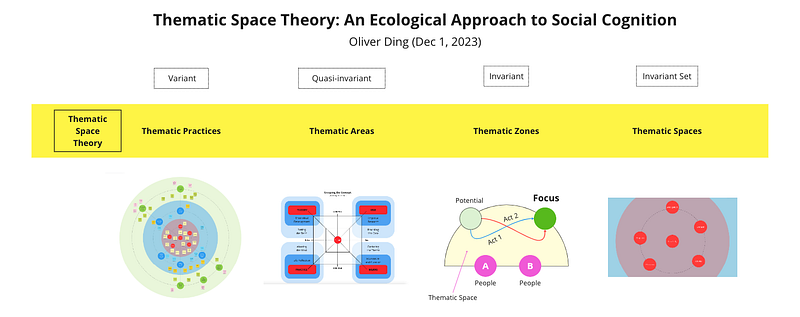
The Ecological Formism framework is an epistemological framework that frames six units of analysis from four types of knowing.
The above TST framework uses “Variant > Quasi-invariant > Invariant > Invariant Set” as the foundation to define four types of entities for knowing.
- Invariant: Thematic Zones
- Invariant Set: Thematic Spaces
- Quasi-invariant: Thematic Areas
- Variant: Thematic Practices
The level of “Invariant Set” refers to a set of themes and their thematic spaces. Also, it defines the concept of “Thematic Space” as a general term. In this way, we could use it as a normal word.
To connect the concept of “Thematic Space” and the concept of “Social Territory”, I decided to use the term “Thematic Zones” as the basic unit of analysis for Social Moves. The term “Thematic Zones” was inspired by the ARCH framework.
The level of Variant refers to the origin experience of life world. For the TST framework, I used the term “Thematic Practices” to highlight the thematic aspect of human life.
From one side, the level of “Quasi-invariant” can be seen as Patterns or Structures of the level of “Variant”. On the other side, the level of “Quasi-invariant” can be seen as the Context of the level of “Invariant”. I used the term “Thematic Areas” to name this level.
You can find more details about the Thematic Space Theory (TST) in Social Moves: Thematic Zones, Thematic Areas, and Social Territory.
2.3 Activity, Thematic Space, and Knowledge Framework
The Ecological Formism Framework offers a solution to connect the concept of “Thematic Space” with other units of analysis. The diagram is an example.
The “Activity” level is about different patterns of actions. On Sept 27, 2023, I reflected on the concept of “Activity” and made the diagram below.
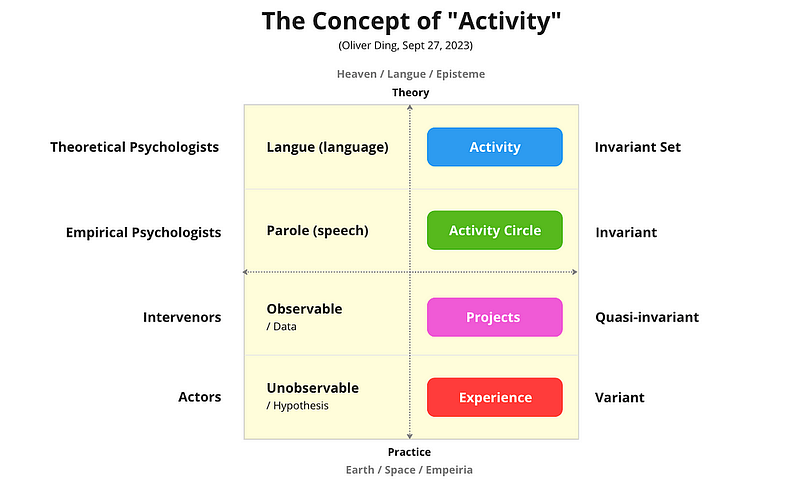
In the above diagram, I used “Activity Circle” as an example of Invariant.
While Activity Theorists develop various theoretical approaches to Activity Theory, they accept a basic worldview: Activity is a dynamic and developmental process.
In order to understand the complexity of the process, each Activity Theorist tends to emphasize a particular aspect or a specific structure of the process.
- Lev Vygotsky: the “Mediation” aspect
- A.N.Leontiev: the “Hierarchy” structure
- Yrjö Engeström: the “System” structure
- Andy Blunden: the “Concept” aspect
- Benny Karpatschof: the “Meaning” aspect
- Clay Spinuzzi: the “Network” structure
The Activity Circle belongs to Benny Karpatschof’s theoretical approach which emphasizes the process of Sign/Meaning/Concept. The AAS framework emphasizes the “Anticipation” aspect of Activity.
You can find more details in Knowledge Engagement: The Concept of “Activity”.
Yrjö Engeström’s Activity System Model refers to the “System” structure of Activity. We could place it in the section of “Invariant”. However, it was derived from Lev Vygotsky’s “Mediated Action”, it could be placed in the section of “Quasi-invariant”.
Finally, I placed it between “Quasi-invariant” and “Invariant”.
At the “Thematic Space Theory” level, the Activity System Model refers to thematic practice about the following concepts:
- “Activity”
- “Subject”
- “Object”
- “Instruments”
- “Community”
- “Rules”
- “Division of Labour”
If we use the Activity System Model +, we will do more Thematic Spaces with the following concepts:
- “Production”
- “Consumption”
- “Exchange”
- “Distribution”
- “Development”
- “Resource”
- “Reward”
At the “Diagram” level, my examples of using the Activity System Model are “Situational Diagrams”.
At the “Framework” level, the Activity System Model refers to a single knowledge framework. However, the Activity System Model + refers to a network of knowledge frameworks.
I am going to edit a new possible book about Creative Diagramming and Early Discovery. This post is part of the project.
Related Articles:
- Diagram Explained: The Ecological Formism Approach to Diagrams — Jan 30, 2024
- Diagram Explained: Concept System, Diagram Network, and Knowledge Frameworks — Jan 31, 2024
- Diagram Explained: Activity, Knowledge, and Moving on Diagrams — Feb 1, 2024
- Diagram Explained: Themes, Concepts, and Situational Diagrams — Feb 2, 2024
- [Creative Diagramming] Graphic Space Affordances, Thematic Space, and Possible Paths — Oct 31, 2023
- Thematic Space: Place as Container — Jan 14, 2022
- D as Diagramming: An Integrated Framework for Studying Knowledge Diagrams (Part 4B) — Ecological Situation — Dec 11, 2021
- [Slow Cognition] The Development of the Concept of “Thematic Spaces” — July 19, 2022
- TALE: The Theme of “Conceptual Elaboration” — Dec 6, 2023
- Mental Moves #7: Mental Focus and Moving between Thematic Spaces — Jun 17, 2023
- Social Moves: Thematic Zones, Thematic Areas, and Social Territory — Dec 15, 2023
- Frame for Work: The Ontology of Knowledge Frameworks and Ecological Actualism — Dec 13, 2023
- Frame for Work: The Hermeneutics of Knowledge Frameworks and Ecological Formism — Dec 18, 2023


