
Diagram Explained: Themes, Concepts, and Situational Diagrams
The Concept — Diagram Attachance and the Theme — Concept Transformation
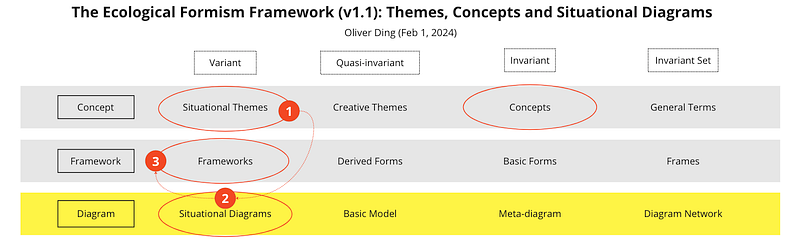
In the previous articles, I discussed three themes about knowledge diagrams:
- The theme of “Hierarchy”: The Ecological Formism Approach to Diagrams
- The theme of “Network”: Concept System, Diagram Network, and Knowledge Frameworks
- The theme of “Path”: Activity, Knowledge, and Moving on Diagrams
This article aims to discuss the theme of “Concept” because it turns a diagram into a framework. The above diagram uses the Ecological Formism Framework as a map to show a story.
1 I captured a Situational Theme → 2 I added the Theme to a Diagram and made a new Situational Diagram → 3 The new diagram became a new Knowledge Framework
Part 1 of the article will tell the story of this case. Part 2 of the article will share more details of the Theme — Concept Transformation.
Part 1: A Story
I will use the “Grasping the Concept” model as an example for the present discussion.
1.1 Two Situational Themes
In Nov 2023, Clay Spinuzzi shared three new papers on qualitative case study research methodology for investigating workplaces on his blog.
On Nov 11, 2023, I read these papers at a restaurant.

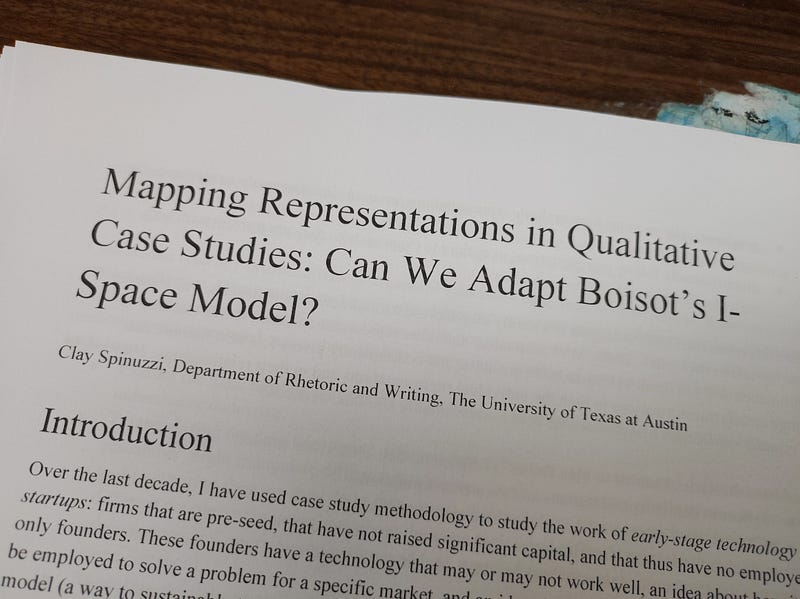
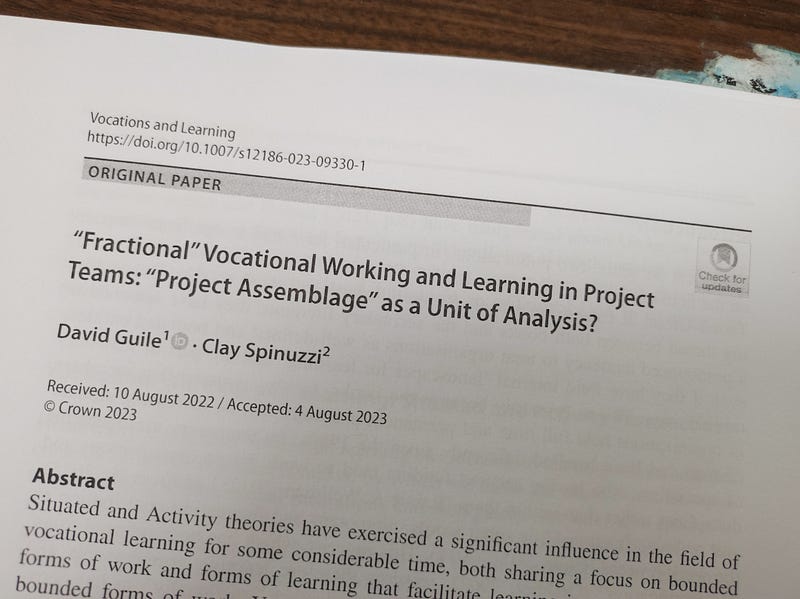
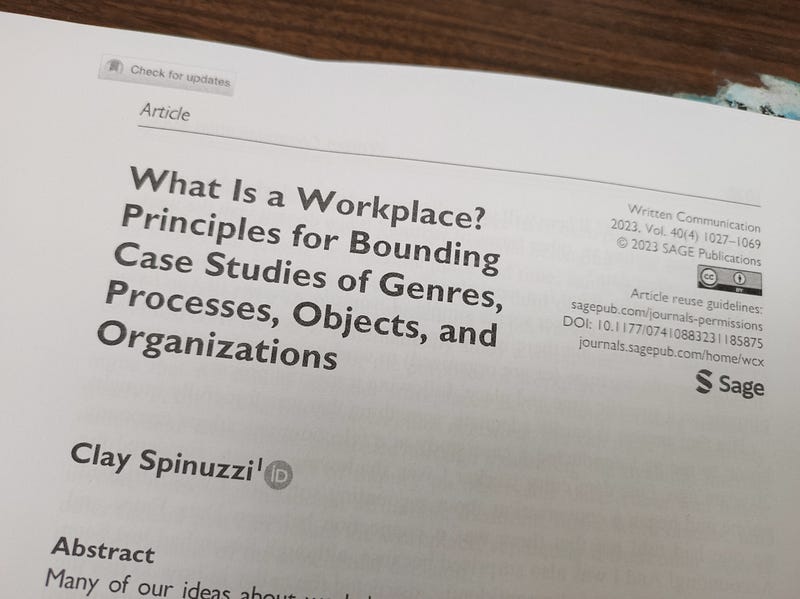
“Bounding the Case” is the primary theme of these papers. For example, Clay mentions the issue in the abstract below.
The question of defining the workplace amounts to how we define the boundaries of a case study — the unit of analysis for a given workplace. Traditionally, workplaces have been bounded by the questions who, what, when, where, why, and how? Or: organizational boundaries, location, time, processes, and work objects/outcomes. Since the Industrial Revolution, corporate work has been organized so that these questions all lead to the same conclusion: a location where work takes place during specific times, by specific people defined by an organizational boundary, using specific genres and processes in service of specific objectives. But that corporate arrangement has been fraying for a while, partly due to new information and communication technologies, and it frayed a lot more during COVID, when a substantial part of the workforce began working from home. In this article, I look at the history of this corporate arrangement and how case study methodology has free-ridden on it. Now that it is faltering, we have to rethink our workplace case study boundaries — including the principle I have been using for a long time, the activity system, which is indexed to a cyclically transformed work object(ive). The article concludes with a discussion of how to select appropriate case boundaries.
At 1:37 pm, I sent a short email to Clay. See the message below.
…
Your projects are really good. Many ideas could spread outside the field of writing study.
Reading these papers helps me to understand your creative life deeply.
While you use “bounding the case” as the primary theme of your work, I use “grasping the concept” from my Creative Life Theory.
What’s a workplace?
An empirical researcher has to grasp the concept of “workplace” in his own way.
The phrase “Grasping the Concept” was inspired by Andy Blunden who is the author of Concepts: A Critical Approach. In Nov 2020, we had a short thematic conversation about concepts via Gmail. He used “… grasped with two different concepts…” to review two different views of Activity Theory.
I mentioned the theme of “Grasping the Concept” in my email. It was triggered by Clay’s theme of “Bounding the Case”.
1.2 One Situational Diagram
From Sept 9, 2023, to Nov 20, 2023, I worked on a case study about the concept of “Mindset” in the field of psychological knowledge engagement. A by-product of the case study is the “Grasping the Concept” model. See the diagram below.
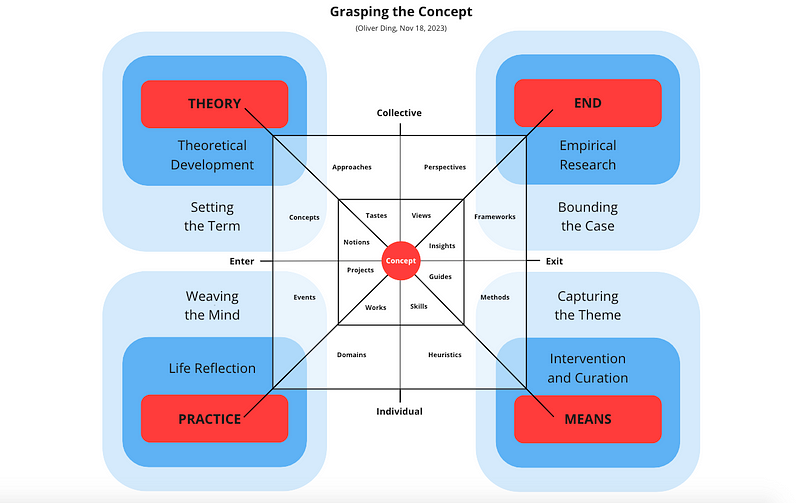
On Nov 18, 2023, I made the above Diagram which is based on the Knowledge Discovery Canvas, and sent an email to Clay.
In the past two months, I worked on a project about the Concept of Mindset. This is part of the “Territory of Concepts” project.
I defined four types of thematic spaces for knowledge engagement.
Theoretical Development -> Setting the Term
Empirical Research -> Bounding the Case
Intervention and Curation -> Capturing the Theme
Life Reflection -> Weaving the Mind
The term “Bounding the Case” was inspired by your papers. Thank you very much!
See the attached diagram.
Oliver
p.s. I will edit a new collection of my articles about Concepts.
Grasping the Concept
The Territory of Concepts and Concept Dynamics
Part 1: The Territory of Concepts Now I use the Four Types of Thematic Sapces to define the “Territory” of Concepts and collect my recent articles about this theme.
Part 2: Concept Dynamics
My articles about the Concept Dynamics framework and my own stories of developing several theoretical concepts.
Part 3: Beyond Common Concept
My articles about the Concept-fit framework and related ideas for developing products.
The idea of “Psychological Knowledge Engagement” will be the next project.
The diagram is a Situational Diagram. Though it was based on the Knowledge Discovery Canvas, It doesn’t need the 16 blocks. It only uses the 4 thematic areas: THEORY, PRACTICE, END, and MEANS. See the diagram below.
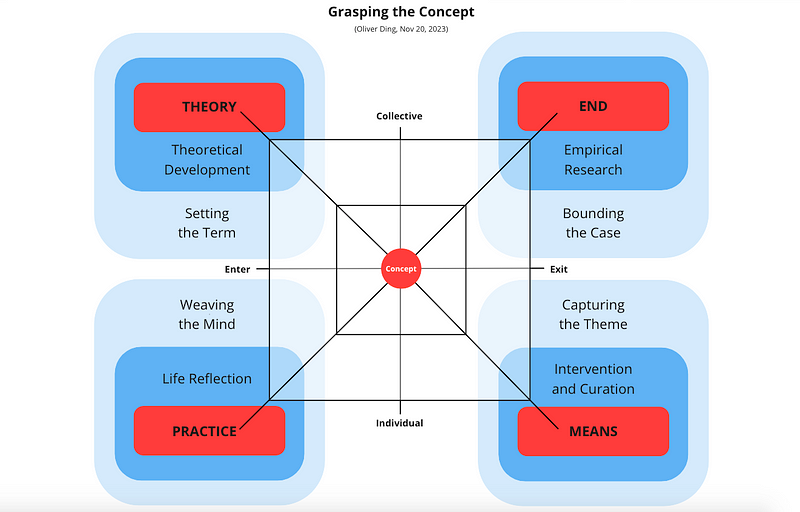
In this Situational Diagram, I used 4 thematic areas of the Knowledge Discovery Canvas to develop a model of “Grasping the Concept”:
How did I develop the model?
I started with the first sub-model for the END thematic area:
- Empirical Research → Bounding the Case
Then, I adopted the diagram below as a trigger. It was a model about “Theme (Concept)”, you can find more details in Themes of Practice: Concept, Activity, and Cognition.
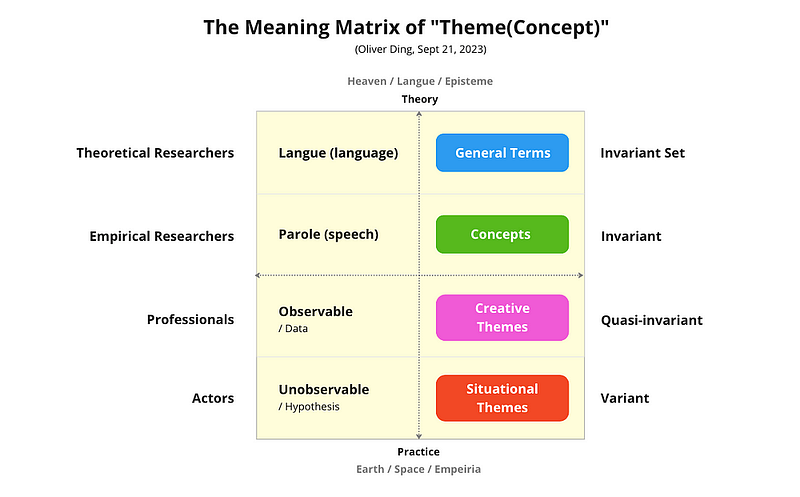
Inspired by the above diagram, I defined two sub-models:
- Theoretical Development → Setting the Term
- Intervention and Curation → Capturing the Theme
How about the last one? The theme of “Weaving the Mind” was inspired by the following thematic card which is one of 21 cards of the ECHO Trip.
- Life Reflection → Weaving the Mind
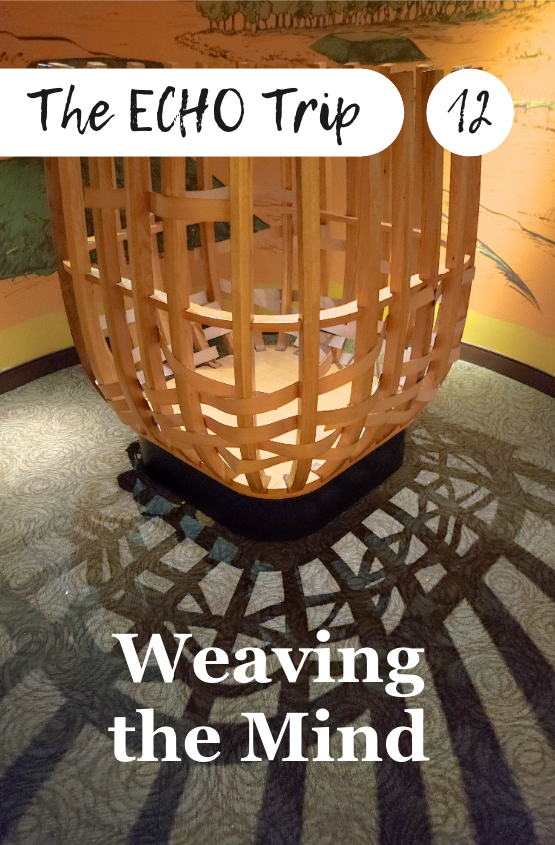
The Thematic Card of # 12 Weaving the Mind connects to the Creative Theme of “Life Curation” and my work about Curation and Curativity Theory.
I have worked in the curation field for over ten years. I was the Chief Information Architect of BagTheWeb.com which was an early tool for content curation (We launched the site in 2010). This experience inspired me to make a long-term commitment to the Curation theme. After having 10 years of various curation-related practical work experience and theory learning, I coined a term called Curativity for discussing general curation practice. In 2019, I wrote a book (draft) titled Curativity: The Ecological Approach to General Curation Practice.
After 2019, I worked on several projects about Curativity Theory. One project is called the Curated Mind (1, 2).
On June 27, We visited the Museum of the Cherokee Indian. I saw a large unfinished basket that represents the Cherokee Weaving history. I immediately recalled my childhood when I was living in a small village where people tended to weave baskets. I also thought about Tim Berners-Lee’s 1999 book Weaving the Web: The Original Design and Ultimate Destiny of the World Wide Web.
I realized that there is an interesting difference in spatial structure between a basket and a web though they share the same weaving technique. A basket is a Container while a web is a Network.
So, I came up with a new theme: Weaving the Mind. I used it as a metaphor and associated with the Curated Mind project. More specifically, I wanted to use it to represent my approach to developing an interdisciplinary epistemological framework.
It’s perfect to use “Weaving the Web” for the PRACTICE thematic area!
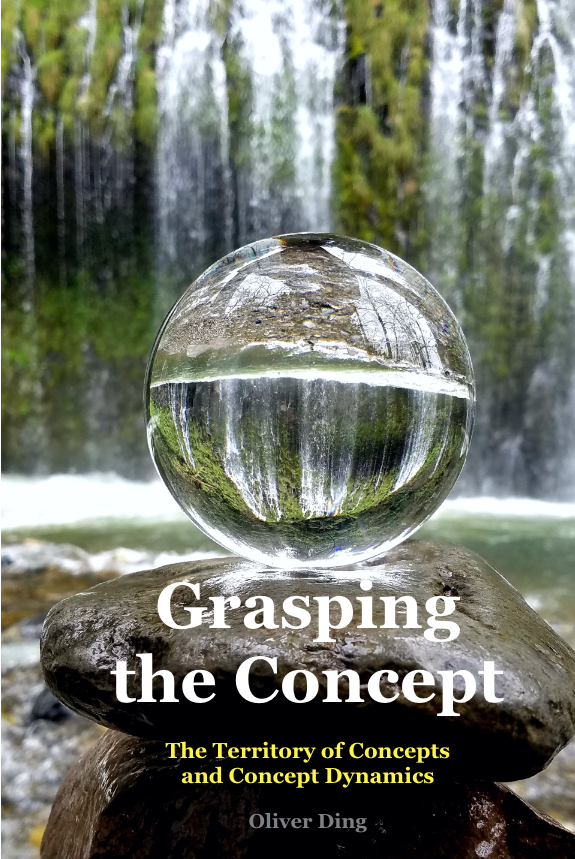
On Nov 29, 2023, I edited a possible book titled Grasping the Concept: The Territory of Concepts and Concept Dynamics. Finally, the term “Grasping the Concept” transformed from a Situational Theme to a Creative Theme.
1.3 One Knowledge Framework
On Jan 19, 2024, I worked on the Meaning Discovery project and developed the Meaning Discovery model. See the diagram below.
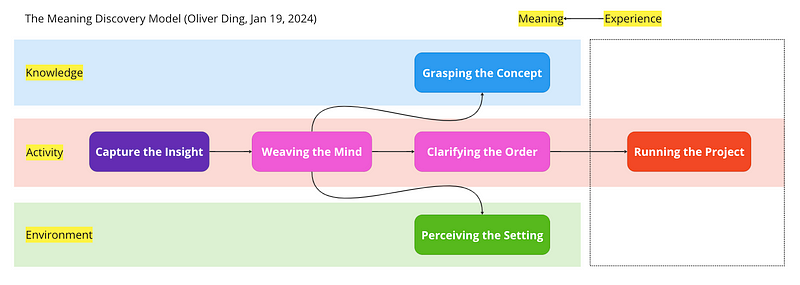
How did I develop the above model? On Jan 18, 2024, I designed the cover image for a possible book.

I used the theme of “Capture Significant Insights” to frame the purpose of “Meaning Discovery”.
So, I started with the theme of “Capture the Insight”, and then added the following five themes to the model:
- Weaving the Mind
- Clarifying the Order
- Running the Project
- Grasping the Concept
- Perceiving the Setting
I also used the following 3*2 conceptual framework to frame the above six focuses:
- The “Meaning — Experience” Transformation
- The “Knowledge — Activity — Environment” Hierarchy
You can find more details in The Meaning Discovery Model (v1, 2024).
In this model, I use “Weaving the Mind” and “Grasping the Concept” again!
Part 2: Discussions
In Dec 2021, I edited a possible book (draft) Diagram Blending: Building Diagram Networks, and focused on the Practice of Diagram Blending by introducing a set of new terms and some real examples.
In July 2023, I developed Attachance Theory and applied it to discuss ecological creative cognition, especially the practice of Developing Knowledge Frameworks. The outcome is a possible book (draft) Mental Moves: The Attachance Approach to Ecological Creative Cognition.
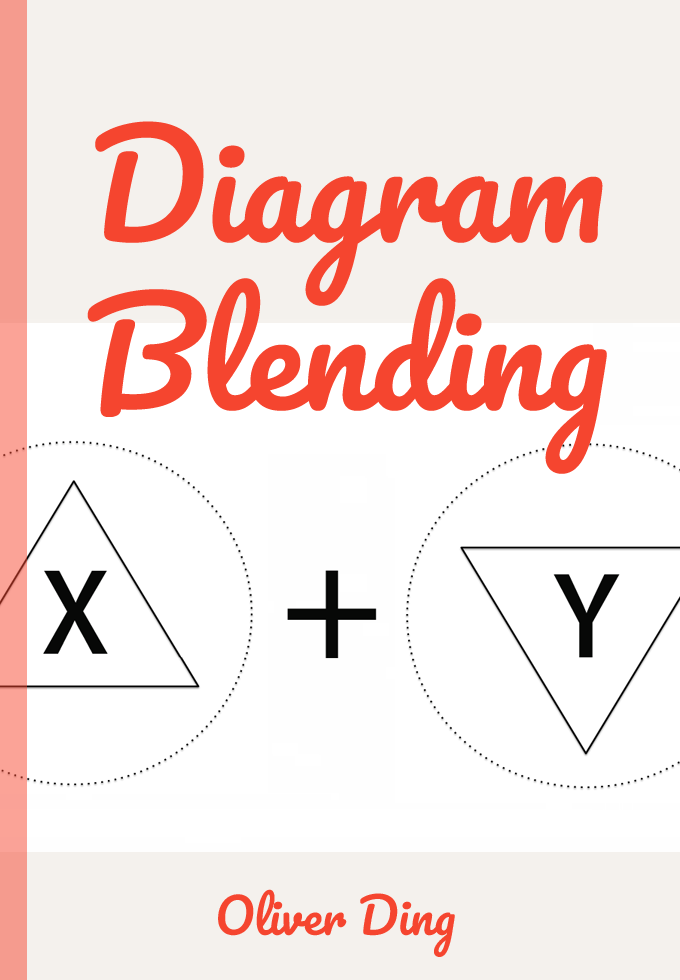

Both books are related to Concepts. Diagrams, and Knowledge Frameworks. In Diagram Blending, I considered “Concept” and “Diagram” as two significant aspects of knowledge frameworks. I roughly defined a knowledge framework as a set of concepts and a diagram. In Mental Moves, I also associated them with Thematic Space. See the diagram below.
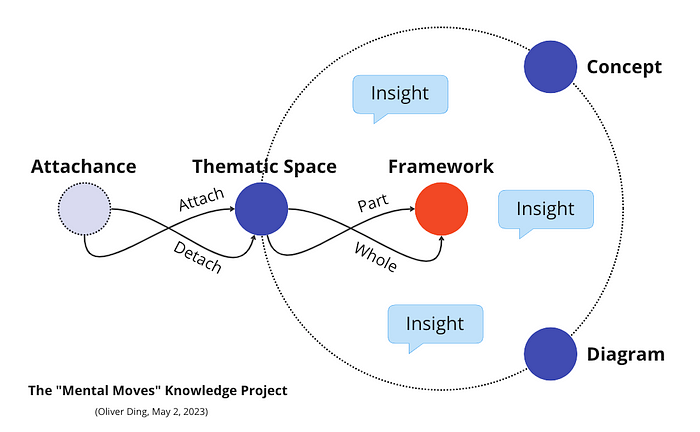
The above diagram represents a dynamic model of developing knowledge frameworks. While an individual knowledge framework is formed by a set of Concepts and a Diagram, the process of developing a knowledge framework is also related to Thematic Spaces of a diagram! You can find more details in Mental Moves #3: Attachance, Thematic Space, and Framework.
In Part 2, I will adopt some ideas from these two books to the present discussion.
2.1 The Concept — Diagram Attachance
In Diagram Blending, I introduced the Diagram Blending Method and its primary theme is about blending two or more diagrams to form a new diagram. The diagram below is the basic model of the Diagram Blending method.
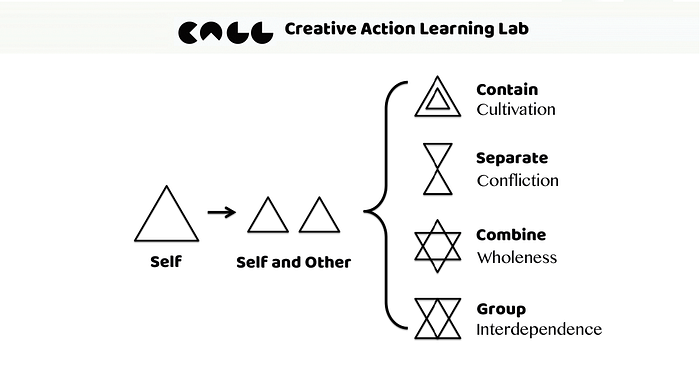
If there is only one thing, then there is no relationship and blending in particular. The above picture shows two things, Self and Other. The four types of “Self — Other” relationships present an archetypal unit of Diagram Blending: blending two triangles together to form a new diagram.
By increasing the number of meta-diagrams and the complexity of meta-diagrams, and adjusting the relationship between meta-diagrams, we can achieve various types of Diagram Blending.
The above discussion points out the foundation of Diagram Blending at the abstract level. If we move to the concrete level, we can find a new meaning of Blending. The diagram below is adopted from a previous article: D as Diagramming: An Integrated Framework for Studying Knowledge Diagrams (Part 2).
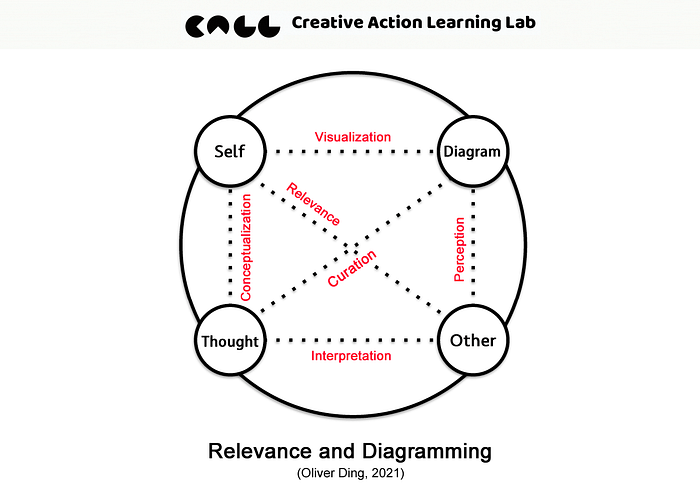
The above diagram represents several types of blending of the Diagramming practice.
- Design: The “Visualization — Conceptualization” Blending
- Impact: The “Perception — Interpretation” Blending
- Relevance: The “Self — Other” Blending
I chose Diagram Blending as the name of the whole system which covers Diagram Blending, Diagram Expanding, Diagram Networks, Diagram Systems, and Meta-diagrams. The Diagram Blending Method refers to related methods.
Finally, there is an important blending that is relevant but it is a higher level of Diagram Blending.
The Diagram — Concept Blending
As mentioned before, my focus is knowledge diagrams and knowledge frameworks. If you read my articles about diagrams, you probably notice that I used the term Diagrams interchangeably with Knowledge Frameworks.
What’s actually the difference between these two things? It’s hard to give a definition to the concept of Diagram. For the D as Diagramming project, I set simple criteria for sorting diagrams: the number of concepts contained in a diagram. If a diagram only represents one concept, then I call it a Single Concept Diagram. If a diagram represents more than one concept and the relationship between these concepts, then I call it a Multiple Concepts Diagram.
My primary interest is not Single Concept Diagrams, but Multiple Concept Diagrams. When I used the term Diagrams interchangeably with Knowledge Frameworks, I always talked about Multiple Concepts Diagrams.
So, Diagram Blending is only half part of the whole thing. We should consider the Diagram — Concept Blending too.
The Diagram Blending method was developed in 2021. Now we can use Attachance Theory to explain the practice of Diagram Blending.
I coined the term Attachance by combining Attach and Chance in 2018 to discuss some ideas related to Affordance, a core idea of Ecological Psychology.
Affordance means potential action opportunities offered by environments. I want to highlight the meaning and value of actual action itself, however, the term Affordance only refers to potential actions. Thus, I coined the term Attachance to emphasize the potential opportunities offered by actual actions, especially the attaching act and the detaching act.
From the perspective of Attachance Theory, the Diagram — Concept Blending is about the Concept — Diagram Attachance.
We could attach some concepts to a diagram, and detach some concepts from a diagram. We see this pattern from the story of Part 1.
In Mental Moves, I introduced a model about “Mental Elements”. There are three aspects of mental elements, see the diagram below.
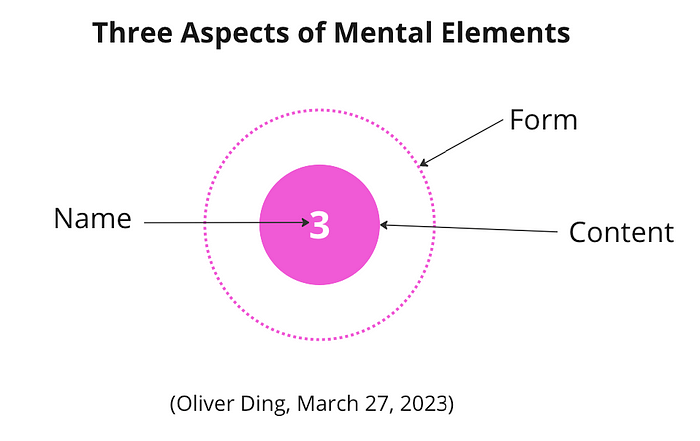
The term “mental elements” is adopted from Dean Keith Simonton’s Chance-configuration theory (Scientific Genius,1988).
What are mental elements?
According to Simonton, “In scientific creativity, the predominant mental elements are cognitions of some kind, such as facts, principles, relations, rules, laws, formulae, and images. Yet immediate sensations may also play a role in laboratory experimentation and field exploration, and feelings may figure in scientific thought and discourse as well (Mahoney 1976). Sometimes these mental elements can be evoked voluntarily (e.g., the deliberate retrieval of a stored fact from memory); at other times these elements enter mental processing involuntarily (e.g., via a conditioned emotional association). Moreover, these mental elements do not have to be fully conscious, but rather, many enter information processing at the periphery of consciousness. ” (1988, p.6)
I highlight some keywords from Simonton’s description of mental elements. It looks like this is a rough definition. And, it is very hard to give an accurate definition for such things.
Dean Keith Simonton doesn’t give us a typology of mental elements. We also don’t know the details of significant aspects of mental elements. From a case study, I realized that three aspects of mental elements are necessary for further discussions.
Based on these three elements, we can develop a framework of mental elements:
- Name: does it have a name?
- Form: does it have an identifiable form?
- Content: does it have more than one identifiable entity?
The picture is an example of the model. You can find more details in Mental Moves #1: The Transformation of Mental Elements.
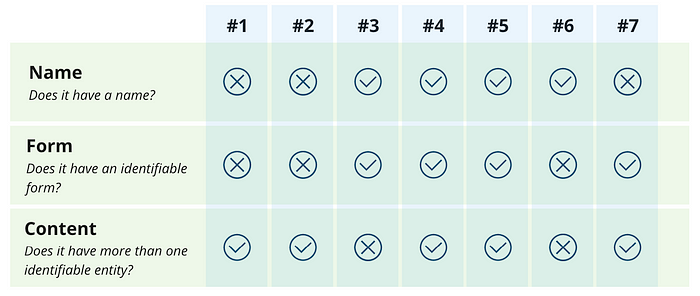
If a knowledge framework has several concepts, then each concept is an identifiable entity. For example, we can find the following concepts from the “Grasping a Concept” model.
- Weaving the Mind (Content / identifiable entity)
- Grasping the Concept (Name)
Also, we can discover some sub-units that are formed by some concepts within a framework as identifiable entities. For example, we can find the shape of the following diagram from the “Grasping a Concept” model.
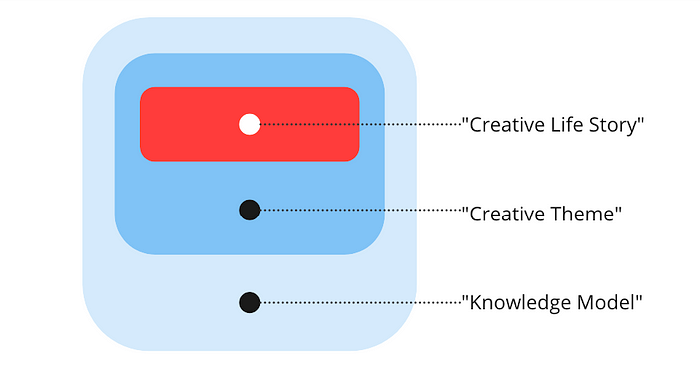
If we remove text from the above diagram, we get the shape that represents a three-layer nested structure. This shape was born in Oct 2023.
2.2 The Theme — Concept Transformation
In Part 1, I used the term “Theme” many times. What’s the relationship between “Theme” and “Concept”?
In 2023, I wrote a possible book titled Thematic Exploration: The Early Discovery of Knowledge Engagement and introduced the Strategic Thematic Exploration framework. I made a distinction between “Theme” and “Concept”. While “Theme” emphasizes subjective experience and understanding, “Concept” is more about objective meaning and definition.

In Themes of Practice: Concept, Activity, and Cognition, I discussed multiple perspectives on “Theme” and “Concept”. See the diagram below.
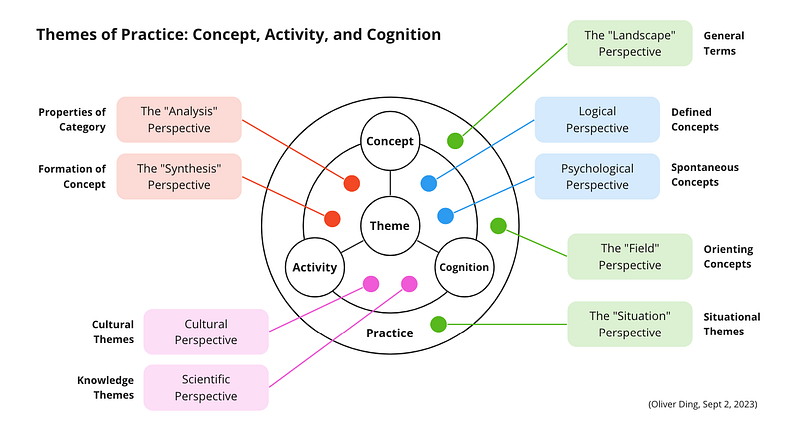
The above diagram represents nine perspectives:
- The “Landscape” Perspective: General Terms
- The “Field” Perspective: Orienting Concepts
- The “Situation” Perspective: Situational Themes
- The “Analysis” perspective: Properties of Category
- The “Synthesis” perspective: Formation of Concept
- The Logical Perspective: Defined Concepts
- The Psychological Perspective: Spontaneous Concepts
- The Cultural Perspective: Cultural Themes
- The Scientific Perspective: Knowledge Themes
Let’s focus on the Early Discovery of the journey of Knowledge Engagement.
We can pay attention to Situational Themes and Knowledge Themes.
Situational Themes are meaningful keywords about immediate life experiences while Creative Themes are abstract themes about knowledge projects.
From June 24 to July 3, 2023, I had a wonderful 10-day road trip with my wife and two little sons. During the busy trip, I couldn’t write notes with details. In order to record exciting moments and engaging experiences, I used short meaningful keywords to capture some insights while taking pictures.
These short meaningful keywords are Situational Themes of my life.
Knowledge Themes are similar to Scientific Concepts. However, Knowledge Themes are more flexible than Scientific Concepts.
How do we transform a theme into a concept?
We can see the “Develop Spontaneous Concept System” model. See the
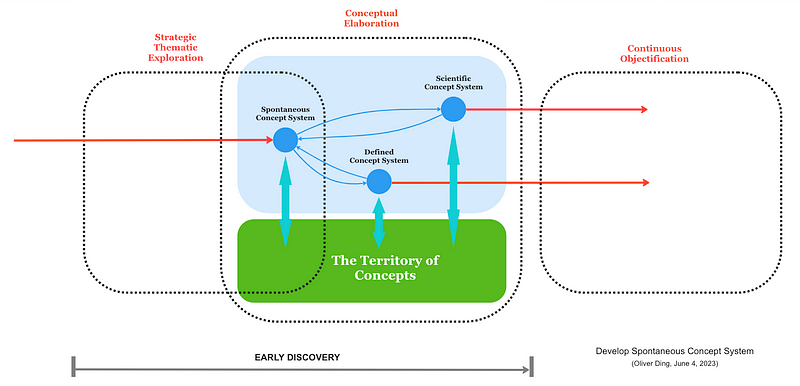
Strategic Thematic Exploration and Conceptual Elaboration are two phases of EARLY DISCOVERY of the journey of knowledge Engagement.
In the Thematic Exploration phase, I use “Situational Themes/Creative Themes/Knowledge Themes” as primary terms.
In the Conceptual Elaboration phase, I use “Spontaneous Concept/Defined Concept/Scientific Concept” as primary terms.
I use “Strategic Thematic Exploration” to frame a creative space for exploring the strategic intent with the thematic analysis methods, especially for knowledge engagement.
I consider “From Theme to Framework” as a significant early phase for the journey of knowledge engagement. There are six stages in the phase.
- A Possible Theme without Clue
- A Possible Theme with Clue
- A Primary Theme without related themes
- A Primary Theme with its network
- A Knowledge Concept with a working definition
- A Knowledge Framework with a set of concepts
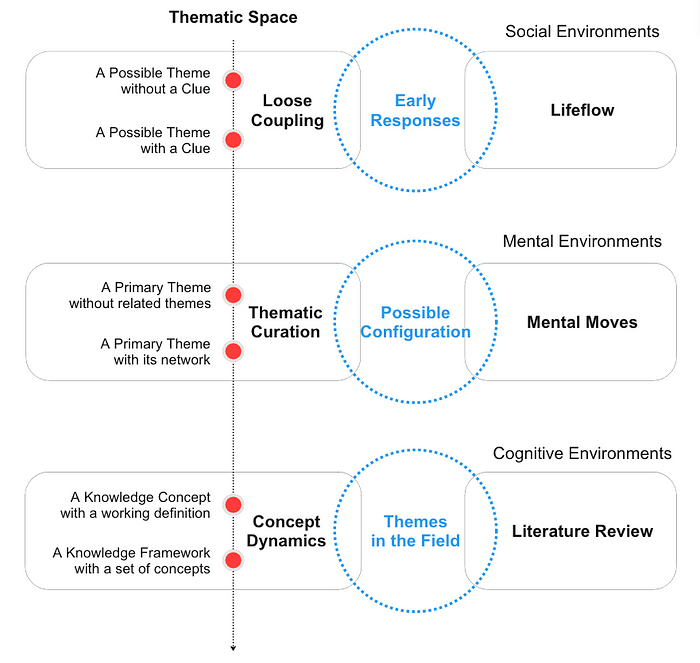
You can find more details in Thematic Exploration: The Early Discovery of Knowledge Engagement (book, v1).
This framework offers a dynamic process of the Theme — Concept Transformation.
I am going to edit a new possible book about Creative Diagramming and Early Discovery. This post is part of the project.
Related Articles:
- Diagram Explained: The Ecological Formism Approach to Diagrams — Jan 30, 2024
- Diagram Explained: Concept System, Diagram Network, and Knowledge Frameworks — Jan 31, 2024
- Diagram Explained: Activity, Knowledge, and Moving on Diagrams — Feb 1, 2024
- [Creative Diagramming] Graphic Space Affordances, Thematic Space, and Possible Paths — Oct 31, 2023
- TALE: The Theme of “Conceptual Elaboration” — Dec 6, 2023
- Mental Moves #7: Mental Focus and Moving between Thematic Spaces — Jun 17, 2023
- Social Moves: Thematic Zones, Thematic Areas, and Social Territory — Dec 15, 2023
- Frame for Work: The Ontology of Knowledge Frameworks and Ecological Actualism — Dec 13, 2023
- Frame for Work: The Hermeneutics of Knowledge Frameworks and Ecological Formism — Dec 18, 2023


