
Day 2 of 60 Days of Deep Learning with Projects Series
With Projects and Examples…
Welcome back peeps. This is Day 2 of 60 days of Deep Learning with projects Series.
System Design Case Studies — In Depth
Design Instagram
Design Messenger App
Design Twitter
Design URL Shortener
Design Dropbox
Mega Compilation : Solved System Design Case studies
Day 1 of 60 days of Deep Learning with projects Series
Prerequisite for 60 days of Deep Learning with projects Series —
You should complete 60 days of Data Science and Machine Learning before jumping the ships. You must have a basic knowledge of the Data Science and ML and terms that I’ll be using in series — It covers everything from scratch and will give you a boot up to build a great foundation and projects ( also understand the complex topics).
Goal
Let’s set a clear objective.
The goal is to develop an intuition and understand (in the depth) the practical side of Deep Learning and build projects/applications.
I have created a GitHub repo for this series where we will be maintaining our code.
Tools
We will be using Google Colabs and Jupyter Notebooks ( based on our requirement).
Projects Videos —
All the projects, data structures, SQL, algorithms, system design, Data Science and ML , Data Analytics, Data Engineering, , Implemented Data Science and ML projects, Implemented Data Engineering Projects, Implemented Deep Learning Projects, Implemented Machine Learning Ops Projects, Implemented Time Series Analysis and Forecasting Projects, Implemented Applied Machine Learning Projects, Implemented Tensorflow and Keras Projects, Implemented PyTorch Projects, Implemented Scikit Learn Projects, Implemented Big Data Projects, Implemented Cloud Machine Learning Projects, Implemented Neural Networks Projects, Implemented OpenCV Projects,Complete ML Research Papers Summarized, Implemented Data Analytics projects, Implemented Data Visualization Projects, Implemented Data Mining Projects, Implemented Natural Leaning Processing Projects, MLOps and Deep Learning, Applied Machine Learning with Projects Series, PyTorch with Projects Series, Tensorflow and Keras with Projects Series, Scikit Learn Series with Projects, Time Series Analysis and Forecasting with Projects Series, ML System Design Case Studies Series videos will be published on our youtube channel ( just launched).
Subscribe today!
We will be covering —
1. Deep Learning Basics
2. Programming and Data
Exploratory Data Analysis
ETL process
Shell programming and Automation
3. Neural Networks
Neural Networks basics
Different types of neural networks
Linear Classifiers
Optimization
Hyper Parameter Tuning
Gradient Descent
Backpropagation Algorithm
Regularization — L2 and dropout regularization
Batch normalization
Build a neural network in Keras
Build a Neural Network With Pytorch
Build a neural network in TensorFlow
Train Neural Networks
Feedforward neural network
Popular Optimization Algorithms
Activation Functions
Strategies for reducing errors
Shallow Neural Networks
4. Convolutional Neural Networks
Convolution basics and CNN Architectures
Residual networks
Build a Convolutional Network
Batch Normalization and Dropout
5. Recurrent Neural Networks
RNN Basics
LSTM: Long Short Term Memory Cells
Natural language processing and Word Embeddings
6. Tensorflow
Tensorflow basics
Tensorflow Playground
Custom Loss Functions
Custom Layers and Models
Callbacks
Distributed Training
Data Pipelines with TensorFlow Data Services
Performance
7. Autoencoders
Autoencoders Basics
Generative Learning
8. Generative Adversarial Networks
Generative Adversarial Networks Basics
Useful activation functions and Batch normalization
Transposed convolutions
Generator and Discriminator
Deep Convolutional Generative Adversarial Networks
Implement Generative Adversarial Networks
9. Attention and Transformers
Attention and Transformers Basics
Sequence to Sequence Models
Attention
Multi-Head Self-Attention
Building Blocks of Transformers
Encoder
Decoder
Parameters Sharing
Build a Transformer Encoder
10. Graph Neural Networks
Basics of Graphs
Graph Convolutional Networks
Implement — Graph Convolutional Network
11. Natural Language Processing
Natural Language Processing Basics
Probabilistic Models
Sequence Models
Attention Models
12. Federated learning
13. MLOps
14. Research Papers
Some amazing research papers- Deep Learning that I have read over the years to help you boot up to the industry standards and what’s next in this field.
Lets dive in — Day 2 : Basics of Deep Learning!
What is Deep Learning?
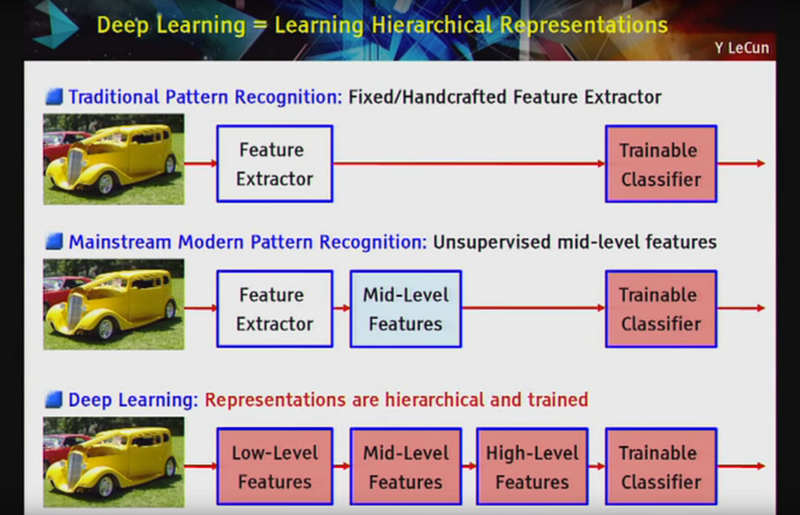
Deep learning is a branch of Machine learning which works with Artificial neural network — to imitate how human think, learn and pass the information. It consists of sophisticated neural networks which allows machines to observe, learn the complex data and conditions/situations way faster than human beings. It’s heavy on statistics and predictive modelling.
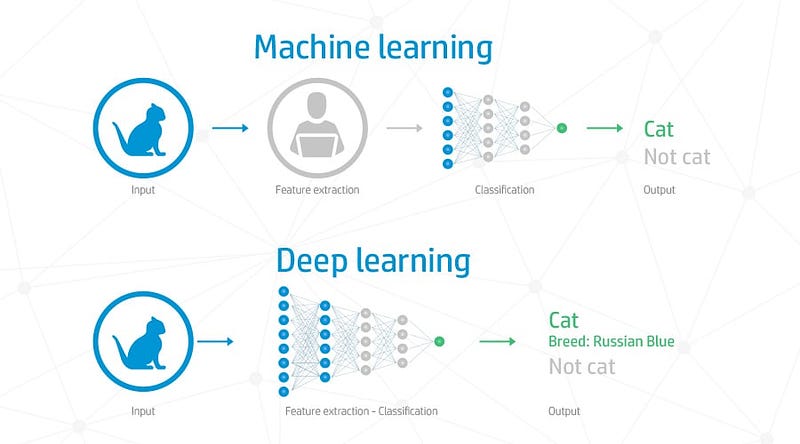
“Deep learning is a kind of learning where the representation you form have several levels of abstraction, rather than a direct input to output” ~ Peter Norvig, Director of Research at Google
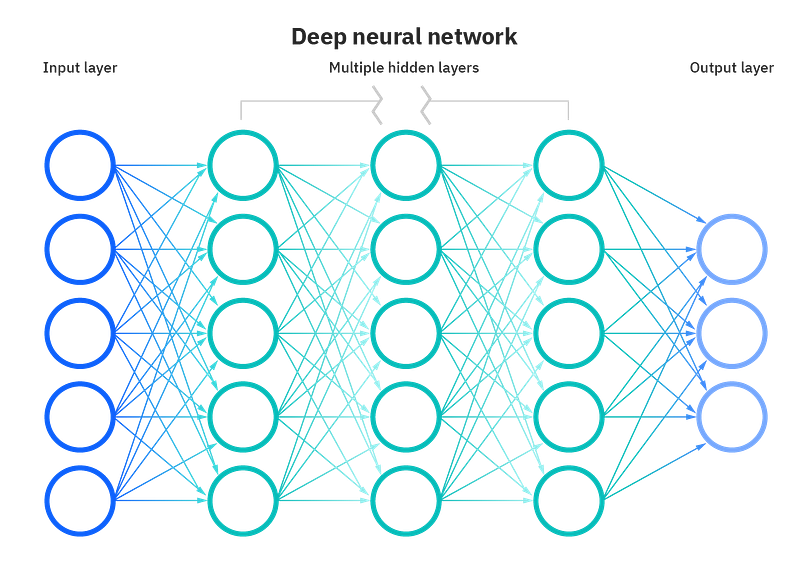
Neural network is the heart of deep learning — inspired by the structure of human brain i.e how brain neurons exchange information/signals with each. It has an input layer ( with inputs weighted based on different criterias’) and output layer and in between many hidden layers which are also known as processing layers. These layers are connected by nodes and these connections constitute a network.
Neural networks in general allows machine programs to recognize the patterns. Some of the examples of Neural networks are the the multilayer perceptron, Boltzmann machine, and the Kohonen network etc. NN makes the heart of DL algorithms. Deep NN’s learn by discovering complex structures in the data they are input with. Along with that they create levels of abstractions wrt data representation.
Why Deep learning?
More data + Bigger Modes + Better Algorithms + More Computations = new and improved insights
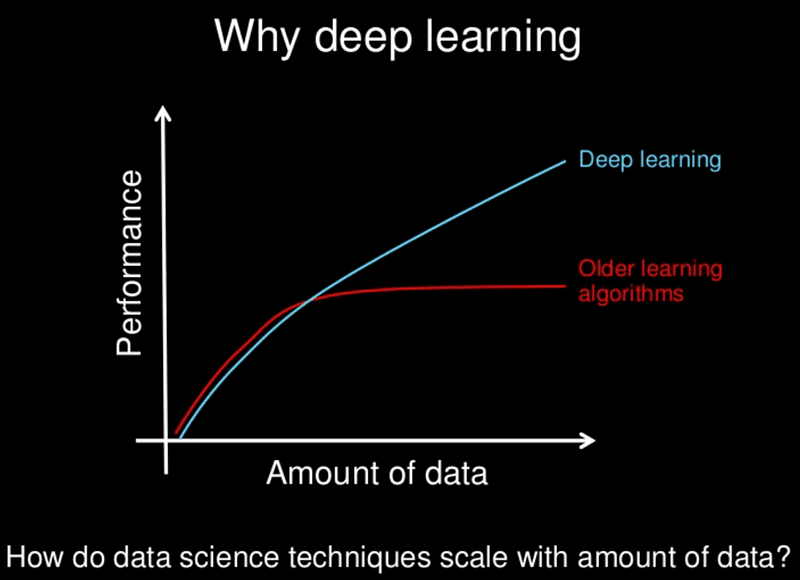
Deep Learning — Machine Learning
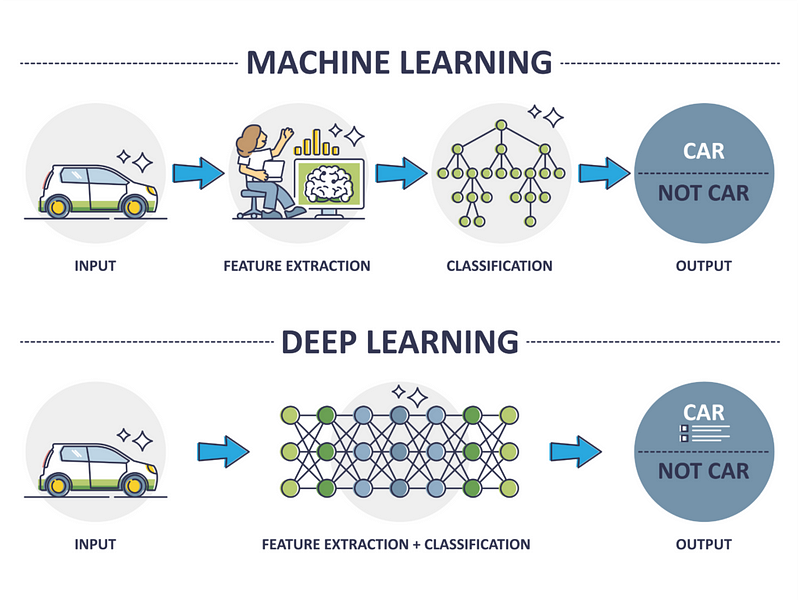
Machine Learning performs well with medium dataset whereas deep learning needs big dataset and machines with GPU. The training time is long in case of deep learning and data interpretation is difficult. In case of ML, the training time is relatively short and (some)ML algorithms are easy to interpret.
Supervised and unsupervised deep learning
Deep learning employs supervised learning in the tasks like object detection and digit recognizer, image classification etc — to predict a label or a number. In the case of Autoencoders, the NN employs unsupervised learning.
Deep Learning Methods ( which we will cover in detail later )—
Adaptive Learning Rates — to increase performance and reduce training time.
Transfer Learning — Reduce computation time
Training from scratch — Useful for new applications with many output categories
Dropout — Solves the problem of overfitting and thus the performance of NN
Applications of Deep Learning
Deep learning is a widely used in natural language processing, Image recognition, Speech Recognition, Computer Vision, Medical Research, Aerospace industry etc. Some of these we will discuss in this series going forward.
So, what’s important to know —
Neural Network
Deep Learning methods
That’s it for now! Get ready to take a deep dive because Day 3 is Coming soon!
Subscribe/ Follow and Stay Tuned!!
Some of the other best Series —
How to solve any System Design Question ( approach that you can take)?
30 days of Data Structures and Algorithms and System Design Simplified
Data Science and Machine Learning Research ( papers) Simplified **
100 days : Your Data Science and Machine Learning Degree Series with projects
Complete Data Visualization and Pre-processing Series with projects
Exceptional Github Repos — Part 1
Exceptional Github Repos — Part 2
Tech Newsletter —
If you are interested, you can join my newsletter through which I send tech interview tips, techniques, patterns, hacks — Software Development, ML, Data Science, Startups and Technology projects to more than 30K readers. You can subscribe to Tech Brew :
System Design Case Studies — In Depth
Design Instagram
Design Messenger App
All the Complete System Design Series Parts —
6. Networking, How Browsers work, Content Network Delivery ( CDN)
Github —
Keep learning and coding :)
For Python Projects —
For complete 60 days of Data Science and ML : Day 1 — Day 60 : Quick Recap of 60 days of Data Science and ML
Follow for more updates. Stay tuned and keep coding! Disclosure: Some of the links are affiliates.
For other projects, tune to —
Build Machine Learning Pipelines( With Code)
Recurrent Neural Network with Keras
Clustering Geolocation Data in Python using DBSCAN and K-Means
Facial Expression Recognition using Keras
Hyperparameter Tuning with Keras Tuner
Custom Layers in Keras


