
About Me — Matthew Maniaci
Ten pounds of weird in a five-pound bag.

Hi, my name is Matthew Maniaci, I’m 34, and I’m a huge nerd. I enjoy playing board games with friends, going to sci-fi conventions, and playing with my four cats. Also, apparently I can’t write a short article to save my life.
The Story of my Life (Abridged)
I was always an awkward kid in grade school. I would often spend my recesses walking around the blacktop and just…thinking. The teachers were a bit worried about me. In sixth grade, with all the changes and hormones, I started getting depressed. I got so depressed, in fact, that toward the end of the year, at age 12, I began feeling suicidal. This culminated in an incident during a school rally where I snuck away from my class and began beating my head against a brick wall. My parents took me to a psychiatrist, and I was diagnosed with Depression.
As I went through puberty, my symptoms increased and changed, and I started experiencing mood swings. I would bounce around between horrible depression and huge bouts of energy that affected my interactions at school. We tried a variety of medications, but nothing seemed to help. At age 14, I was re-diagnosed as Bipolar. As this was the 90s and treatments were not as advanced as they are now, my psychiatrist was concerned that I would not be able to function as an adult and that I would have to live with my parents indefinitely.
Living with bipolar is like an emotional roller coaster. People with bipolar disorder fluctuate between manic highs and depressive lows, sometimes shifting between moods a few times a year, sometimes shifting every few months. Being in a manic upswing for me is like having unlimited energy and potential. Anything is possible, and there are no obstacles big enough to stop me. Sometimes, I lose sleep to some passion project or another; other times, I make terrible life choices like spending hundreds of dollars buying things online because it “seemed like a good idea.” Every random idea that pops into my head is the greatest idea ever, and my thoughts race through my head at a hundred miles an hour.
Depression is like an absence of energy. Everything is horrible, nothing seems like a good idea, and all my motivation is gone. Things that used to bring me pleasure no longer do so, and the things that I do to take care of myself, like eating well and exercising, fall away due to low energy. It’s like everything you eat tastes like mashed potatoes. You try to eat your favorite foods, or spice things up with hot sauce, but it’s all just bland potatoes, so you eventually stop trying to season anything at all and just give in to the blandness.
My teenage and young adult years were largely defined by my illness. I went through a number of medications and side effects and mood shifts, was hospitalized once, and wound up moving to a school with a focus on therapy for kids like me. Thanks to their help, I gained a lot of good coping skills and graduated a semester early, starting community college.
College brought its own challenges. I decided to major in Chemistry, but used my community college days to take a variety of courses, including a lot of philosophy classes. When I eventually moved to the University of Missouri-St. Louis, I was woefully behind on my Chemistry classes and would have to spend an extended time catching up.
After a few semesters of struggling with both my classes and mental health, I stopped taking my meds. This period, which I now refer to as “the bender,” resulted in several months of poor life choices and me just generally being an asshole. Thanks to some supportive friends who staged an intervention for me, I came clean to my psychiatrist, who gently scolded me before prescribing me the medications that would keep me stable for the next 12 years.
One major life choice that resulted from the bender was my realization that I hated chemistry. So, with some thought and research, I changed my major to technical writing. I’d been taking technical writing classes along with my chemistry, and while I was barely passing my chemistry classes, I was getting fantastic grades in my writing classes. My parents became worried that I’d be an unemployed writer and that they’d have to remodel the basement.
As part of my graduation requirements, I had to do an internship. I found one as a grant writer, which a mentor of mine suggested that I’d like, and that was that. I enjoyed it so much that I went into grant writing as a career, and have been a professional grant writer for over a decade.
About a year after college, I got my first grant writing job and moved out of the house with two roommates. One of those roommates, a young woman named Emily that I had connected with in community college, became an incredibly strong friend over our time living together. Eventually, we both developed crushes on each other, although we both harbored them for about a year before Emily confessed and I reciprocated.
After about ten months of being together, we were forced to move out of our apartment on short notice. We landed at Emily’s mom’s house, where we stayed for six months while I saved up money for a down payment on a house. We eventually bought a nice house in a semi-urban area with low crime and good amenities, and moved into our new home.
Since landing here, I’ve been through a few job transitions, eventually landing at an agency that provides services for people with mental illnesses. I find the work incredibly fulfilling, as I am helping fund programs that serve people like me.
When I graduated college at age 22, my psychiatrist told me how proud of me he was. He’d been with me since I was 12 at that point, and although I was forced to leave him not long after for insurance reasons, I still hold him in the highest regard.
What I Write About
My journey on Medium started on a whim. I was on a new medication that was causing me to not sleep very well, and in one of my insomnia moments, I came up with the idea to answer questions that people had about mental illness. Anything was on the table, and all questions would be answered honestly. I started up a Google Form and posted it to my social media. After about a day, questions started rolling in.
After a week or two of frantically answering questions and posting them in a public Google Doc, I realized that people were really interested in this. I began writing the answers into a more formal document, which later became an autobiography-slash-self-help book draft. Over the course of four weeks, I wrote 52,000 words of it, accidentally completing a NaNoWriMo in April. Still needing a proper outlet for my work, I did some research and found Medium. I repurposed a bunch of my answers and started posting them.
It didn’t go well. At least, not at first.
I would only get a few views on each article, mostly friends. After a few months of disappointment, I started looking into the platform properly to try to leverage an audience. I eventually published a piece in Invisible Illness, which was my first success, garnering several hundred views in a few weeks. Encouraged, I started writing more original content rather than repurpose my old answers, and away I went.
Here’s that article if you’re interested. Trigger warning: depression, suicide.
Having found an audience, I began writing more broadly about my life and experiences with mental illness. The articles had varying degrees of success, but I began learning how to craft a title, how to make my articles more appealing to curators, and how to market them outside of Medium. I also found some supportive groups on Facebook that helped me learn the ropes a bit better.
A lot of my articles focus on self-help aspects of mental health. I enjoy using my experiences to help others, and I have received feedback that my articles have had an impact on a number of people. That makes me incredibly proud and happy, and even though most of my articles don’t get more than a few hundred views, I’m glad to help whomever I can.
Here are a few of my most popular self-help articles. Trigger warning: depression, suicide.
Aside from my articles about mental health, I write about a variety of other topics. I’ve written a bit about my relationship with my wife, which people seem to like.
I’ve also dabbled in some satire and humor articles. I’ve always enjoyed The Onion and other humorous and satire publications, so I wanted to try. I’m not terribly good at them, but I still enjoy writing them.
Recently (and not so recently, as you may notice from my satire), I’ve taken up writing about social justice causes. I am an unabashed liberal, a big fan of democratic socialism, a Bernie Sanders and Liz Warren stan, and a guy who thinks that Social Justice Warrior is a compliment. I have strong opinions on Trump and the failings of America as a country, but I believe that we can and will do better in my lifetime, so I’m not going anywhere. I do most of my writing in a publication called An Injustice! (shameless plug), which is an up-and-coming publication that I think has its finger on the pulse of modern social justice causes. My recent magnum opus outlines why my generation gravitates to socialism (that’s democratic socialism, before anyone gets their pants in a knot), and it took me the better part of a year to write and research. It’s a long article and not for the faint of heart.
Odds and Ends
Since I don’t know how else to wrap this up, I figured I’d include a bunch of random facts about myself.
- I have been married to my wife for three years, and we have been together for eight years.
- My parents were incredibly supportive of me growing up, and they did their best for me, but as an adult, I have stopped talking to them for a variety of reasons, particularly my mental health, and I will likely never speak to them again. I would probably have died if it weren’t for them, but I can’t imagine welcoming them back into my life. If you’ve experienced something like that, I want you to know that it’s okay.
- I used to read books voraciously, but sometime after college, I just stopped. My favorite book series in college was Terry Pratchett’s Discworld series, followed by the various Star Wars novels that made up the Expanded Universe. I have recently discovered audiobooks, which I am enjoying, and have been listening to Gail Carriger’s various Victorian-era books, including the Soulless series, the Finishing School series, and the Custard Protocol series.
- As I said, I have four cats: three black cats named Jello, Billy Jo (Bilbo), and Katsu, and a grey tabby named Toner (we got her last, and since she’s not black, we decided that the printer was low on ink — my wife’s idea, and it stuck). Jello and Bilbo are brothers, and they had a third brother, Darby, who died when he was two for reasons we still don’t know.
- I enjoy video games, and am really into Animal Crossing: New Horizons right now. I have a really bad tendency to get to the final bosses of a video game and then put it down before beating it — currently, I’ve played the heck out of Legend of Zelda: Breath of the Wild, but in spite of having accomplished most of the various side-quests and having upgraded about everything I can, I haven’t fought the final boss yet. I put it down about a month ago and haven’t picked it up again.
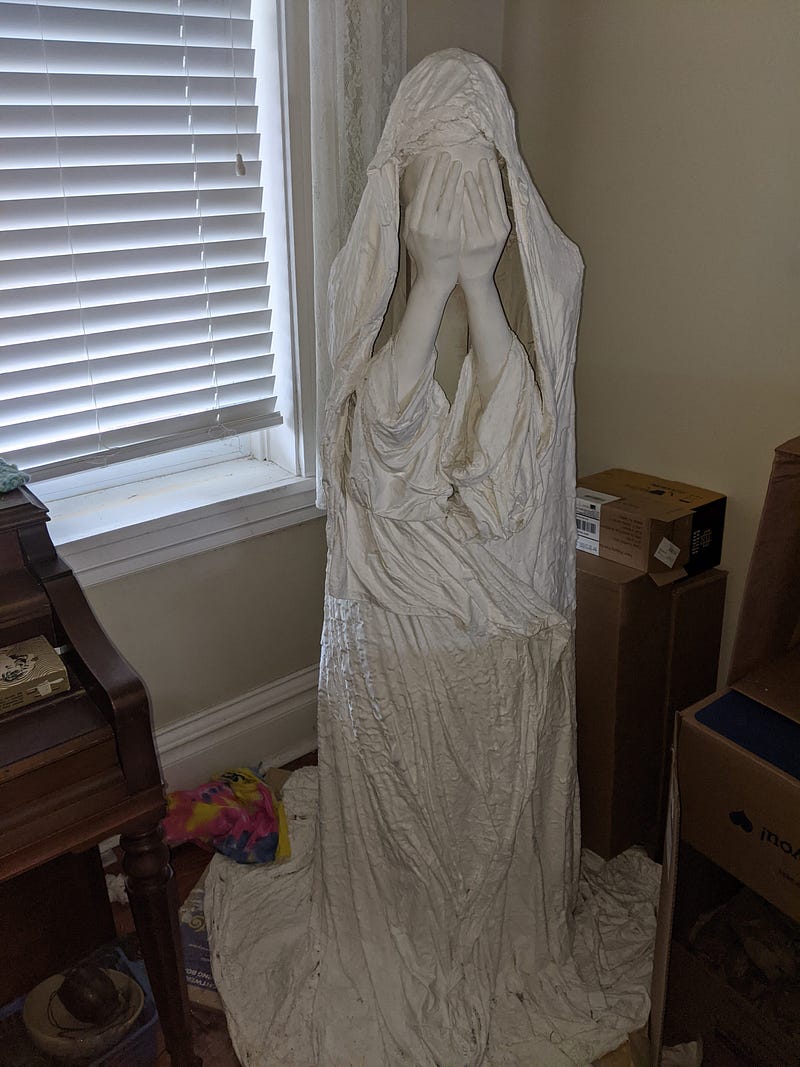
- My wife made a life-sized Weeping Angel sculpture out of plaster in college, which now stands in our living room. It is modeled on our friend Sean, who graciously sat for the molding process breathing through straws for a couple of hours.
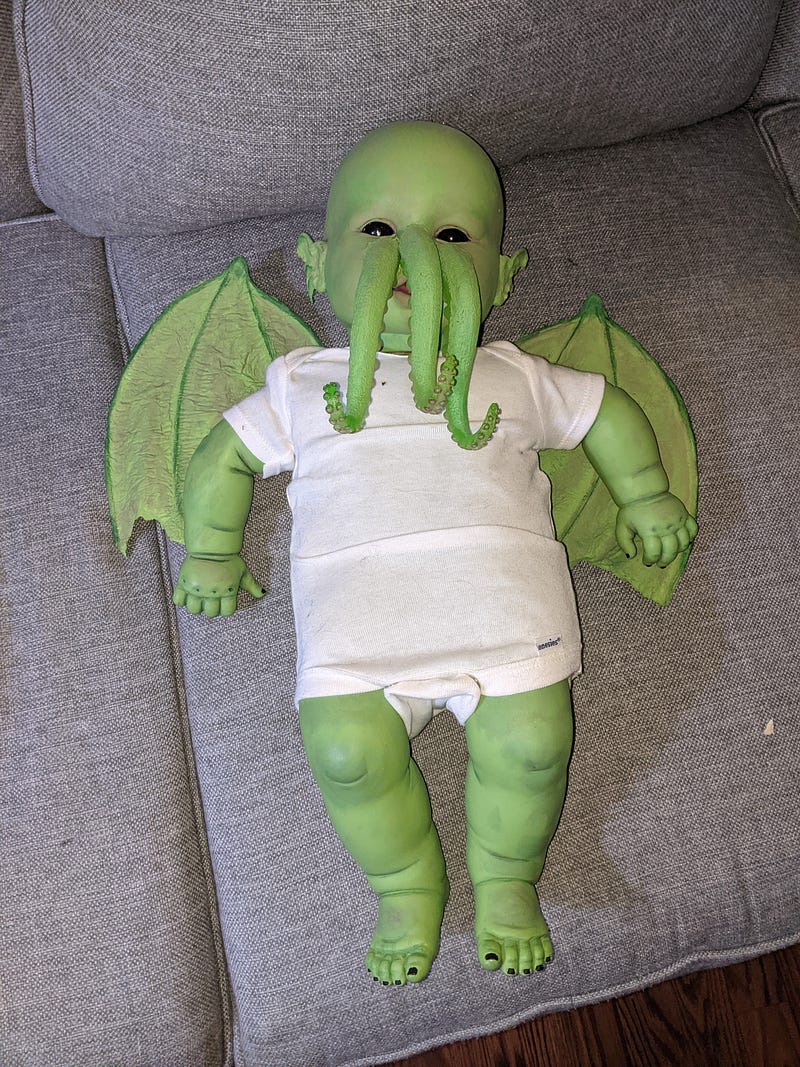
- My wife, being the crafty type, also made a baby C’thulhu. She took it to a convention and ruined a number of people’s buzzes with it.
- I present for my local chapter of the National Alliance on Mental Illness (NAMI), telling the story of my life with mental illness. It’s cathartic to tell my story and be an advocate for people with mental illness.
- I recently stopped taking the medication that my doctor prescribed me after the bender (under the guidance of my nurse practitioner, of course) and am starting up a new medication. The old one stopped working, as meds commonly do when taken for long periods, and while I’m happy to be on a new med that will help me be more stable, I have some sadness that I have to stop the medication that helped me realize that I need meds to function and changed my life for the better.
- I once wrote several short erotic stories, which I published on Amazon under a pseudonym. No, I’m not going to link them.
- I am an Oxford Comma stan. Fight me.
- I love writing here, and even though I don’t have a huge audience and don’t make much money, I mostly do it for the catharsis. The idea that people read this is both funny and fulfilling to me.
Thanks for reading!


