
Why Millennials Like Socialism
A tax increase on the wealthy can help fund healthcare, education, and infrastructure
I am an older millennial, having been born in the mid-80s and grown up with Oregon Trail, dial-up internet, and the dawn of Amazon and Google. I have a wide variety of friends, who like a wide variety of things and have a wide variety of backgrounds.
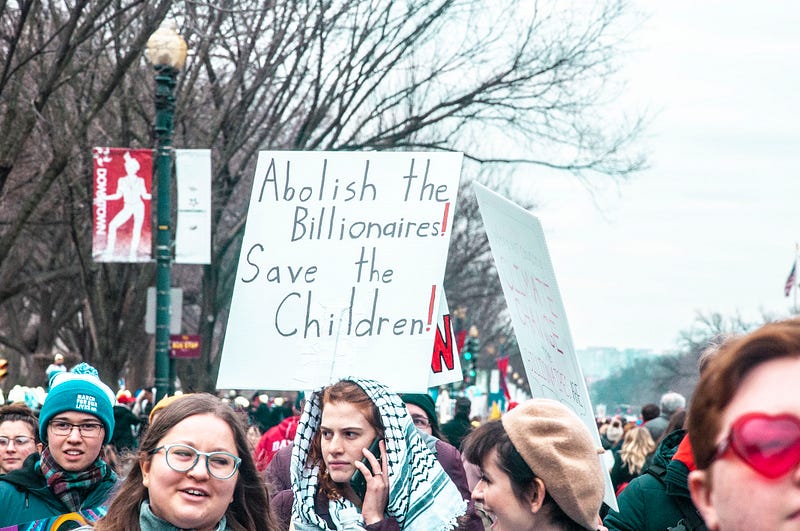
One of the uniting factors among my friends: we are all pretty liberal, with views ranging from “Biden is a reasonable candidate, if you can look past the moldy bits” to “Capitalism is evil and needs to be abolished! Seize the means of production! Eat the rich!” It’s that second group I’d like to focus on today.
Pretty much all of my friends agree that there needs to be universal healthcare in this country. We all agree that we need to tax the rich more, make it easier to vote, and do away with any chance of gerrymandering. We all support Pride and #BLM, and we all think Trump is a monster. But how did we all get here? How is it that so many of my friends, and so many of my generation in general, become so liberal?
First off, let’s start with the general liberal-ness of Millennials. Excluding Gen Z (which is trending quite liberal itself), Millennials are both much more liberal than past generations and have grown significantly more liberal over time, in defiance of the “you’ll get more conservative as you get older and gain life experience” mantra.
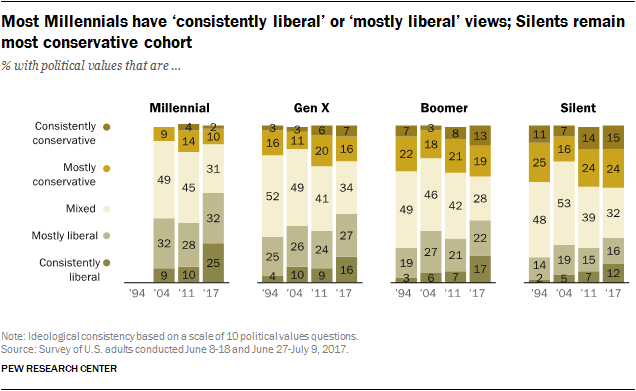
From the Pew Research Center, https://www.pewresearch.org/
Per this chart, that’s 57% of Millennials surveyed in 2017 that are consistently or mostly liberal, compared with 41% as polled in 2004. By comparison, the share of consistently or mostly conservative Millennials has stayed roughly the same, sitting at 12% in 2017 (with a paltry 2% of consistently conservative Millennials).
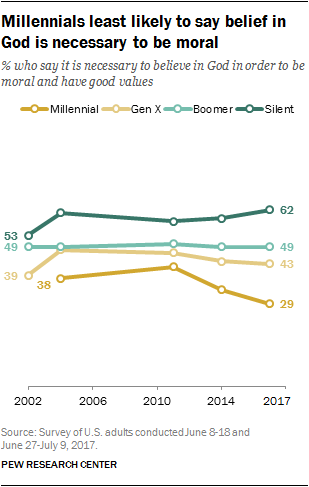
Generally speaking, we love Obama, hate Trump, think that racism is holding back minorities, and are more accepting of LGBTQ+ folks. We’re also more racially diverse and less religious than past generations, and we tend to think that the government needs to do more to solve the problems of its people.
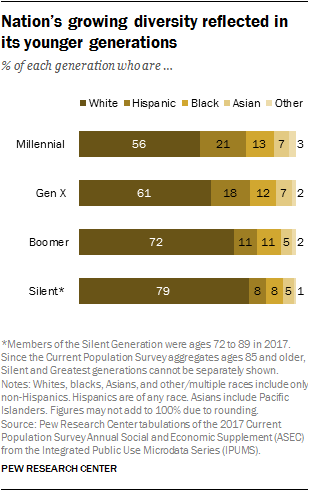
From the Pew Research Center, https://www.pewresearch.org/
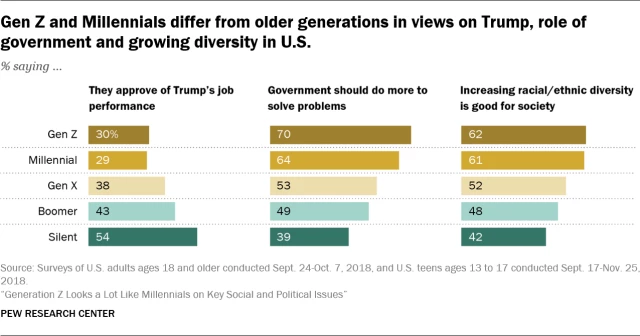
From the Pew Research Center, https://www.pewresearch.org/
So, way back in 2004, we were already pretty liberal, and have only gotten more liberal since then. How did that happen? What follows is an incomplete but evidence-backed guess on my part.
Education
First off, we were shuffled into college degree programs as the only way to guarantee good jobs down the line. This created several issues: student loan debt is massive, vocational jobs are short of people to do them, and while the gap between poor and rich student college attendance has shrunk dramatically, poor students are no more likely to graduate and the gap between poor and rich student graduation rates has grown as a result.
Essentially, what happened was that our well-meaning parents, many of them college graduates themselves, viewed college as a way to a better life for their kids. I distinctly remember my father, on multiple occasions, pointing to a construction worker or landscaper and saying something to the effect of “That is good, honest work, but it’s hard and backbreaking. Stay in school.” He impressed this upon me over and over, subtly reminding me that I was better than that. (Side note: for reasons I will explain later, fuck that shit, and fuck him for implying that.)
As a result, we were shuffled into any degree that we wanted, regardless of potential. It almost didn’t matter what degree it was — I heard something like “you can work anywhere with an English degree!” hundreds of times, which I came to find out was (mostly) crap. This led to a lot of aimless degrees, long meanders through multiple majors, and a whole lot of people just straight-up dropping out of college.
However, college wasn’t cheap anymore. The net cost of tuition, fees, room, and board for a 4-year state college rose by $6,670 between the 1990–91 and 2017–18 school years, adjusted for inflation. That means, if you had paid for a college degree in 1990 using 2018 dollars, you would’ve paid about 55% of what you would pay in 2018. Adjusted for inflation, the net cost of a 4-year state college in 1990 was $4,331.53 using September 1990 dollars.
To pay for that, you would’ve had to work a minimum-wage job for 1,140 hours or about 22 hours per week at the federal minimum wage of $3.80 in 1990. On the other hand, to pay the net cost of $14,910 for the state college in 2018, you would have to work a little less than 40 hours per week at the federal minimum wage of 7.25.
All of this assumes that you have scholarships and grants. If not, that education in 1990 will cost you $9,800, or $5,151.58 in 1990 dollars. That puts your necessary hours at just over 26 per week at minimum wage to cover that cost. In 2018, however, your cost now jumps to $21,400, requiring you to work almost 57 hours per week at minimum wage.
Alternatively, you could do the new young people thing and live at home during college, saving you the cost of room and board. In that case, you’d only pay $3,780 in net tuition and fees, assuming you got any grants and/or scholarships. If not, It would run you over $10,000. All of this, however, is largely made moot by pushing students into loans for their education.
Then there’s the for-profit college system’s effects on student loans. For-profit colleges would often lure students in with lofty promises, only to not deliver or worse, scam them out of their loans. Then there are private student loans, which are often taken out by borrowers who have taken out the maximum in federal student loans. Not surprisingly, they are less flexible in their payment options, which can damage earnings potential, retirement savings, and credit.
Almost none of my friends who went to college remember any of the student loan paperwork we filled out, just that it was necessary for the application. We also don’t seem to remember having any conversations about it with our parents.
Many students received checks for the balance of our loans that weren’t necessary for college costs and did what any rational 18-year-old would do with a large sum of money. As a result, many, many of us wound up with these loans that we don’t remember the details of, just that we need to pay them back.
Unfortunately, not everyone who took out student loans graduated with a degree. Those without a degree are at higher risk of defaulting on their loans despite having smaller balances, perhaps because they didn’t get a degree and have suffered in an economy that increasingly requires one. They’re in good company, though: the overall default rate could hit 40% in the next few years.
So, we went into massive debt, powered through our useless degrees (maybe), and graduated in four(ish) years! Now, our earnings will skyrocket! Unless you graduated in 2009, as I did. I entered the workforce with a 9.5% unemployment rate looming over my head, as did many of my friends.
I was lucky enough to find a part-time job in my field in 2010, and have been through two job transitions and increasing salaries since then, but a number of my friends spent years working retail jobs or administrative assistant jobs that they were massively overqualified for.
Jobs
Millennials, particularly older Millennials, have collectively lost a significant chunk of earnings and net worth potential to student loans, low wage growth, and the recession. As a result, we have largely had to delay milestones like moving out, getting married, and buying a home. This is exacerbated by several moves in the overall job market in the past decade.
First is the increased need for a college degree to get any manner of job. Part-time administrative assistants making $10 an hour need a bachelor’s degree, again, that degree that cost us $25,000. It seems that to get any kind of job that has any kind of prospect of moving up, you have to put yourself tens of thousands of dollars into debt, and it’s not a guarantee.
Interestingly, this has led to a shortage of workers for skilled trade jobs, like ironworking and construction. Remember my dad insinuating that I was better than that? Well, those jobs are highly-paid and in demand, and we kind of need them to build the buildings and infrastructure of this country.
With loads of college grads and even more college dropouts, manufacturing seems the way to go for unskilled labor. Unfortunately, we are losing manufacturing jobs rapidly, even despite the trade war that was supposed to bring them back. Whether you believe that manufacturing jobs are being lost to trade policy, automation, or a bit of both, those jobs are going away, and with them, the prospect of solid wages for people with a high school diploma.
From there, it’s largely a shuffle into service sector jobs. The U.S. is moving very strongly to a service-based economy, first dominated by retail and now moving into healthcare for the aging Boomer population.
Yet despite this trend, we can’t keep up with the demand for medical professionals. Nurses and doctors are both in demand, but those positions require degrees, particularly advanced degrees that cost six figures to obtain. People who want to be doctors have opportunities, but it may not be lucrative enough to afford their student loans. This may also contribute to new doctors shifting away from primary care fields, which are less lucrative than medical specialties.
The other half of the need for medical professionals is a need for home health aides. Again, the boomers are getting older and somebody needs to take care of them. These jobs only require a high school diploma, so they’re more accessible. On the other hand, the median salary is $23,000 a year, which is not enough to live comfortably on by most standards.
Indeed, wages in this country are in a bad spot right now. The minimum wage hasn’t gone up in a decade, and it has bounced around the same level in adjusted 2019 dollars for about 35 years. Meanwhile, the average rent for an unfurnished apartment has increased from $1,064 in 2009 to $1,588 in 2018, a nearly 50% increase in a time when the federal minimum wage was unchanged. For reference, in 1968, the minimum wage was $1.60, which equals about $12.22 today.
Right now, it is incredibly difficult to live on minimum wage. Currently, a single minimum wage puts you well below poverty for a family of two, and two minimum wages put you below poverty for a family of four. That’s assuming you work 40 hours at said wage. The problem is, the minimum wage was explicitly created to be a living wage, not a poverty wage. As of 2017, the living wage in the U.S. was $16.07 per hour for a family of four, with variances depending on location.
The shift from a minimum wage as a living wage to a starter wage has had a lot of effects on society. Minimum wage jobs are often seen as menial, like flipping burgers or washing dishes. They are seen as jobs for teenagers getting entry into the market and learning job skills. Real adults can get better than a minimum wage job.
The much-touted wealth gap has relegated the vast majority of wage and wealth gain to the upper 10% of earners, while the bottom 50% largely get hosed. This has a variety of effects on life expectancy, among other things.
This is exacerbated by the generational wealth gap between boomers and millennials. As compared to 20 years ago, a person age 20 to 35 has seen a decline in real average net worth by about $2,600, while a person age 52 to 70 has seen an increase in real average net worth by $452,400. Compared to twenty years ago, young people are mostly treading water while quite a few older people got the golden ticket.
It’s no wonder when you realize that in the 80s, public companies shifted to a policy of maximizing profits for shareholders. Suddenly, employees and customers were not as important as maintaining the bottom line. Share price became the only thing that mattered.
This impacted a lot of the stuff I described above. Manufacturing chains were shifted overseas and massive investments were made in automation to save money. This helped drive the shift towards education as the path to the middle class, which in turn drove the increase in college costs and student loans. Meanwhile, companies lobbied to keep the minimum wage low to hold onto more profits and increase corporate tax breaks, encouraging the sham of trickle-down economics.
Then, when a massive corporate tax cut was passed in 2017, these companies, eager to show that they cared about their workers, passed savings onto their workers in the form of bonuses. Unfortunately, those bonuses were largely a one-time scheme to get good press, not to be repeated the following year.
Life
So, Millennials are drowning in student debt and chronically underemployed. Is it any wonder that we aren’t buying houses? The homeownership rate among Millennials is estimated to be about 7–8% lower than GenX and Boomers at the same age.
One of the upshots of this is that we are upending the tradition of marriage. From getting married later (or not at all) to cohabitating before marriage to signing more prenups, Millennial marriage looks very different from years past.
Another upshot is that we’re not having as many kids. This is fueled by student loan debt, job security, the political climate, and climate change, among other things. Considering that one month into 2020, we had World War 3 trending, and the year has been defined by a global pandemic and a brutal election cycle, it sometimes feels like it will be a miracle if the human race survives to 2100.
Then there is the ever-present fear that we will be rendered destitute by an unforeseen medical expense. Because health insurance is tied to jobs, and we as a generation are often underemployed, the potential to lose a job and whatever meager insurance we have is a major stressor. Even with insurance, it would not be unreasonable to go bankrupt due to a sudden medical expense, which causes upwards of 60% or more of bankruptcies here.
Not that our student loans are helping either. Thanks to that underemployment trend, it is entirely feasible to pay your student loans on time for ten years and owe more than you started with. This is thanks to income-based repayment plans. When your income isn’t high enough to support the monthly interest payment on your loans, you can find your principle creeping ever upwards every month thanks to that unpaid interest.
This trend is exacerbated by the ongoing Millennial wealth gap, which has our generation holding 41 percent less wealth than a similarly aged adult in 1989. The wealth of this country is increasingly being concentrated in the upper class. The middle class is shrinking, both in size and in the percentage of wealth held, while the upper class is experiencing a boom in wealth. This is reflected in stock ownership — while 55% of households hold stocks, the top 1% holds 51.8% of all stocks, and the top 10% holds 87.2% of all stocks.
Then there’s the fact that Millennials are constantly blamed for killing entire industries. We’re apparently killing napkins, beer, and Applebee’s, among many, many other things. Unfortunately for the inflammatory headline writers, it wasn’t necessarily our choice. All the aforementioned economic woes we’ve faced, coupled with the standard shifting trends that define all brands and leave obsolete ones behind, have created a perfect storm for brand upheaval as we come of age. Indeed, a Millennial writer for Business Insider, who themselves wrote numerous “Millennials are killing” headlines, wrote a recent article lamenting the trend and laying the blame at the feet of poor economics.
So, what does this all mean?
What all of this means is that Millennials, and Gen Z behind us, are becoming more progressive and leaning into socialism. We’re a generation of Bernie Bros who believe that corporations and the wealthy need to be taxed at the levels that funded the greatest economic expansion the country ever saw in the 50s and 60s. We were born into trickle-down economics, and we’ve seen it enrich the upper class and screw us all over. With the benefit of hindsight, we can see how much of a monster Reagan really was, and how much he sold the middle class a pack of lies.
Now, I want to be clear about something. I use the term “socialism” to mean “democratic socialism,” a la Bernie Sanders and Liz Warren. I’m not talking about China’s brand of socialism, I’m talking about the kind of socialism that’s found in pretty much every other industrialized country in the world. The kind that has a fairer tax structure that pays for universal health care and affordable college tuition.
You see, we as Millennials have started looking elsewhere in the world for ideas thanks to the power of the internet, and we’ve seen a lot of interesting things. First off, America’s Democrats and “extreme left,” as a lot of Republicans like to characterize it, is actually fairly moderate in most other industrialized countries. Turns out that in places like Scandinavia, even the right-wing likes their universal healthcare.
Speaking of Scandinavia, Millennials are a fairly educated generation, thanks to the aforementioned push for us to go to college, so we are well-versed in doing research. The internet has again helped us in this effort, and the result is that we read articles like this one, where we see that Finland is the happiest country in the world and the U.S. ranked 18th, after every Scandanavian country and much of Europe. We read the analysis that says that the state-funded education system that focuses on experiential learning over rote testing, plus a general reverence for education in general, helps bolster this.
We then read the list of the healthiest countries in the world, and find that the U.S. ranks 35th, below places like Slovenia, Costa Rica, Estonia, and even the much-reviled Cuba. We see a host of countries with universal health care at the top of the list, and we see that the U.S. is below the global average.
We see this all over the different measurements of happiness and equality. Scandinavia cares more about inequality than America. In measurements of freedom, arguably the founding principle that Americans point to as what makes us the best in the world, America ranks 15th. We see that America ranks 22nd for median wealth, after places like Qatar and Hong Kong. On all the seemingly-important measures of health, wealth, and happiness, we are lagging.
For Millennials, socialism is the answer. We see that we need to increase taxes on the wealthy, institute a wealth tax and a death tax on high-earners, make a more equitable corporate tax structure, and use that money to fund healthcare, education, and infrastructure. We understand that our healthcare is the most expensive of industrialized countries, yet we get less for it, and we understand that it doesn’t have to be that way.
We see the right wing’s attack on education, characterizing it as a tool for left-wing indoctrination while keeping an ignorant populace sated on a diet of Fox News and OAN conspiracies. We see how they attack socialism as the downfall of American freedom and liberty when the countries that have adopted it are freer and more just than we are. We do not shy away from socialism because the term, like words in any language, has a new meaning in the 21st century.
Meanwhile, the right-wing’s “defense” of democracy sees a militarized police force killing unarmed citizens and committing brutality against protestors. Their “defense” of the free market sees the disenfranchisement of the bottom 50% of the population, along with minorities and women, and the empowerment of a few hundred billionaires who do nothing but hoard wealth. We look at those billionaires and ask ourselves: do they even need to exist? Why does one person need a billion dollars, much less a hundred billion dollars? What else can we do with that money?
Right now, we’re at a turning point. The Republican party has grabbed hold of power and is stripping away many of the things that make America what it is, all to do as much damage as possible before demographics make their current platform irrelevant. Donald Trump is emblematic of everything that makes America awful — a wealthy white guy engaging in self-dealing and doing everything he can to enrich himself and his friends at the expense of his political office with no regard for that office’s standing. It needs to stop.
And for me, and many like me, socialism is the way. Wealth redistribution isn’t a dirty word anymore. Higher taxes are a welcome change of pace since they pay for things that we desperately need. The government doesn’t have to be the enemy, it can be the solution. Corporations don’t have the worker’s best interests at heart, and that has to change. No more earning money for the shareholders at the expense of everyone else, no more suppressing wages and cutting benefits, no more billionaires on the backs of low-wage overworked employees.
The rest of the industrialized world, and even some less-industrialized countries, have had this figured out for a while. Why can’t we? We’re supposed to be the greatest country in the world, but we constantly fall down on the things that make a country great.
We can do better than unfettered capitalism and crony politics. Let’s build a country with a representative government that works for the people. Let’s build a country where the minimum wage is a living wage and companies work for their employees, not their shareholders. Let’s build a country where everyone has a shot and restore the American Dream to its former glory.
If we’re the greatest country in the world, it’s high time we started acting like it.
Disclaimer: I use a lot of data in this article from Pew Research Center, one of my personal favorite data sources. The disclaimer per their terms of service: Pew Research Center bears no responsibility for the analyses or interpretations of the data presented here. The opinions expressed herein, including any implications for policy, are those of the author and not of Pew Research Center.


