What Kind of Person Kills Themselves?
A rundown of suicide facts and what you can do about it.

Suicide is this sort of mystical thing for many people. Every now and then, a famous person will end their life, and the media will cover it, and everyone mourns for a while until it gets swept out of the public consciousness a week later. We as a country start to have a conversation about suicide, only for some other newsworthy thing to drag the conversation away.
But, in spite of the media blitz and the donations that fly in and the spike in both calls to the suicide hotline and completed suicides, it continues to be an issue. Even after the calls for action have grown quiet and the money stops flowing, people throughout the country continue ending their own lives. But who is it that is doing this? What predisposes a person to end their own life? It turns out that there are quite a few factors that influence someone’s decision to die by suicide.
The obvious ones are people with mental illness, substance abuse, past suicide attempts, or a family history of any of those things. These people get a lot of media coverage, typically because a famous person who dies by suicide often has one or more of these risk factors that are highly publicized after their death. Anthony Bourdain, Kate Spade, and Robin Williams all had mental illnesses that contributed to their deaths.
Victims of abuse and sexual violence are another group that often attempt suicide; veterans and service members are another group that often gets more publicity than average. Having been in prison or jail also increases one’s risk. Generally speaking, the traumas experienced by these groups leave them at higher risk of mental illness, such as post-traumatic stress and depression, and contributes to higher rates of suicide.
LGBTQ folks, particularly youth, are also at great risk. Nearly 30% of LGBTQ youth had attempted suicide, and LGBTQ youth are at greater risk of depression and substance use. This is particularly prevalent in schools where there are no support groups or gay-straight alliance groups. Additionally, having to hide one’s identity or being out in a hostile environment also increased risk factors for mental health issues and suicide.
These all seem fairly obvious. Mental health issues and trauma are very obvious links to suicidal behavior. What if I told you that simply being young, or old, or male, increases your chances of dying by suicide? What if I told you that about twice as many people died by gun suicides than gun homicides? Would you believe me?
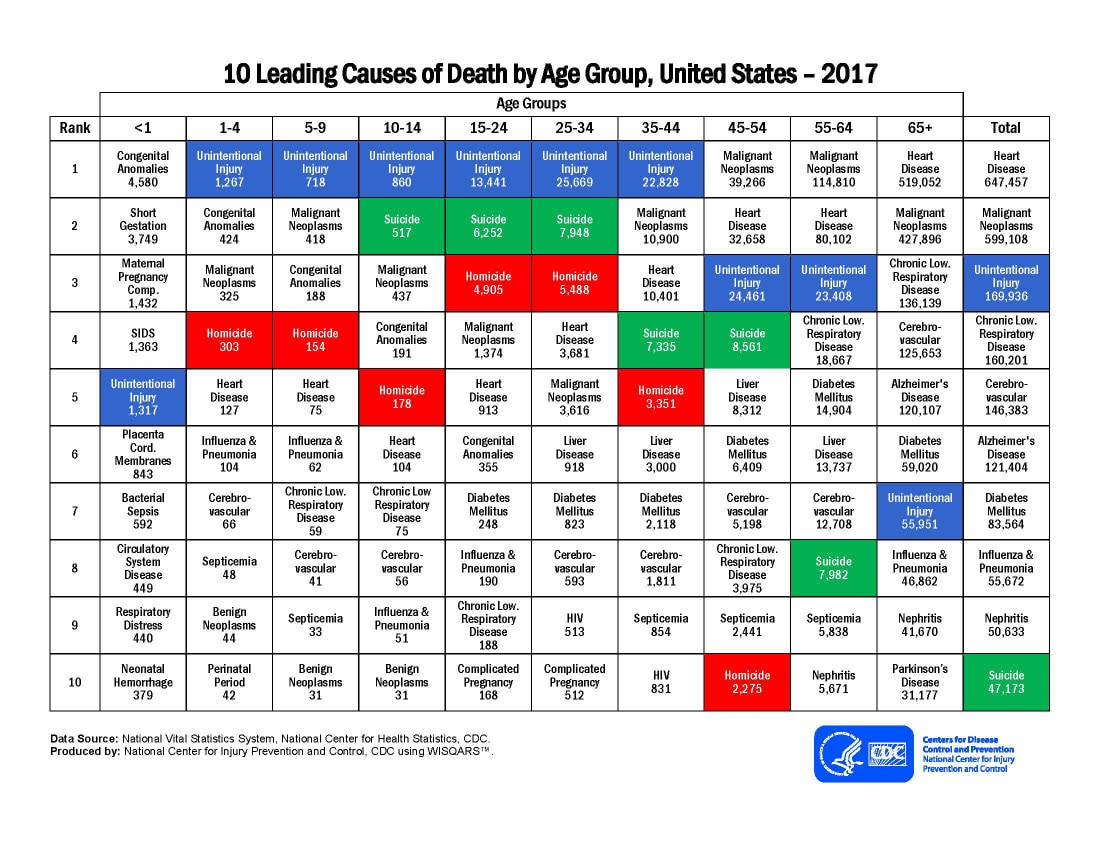
In the United States, suicide is the tenth leading cause of death. For people ages 10–34, it is the second-leading cause of death, with only unintentional injuries causing more deaths. For people ages 35–54, it is the fourth-leading cause of death. In 2017, 47,173 people in the U.S. died by suicide, while 19,510 people died by homicide. Additionally, the suicide rate per 100,000 was highest for men age 65 and up.
Generally speaking, men — particularly non-Hispanic white and American Indian men — have the highest rates of completed suicides, accounting for nearly 80% of all completed suicides. On the other hand, women are more likely to attempt but not complete suicide.
This often breaks down to method: while women prefer less-fatal means such as poisoning or overdosing, men prefer deadlier means, such as firearms and suffocation.
Because of this, firearms are the leading suicide method, accounting for about half of all completed suicides in 2017 at 23,854. On the other hand, there were 14,542 gun homicides in the same year, according to data from CDC WONDER, putting gun suicides at almost two-thirds of all intentional gun deaths.
Of men who completed suicide in 2017, 56.0% used a gun. While gun owners themselves may not be inherently more at risk of suicide, they are often at higher risk of completing suicide when they attempt because of their access to an incredibly lethal means.
To make matters worse, suicide is often contagious. There was a notable spike in completed suicides after Robin Williams’ death by suicide in 2014, particularly among men and younger adults. Generally speaking, suicide attempts and completions rise after media reports of a political or celebrity suicide.
In my own experiences working for a suicide hotline, we got a spike in calls after the deaths of Anthony Bourdain and Kate Spade. Callers often say “if someone so famous and beloved can’t make it, how could I?”
In 2017, there were 47,173 deaths by suicide, which is a mere fraction of a percent of the population of the U.S. However, it is estimated that there were 1.4 million suicide attempts, 3.2 million people who made suicide plans, and 10.6 million adults who had serious thoughts of suicide. Over 10% of adults ages 18–25 had suicidal thoughts in 2017.
While men complete suicide more often, women are at higher risk of suicidal thoughts. Of high school students, 22.1% of females and 11.9% of males considered suicide; 17.1% of females and 9.7% of males planned suicide; and 9.3% of females and 5.1% of males attempted suicide. Over 5.8 million women in the U.S. had suicidal thoughts in 2017, about 1 million more than men.
Looking at all of this data, we begin to see a portrait of the people who attempt and die by suicide. The typical person who dies by suicide is a non-Hispanic white male under 35 with a mental health or substance use disorder and who uses a firearm. The typical person to attempt suicide is a young non-Hispanic white female who attempts to poison herself. They are disproportionately LGBTQ+ and have often suffered from trauma or abuse.
So what do we do about this? More funding for mental health services, especially for the populations above, would be a good start. More realistically, we need to start normalizing mental health treatments such as medication and talk therapy and reduce the stigma around people with mental health conditions.
We should also encourage programs that train more mental health practitioners and doctors, expand the abilities of nurse practitioners to prescribe psychotropic medications, and expand telephone and computer-based therapy and treatment.
That doesn’t help you, though. What can you, the reader of this article, do to help address suicide in this country, or anywhere? One thing you can do is say its name. If you suspect someone you know is feeling suicidal, ask them if they’re feeling suicidal. It’s easy to dodge an open-ended question like “are you doing okay?” and people often don’t want to trouble their friends due to depression or anxiety.
Asking directly often makes the person feel better and more willing to admit it because you show that you’re not afraid to talk about it. That can be encouraging when you don’t feel like you have anywhere to go: it shows that somebody is there to help.
We live in a marvelous world where everyone has a tiny computer in their pocket. As such, it can be easy to access crisis hotlines and services, and there is a multitude of them. Don’t be afraid to call on behalf of someone who can’t call themselves.
If you’ve determined that someone is suicidal, don’t feel like you have to help them by yourself. You can call one of the helplines or access a text-based service and they can help you. It’s okay to not know how to help. If you’re feeling suicidal yourself, call a hotline and be honest. You’re not the only one.
If you have a mental illness or substance use disorder that makes you prone to suicidal thoughts and behaviors, find a support group. There are numerous groups throughout the country that allow you to connect with other people like you who can help you cope with your feelings and feel less alone.
There are also social media support groups that are active and have thousands of members. I recently joined one, and both the number of posters and the number of supportive responders is amazing to me.
Another thing you can do is change the narrative. People often use the term “commit suicide,” which is a throwback to the time when suicide was a literal crime. Many religions consider suicide to be a sin and speak in absolutist terms about eternal damnation and torment from suicide.
The threat of punishment is used as a bludgeon to beat people away from suicide, which often makes them feel more depressed and hopeless and often brings them closer to the edge. Changing the language, such as using “died by suicide,” can subtly but positively alter the narrative.
Talk openly among your friends about mental health. Make it normal to talk about your feelings with others. Many people, particularly men, often feel like there isn’t anyone to talk to about the things that bother them.
It’s considered rude or inappropriate in many circles to discuss your emotions, leading people to bottle their depression and anxiety to save face. Tell your friends it’s okay to be open with you, and encourage them to get help if they need it.
Practice and encourage self-care. Don’t be afraid to take a day to do something for yourself, and encourage your friends to do the same. Don’t judge your friends for dropping out of an event; they may be overwhelmed, anxious, or depressed and simply don’t have the energy to be out in the world. If your friend is working too much, try to encourage them to take a day off. If you are feeling overwhelmed or anxious about work or life, find a way to decompress.
We as a society have a long way to go before we can properly address suicide. Simply being aware of the risk factors and how to help address them can go a long way toward helping. Suicide is often the result of hopelessness, the belief that there is nothing that can be done to improve things. We can all work harder to reduce the stigma around suicide and mental illness and show people that not only is it okay to feel depressed and hopeless, but that there is help, there is hope, and there is a way out.
If you are suicidal or in crisis, call the National Suicide Prevention Lifeline at 1–800–273–8255.