
3 Ways the Drama Triangle Shows Up in Narcissistic Abuse
Here’s how it impacts your relationships long after.

Jeff told his girlfriend she needed to move out, and she threw herself down the stairs, breaking her ankle. They hadn’t gotten along for a while. She was increasing his stress and disrupting his sleep. His work performance was sliding. His request was simple and straightforward.
Now, rather than breaking up and going their separate ways amiably, his girlfriend created a situation where she’s unable to find a new place, pack, or move anytime soon. And Jeff* is left to either insist that she leave in her injured state or take care of her until she recovers.
As a narcissistic abuse recovery specialist, I’ve heard it all. This story is extreme but not unusual. It’s a classic example of the Karpman Drama Triangle.
The Karpman Drama Triangle
Dr Stephen Karpman, M.D. first described the drama triangle back in 1968. It includes three interrelated roles — rescuer, persecutor, and victim.
The person in the role of victim feels powerless upon encountering a challenge. The other person also believes the victim is powerless and either tries to help (rescue) or judge harshly (persecute).
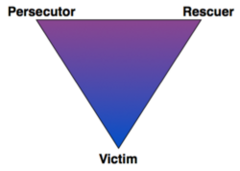
Early research found the Drama Triangle was common in families with an alcoholic parent. The alcoholic adult was in the role of persecutor. Their spouse was in the role of rescuer, enabling their partner’s behavior and hiding it from the world. The children were in the role of victim.
The Drama Triangle and Narcissistic Abuse
In narcissistic abuse, it would be simple if the narcissist were always in the role of persecutor and the victim in the role of victim, but this isn’t the case.
This is an important concept, so let’s break it down.
For purposes of clarity, I’ll refer to the person using narcissistic tactics as the narcissist and the person they use these tactics on as the victim in describing narcissist/victim scenarios.
It’s important to note that either the narcissist or the victim can play any of the three interrelated roles — and they can switch between them quickly.
The Drama Triangle in narcissistic abuse plays out in three different ways.
#1 The victim in the role of victim
In this case, the victim of narcissistic abuse actively plays the role of victim. The narcissist may choose the role of rescuer and love bomb or intermittently reinforce. They may also choose the role of persecutor and devalue the victim further.
Sarah* discovers that her husband, Seth*, is cheating — again. She feels hurt and betrayed. She also feels it’s impossible to leave because she fears a court will give Seth 50% placement of their two children.
Sarah has been victimized by Seth. Because she feels completely powerless to solve her problem, she also plays the role of victim in the drama triangle. Seth initially tries to make Sarah feel better — saying he wants to make things up to her. He plays the role of rescuer.
After a few days, Seth grows tired of rescuing. He’s tired of talking about it. He starts telling Sarah that he cheated because she isn’t “in the mood” often enough. He leaves to go out without telling her where and stays out all night, knowing it will drive her out of her mind. He has switched to playing the role of persecutor.
#2 The narcissist in the role of victim
The narcissist often plays the role of victim, especially if they are a covert, vulnerable narcissist, or if they wish to avoid accountability. The victim who participates in the triangle must take on the role of persecutor or rescuer. Those are the only roles left.
David* catches his wife, Danielle*, lying about her spending. She has a history of lying and this is a point of contention between the two of them. When he confronts her, she feels attacked, powerless, and takes on the role of the victim.
Danielle starts sobbing, reminding David how her family was so poor growing up that she wasn’t allowed to buy anything, and — if she did — she needed to lie about it to remain safe.
David swoops in to comfort her, reassuring Danielle that he is not her father, and she can trust him. David plays the rescuer.
#3 The constantly changing scenario
Sometimes, it’s nearly impossible to keep track of who is in which role, as the roles change very quickly. It’s one of the ways the narcissist disorients the victim.
This is the case with Jeff* and his girlfriend. Jeff is a victim of his girlfriend’s narcissistic abuse tactics that increase his stress level, disrupt his sleep, and negatively impact his work performance.
He gathers the strength to tell her they need to break up and she needs to move out. She then “accidentally” falls and breaks her ankle. Now she is injured, with nowhere to go and no ability to pack and move her things. She feels powerless and has shifted to the role of victim.
Jeff now feels powerless. He either must tell her to go anyway and look like a complete jerk (persecutor) or let her stay and take care of her until she recovers (rescuer) AFTER he’s ended the relationship. He feels he can’t win and shifts back to the role of victim.
His girlfriend becomes more and more demanding with her care and belittles Jeff for his efforts. She knows he feels powerless (after all, she created the situation) and judges him for being so weak. She is now again persecuted.
Eventually, she crosses the line, and Jeff is distraught (victim). She swoops in to emotionally rescue him (rescuer). Then, her devaluation of him crosses the line (persecutor), and he tells her to go, broken ankle or not (persecutor). She’s again become the victim.
Why the Drama Triangle is Harmful
You may be reading this thinking, “Sounds pretty normal.”
While this pattern is common, it is an unhealthy behavior pattern that creates conflict and eliminates problem-solving for both parties, keeping them woefully stuck. It reinforces the feeling of powerlessness and prevents problem-solving and conflict resolution.
When one has acclimated to the triangle as their “normal” method of interaction, it’s easy to feel powerless when your only choices are one of the three roles.
Even worse, once you are used to the pattern, it feels familiar, and you recreate this dynamic with others.
For example, if you are used to the role of victim, you’ll tend to attract new saviors (rescuers) and abusers (persecutors).
Takeaways…
The Karpman Drama Triangle is a common, unhealthy behavior pattern that keeps its participants disempowered and stuck while being invisible to those who are in it.
The participants alternate between roles of victim, persecutor, and rescuer, sometimes very quickly. This contributes to the destabilization of the narcissistic abuse victim and makes it easier for the narcissist to take control.
Even long after the relationship has ended, the narcissistic abuse survivor is likely to create a similar dynamic in future relationships, increasing the possibility of revictimization.
*Names changed for privacy.
Disclaimer: This is for informational and educational purposes only and does not constitute medical or legal advice. It’s a recount of how I’ve been able to help myself and others heal from narcissistic abuse and how it may be helpful to you.
Dr Melissa Kalt, MD, is a narcissistic abuse survivor turned recovery specialist and CEO of Sustainably You, where we help Soul-driven leaders transcend their past experience of narcissistic abuse to create massive leaps in their health, wealth, and relationships. Download her free guide, 7 Surprising, Costly Mistakes Leaders Make After Narcissistic Abuse, and find information about working with her on her website.


