avatarJillian Enright

Free AI web copilot to create summaries, insights and extended knowledge, download it at here

4420

Abstract

dging them and making room for people to seek clarification, we pathologize and try to “<i>modify</i>” their thought patterns.</p><h2 id="a59d">Cognitive therapy</h2><p id="92b2">When I was in university, we were taught cognitive behavioural therapy (CBT) counselling and intervention techniques.</p><p id="3a1e">In essence, CBT is intended to challenge unhelpful thought patterns which cause discomfort, anxiety, and distress. <a href="https://www.anxietycanada.com/articles/what-is-cognitive-behaviour-therapy/">CBT contends</a> it is the <i>meanings</i> we assign to, and assumptions make about, a situation which impact how we feel and act, rather than the situation itself.</p><p id="15cc">The role of the therapist is to challenge, and then help the client challenge, distorted or inaccurate thoughts — called <a href="https://dictionary.apa.org/cognitive-distortion">cognitive distortions </a>— which are causing the individual difficulty.</p><p id="4745">The problem with this is it comes from a deficits-focused perspective: it assumes the client’s thinking is disordered or “distorted”, and needs changing.</p><p id="6d34">Rather than validating the client’s feelings and offering tools to manage the distress, it can sometimes lead to clinicians <a href="https://doi.org/10.1186/s40359-021-00658-8">invalidating or dismissing</a> their client’s feelings — the opposite of what you need for an effective therapeutic relationship.</p><p id="6aed">This can be particularly true for <a href="https://readmedium.com/how-to-know-if-youre-autistic-644ea6050596">Autistics</a> and other <a href="https://readmedium.com/what-is-neurodiversity-b0e6e902ef9a">neurodivergent</a> people, who literally and neurologically experience the world differently from neurotypicals (NTs). Challenging an Autistic person’s interpretations or experiences based on a neurotypical worldview could be harmful, and certainly <a href="https://doi.org/10.1186/s40359-021-00658-8">wouldn’t be helpful</a>.</p><p id="9529">Depending on where you do your research, there are anywhere from 10 to 15 different types of cognitive distortions. In the interest of brevity, I’ll just touch on two here.</p><figure id="4a0a"><img src="https://cdn-images-1.readmedium.com/v2/resize:fit:800/1*yswJoTzJiHi2_cSXxsaGKg.png"><figcaption>Created by author</figcaption></figure><h2 id="9bf5">Catastrophizing</h2><p id="2757"><a href="https://dictionary.apa.org/catastrophize">Catastrophizing</a> is described as thinking which exaggerates the negative consequences of events or decisions, which then leads to worries, and can quickly escalate to worst-case scenarios.</p><p id="5272">Sometimes people do catastrophize, especially kids — “<i>this is the worst ever</i>!” This, however, is developmentally appropriate for a child, not disordered thinking.</p><p id="d8ea">That aside, all people experience and process events differently. When people are neurodivergent, experiencing the world differently is a key feature of having a differently wired brain.</p><p id="6675">This also fails to consider people’s trauma histories, the skills they may or may not have developed growing up, or even events leading up to the incident itself.</p><p id="6452">If I get cut off in traffic on a good day, I’ll probably mutter some choice under my breath, maybe give the driver a “WTF?” look. If I get cut off in traffic after I’ve already had a fight with my spouse, lost my keys, spilled my coffee, and am late for a meeting — well, then I might just feel a sense of impending doom.</p><figure id="7f4d"><img src="https://cdn-images-1.readmedium.com/v2/resize:fit:800/1*_9YRxHCuuphlRdk6P0ehNA.png"><figcaption>Created by author</figcaption></figure><h2 id="0ef6">“Should” statements</h2><p id="bce6">These are rigid expectations about what a person “<i>should</i>” do, which are enforced on oneself and others.</p><p id="bb3e">It’s no surprise to me that many neurodivergent people struggle with these — they’ve been drilled into us our whole lives! We frequently don’t behave the way people think we’re <i>supposed</i> to, for which we are chastised, corrected, and criticized.</p><p id="218b">A lot of Autistics <a href="https://readmedium.com/uncovering-the-camouflage-ee609e003889">mask</a> by learning and internalizing these implicit rules as a matter of self-preservation: we need to learn these <a href="https://readmedium.com/most-social-norms-are-arbitrary

Options

-283db0b477af">arbitrary social norms</a> to avoid ostracization and rejection.</p><p id="e38a">Society beats these expectations into us, so we figure them out and try to follow them for a while. Society then turns around and tells us we’re <i>too</i> rigid and are experiencing cognitive distortions as a result.</p><p id="f62f"><i>Sigh</i>.</p><h2 id="5481">However</h2><p id="6e67">There are occasions when our thought processes really <i>do</i> increase our distress or anxiety. How do we support loved ones with this, or address this in our own lives?</p><p id="9b8a">My <a href="https://readmedium.com/emotional-skillset-power-up-5d555d257119">next piece</a> will offer support for challenging cognitive distortions <i>without</i> the <a href="https://readmedium.com/education-sponsored-gaslighting-f2baf482d1d6">gaslighting</a>.</p><figure id="215d"><img src="https://cdn-images-1.readmedium.com/v2/resize:fit:800/1*Mlx5D5sX5teFghbzbexPuw.png"><figcaption></figcaption></figure><h2 id="bcbb">Ways to support my work</h2><p id="e63c">You can leave a “tip” on Ko-Fi at <a href="https://Ko-Fi.com/NeurodiversityMB">https://Ko-Fi.com/NeurodiversityMB</a></p><p id="036c">Become a paid subscriber to <a href="https://twoemb.substack.com">my Substack publication</a></p><p id="ec41">Check out my online store at <a href="https://NeurodiversityMB.ca/shop">https://NeurodiversityMB.ca/shop</a></p><p id="ebba">Read and share my articles from <a href="https://twoemb.medium.com">twoemb.medium.com</a></p><h2 id="6f6f">Part two</h2><div id="8d1a" class="link-block"> <a href="https://readmedium.com/emotional-skillset-power-up-5d555d257119"> <div> <div> <h2>Emotional Skillset Power-Up</h2> <div><h3>Support for challenging cognitive distortions without the gaslighting</h3></div> <div><p>medium.com</p></div> </div> <div> <div style="background-image: url(https://miro.readmedium.com/v2/resize:fit:320/1*9XkuJtHkLqkbkVYxPMe_Qg.png)"></div> </div> </div> </a> </div><h1 id="5d13">Related Articles</h1><div id="9bb7" class="link-block"> <a href="https://readmedium.com/education-sponsored-gaslighting-f2baf482d1d6"> <div> <div> <h2>Education-Sponsored Gaslighting</h2> <div><h3>Some social-emotional programs are ableist and invalidating</h3></div> <div><p>medium.com</p></div> </div> <div> <div style="background-image: url(https://miro.readmedium.com/v2/resize:fit:320/1*lSwYyvQPd7htKM_W-Ts0pA.jpeg)"></div> </div> </div> </a> </div><div id="dfae" class="link-block"> <a href="https://readmedium.com/interoception-and-emotion-regulation-fd6d5b877f2c"> <div> <div> <h2>Recognizing How Emotions Feel Physically In Our Bodies</h2> <div><h3>Interoception & Emotion Regulation: What one has to do with the other, and why they’re important</h3></div> <div><p>medium.com</p></div> </div> <div> <div style="background-image: url(https://miro.readmedium.com/v2/resize:fit:320/1*tqWoTd3l17O8Bu_E1m-7tg.png)"></div> </div> </div> </a> </div><div id="919c" class="link-block"> <a href="https://readmedium.com/the-power-of-validation-483bb53f9b93"> <div> <div> <h2>The Power of Validation</h2> <div><h3>A profound way to strengthen any relationship</h3></div> <div><p>medium.com</p></div> </div> <div> <div style="background-image: url(https://miro.readmedium.com/v2/resize:fit:320/1*xBmjJaLLpHtM-qJZ_1djfA.jpeg)"></div> </div> </div> </a> </div><h2 id="55a9">References</h2><p id="c16a">Sharma, S., Hucker, A., Matthews, T., Grohmann D., Laws, K. R. (2021). Cognitive behavioural therapy for anxiety in children and young people on the autism spectrum: a systematic review and meta-analysis. <i>BMC Psychology 9</i>(151). <a href="https://doi.org/10.1186/s40359-021-00658-8">https://doi.org/10.1186/s40359-021-00658-8</a></p></article></body>

Reframing Distorted Thoughts

Our cognitive processes are a combination of neurology and learned coping strategies

Created by author on Canva

A disclaimer

This will be more of a discussion about reframing the concept of distorted thinking, rather than one which tells you how and why your thoughts and feelings are wrong.

Our cognitive processes are a combination of neurobiology and learned coping skills. We think the way we do because our brains are wired that way, and because our ways of thinking and doing have been somehow useful to us in the past.

While we may need to develop some additional strategies when the old ways of thinking and doing are no longer helpful, this does not mean what we needed to learn is now disordered, it just means we’re ready to upgrade our skillset.

Kind of a powering up, if you will.

Fear of the unknown

When I was in university, I had an interesting group of friends. We were all interested in psychology, having met in the psychology department at school, but that seemed to be where our similarities ended.

They’re all fantastic people and I learned a lot from them, in large part because of our differences.

One day after classes, we spent the afternoon hanging out together. I can’t remember all of what we did, but it included walking around downtown and going out for coffee.

After one of our friends left, another got a text from him.

So, I’m guessing you were all talking about me right after I left?”

Instead of rolling her eyes at his insecurity, she told him exactly what our conversation had been after he said goodbye, none of which had involved him.

A little paranoid, isn’t he?” I asked in a judgemental tone. I’ll admit, it was not my finest moment. I was still heavily masked and hid my own insecurities behind a blasé façade.

My friend answered something along the lines of, “Better for him to check in instead of suffering with anxiety from the assumptions he’s making.”

She was so right. It’s not all that far-fetched to think people may talk about you right after you leave a group — not necessarily in a negative or malicious way — they may even say something nice about you.

Lessons learned

I can admit now that I am incredibly socially anxious and insecure, and often worry about what people think of me. I have come to better accept myself and embrace my differences, but after a lifetime of bullying, criticism, and rejection, it’s easy to understand why I’d be self-conscious.

I wish North American culture were more blunt and straightforward; that people would say what they mean and mean what they say. Maybe then people wouldn’t play those social mind-games and wouldn’t have to wonder what people think — they’d just know.

My friend was much wiser and more compassionate than I was at that time. Instead of dismissing or mocking our friend’s anxiety, she validated him and gave him a straight answer. She respected his willingness to put himself out there and ask for reassurance.

Created by author

This was nearly 15 years ago, but over the past decade, not enough has changed in how we approach these types of worry thoughts. Instead of simply acknowledging them and making room for people to seek clarification, we pathologize and try to “modify” their thought patterns.

Cognitive therapy

When I was in university, we were taught cognitive behavioural therapy (CBT) counselling and intervention techniques.

In essence, CBT is intended to challenge unhelpful thought patterns which cause discomfort, anxiety, and distress. CBT contends it is the meanings we assign to, and assumptions make about, a situation which impact how we feel and act, rather than the situation itself.

The role of the therapist is to challenge, and then help the client challenge, distorted or inaccurate thoughts — called cognitive distortions — which are causing the individual difficulty.

The problem with this is it comes from a deficits-focused perspective: it assumes the client’s thinking is disordered or “distorted”, and needs changing.

Rather than validating the client’s feelings and offering tools to manage the distress, it can sometimes lead to clinicians invalidating or dismissing their client’s feelings — the opposite of what you need for an effective therapeutic relationship.

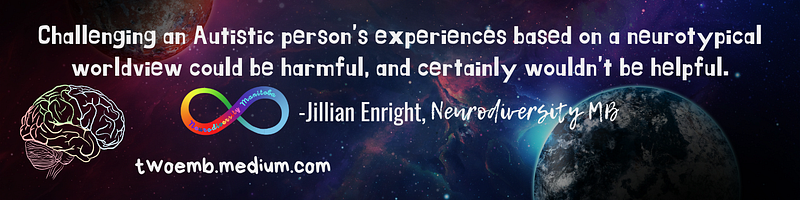
This can be particularly true for Autistics and other neurodivergent people, who literally and neurologically experience the world differently from neurotypicals (NTs). Challenging an Autistic person’s interpretations or experiences based on a neurotypical worldview could be harmful, and certainly wouldn’t be helpful.

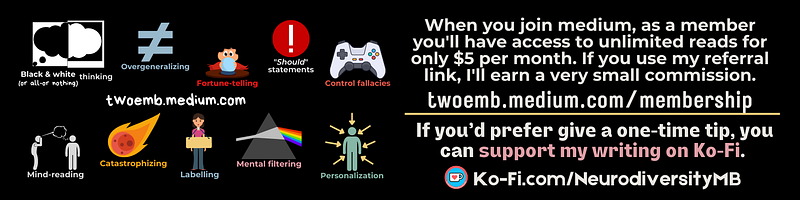
Depending on where you do your research, there are anywhere from 10 to 15 different types of cognitive distortions. In the interest of brevity, I’ll just touch on two here.
Created by author

Catastrophizing

Catastrophizing is described as thinking which exaggerates the negative consequences of events or decisions, which then leads to worries, and can quickly escalate to worst-case scenarios.

Sometimes people do catastrophize, especially kids — “this is the worst ever!” This, however, is developmentally appropriate for a child, not disordered thinking.

That aside, all people experience and process events differently. When people are neurodivergent, experiencing the world differently is a key feature of having a differently wired brain.

This also fails to consider people’s trauma histories, the skills they may or may not have developed growing up, or even events leading up to the incident itself.

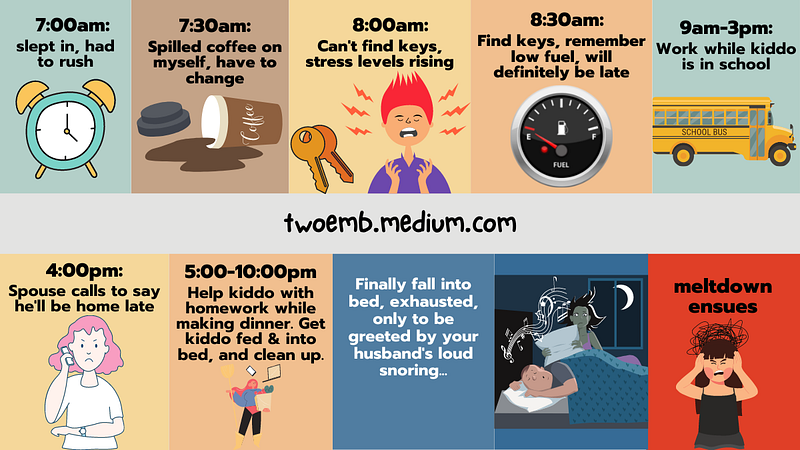
If I get cut off in traffic on a good day, I’ll probably mutter some choice under my breath, maybe give the driver a “WTF?” look. If I get cut off in traffic after I’ve already had a fight with my spouse, lost my keys, spilled my coffee, and am late for a meeting — well, then I might just feel a sense of impending doom.
Created by author

“Should” statements

These are rigid expectations about what a person “should” do, which are enforced on oneself and others.

It’s no surprise to me that many neurodivergent people struggle with these — they’ve been drilled into us our whole lives! We frequently don’t behave the way people think we’re supposed to, for which we are chastised, corrected, and criticized.

A lot of Autistics mask by learning and internalizing these implicit rules as a matter of self-preservation: we need to learn these arbitrary social norms to avoid ostracization and rejection.

Society beats these expectations into us, so we figure them out and try to follow them for a while. Society then turns around and tells us we’re too rigid and are experiencing cognitive distortions as a result.

Sigh.

However

There are occasions when our thought processes really do increase our distress or anxiety. How do we support loved ones with this, or address this in our own lives?

My next piece will offer support for challenging cognitive distortions without the gaslighting.
Ways to support my work

You can leave a “tip” on Ko-Fi at https://Ko-Fi.com/NeurodiversityMB

Become a paid subscriber to my Substack publication

Check out my online store at https://NeurodiversityMB.ca/shop

Read and share my articles from twoemb.medium.com

Part two

Related Articles

References

Sharma, S., Hucker, A., Matthews, T., Grohmann D., Laws, K. R. (2021). Cognitive behavioural therapy for anxiety in children and young people on the autism spectrum: a systematic review and meta-analysis. BMC Psychology 9(151). https://doi.org/10.1186/s40359-021-00658-8

Mental Health
Psychology
Autism
Neurodiversity
Therapy
Recommended from ReadMedium