
Emotional Skillset Power-Up
Support for challenging cognitive distortions without the gaslighting

I remembered
My recent piece explored two types of cognitive distortions: catastrophizing and “should” statements, at the end of which I promised a follow-up, and I actually remembered!
When I discussed reframing cognitive distortions, I was really talking about reframing the very concept of distorted thinking, rather than telling people how and why their thoughts and feelings are wrong.
That said, there are occasions when our thought processes really do increase our distress or anxiety. How do we support loved ones with this, or address this in our own lives?
While we may need to develop some additional strategies when the old ways of thinking and doing are no longer helpful, this does not mean what we needed to learn is now disordered, it just means we’re ready to upgrade our skillset.
Kind of a powering up, if you will.
Here I will discuss a few cognitive distortions which can cause us distress. While it is not effective for someone to dismiss or invalidate our feelings and experiences, it can be useful for us to develop strategies for challenging patterns of thinking that we find unhelpful.
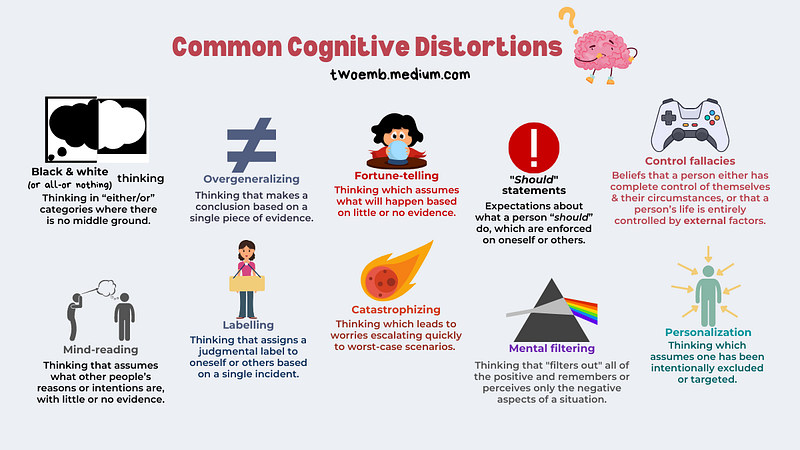
Fortune Telling
“This is going to be awful.”
Fortune telling is thinking which guesses or assumes what will happen based on little or no evidence.
I’ve seen folks get themselves really worked up anticipating all the ways something will go wrong, or how dreadful something will be.
My son dislikes swimming lessons. It’s the one and only activity in which we “force” him to participate for safety reasons. We love camping, kayaking, and going to the beach, so it’s imperative he knows how to swim.
He doesn’t like it because it’s boring, he gets cold, and it’s too loud in the pool area (I agree!). Sometimes when we talk about swimming lessons he starts imagining all the unpleasant things that will happen, predicting the worst outcomes possible.
Yet once he’s there, he usually has a great time. He participates well, has fun, and gets nicely warmed up in the shower afterward.
I find this to be the best strategy for combating these “fortune telling” thoughts: to remind oneself (or the person) of similar occasions when they anticipated not enjoying something, but once they got there, they had a good time.
Labelling
Labelling is thinking that assigns a judgmental label to oneself or others based on a single incident.
I do this often while driving. I am not a patient person, and that becomes very apparent the moment I encounter a slow or inexperienced driver.
“What a bad driver,” I think. Except, are they? Maybe yes, maybe no. My single observation of their skill (or lack thereof) is not necessarily indicative of how they drive all the time. We’ve all made mistakes on the road, but that doesn’t automatically make us bad drivers.
That may not be such a big deal, but what happens when we do this to ourselves and to the important people in our lives? When I make a mistake on something I think should be easy, I often label myself. “Ugh, I’m such an idiot,” I’ll think.
Many people with ADHD already struggle with low self-esteem and receive more criticism than their neurotypical counterparts on a regular basis. Part of this is likely due to internalized ableism and self-stigma — if we hear a message often enough, we’re likely to start believing it.
Piling on isn’t likely to help.
To counteract labelling, oftentimes recognizing we’re doing this and pausing can make a significant difference. If you catch yourself labelling someone (including yourself), take a beat.
If you can, acknowledge the emotion underlying the label (i.e. frustration, anger, hurt feelings). Validate your experience, then try to take a step back and look at the situation more objectively.
I’m not an idiot for making a mistake, I’m human. Even if the task is considered “easy” (another label) doesn’t mean one must — or can — be perfect.
A destructive duo
What about when we do this to our loved ones?
My spouse is a very regulated, level-headed, easy-going guy — he’s essentially my complete opposite. When I get into a negative space psychologically or emotionally, I often think he can’t understand.
“He just doesn’t get it, he’s too sheltered to understand!”
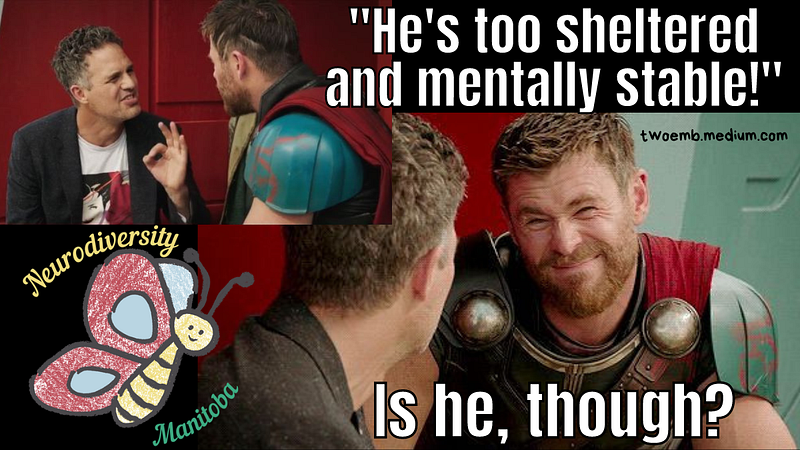
I’m engaging in two different types of distorted thinking. First, I’m labelling him as sheltered because he hasn’t shared my experiences; secondly, I’m overgeneralizing by assuming he’ll never understand because he doesn’t get it in this particular instance.
Once I’ve utilized some of my self-regulation strategies, I am more willing and able to engage in reflective thinking.
Is it really true he never understands and never will? It would be more accurate to say I felt misunderstood in that instance, but this doesn’t mean my spouse can’t possibly get it.
Further, making a blanket statement that he’s too sheltered only fuels my own emotions. If I am honest with myself, I can acknowledge this comes more out of jealousy — I’m envious of my husband’s happy family and healthy upbringing.
It also places the onus fully on him to somehow understand what is happening for me internally. If I simply say “you don’t get it,” while making no effort to try to explain, then it’s not really fair to expect him to read my mind.
Although reading my mind might take care of the whole “mentally stable” thing for him…
© Jillian Enright, Neurodiversity MB
Black and white thinking
Another cognitive distortion I didn’t cover in this article is dichotomous or polarized thinking, which places events in “either/or”, all-or-nothing categories where there is no middle ground.
A lot of neurodivergent people struggle with this due to cognitive rigidity, which is something I’ve written about previously.
Part Three
Challenging thought distortions — sans gaslighting — continued
Three Ways Our Thoughts Can Contribute To Emotional Distress
When you join medium, as a member you’ll have access to unlimited reads for only $5 per month. If you use my referral link, I’ll earn a small commission, and you’ll earn my undying gratitude.
If you’d prefer give a one-time tip, you can support my writing on Ko-Fi.
Related Articles
References
Beaton, D.M., Sirois, F., Milne, E. (2022). Experiences of criticism in adults with ADHD: A qualitative study. PLoS ONE 17(2): e0263366. https://doi.org/10.1371/journal.pone.0263366
Kita, Y., & Inoue, Y. (2017). The Direct/Indirect Association of ADHD/ODD Symptoms with Self-esteem, Self-perception, and Depression in Early Adolescents. Frontiers in psychiatry, 8, 137. https://doi.org/10.3389/fpsyt.2017.00137
Pawaskar, M., Fridman, M., Grebla, R., & Madhoo, M. (2020). Comparison of Quality of Life, Productivity, Functioning and Self-Esteem in Adults Diagnosed With ADHD and With Symptomatic ADHD. Journal of Attention Disorders, 24(1), 136–144. https://doi.org/10.1177/1087054719841129


