
Three Ways Our Thoughts Contribute To Emotional Distress
Challenging thought distortions — sans gaslighting — continued

The Final Three
In this piece I’m going to cover the final three cognitive distortions, with some suggestions for finding the balance between validating one’s own (or another’s) experiences and feelings, while challenging unhelpful and potentially inaccurate thoughts which may cause distress.
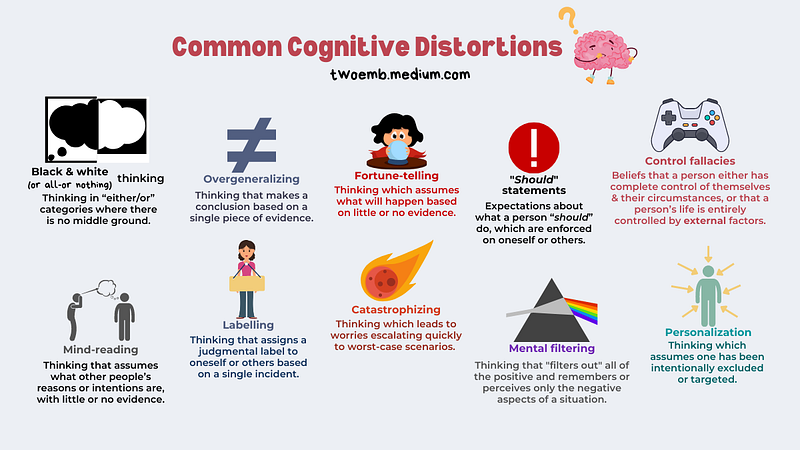
Personalization
Thinking which assumes one has been intentionally excluded or targeted.
My closest friend has always been kind to me and also honest with me. Most of the time, if she is unavailable, I accept exactly what she says at face value because I trust her.
Sometimes, however, my history of rejection and bullying rears its ugly head, leading my mind down unhelpful trains of thought. I wonder if she is getting tired of hanging out with me or if she is upset with me for some reason.
If I let myself, I can dig myself a fairly deep hole of “what ifs” and assumptions. Because she and I have a solid friendship build on trust and honesty, I can usually catch myself fairly quickly and walk it back. If I’m really stuck I can check in with her and clear the air.
When it’s someone I don’t know as well, with whom I don’t have a history of understanding, that’s a whole different story.
When I’m sitting with my teammates and they’re all chatting away and I feel as though I can’t join the conversation, sometimes I’ll start thinking they’re intentionally excluding me because they don’t like me.
I have no evidence of this, I’ve never had a teammate do something to directly and clearly communicate they don’t like me or don’t wish to socialize with me. It’s more a matter of a group of people all talking and it’s sometimes difficult to get a word in edgewise.
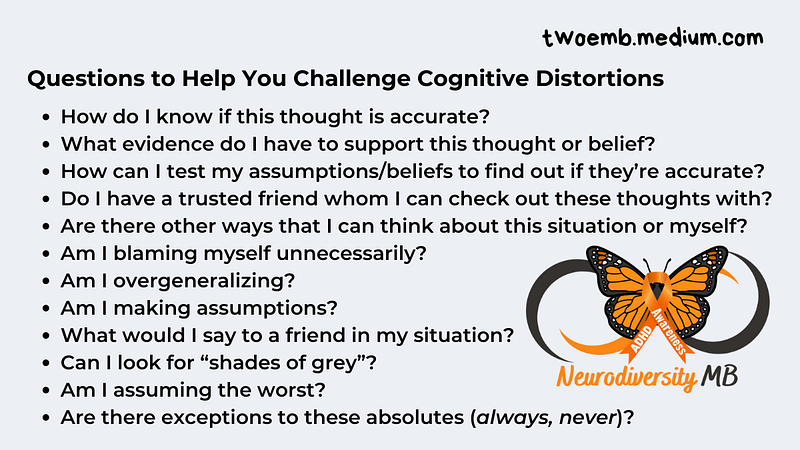
So my strategy for personalization is to check my assumptions:
- Check my assumptions with the person if I feel comfortable doing so;
- Check my assumptions with myself, ask myself if I have any proof to back up my thoughts.
Mind-reading
Thinking that assumes what other people’s reasons or intentions are, with little or no evidence.
“They must think I’m such a know it all.”
One of my social masks is one I like to call “Smarty Pants”. This is when I over-intellectualize and hide my insecurities behind my intelligence. I may come across as arrogant, but it’s really a thinly veiled cover for self-doubt.
Upon reflection (and with time, maturity, and increased self-awareness), I can see that this is my own self-consciousness and self-criticism I am projecting unto others.
I’m concerned that I was being too much of a know-it-all, and so I’m worried others thought this of me, regardless of whether there was any objective reason to think so.

When I look back over a social encounter I’ll often have post-event anxiety, also called post-event rumination, which is when we replay the interactions in our minds and evaluate our performance.
When we engage in mind-reading, we often assume the other people were thinking negatively about us. This is a cognitive distortion, but can also be driven by a type of projection, whereby we attribute our criticisms of ourselves to others.
Understanding this helps us evaluate the interactions more objectively and accurately, once we have acknowledged our own insecurities and taken responsibility for them, rather than projecting them onto someone else.
When we catch ourselves assuming we know what someone else is thinking, without having asked them what they’re thinking, we can pause and take a moment to reflect.
Mental filtering
Thinking that “filters out” all of the positive and remembers or perceives only the negative aspects of a situation.
Mornings are tough, and some days my son and I are throwing on our shoes and hustling out the door so he doesn’t miss the bus. As we’re walking down our lane to the bus stop, I make a point of mentioning something that went well that morning.
I used to come back to the house feeling like some mornings were just awful, but that usually meant I’d lost sight of at least one thing that had gone right.
Even if much of the morning felt like sparsely contained chaos, a mad rush, and an exercise in frustration… there is always something I can highlight as a positive moment.
The feelings are real
Even if one’s thoughts are unhelpful or inaccurate, the feelings associated with them are still very real.
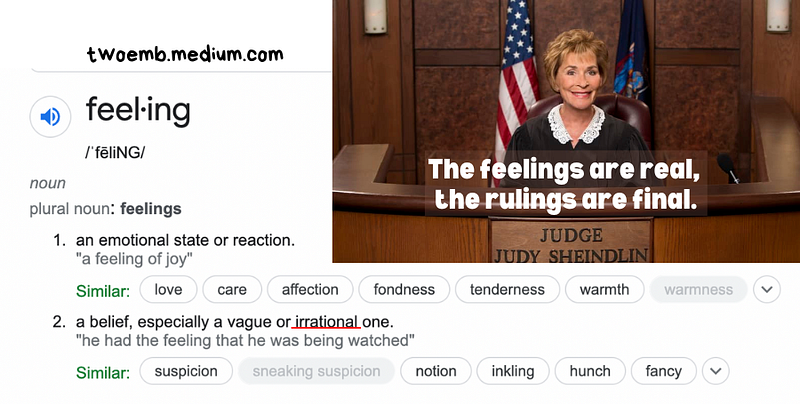
It’s important to validate one’s own — or a loved one’s — experiences. When we simply skip straight to challenging, we’ll often be met with resistance and defensiveness. That’s because nobody likes being told their feelings are wrong — feelings can’t be wrong.
Feelings are, by definition, not rational. They are emotional reactions, unreasoned opinions or beliefs, meaning they happen before we’ve had time to objectively and logically assess them.
Allow yourself and your loved ones to feel emotions, validate your — and their — experiences, just don’t get swept up in unhelpful patterns thinking.
© Jillian Enright, Neurodiversity MB
Related Articles
When you join medium, as a member you’ll have access to unlimited reads for only $5 per month. If you use my referral link, I’ll earn a small commission, and you’ll earn my undying gratitude.
If you’d prefer give a one-time tip, you can support my writing on Ko-Fi — also, it’s free to follow me on Facebook!

References
Brozovich, F., & Heimberg, R. G. (2011). The Relationship of Post-Event Processing to Self-Evaluation of Performance in Social Anxiety. Behavior Therapy 42(2), 224–235. https://doi.org/10.1016/j.beth.2010.08.005


