
April is National Poetry Month
Poemorama is Back!
Our poetry celebration continues
“The world is full of poetry, the air is living with its spirit and the waves dance to the music of its melodies and sparkle in its brightness.” James Gates Percival (1795–1856) source
Wow, have we ever been sparkling in poetry’s brightness these past few weeks! ✨
We celebrated World Poetry Day on March 21st with the ‘Always Be a Poet’ prompt. Our talented poets responded with beautifully flowing words inspired by the warmth of their heartfelt sentiments. See for yourself —
🌷 A Poem Dipped in Blue — by Dennett 🌻 A Poet — by Sinus Kosinus 🌷 A Fascination for My Poet’s Eye — by Carolyn Hastings 🌻 Poetry Enlightens Our Paths, Celebrating the Beauty and Power of Words — by Francine Fallara 🌷 The Tired Poet — by Priyanka Srivastava 🌻 Always Be A Poet Even In Prose — by William J Spirdione 🌷 Always A Poet — by Neera Handa Dr 🌻 Poetry — by Lubna Yusuf 🌷 Freedom Called Poetry — by Monoreena Acharjee Majumdar 🌻 Ode to Green — by Jenine "Jeni" Baines 🌷 The Poetry of Life — by Mia Verita 🌻 It’s a Pleasure to Write Poetry — by Douglas Lim 🌷 Desire — by James G Brennan 🌻 How A Poem Can Persuade A Man To Move His Truck — by Shereen Bingham
Thank you, Dennett, Sinus, Francine, Priyanka, William, Neera, Lubna, Monoreena, Jeni, Mia, Douglas, James and Shereen for making our World Poetry Day celebration such a success. 🙏 💖
April is National Poetry Month
The celebrations have only just begun!
April is National Poetry Month in the US and for us here at Paper Poetry we’re celebrating big time — and we hope you will join us. 💞
Last year for National Poetry Month we ran Poemorama, a month-long poetry writing event that encompassed 30 prompts. It was a huge success with many contributing poets requesting we make it an annual event.
So that’s what we’re doing! 🤩
Yay, Poemorama is back!
Poemorama 2023
When: Saturday April 1 — Sunday April 30, 2023
Where: only at Paper Poetry
Who: everyone is welcome to take part
What: 30 poetry prompts announced in three parts of 10 prompts each with the following schedule - Part 1 — Saturday April 1 — see below for prompt details Part 2 — Tuesday April 11 Part 3 — Friday April 21
How: all prompts remain open from the time of their release until the last day of the event (April 30). Submissions for Part 1 prompts will be accepted for the full 30-day timeline, while submissions for Part 2 prompts will be open from April 11–30, and Part 3 prompts from April 21–30.
Details for All Prompt Submissions
Tags: please use ‘Poemorama’ as one of the tags
Kicker: please use ‘Poemorama at Paper Poetry’
Title/subtitles: your choice but should refer to the specific prompt in some way
Image: minimum one image; maximum two images Please note: one of the images must incorporate a handwritten/handcrafted element in either paper or digital format in accordance with Paper Poetry’s submission guidelines. Suggestions: a handwritten segment of your story, a decorative title, an illustration that depicts an aspect of your story, a digitally enhanced free-to-use image or personal photo that relates to your story. AI-generated images are acceptable provided you include the source link as evidence in the caption or explain how the image was derived.
Promotional link: please include a link to the Poemorama prompt announcement that relates to your submission e.g. if responding to a prompt from Part 1, then link this announcement into your story
Handle tags: if you like, invite (@ handle tag) a maximum of five Medium authors to join the Poemorama event
Shoutouts: if you like, promote a maximum of three other Poemorama submissions (either your own or from other poets)
Number of submissions: you are invited to respond to any or all of the prompts as many times as you like, however, a daily limit of two published pieces will apply.
Exclusions: ChatGPT and your AI cronies - please know that you are not welcome here — kindly take your manufactured poetry elsewhere!

Poemorama Part 1 — Line-by-Line
This year we’re trying something different. We’re looking at poetry line-by-line.
The 10 prompts we have prepared for you are based on the number of lines per poem/stanza — from one-line poems to 10-line poems. 😊
To power up your creative cogs, we’ve compiled a selection of poetic forms for each of the 10 prompts. It is by no means an exhaustive list. In fact, we encourage you to submit poems in whatever form you like providing they meet the line count requirement for the specific prompt you are responding to. For instance, if responding to Prompt 5 (five-line poems), your poem can be a single verse of five lines or have multiple 5-line stanzas. In other words, the stanzas in a multi-stanza poem must all have the same line count.
For your convenience, here’s a directory for the set of 10 prompts —
Prompt Directory
Prompt 1: One-line poems Prompt 2: Two-line poems Prompt 3: Three-line poems Prompt 4: Four-line poems Prompt 5: Five-line poems Prompt 6: Six-line poems Prompt 7: Seven-line poems Prompt 8: Eight-line poems Prompt 9: Nine-line poems Prompt 10: Ten-line poems
Prompt 1: One-line poems
In literary terms, a one-line poem is known as a monostich.
Japanese-influenced monoku is the primary contender in this category — a single line of non-rhyming poetic prose, preferably with a turn and minimal, if any, punctuation including no initial capital letter. Convention states that a monoku is constructed with exactly 17 syllables, however, fewer syllables are acceptable. Here’s one by B.R. Shenoy —
Another option is a free verse poem comprised entirely of single lines — personally, I have no idea how that would work but I’m sure there’s someone far more creative than me who could pull one off! 😅
Prompt 2: Two-line poems
Okay, now we’re getting a bit of variety happening!
Free verse poems arranged in paired lines are a popular choice among contemporary poets.
For those who prefer more structure to their poetry, then couplets are the go. Learn more about couplets and their various forms, here.
For an extra challenge, why not try a ghazal as Megan Nicole Morgan did here —
Or maybe a Cretan 15-syllable mantinada like this one from Patrick M. Ohana.
Prompt 3: Three-line poems
Three-line poems are generically known as tercets.
The obvious choice is haiku — or senryu or zappai or sciku or any other 3-line, unrhymed verse with a 5–7–5 syllable/line structure.
However, believe it or not, there are other types of tercet poetry such as the Italian terza rima like the one William J Spirdione wrote —
Another Italian tercet, the stornello, has 11 syllables per line and an aaa rhyme scheme. Here’s one I wrote for Paper Poetry’s first anniversary.
Prompt 4: Four-line poems
Now we’re talking!
Poems arranged in four-line stanzas have all but become a poetry stereotype — just ask ChatGPT! 😆
Any form of quatrain (a rhyming 4-line stanza) is acceptable including those with specific requirements e.g. a Filipino tanaga with its 7–7–7–7 syllable/line count and choice of end rhymes; and my favourite, twittle, constructed with exactly 100 alphabet letters.
Non-rhyming four-line poems include the Japanese dodoitsu with a 7–7–7–5 syllable/line count and the Indian naani constructed in free verse using 20–25 syllables like the one Kimberly Hampton Nilsson wrote —
Prompt 5: Five-line poems
As a class of poems, five-liners are called cinquains and include American cinquains which are written in iambic (da-DUM) meter with 2–4–6–8–2 syllable/line structure.
Other popular five-line poems include the Japanese tanka (5–7–5–7–7 syllable/line count) and limericks like these from Margie Willis.
If it’s something different you’re looking for, why not try Arjan Tupan’s tritriplicata — a 27-syllable micropoem with a 3–6–9–6–3 syllable/line count. Here’s one Dennett gifted us last year —
Prompt 6: Six-line poems
In literary lingo, a six-line poem is known as a sestet or a hexastich. If it has a rhyme scheme, it becomes a sextain.
A shadorma is a six-line unrhymed poem with a 3–5–3–3–7–5 syllable/line structure, like the one Selma wrote —
If you prefer even numbers, then the termelay may be the one for you! It has a 4–4–4–8–8–4 syllable/line structure with line 3 repeated as a refrain in line 6 and no specified rhyme or meter.
If those don’t appeal, how about an acrostic using ‘Poetry’ as the embedded vertical word? 😄
Prompt 7: Seven-line poems
Septet or heptastich are the terms used to describe a seven-line poem.
The ‘father of English poetry’, Geoffrey Chaucer, gave us a rhyming seven-line verse known as a rhyme royal (or rime royal). Written in iambic pentameter (10 syllables per line with a da-Dum beat), it has an ababbcc rhyme scheme which kind of makes it a half sonnet. In fact, Chaucer used this stanzaic form as the framework for many of his sonnets.
Speaking of half sonnets, Selma introduced us to an even briefer form, the ha’sonnet — seven lines each of four syllables with an ababccd rhyme scheme. Quite a challenge when, as is the case with traditional sonnets, the ha’sonnet requires a problem to be resolved in the closing lines.
From France, we have another challenge — the seven-line rondelet with its 4–8–4–8–8–8–4 syllable/line count, AbAabbA rhyme scheme (A being the refrain). Amy Jasek proved it could be done with this beautiful English-French treat —
Prompt 8: Eight-line poems
You probably won’t be surprised to know that an eight-line poem is referred to as an octet, octastich, or octave. 😊
The Italian ottava rima is an eight-line verse with an abababcc rhyme scheme written in iambic (da-DUM) meter. Traditionally, the lines are each 11 syllables, but English-language poets often use 10 syllables per line. William J Spirdione shows us how it’s done here —
With my muse’s help, I recently attempted a French-Spanish huitain — a single eight-line poem with eight syllables per line written with or without iambic tetrameter (four sets of da-DUMs) and a choice of rhyme schemes e.g. abbaacca.
Another French form is the triolet. The ‘tri’ suggests that it would be a three-line verse, but it actually refers to three of the eight lines being repeated as a refrain. In fact, there are two refrains in this short poem meaning that there are only four unique lines in the whole piece! The rhyme scheme is ABaAabAB (A, B denotes the refrains). The good news is there is no restriction on the number of syllables per line. The bad news is, they all need to be the same length and meter! Esther Spurrill-Jones explains all here —
Prompt 9: Nine-line poems
A nine-line poem is simply known as a nonet.
However, nonet is also the name given to a nine-line poem with a simple syllabic formula: first line is nine syllables, each subsequent line has one less syllable than the preceding line. The last line is one syllable. No rhyme or meter requirements. Lee Ameka’s nonet is an excellent example —
The lai is a nine-line verse with an aabaabaab rhyme scheme. Each of the ‘a’ lines is five syllables while the ‘b’ lines are two syllables. I wrote a lai about sonnets!
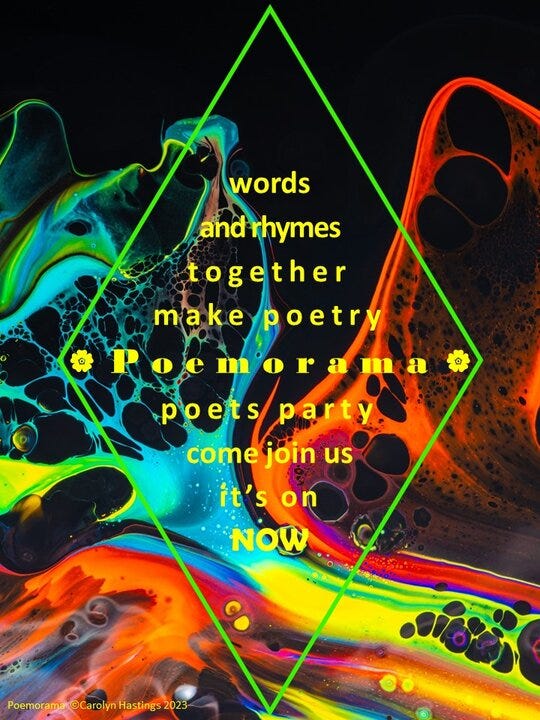
I’ve also gone one step further and actually invented my own nine-line poem — it’s a 25-syllable poem based on a simple narrative or procedure and presented in the shape of a diamond. I call them harlequin poems. The diamond-shaped poem in the image introducing Poemorama is an example of one. 😊
Prompt 10: Ten-line poems
A ten-line poem is known as a decastich.
The dizain is a French poetic form constructed with ten lines each with ten syllables written in iambic pentameter and an ababbccdcd rhyme scheme. Jenine "Jeni" Baines did a splendid job with her dizain —
The Japanese somonka is a dialogue-style poem constructed with pairs of tanka (5–7–5–7–7) verses and written from the perspective of two people (typically lovers) exchanging notes with each other. Traditionally a collaborative form between two poets, these days it’s acceptable for one poet to write both parts. Kimberly Hampton Nilsson has done exactly that with her somonka.
New Writers
We welcome new writers to join the prompt. Please leave a comment requesting to be added as a writer and include your Medium @ handle; or email us at [email protected]
Sign up for our newsletter
To make sure you never miss our poetry prompt announcements, subscribe to our newsletter, Paper Poetry Sparks. Please find the sign-up form at the end of this post.
Poemorama is back!


