
8 Steps to Writing a Harlequin Poem
Whoever heard of a 25-syllable story?
A story in 25 syllables! You don’t believe me? Well that’s probably because you haven’t heard of harlequin poems.
Until now that is!
Hang around and I’ll show you how to write these little diamond gems, plus there’ll be examples along the way. Here’s one I wrote that gives you a snapshot of what I’m talking about — a harlequin poem about how to write a harlequin poem. How meta is that?!
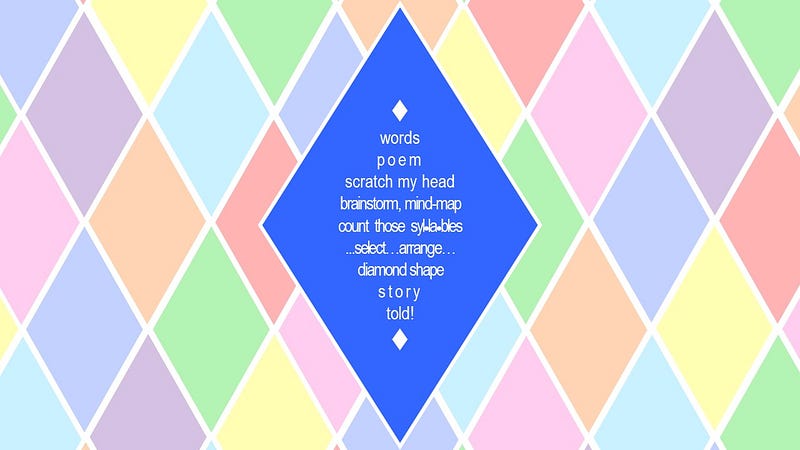
words poem scratch my head brainstorm, mind-map count those syllables select, arrange diamond shape story told!
Of course, there’s one big problem with this. It’s a wonky triangle! Definitely not a diamond. That’s because center-alignment, for reasons that I won’t bore you with, is not an editing option on this platform so in lieu of a formatting hack, here’s a photo of my meta harlequin poem.
What makes harlequin poems different to diamante poems?
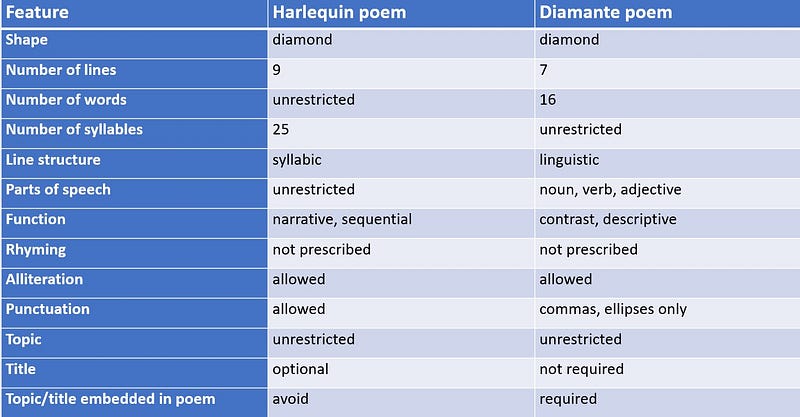
The harlequin poem, like its better-known diamond cousin, the diamante poem, has a specific linguistic structure that make both poetic forms ideal for novice poets. And like many cousins, that’s about as far as the similarities go; in most other respects, diamante and harlequin poems are quite different as you’ll see in Table 1 below.
Line structure of a harlequin poem
You’ve probably figured out already that there’s a simple pattern to the line structure of a harlequin poem but since this is an instruction guide, I’ll set it out for you anyway.
Line 1~1 syllable word Line 2~2 syllables — either a 2-syllable word or 2 x 1-syllable words Line 3~3 syllables — 1 x 3-syllable word or 3 x 1-syllable words or 1 x 2-syllable word + 1 x 1-syllable word Line 4~4 syllables — any combination of words totaling 4 syllables Line 5~5 syllables — any combination of words totaling 5 syllables Line 6~4 syllables as for line 4 Line 7~3 syllables as for line 3 Line 8~2 syllables as for line 2 Line 9~1 syllable word
Function of a harlequin poem
Harlequin poems are story poems. To be more precise, their function is to outline a story or an action sequence. Think of them as being like a mini draft of a narrative or instructional text — a skeletal framework if you will. After all, whoever heard of a story being told in 25 syllables?!
Harlequin poems are a fun way for budding poets to practice their craft and for reluctant writers to give creative writing a crack. It also has heaps of other benefits, but I’ll tell you more about those later on.
For now, let’s get down to business.
How to write a harlequin poem
Step 1 — choose a topic
The first step to writing a harlequin poem is to choose a topic. You can make up your own topic about an event, an adventure, an experience, an activity — anything from the most exciting and extraordinary to the most trivial and mundane. A spider consuming a fly, planting seedlings in the veggie patch, a night at the carnival, eating spaghetti Bolognese, writing a poem (done that one!), trapped in a dungeon, and so on.
Your topic might be based on a theme — hobbies, family, sport, holidays, nature, sci-fi, etc.
It can be real or imaginary.
Books (fiction and non-fiction), fairy tales, movies, TV shows, computer games, comics, graphic novels, photographs are all good sources of inspiration.
Step 2 — brainstorm words
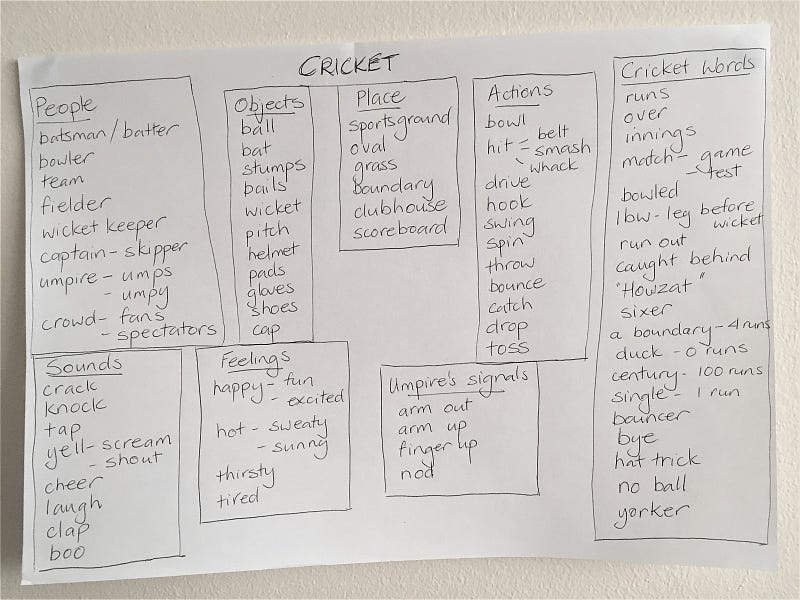
The next step is to brainstorm words and phrases that are associated with your topic. This can be done as a list, a graphic organizer or a collection of sticky notes assembled on a large piece of paper or a whiteboard. For the techno-savvy, a digital device will do the job just as well.
Think about all aspects of the topic — the who, what, where, when, why and how. Include descriptive, emotive and sensory details. Sight, sound, touch, taste, smell. Don’t forget to add in synonyms and literary devices like idioms, and similes that relate to your topic.
Here’s an example of a graphic organizer that I used to construct a harlequin poem about cricket.
Step 3 — organize into a syllable chart
Now that you have your set of words and phrases, you’ll need to organize them by syllable count. To do that, draw up a 5-column table. Label the first column, 1-syllable; the second column, 2-syllables, etc. as shown in the example.

Work out the number of syllables for each of the brainstormed words and phrases and allocate to the relevant column in the syllable chart.
Tapping or clapping the syllables is a helpful strategy for working out the syllable count.
For phrases longer than 5 syllables, decide if they can be shortened some way and record accordingly; if not, set aside or discard.
Step 4 — color coding
It’s useful to highlight the words and phrases in the syllable chart that relate to the beginning, middle and end phases of the story or action sequence. This will make it easier to select the best words that will give structure to the sequential or story-telling aspect of the poem.
Use three different colors — one for each of the three categories: beginning, middle, end. There’s no need to color-code all the words in the syllable chart.
Step 5 — choose your poem’s first word
The first line of a harlequin poem requires a one-syllable word so the first place to go looking for that word is in the 1-syllable column of your syllable chart.
More often than not, the poem’s first word will be a noun, a naming word, but it really depends on the topic and tone of the poem. In some instances, a verb (action word), adjective (describing word) or adverb (modifying word) may have more impact. For example, a poem about catching a fish might begin with ‘tug’ while a poem about waiting at the traffic lights might have ‘red’ as its first word.
The main objective is to choose a word that is a key element to how the story or action sequence begins. Where possible avoid using the topic or the title of the poem as the first word.
Step 6 — keep going
Follow the line structure model provided earlier to construct your poem, line by line, sourcing words from your syllable chart and adding in others as needs be. You want the words to build a picture in the reader’s mind of the story or action sequence you are describing so word order and progression are important.
Splitting a phrase over two lines is acceptable; however avoid using complete sentences and grammatical filler words such as ‘is’ and ‘the’, and tense markers ‘-ed’ and ‘-ing’. These are syllable gobblers and when you only have 25 syllables to play with, you don’t want to waste any of them. Think of the syllables and words as products on the supermarket shelf — each one must earn its space in the poem by adding value to the story or action sequence.
As well as being guided by the beginning-middle-end color-coding in your syllable chart, you might find it useful to verbalize the story or action sequence so you can keep track and prompt yourself with what comes next.
Think about the tone you are trying to convey and choose words and phrases to match. Ending the poem with an emotive word is an effective strategy.
And remember to tap or clap the syllables as you go!
Step 7 — format your poem into a diamond shape
Once you’re satisfied with your poem, it’s time to present it in its finished form. That means rewriting or typing it into a diamond shape. Center-formatting takes the hard work out of that exercise but you might want to adjust the letter- and word-spacing, add in ellipses, periods, emojis or wingdings here and there to tweak the poem into a proper diamond shape.
The handwritten version can be a little trickier to master. Having a diamond template to work from can help ensure that the lay-out is centered reasonably well. Add decorative details as desired.
Step 8 — choose a title
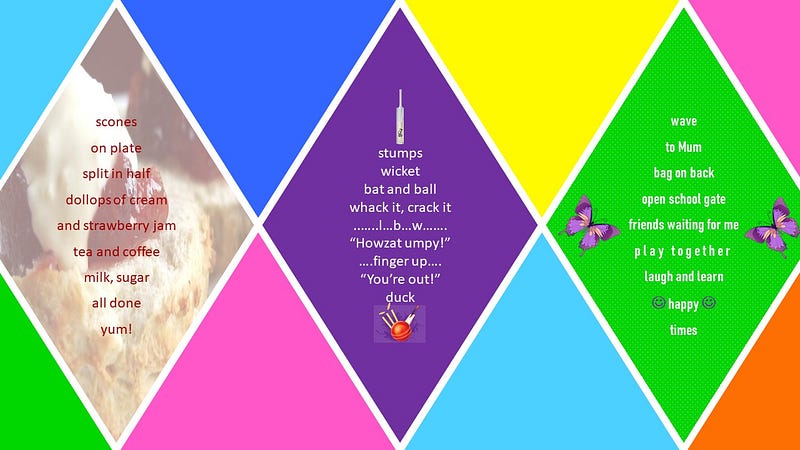
You can choose whether or not to give your poem a title. You might prefer to let your reader figure out for themselves what your poem is about, or you may have decorated your poem with a picture that makes the need for a title redundant. If your harlequin poem is part of a tessellation, like the one in the image below, then there might not be room for titles.
Shortcuts
In case you’re thinking this is a long-winded way to generate 25 syllables of content, you’re right. The steps I’ve detailed above are primarily to assist teachers and parents with the task of encouraging children to explore their emerging poetic prowess.
For those of you who had the gist of it by the time you’d finished reading my meta harlequin poem and feel ready to put yourselves to the 25-syllable test, feel free to skip any steps deemed superfluous. It literally took me two minutes to punch out the meta poem but then I’ve had a bit more practice at this style of poem than most.
…which probably has you saying to yourself…
“But I’ve never heard of harlequin poems. How come she know so much about them?”
Okay, so now it’s time to let the cat out of the bag.
The background story to harlequin poems
Harlequin poems were created by none other than moi. Yes, me!
Try googling ‘harlequin poems’ and I can assure you that all you’ll find will be links to poems that include the word ‘harlequin’ or a now defunct literary magazine. Google ‘25 syllable poems’ and you’ll be directed to the shapeless, 4-line Naani poetic form. The closest short-form poetry style to a harlequin poem is the Nonet, a 45-syllable, inverted triangular poem.
You won’t find anything about my style of diamond poetry because I’ve never published anything about it. Until now, that is.
But I can’t take all the credit for harlequin poems. Some of that belongs to students I’ve worked with over the years, one of them being Evan, the clapping poet, who I wrote about in a recent article. The cricket poem I’ve used here in this article (see the tessellation image above) is a variation of one he wrote with me. I remember him being highly amused when he discovered the letter combination, ‘l-b-w’, represented a total of five syllables, the same as its lexical equivalent, ‘leg-before-wicket’. He opted to use the abbreviation in his poem as he was more familiar with that form of cricket-lingo. Evan found it hysterical that the longest line in his poem (by syllable count) was the shortest in written form and that it threatened to spoil his poem’s diamond shape — hence the need for plenty of padding.
Harlequin poems were borne out of necessity. A necessity to give students with language disorders creative yet functional opportunities to extend their communication and literacy skill-set.
The process of constructing a harlequin poem taps into many skills –
- vocabulary and word association
- semantics
- narration
- sequencing
- literary devices
- planning and organization
- syllabification
But that’s not all. Other benefits, include –
- the poem’s short format appeals to students because they see it as something they can achieve without investing a huge amount of effort
- the challenge of limiting word choice to a total of 25 syllables can be easily repackaged as a game — and what student can resist the offer of a game?
- adapts easily to individual, small group and whole class applications
- reading the poem out aloud to the class is doable for all but the most print-to-speech averse students
- the poems can be used as scaffolds for supporting longer, more detailed versions of the story or action sequence similar to how cue cards are used as prompters for oral presentations
- the resource material collated in the graphic organizers can be repurposed for other tasks
- giving students the freedom to choose topics they have prior knowledge of or an interest in fosters motivation and engagement
Let’s face it. Poetry isn’t for everyone and, as many teachers and homeschoolers know, poetry can be a tough sell to students, especially those who have a fixed mindset that poetry must have rhyme and meter to even be classed as a poem. Harlequin poems override most objections, except the one about them being too short. But there’s a simple solution to that one too…
…a harlequin chain — a longer format poem made up of two or more harlequin stanzas
…a jumbo harlequin — insert extra lines after line 5 taking care to maintain the ascending-descending syllable pattern.
Come on, give it a go! It’s fun. I’d love to hear your thoughts in the comments.
Disclaimer
To my knowledge the name, style and format of the poetry form referred to in this article as a harlequin poem, are my unique creation. In sharing this information on a public platform, I am granting open access to it being used, modified and adapted as the user sees fit on condition that its intended purpose, being the education of young learners and the entertainment of all, is preserved.
If anyone has reason to believe that I am not the lawful owner of this intellectual property, then I ask you to email me with details supporting your claim.