avatarCarolyn Hastings

Free AI web copilot to create summaries, insights and extended knowledge, download it at here

4405

Abstract

er based on the prompt “A Dan Flavin art of a rabbit”.</figcaption></figure><p id="2b9b">It’s a beauty. Simple, poetic, surprising. The reference to Dan Flavin creates an atmospheric, illuminated render of the rabbit. I could see this as a piece in my own space.</p><p id="16cf" type="7">“An Isamu Noguchi art of a rabbit”</p><figure id="8d22"><img src="https://cdn-images-1.readmedium.com/v2/resize:fit:800/1*gj4fxhoA7HyROuRpYyb8Ig.png"><figcaption>A DALL-E render based on the prompt “An Isamu Noguchi art of a rabbit”.</figcaption></figure><p id="113c">Stunning. There is a bit of surrealism in the form itself, but it’s an impressive concept of a rabbit.</p><p id="03ce" type="7">“A Barbara Hepworth sculpture of a rabbit”</p><figure id="4eee"><img src="https://cdn-images-1.readmedium.com/v2/resize:fit:800/1*7LOC2oigQDzizr7kBf2stg.png"><figcaption>A DALL-E render based on the prompt “A Barbara Hepworth sculpture of a rabbit”.</figcaption></figure><p id="7855">This render looks right out of the imaginary sculpture park itself. The texture is amazingly realistic, the composition is dynamic. In its poise, the rabbit displays a big personality.</p><h1 id="830a">Defining the three-prong prompt: A sculptural reference, persona, and an action</h1><p id="5b77">Now that we’ve explored a basic static DALL-E render of a sculptural reference, we can expand the prompt with a third contextual element, <b>action</b>.</p><p id="56be">We’ll ask for the rabbit to be active, jumping, or leaping.</p><figure id="3b09"><img src="https://cdn-images-1.readmedium.com/v2/resize:fit:800/1*lYLI6loWGLuEmEit8uZNKw.png"><figcaption>Adding ‘action’ to the initial prompt. This defines the 3-prong approach for the prompt.</figcaption></figure><p id="2f0c">Defining an action for our persona will add fluidity and spatial aspects. We can describe the action as leaping, or jumping through the air.</p><p id="360c">The prompts for DALL-E are thus:</p><p id="e870" type="7">“A Dan Flavin art of a rabbit leaping through the air”</p><figure id="a91c"><img src="https://cdn-images-1.readmedium.com/v2/resize:fit:800/1*OhgL44MaPkgu2NcnBBcPwA.png"><figcaption>A DALL-E render based on the 3-prong prompt “A Dan Flavin art of a rabbit leaping through the air”.</figcaption></figure><p id="1c1b">DALL-E rendered this beautifully based on the 3-prong input. The image has a cinematic, ethereal quality. While we’re not sure where this narrative is going, it can be the take-off point for the rabbit hero story.</p><p id="ac7b" type="7">“An Isamu Noguchi sculpture of a rabbit jumping through mid air”</p><figure id="5b4e"><img src="https://cdn-images-1.readmedium.com/v2/resize:fit:800/1*-tfcnwiVkpOpni9ziPb53Q.png"><figcaption>A DALL-E render based on the 3-prong prompt “An Isamu Noguchi sculpture of a rabbit jumping through mid air”.</figcaption></figure><p id="9b64">In this DALL-E image, the hero, the rabbit is taking on a playful personality, jumping into the air, escaping the picture, leaping into his freedom. Action here defines the hero as having energy and aspirations.</p><p id="6506" type="7">“A Barbara Hepworth sculpture of a rabbit jumping”</p><figure id="60fc"><img src="https://cdn-images-1.readmedium.com/v2/resize:fit:800/1*tn92Rom8N8RRMEy5-MTVvg.png"><figcaption>A DALL-E render based on the 3-prong prompt “A Barbara Hepworth sculpture of a rabbit jumping”.</figcaption></figure><p id="c4a3">This DALL-E rabbit seems to be dancing on his concrete cube, excited to be in this park-like environment. The action here adds delightfulness and subtlety.</p><h1 id="0612">Defining the four-prong prompt: The sculptural reference, persona, action, and environment</h1><p id="600e">We can expand a 3-prong set-up to include any other attribute. We can set the stage by defining the surroundings, colors, expression, background, textures, and so many other aspects.</p><figure id="44e0"><img src="https://cdn-images-1.readmedium.com/v2/resize:fit:800/1*_LiLU-WRYZnBBdfaLNyXCQ.png"><figcaption>An illustrative outline of a 4-prong approach to crafting the prompt. This includes the sculptural style reference, the hero (rabbit), the action, and the environment.</figcaption></figure><p id="b24a">For this exploration, we define the environment on the Barbara-Hepworth-inspired dancing rabbit.</p><p id="5bd8" type="7">“A Barbara Hepworth sculpture of a rabbit diving into a big swimming pool”</p><figure id="cc8

Options

f"><img src="https://cdn-images-1.readmedium.com/v2/resize:fit:800/1*VM3eVfQ3YmXeriXWTUAQBA.png"><figcaption>A DALL-E render based on the 4-prong prompt “A Barbara Hepworth sculpture of a rabbit diving into a big swimming pool”.</figcaption></figure><p id="0744">It’s a nice rendering, although it took a few rounds to get a render of the rabbit’s entire body. The form of the sculpture is lovely, smooth, and artistic. I could see this sculpture in someone’s swimming pool.</p><p id="3c60">This can become an idea for a prototype. Or it can be a visual cue for a story that yet has to be written.</p><p id="58a0">Expanding on the prompts can add interesting dimensions, although it will take several tries before DALL-E can loosely match one’s expectation, even on a rudimentary level.</p><h1 id="f09d">Learnings and takeaways</h1><p id="e758">DALL-E renders take time (and money). They need a meaningful prompts to make a render valuable to the designer.</p><p id="ea35">Crafting a prompt takes a conceptual input. We need to define our expectations of a DALL-E render. (Randomness is fine, but unsurprisingly, the outcome is unpredictable).</p><p id="4faf">It is important to know the artistic style references well. Read up about artists’ and their work and look images of their oeuvre. Delve into their universe that took them decades to create.</p><p id="6c89">Study art history, visit museums, attend art lectures, research art movements. It will come in handy when you need to write design inputs.</p><p id="47f6">Keep being amazed by what you see around you and make a note of it.</p><p id="2ce2">Experiment with the prompt, but don’t ask for the impossible. Remember, DALL-E pulls from open source databases. DALL-E doesn’t have the human ability to bend its mind around corners.</p><p id="5f04">Remain humble and always remember, DALL-E does not replace the human imagination and creative mind. DALL-E is a tool. We can use it to explore.</p><p id="bd7b">Above all, enjoy the journey into AI.</p><p id="87ca">And then, take a break from it all.</p><p id="734f"><b>Interested in learning more about UX design, AI, design tools & trends, and art? Join Medium with <a href="https://evaschicker2012.medium.com/membership">this link</a>, and support my future writing. Thank you! </b>✍️🧡</p><p id="7ff8"><i>All images created with DALL-E ©Eva Schicker 2023.</i></p><p id="be5c">Read more about AI and design:</p><div id="f8f5" class="link-block"> <a href="https://evaschicker.medium.com/applying-abstract-art-references-to-dall-e-as-stylistic-concepts-55a000660f8c"> <div> <div> <h2>Applying abstract art references to DALL-E as stylistic concepts</h2> <div><h3>5 explorations on how DALL-E’s AI is interpreting modernist art styles</h3></div> <div><p>evaschicker.medium.com</p></div> </div> <div> <div style="background-image: url(https://miro.readmedium.com/v2/resize:fit:320/1*FJxhtMEaieIBKV-Tqsu18w.jpeg)"></div> </div> </div> </a> </div><div id="144e" class="link-block"> <a href="https://evaschicker.medium.com/how-to-explore-the-golden-ratio-in-design-and-typography-b124331ba378"> <div> <div> <h2>How to explore the golden ratio in design and typography</h2> <div><h3>The secret lies in 1.61803398875</h3></div> <div><p>evaschicker.medium.com</p></div> </div> <div> <div style="background-image: url(https://miro.readmedium.com/v2/resize:fit:320/1*6VIjPYDeIFm-JvSKNYg50g.jpeg)"></div> </div> </div> </a> </div><div id="770e" class="link-block"> <a href="https://evaschicker.medium.com/creating-steam-in-css-d8641ba7525c"> <div> <div> <h2>Creating steam in CSS</h2> <div><h3>Think hot, delightful, freshly brewed coffee</h3></div> <div><p>evaschicker.medium.com</p></div> </div> <div> <div style="background-image: url(https://miro.readmedium.com/v2/resize:fit:320/1*VuQaTsutYWfyUueWNHz2aQ.gif)"></div> </div> </div> </a> </div><p id="0bce">Thank you.</p></article></body>

Springtime

A clapping poem by a boy who loves to clap
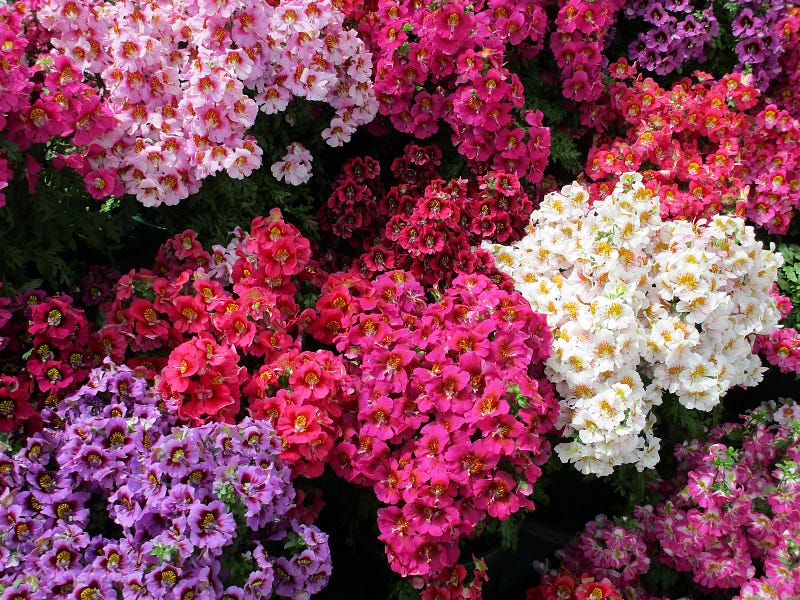
graphic created by author

Spring has sprung here in what was once called the most liveable city in the world — Melbourne, Australia. That was eons ago. Or at least it feels like eons ago as we struggle through our sixth week of stage 4 second-wave lockdown. And it’s not over yet. We all need a good solid dose of cheering up right now. Lucky for us Southern Hemispherians, Mother Nature has an answer — Spring. 🌷

Lucky for me, I have Evan!

“Who’s Evan?”

Good question.

Evan is the clapping poet …

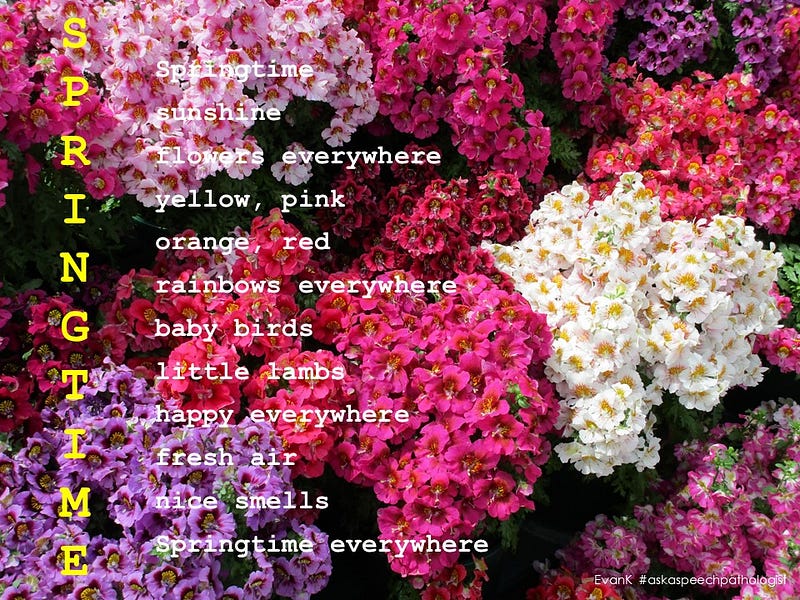
…and this is his Springtime poem.

Springtime sunshine flowers everywhere yellow, pink orange, red rainbows everywhere baby birds little lambs happy everywhere fresh air nice smells Springtime everywhere

It’s a simple poem but it’s quite lovely in the way it captures the essence of Spring. It makes me happy every time I read it. Evan’s poems have that effect on most people who read them. Those who know Evan know that his poems reflect how he sees the world.

Evan’s knack for poetry has its roots in his love of rhythm. He loves anything with a beat. Anything that gives him cause to clap. Evan loves clapping. That’s why he’s called the clapping poet.

Evan has always been a clapper. He was a clapper well before he came to see me for help with his speech. His love of clapping became a handy (pardon the pun!) tool for teaching him to sequence sounds and syllables into words and words into phrases. In the early days, we used syllable clapping to practice his name because, as circumstance would have it, he was born into a family with a surname the length of a road train and the complexity of a Newtonian formula. To be honest, it helped me to syllable-clap his name too.

Talking is not something that comes naturally to Evan. Words elude him. Play hide’n’seek games in his brain. Drive him nuts. He talks in fragments. Like a telegram. Telegrammatic speech.

Even now as a young man, Evan can barely put a sentence together. Having a conversation is hard work. Telling a story from start to finish is very nearly impossible. As for writing a story — forget it.

It took a while for Evan’s teachers to understand and then accept that dot points and key words might be the best they could expect from him.

Poetry, on the other hand, was a natural fit for the boy of few words. In fact, it was one of his classmates who pointed out to their teacher that the two strings of words Evan had laboriously scratched out on paper sounded more like poetry than a story.

Substituting poetry for prose was a logical learning adjustment. Evan was very happy with that adjustment because it gave him license to clap. 👏

Evan was 12 years old when he clap-created his Springtime poem. We worked on it together with me taking on the roles of thought jogger and scribe and Evan being chief-clapper. The first step involved constructing a mind-map of words that Evan associated with Spring. That took some work.

Then came the fun.

Choosing words from the mind-map and organizing them into a clapping pattern based on syllable count and meter. Quick claps. Slow claps. Quick, quick, slow claps. Lots of trial-and-error. Lots and lots of clapping. One very happy boy. 😄
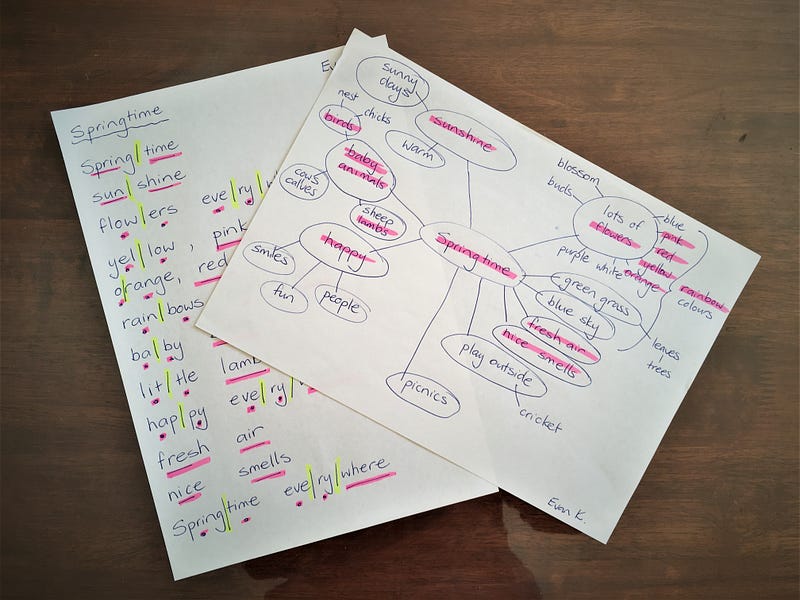
graphic created by author

Evan judges a poem’s worthiness by its syllable count and its ‘clapability’. Anything under 20 syllables fails to pass muster. That’s bad news for Haiku poems (17 syllables) but good news for Tanka poems (31 syllables). Shape poems rate poorly on Evan’s clapability scale while poetic forms that rely on some linguistic nous e.g. acrostics, cinquains, quatrains, are quickly and unceremoniously given the flick.

Evan’s poetry of choice was, and still is, free verse. It gives him the flexibility to choose his own words, his own rhythm, his own clapping pattern. The more claps, the better. Springtime, clocking in at 40 claps, ticks all his boxes.

No matter what season it is in your part of the world right now, I hope Evan’s Springtime poem brings you some cheer and has you clapping along too. Quick–quick–quick–quick–slow. Happy everywhere. Just the way Evan likes it.
graphic created by author

Here’s a recent article I wrote that tells you more about language disorders —

Thank you for reading. 🙏 💕

Here’s your invitation to join Medium where you’ll have unlimited access to every article, including mine. 👉 Click here to use my referral link. 👈 As this is part of an affiliate program, I will receive a percentage of your membership fee. 🙏

Poetry
Inspiration
Disability
Education
The Speechery
Recommended from ReadMedium