avatarJ3

Free AI web copilot to create summaries, insights and extended knowledge, download it at here

8386

Abstract

medium.com/v2/resize:fit:800/1*nc_EVkZxMCiNCi_AZyE6fA.gif"><figcaption>Fig 7. Mounting our humble geartrain with worm gear</figcaption></figure><p id="6699">So, considering our humble geartrain above: at each turn of the worm axis, only one tooth of the 24t advances, so we need 24 turns of the worm axis to give an entire turn of the 24t shaft. the resulting is 1 : 24, while the resulting torque is twenty-four times to one (hence it is easy to turn the lever with load). Therefore, the ratio is 1:24, hurray!</p><p id="02eb">Annotations about Geartrain:</p><div id="07a2"><pre><span class="hljs-number">1</span>) It gives you incredible power (see video above)<span class="hljs-comment">;</span></pre></div><div id="a56c"><pre><span class="hljs-number">2</span>) You can trade <span class="hljs-keyword">as</span> much velocity <span class="hljs-keyword">as</span> you want <span class="hljs-keyword">for</span> <span class="hljs-title class_">the</span> same amount of torque;</pre></div><div id="6f94"><pre><span class="hljs-number">3</span>) All this strength must <span class="hljs-keyword">be </span>used with care, however, <span class="hljs-keyword">because </span>if something gets <span class="hljs-keyword">jammed, </span>the strength of a LEGO motor <span class="hljs-keyword">multiplied </span><span class="hljs-keyword">by </span><span class="hljs-number">3</span>^<span class="hljs-number">5</span> is enough to deform your <span class="hljs-keyword">beams, </span>wring your axles, <span class="hljs-keyword">or </span><span class="hljs-keyword">break </span>the teeth of your gears;</pre></div><div id="1294"><pre><span class="hljs-number">4</span>) <span class="hljs-comment">Remember that in adding multiple reduction stages, each additional stage introduces further friction, the bad guy that makes your world less than ideal. For this reason, if aiming for maximum efficiency, you should try and reach your final ratio with as few stages as possible.</span></pre></div><p id="6ed0">And talking about few stages…</p><p id="0549"><b> The Worm gear</b></p><p id="c4b0">This is another strange gear, a grey one that resembles a sort of cylinder with a spiral wound around it. Is this thing really a gear? Yes, it is, but it is so peculiar we have to give it a special mention</p><figure id="3103"><img src="https://cdn-images-1.readmedium.com/v2/resize:fit:800/0*MUFChBUQw4DFAEgq.gif"><figcaption>Fig 8. Gif from <a href="https://giphy.com/">https://giphy.com</a> How worm gear works :)</figcaption></figure><p id="ceee">Here are some Worm Gear <b>features</b>:</p><div id="74e4"><pre><span class="hljs-number">1</span>) The worm gear leads <span class="hljs-keyword">to</span> an asymmetrical <span class="hljs-keyword">system</span>;</pre></div><div id="eeda"><pre><span class="hljs-number">2</span>) The two axles are perpendicular <span class="hljs-keyword">to</span> <span class="hljs-keyword">each</span> other<span class="hljs-punctuation">;</span></pre></div><div id="da1b"><pre><span class="hljs-number">3</span>) As we turn <span class="hljs-keyword">the</span> worm gear axle slowly <span class="hljs-keyword">by</span> exactly <span class="hljs-literal">one</span> turn, <span class="hljs-keyword">the</span> <span class="hljs-number">24</span>t gear rotates <span class="hljs-keyword">by</span> exactly <span class="hljs-literal">one</span> tooth, <span class="hljs-keyword">at</span> <span class="hljs-keyword">the</span> same <span class="hljs-built_in">time</span>; </pre></div><div id="0332"><pre><span class="hljs-number">4</span>) <span class="hljs-keyword">As</span> consequence we <span class="hljs-keyword">get</span> a <span class="hljs-number">1</span>:<span class="hljs-number">24</span> ratio <span class="hljs-keyword">with</span> a <span class="hljs-type">single</span> stage;</pre></div><div id="0fb9"><pre><span class="hljs-number">5</span>) The asymmetry makes <span class="hljs-keyword">the</span> worm gear applicable only <span class="hljs-keyword">in</span> reducing speed <span class="hljs-keyword">and</span> increasing torque, because, <span class="hljs-keyword">the</span> friction <span class="hljs-keyword">of</span> this particular device <span class="hljs-keyword">is</span> too high <span class="hljs-keyword">to</span> <span class="hljs-keyword">get</span> <span class="hljs-keyword">it</span> rotated <span class="hljs-keyword">by</span> another gear;</pre></div><div id="18a4"><pre><span class="hljs-number">6</span>) The same high friction also makes <span class="hljs-keyword">this</span> solution very inefficient, <span class="hljs-keyword">as</span> a lot of torque gets wasted <span class="hljs-keyword">in</span> the process;</pre></div><div id="952b"><pre><span class="hljs-number">7</span>) But not always <span class="hljs-keyword">this</span> inneficience <span class="hljs-keyword">is</span> a bad thing. There are common situations <span class="hljs-keyword">where</span> <span class="hljs-keyword">this</span> asymmetry <span class="hljs-keyword">is</span> exactly what we want. For example, <span class="hljs-keyword">when</span> designing a robotic arm to lift a small load (see image below)</pre></div><figure id="5e80"><img src="https://cdn-images-1.readmedium.com/v2/resize:fit:800/1*Whl8gTycm83xjj0XB8KrMA.gif"><figcaption>Fig 9. Using worm gear for heavier object…realize that it hangs steady!</figcaption></figure><p id="50c9">In situations where you desire precise and stable positioning under load, the worm gear is the right choice. And it’s also the right choice when you need a high reduction ratio in a small space since allows very compact assembly solutions.</p><p id="0e7d">So, it’s friction that makes it possible…otherwise, the load could return and cause a catastrophe in the engine gears or kill someone; it’s like a hardware brake! superb!</p><figure id="cd1b"><img src="https://cdn-images-1.readmedium.com/v2/resize:fit:800/1*Z4EN0kSfC_HVTIhRc0eNkw.gif"><figcaption>Fig 10. Using only regular gears...it unlocks easily!</figcaption></figure><p id="1dff"><b>The clutch gear</b></p><p id="f44a">Another special device you should get familiar with is the clutch gear: It offers some resistance, but it turns. This is its purpose in life: to offer some resistance, then give in!</p><figure id="97b5"><img src="https://cdn-images-1.readmedium.com/v2/resize:fit:800/1*jlaIMgDEslWHqQMCJ9bWvw.png"><figcaption>Fig 11. A system with an output torque of 25 Ncm will be able to produce a force ten times stronger than one of 2.5 Ncm. In other words, it will be able to lift a weight ten times heavier</figcaption></figure><p id="f4f0">This clutch gear is an invaluable help to limit the strength you can get from a geared system.</p><p id="4a81">The mysterious <i>2.5·5 Ncm</i> writing stamped on it (Ncm is a newton-centimeter, the unit of measurement for torque) indicates that this gear can transmit a maximum torque of about 2.5 to 5 Ncm. When exceeding this limit its internal clutch mechanism starts to slip.</p><p id="e049">10º<b> What’s this feature useful for?</b></p><div id="7c3c"><pre>This clutch gear helps you limiting <span class="hljs-keyword">the</span> final strength <span class="hljs-built_in">to</span> <span class="hljs-keyword">a</span> reasonable <span class="hljs-built_in">value</span></pre></div><p id="f8ff">You have seen before that through some reduction stages you can multiply your torque by high factors, thus getting a system strong enough to actually damage itself if something goes wrong.</p> <figure id="5dfe"> <div> <div> <img class="ratio" src="http://placehold.it/16x9"> <iframe class="" src="https://cdn.embedly.com/widgets/media.html?src=https%3A%2F%2Fgiphy.com%2Fembed%2F3o6Zta541z5bneFxLy%2Ftwitter%2Fiframe&amp;url=https%3A%2F%2Fmedia.giphy.com%2Fmedia%2F3o6Zta541z5bneFxLy%2Fgiphy.gif&amp;image=https%3A%2F%2Fi.giphy.com%2Fmedia%2F3o6Zta541z5bneFxLy%2Fgiphy.gif&amp;key=a19fcc184b9711e1b4764040d3dc5c07&amp;type=text%2Fhtml&amp;schema=giphy" allowfullscreen="" frameborder="0" height="244" width="435"> </div> </div> </figure></iframe></div></div></figure><p id="c656">If you want to know exactly how clutch gear works buy this: I have no 42056 piece, the iconic <a href="https://www.amazon.com/LEGO-Technic-Porsche-911-GT3/dp/B01CU9X8EI">LEGO

Options

Technic Porsche 911 GT3 RS</a> :/</p><p id="18f2">But this is my next online order.</p><p id="fd82">But for now please considered watch these videos:</p> <figure id="6ad7"> <div> <div> <img class="ratio" src="http://placehold.it/16x9"> <iframe class="" src="https://cdn.embedly.com/widgets/media.html?src=https%3A%2F%2Fwww.youtube.com%2Fembed%2F87gg9RwA3EU%3Ffeature%3Doembed&amp;url=http%3A%2F%2Fwww.youtube.com%2Fwatch%3Fv%3D87gg9RwA3EU&amp;image=https%3A%2F%2Fi.ytimg.com%2Fvi%2F87gg9RwA3EU%2Fhqdefault.jpg&amp;key=a19fcc184b9711e1b4764040d3dc5c07&amp;type=text%2Fhtml&amp;schema=youtube" allowfullscreen="" frameborder="0" height="480" width="854"> </div> </div> </figure></iframe></div></div></figure> <figure id="b4f6"> <div> <div> <img class="ratio" src="http://placehold.it/16x9"> <iframe class="" src="https://cdn.embedly.com/widgets/media.html?src=https%3A%2F%2Fwww.youtube.com%2Fembed%2FpqF-aBtTBnY%3Ffeature%3Doembed&amp;url=http%3A%2F%2Fwww.youtube.com%2Fwatch%3Fv%3DpqF-aBtTBnY&amp;image=https%3A%2F%2Fi.ytimg.com%2Fvi%2FpqF-aBtTBnY%2Fhqdefault.jpg&amp;key=a19fcc184b9711e1b4764040d3dc5c07&amp;type=text%2Fhtml&amp;schema=youtube" allowfullscreen="" frameborder="0" height="480" width="854"> </div> </div> </figure></iframe></div></div></figure><p id="3e2c">All right! That’s all Lego’s fun! In the next episode, we’re gonna discuss more Lego’s issue.</p><p id="521f">Be happy building Lego contraptions and learning by doing this Lego series!</p><p id="59f9">Bye!</p><p id="62e3"><a href="https://drive.google.com/open?id=1dE2KMhE43UMVdzrfOaFBEvearbSXoVF_">Download All Files For This Project</a></p><h2 id="f220">Credits & References</h2><p id="ad6f">Based on the book <a href="https://g.co/kgs/AbKS2C">Building Robots With Lego Mindstorms by Guilio Ferrari and Mario Ferrari</a></p><p id="fb1f"><a href="https://youtu.be/k-VdL36vd8Q">LEGO Gears for EV3 Robots Part 4: Specialty Gears</a> by <a href="https://www.youtube.com/channel/UCuXq-jiU0ANeBcF_Tvq1D7g">Builderdude35</a></p><p id="ccd5"><a href="https://education.lego.com/en-us/support/mindstorms-ev3/building-instructions">Building Instructions & Program Descriptions</a></p><p id="212c">Gear from <a href="https://education.lego.com/en-us/lessons/advancing-with-spm/gear#Connect">education.lego.com</a></p><p id="e629"><a href="https://youtu.be/JOLtS4VUcvQ">Spinning Levers — How A Transmission Works</a> (1936) from <a href="https://www.youtube.com/channel/UCTdLvmSFokrAtp1ZtP-HhSw">US Auto Industry</a></p><h2 id="c5f9">Related Posts</h2><p id="2af3">76Ardu_Serie — <a href="https://readmedium.com/arduino-meets-pixy-36138c474912"><b>Arduino Meets Pixy </b></a>— How-To Get Up & Running Flying Pixy!</p><p id="4518">01º Lego Episode — <a href="https://readmedium.com/lego-our-startups-journey-2db83f9e92a4"><b>Our Startup’s Journey</b> </a>— Invaders and Invasions?</p><p id="da00">02º Lego Episode — <a href="https://readmedium.com/timmyton-lego-adventures-02-faae7d8c6fea"><b>Timmyton </b><b>Lego-Learning-By-Playing — L2BP Series</b></a></p><p id="b1d2">04º Lego Episode — <a href="https://readmedium.com/lego-motions-episode-04-41dff47e8834"><b>Lego Motions</b><b>Tribot v 1.0</b><b>Seeing Your Creation Move</b> </a>— Move Steering Block</p><p id="0d41">05º Lego Episode — <a href="https://readmedium.com/lego-motions-move-tribot-around-deb227946425"><b>Lego Motions </b><b>Move Tribot Around</b> </a>— And Backward…Five Programs Files</p><p id="98f9">06º Lego Episode — <a href="https://readmedium.com/lego-sensors-touch-n-color-edbe0f6642f"><b>Lego Sensors</b><b>Touch N Color</b></a> — Two out of five human senses — Touch N Sight</p><p id="3976">07º Lego Episode — <a href="https://readmedium.com/lego-sensor-color-5db4d42e0203"><b>Lego Sensor </b><b>LineFollower</b> </a>— Line Follower Tribot v1.0</p><p id="5939">08º Lego Episode — <a href="https://readmedium.com/maze-solving-tribot-v1-0-a29963f8742a"><b>Maze Solving Robot v1</b></a><b> </b>— Lego Solution Right-Wall-Follower-Robot</p><p id="b7c2">09° Lego Episode — <a href="https://readmedium.com/lego-gettle-sound-bots-5fb40f6d84df"><b>Gettle_&_Sound_Bots</b></a> — How gentle can a robot be? What is the audible range of the human ear? How deep can we dive?</p><p id="9a96">10° Lego Episode — <a href="https://readmedium.com/lego-data-logging-a2fd59dd7933"><b>Data Logging</b></a> — Data Collection and the EV3</p><p id="14df">11º Lego Episode — <a href="https://readmedium.com/lego-binning-the-linefollower-code-5562e059237e"><b>Binning the LineFollower Code </b></a>— Binning: Arithmetic To Map Sensor Reading</p><p id="2380">12° Lego Episode — <a href="https://readmedium.com/lego-a-proportional-linefollower-robot-d9a951debbef"><b>A Proportional LineFollower Robot </b></a>— Advanced Math To Improve Your Robot’s Steering</p><p id="8b82">8th KidSeries — <a href="https://readmedium.com/j3-folower-line-robot-v1-0-7ad68256de83"><b>J3 Follower Line Robot v1.0</b></a> — The Simplest Follower Line Robot</p><p id="8ab6">13º LEGO Theory — <a href="https://readmedium.com/lego-theory-multitasking-2f060d2e3678"><b>Multitasking </b></a>— A very Useful Programming Technique</p><p id="c586">14° LEGO formula — <a href="https://readmedium.com/lego-formula-normalizing-data-66fefd9eb90e?postPublishedType=repub"><b>Normalizing Data</b></a> — Converting Data to Use The Same Range</p><p id="e388">15º Lego Episode — <a href="https://readmedium.com/lego-pid-the-ultimate-line-follower-45d4e517572b"><b>PID — The Ultimate Line Follower </b></a>— Algorithm for your EV3 PID Line Follower Robot</p><p id="d722">16° <a href="https://readmedium.com/lego-meets-pixy-8f8ea7677114?postPublishedType=repub"><b>Lego Meets Pixy Episode</b></a> — How to Connect Your Inexpensive Camera Module to Lego</p><p id="6ec8">18° Lego Episode —<b> <a href="https://readmedium.com/lego-gears-worms-bf8ef3280d0e">GEARS & WORMS</a></b> — Geartrains & Worm & Clutch Gears</p><p id="e656">23° Lego Episode — <a href="https://readmedium.com/lego-differential-explained-12fa1865f3db"><b>Differential Explained</b></a><b> </b>— How Differential Works?</p><p id="3c3b">24° Lego Episode — <a href="https://readmedium.com/pitbot-a-star-is-born-e04a0f305fb6?source=post_page---------------------------"><b>PitBot — A Star Is Born </b></a>— Working at The First Structure in Our Sparring Robot</p><p id="2b36">25° Lego Episode — <a href="https://readmedium.com/pitbot-is-agressive-well-no-worries-c801adba4b4c?source=post_page---------------------------"><b>PitBot Is Agressive? Well, No Worries! </b></a>— Making PitBot bite!</p><p id="cca4">26° Lego Episode — <a href="https://readmedium.com/dancing-good-w-pitbot-16b5ef035077"><b>Dancing Good w/ PitBot</b></a> — All The Secret for Replicate This Awesome Robot</p><p id="264e">27 ° LEGO Episode — <a href="https://readmedium.com/lego-sumo-arena-is-ready-64a59e8bf987"><b>Sumo Arena is Ready! </b></a>— Here is the playing arena for Arduino x Lego</p><p id="c302">28 ° LEGO Episode — <a href="https://readmedium.com/pick-pitbot-up-7dbfa4edc12e"><b>Pick Pitbot Up!</b></a> — Our Robot Are Leaving Body & Paint Shop</p><p id="9eeb">28 ° LEGO — B — Episode — <a href="https://readmedium.com/pitbot-battery-sensor-setup-4f572fedfe20"><b>Pitbot Battery & Sensor Setup</b></a> — Preparing The infrastructure for running Arduino code</p><p id="6ec9">29 ° LEGO Episode — <a href="https://readmedium.com/bridging-all-sensors-together-pitbot-ca8803bf9cb"><b>Bridging All Sensors Together</b></a> — Pitbot — Collecting All Codes for the Final Act of Giving Behaviors to Robot</p><h2 id="d6a9">Curiosity</h2><figure id="cd7a"><img src="https://cdn-images-1.readmedium.com/v2/resize:fit:800/1*hpRRctCHn-TUF39OebH8yw.jpeg"><figcaption><b>Studs</b> are small, cylindrical bumps that are on top of most <a href="https://lego.fandom.com/wiki/LEGO">LEGO</a> bricks that hold together the brick above it. All studs of LEGO <a href="https://lego.fandom.com/wiki/Brick">Bricks</a> have the word <i>“LEGO”</i> printed on them. Not all LEGO bricks have studs (from <a href="https://lego.fandom.com/wiki/Stud">https://lego.fandom.com/wiki/Stud</a>)</figcaption></figure></article></body>

Lego GEARS & WORMS

Geartrains & Worm & Clutch Gears — Episode #18

Look at this super nice notebook: Jump to videos? to see my Lego’s youtube playlist — click here;)

Fig 1. From www.redbubble.com

A Brain Full of Gears! Superb!

In this post, we will guide you through some new concepts —Geartrains, Worms and Clutch Gears, Speed, Torque— as well as assemble simple contraptions to lay the foundations that will give you some of the main concepts from the machinery: GEARS.

This post is heavily based on the book Building Robots With Lego Mindstorms by Guilio Ferrari and Mario Ferrari

Let’s get it on!

But first…no description or explanation can replace what you learn through hands-on experience so watch our lab videos now!

Let’s gain understanding about gears?

10 Step by step:

Counting teeth

Let’s begin by using two very common Lego gears:
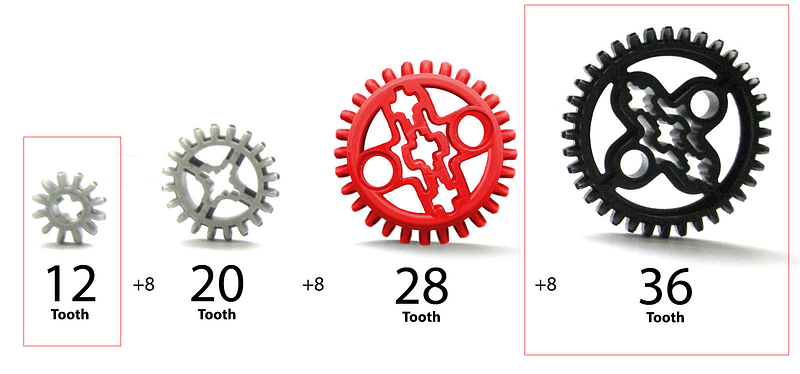
Fig 2. Lego’s gears

For this tutorial, a gear with 12 teeth becomes 12t and the same for the 36t, right?

Fitting Axles

Make this:

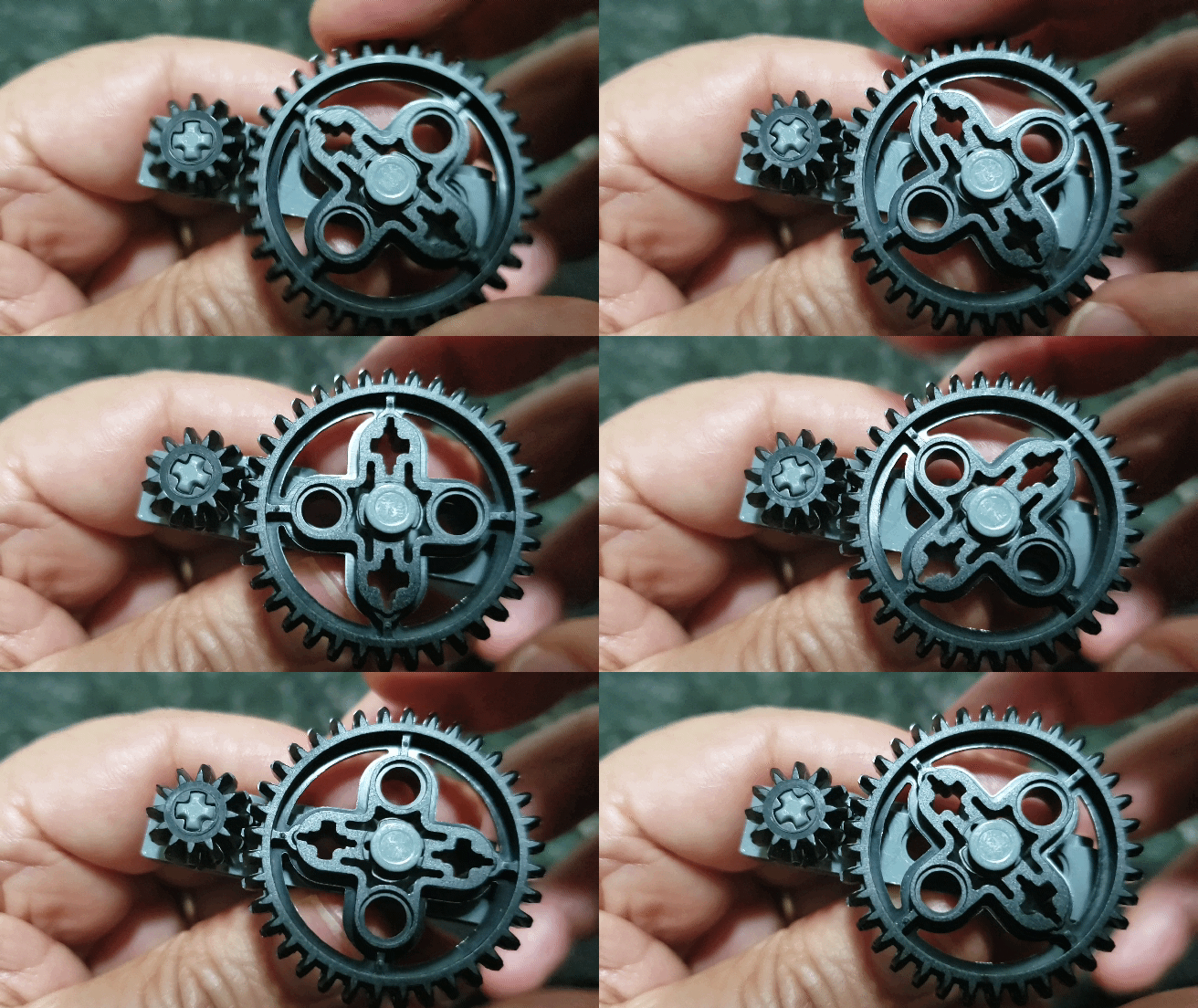
Fig 3. A simple gear ratio 1 : 3 (1 x stage)

Following the notes:

First: The gears are transferring motion from one axle to the other

This is the first thing you should notice is that when you turn one axle, the other turns too. This is their fundamental property, their very nature.

Second: You don't need apply much strength to make them turn 

This is one of the great characteristics of the LEGO TECHNIC system: Parts are designed to match properly at standard distances. Their teeth match well and there is only a small amount of friction.

Third: The two axles turn in opposite directions

One clockwise and the other counterclockwise.

Fourth: The two axles revolve at different speeds

When you turn the 12t, the 32t turns more slowly, while turning the 32t makes the 12t turn faster.

Gear Ratio

For every turn of the 32t, the 12t makes three turns! We express this relationship with a ratio that contains the number of teeth in both gears: 32 to 12. We can simplify it, dividing the two terms by the smaller of the two (12), so we get 3 to 1.This makes it very clear, in numerical terms, that one turn of the first corresponds to three turns of the second. That gives us 1:3 Gear ratio, right?
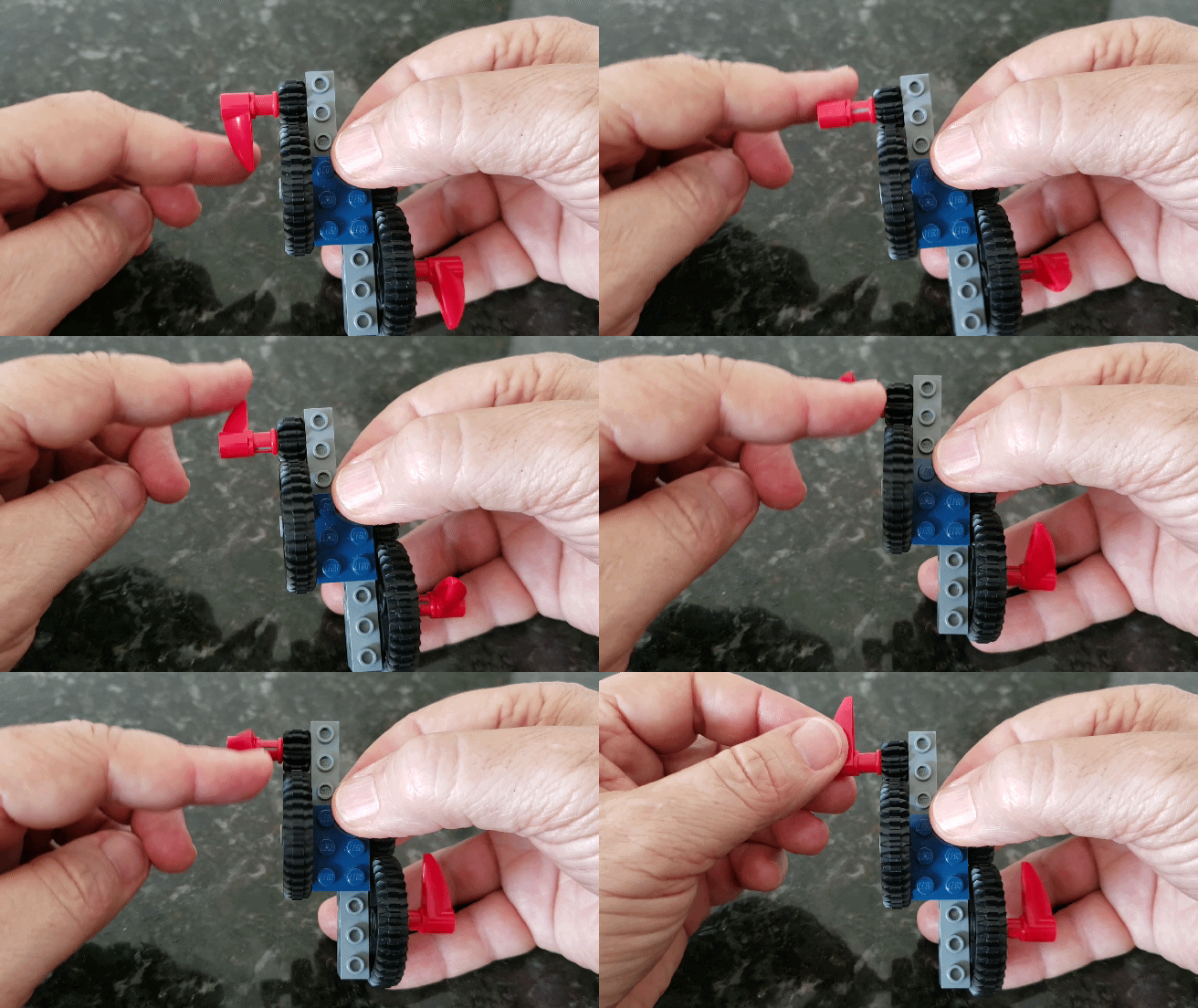
Fig 4. Gear ratio 1 : 3 by 1 : 3 equals 1 : 9

You have found a good method to gain speed (technically angular velocity), alright…but … there is always a but …it is impossible to get something for nothing: you have to pay for this gained speed!

System strength decreases

In other words, the torque falls proportionally to the ratio of the gears relations. But in compensation, you can gain strength by selling speed and that calls for …

Symmetrical Conversion of Gears

One of the nice properties of gears is that this conversion is symmetrical: You can convert torque into velocity or vice versa!

Gearing it down and gearing it up

We say that we gear up when our system increases velocity and reduces torque and that we gear down when it reduces velocity and increases torque.
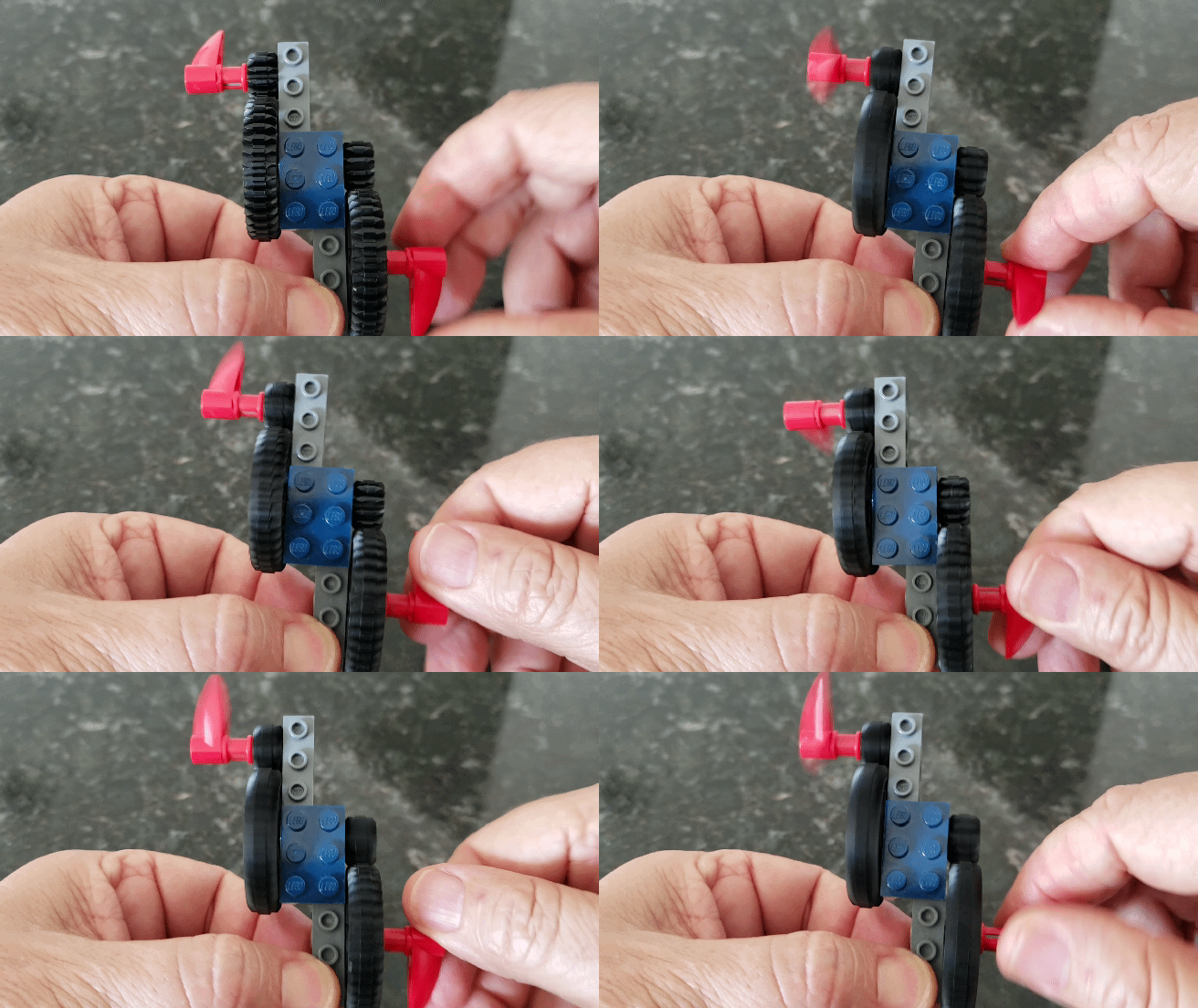
Fig 5. Speed gain by 9 (2 x stages 1 : 3 )

So what is torque for?

To turning something you want: a wheel, a car, a robot...you’ve got it!

Torque is a measure of how much a force acting on an object causes that object to rotate.

Torque is the amount of turning power you have, much in the same way you turn a wrench.

The geartrain

Let’s assume you want more speed. What we must do?

Make a Geartrain, also known as a multistage reduction (or multiplication) system:
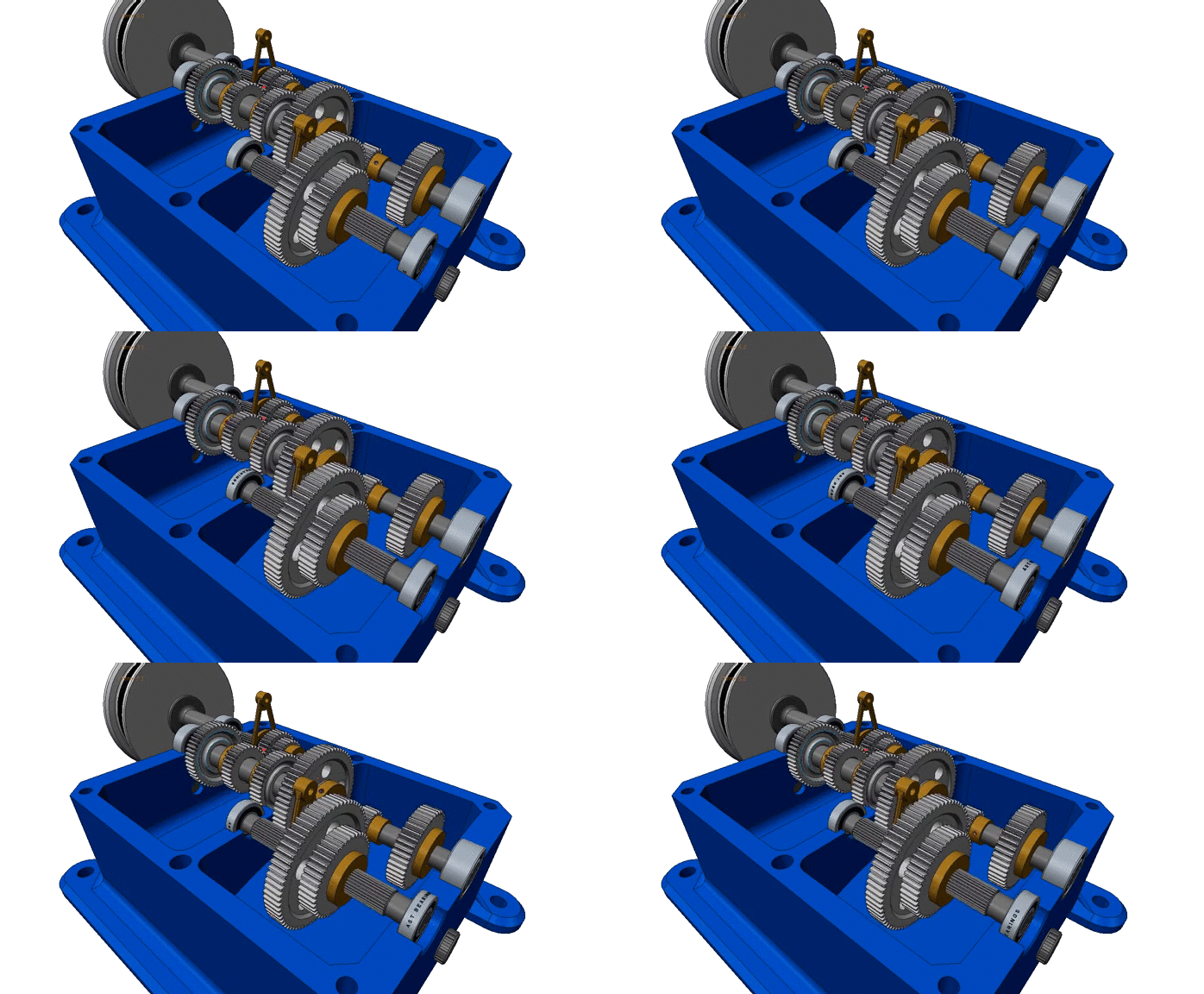
Fig 6. The design is of a 9-speed gearbox for the turret head of a lathe machine operating in the spindle speed range of 1000 rpm to 30 rpm and operated by a motor at 720 rpm. The design involved designing all individual elements and parameters of the gearbox (from https://grabcad.com/library/multi-speed-multi-stage-gearbox-turret-lathe-head-1)
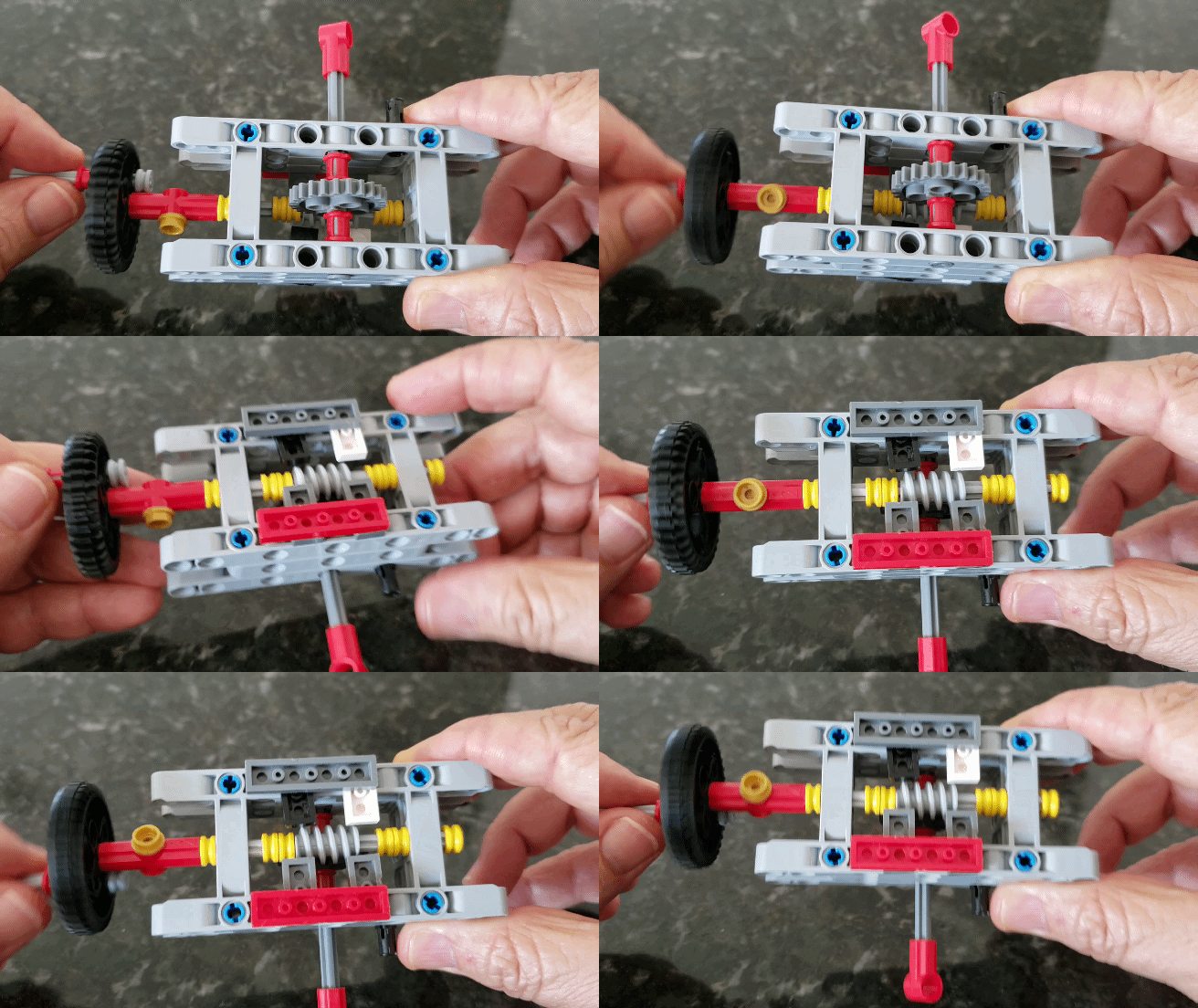
Fig 7. Mounting our humble geartrain with worm gear

So, considering our humble geartrain above: at each turn of the worm axis, only one tooth of the 24t advances, so we need 24 turns of the worm axis to give an entire turn of the 24t shaft. the resulting is 1 : 24, while the resulting torque is twenty-four times to one (hence it is easy to turn the lever with load). Therefore, the ratio is 1:24, hurray!

Annotations about Geartrain:

1) It gives you incredible power (see video above);
2) You can trade as much velocity as you want for the same amount of torque;
3) All this strength must be used with care, however, because if something gets jammed, the strength of a LEGO motor multiplied by 3^5 is enough to deform your beams, wring your axles, or break the teeth of your gears;
4) Remember that in adding multiple reduction stages, each additional stage introduces further friction, the bad guy that makes your world less than ideal. For this reason, if aiming for maximum efficiency, you should try and reach your final ratio with as few stages as possible.

And talking about few stages…

The Worm gear

This is another strange gear, a grey one that resembles a sort of cylinder with a spiral wound around it. Is this thing really a gear? Yes, it is, but it is so peculiar we have to give it a special mention
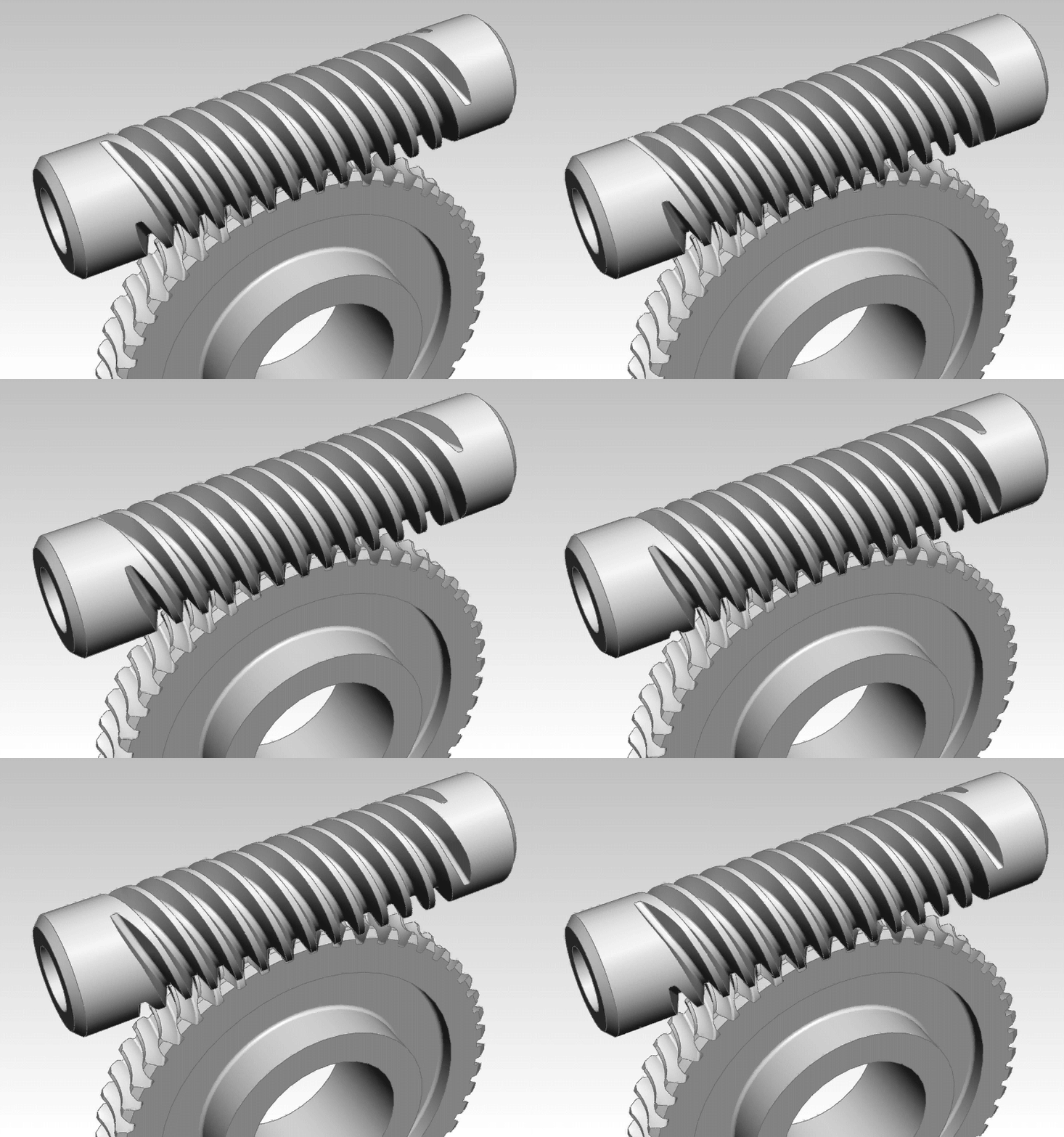
Fig 8. Gif from https://giphy.com How worm gear works :)

Here are some Worm Gear features:

1) The worm gear leads to an asymmetrical system;
2) The two axles are perpendicular to each other;
3) As we turn the worm gear axle slowly by exactly one turn, the 24t gear rotates by exactly one tooth, at the same time; 
4) As consequence we get a 1:24 ratio with a single stage;
5) The asymmetry makes the worm gear applicable only in reducing speed and increasing torque, because, the friction of this particular device is too high to get it rotated by another gear;
6) The same high friction also makes this solution very inefficient, as a lot of torque gets wasted in the process;
7) But not always this inneficience is a bad thing. There are common situations where this asymmetry is exactly what we want. For example, when designing a robotic arm to lift a small load (see image below)
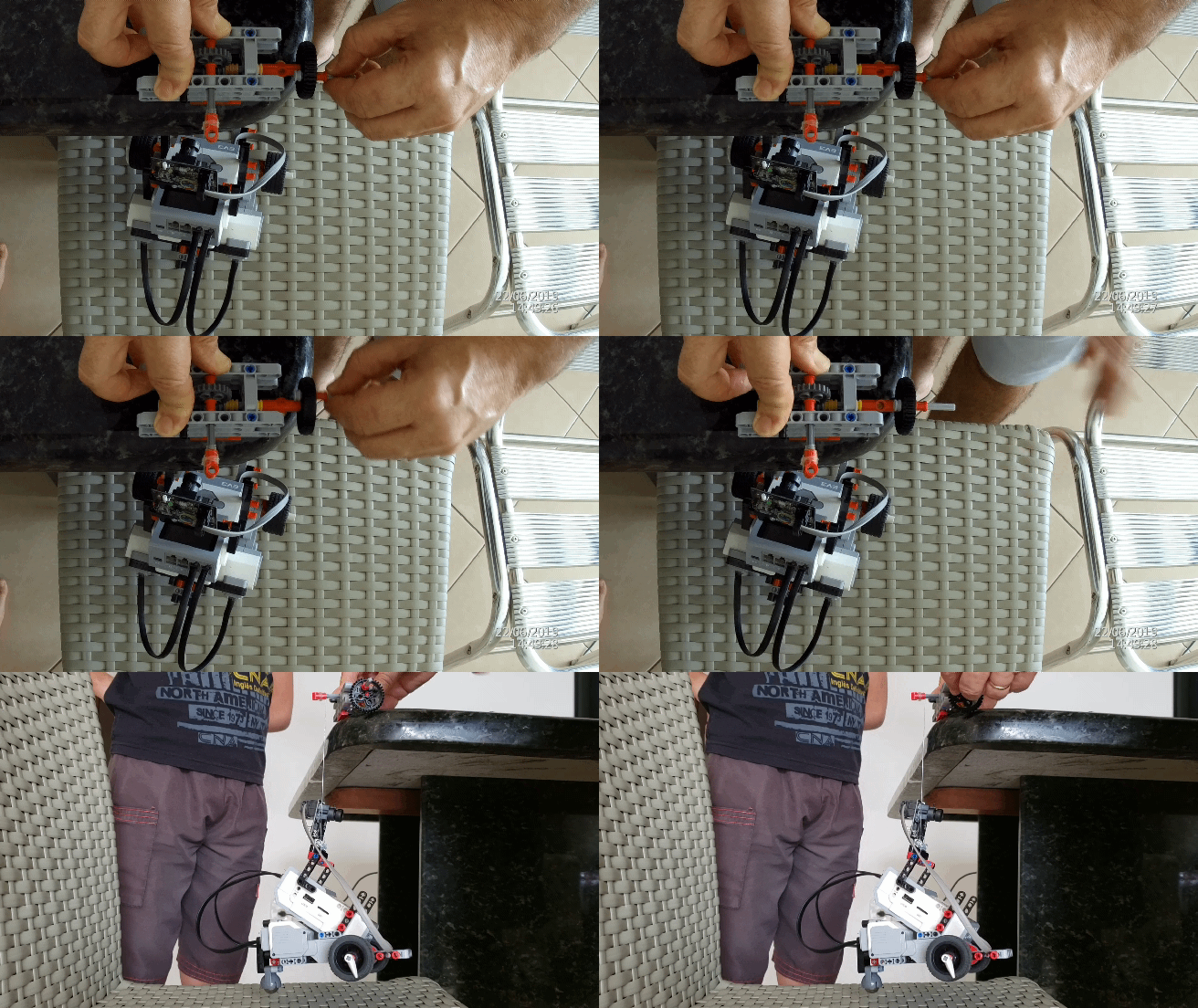
Fig 9. Using worm gear for heavier object…realize that it hangs steady!

In situations where you desire precise and stable positioning under load, the worm gear is the right choice. And it’s also the right choice when you need a high reduction ratio in a small space since allows very compact assembly solutions.

So, it’s friction that makes it possible…otherwise, the load could return and cause a catastrophe in the engine gears or kill someone; it’s like a hardware brake! superb!
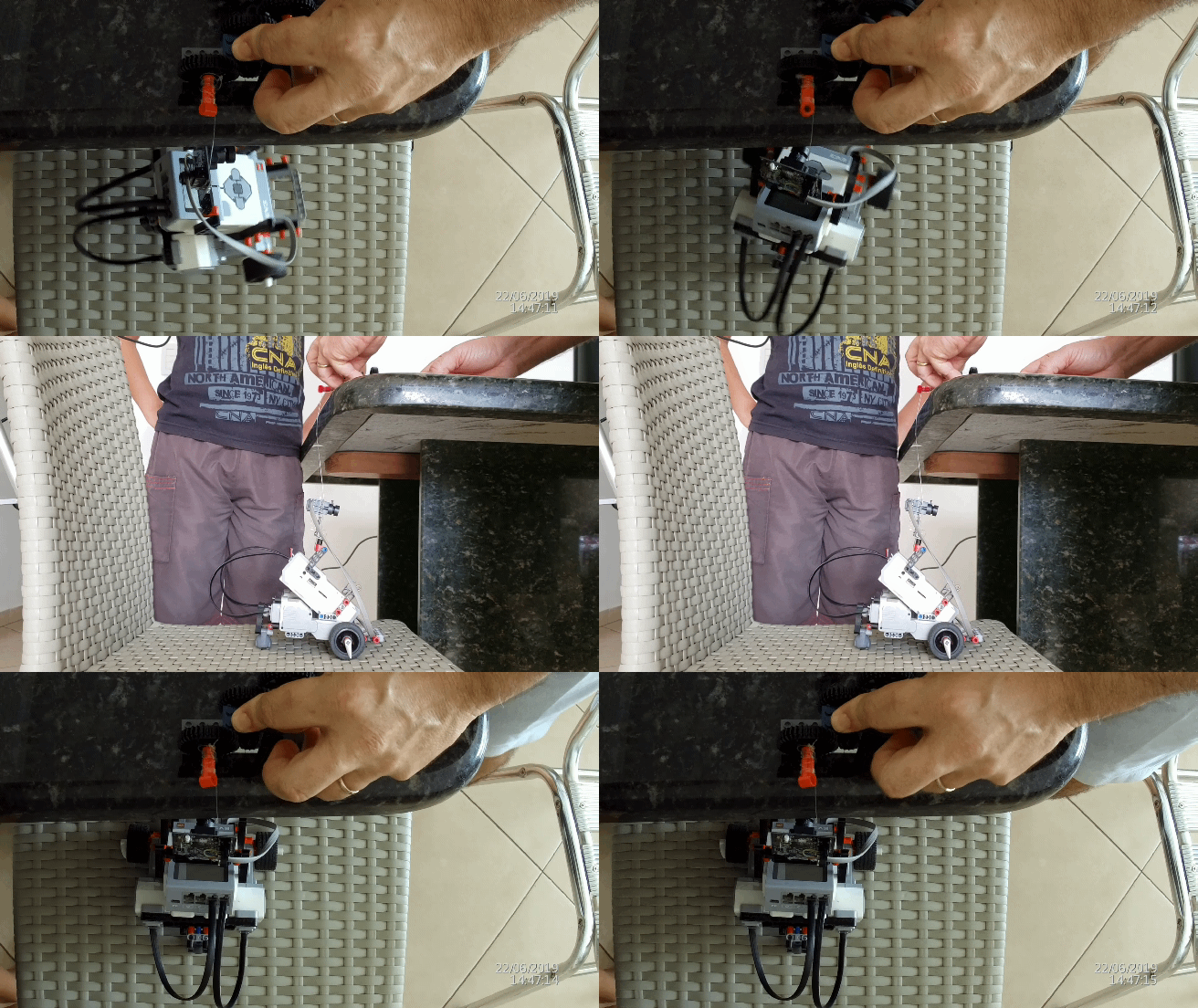
Fig 10. Using only regular gears...it unlocks easily!

The clutch gear

Another special device you should get familiar with is the clutch gear: It offers some resistance, but it turns. This is its purpose in life: to offer some resistance, then give in!
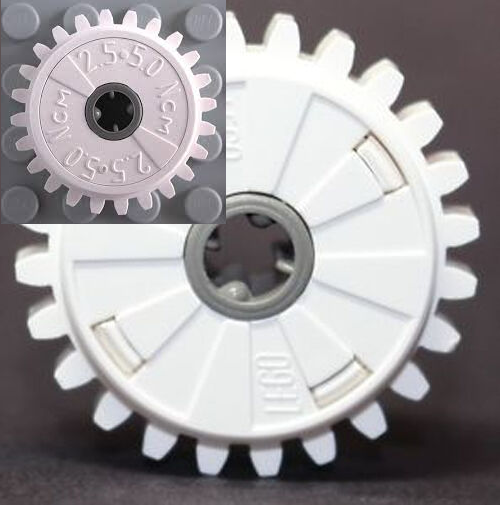
Fig 11. A system with an output torque of 25 Ncm will be able to produce a force ten times stronger than one of 2.5 Ncm. In other words, it will be able to lift a weight ten times heavier

This clutch gear is an invaluable help to limit the strength you can get from a geared system.

The mysterious 2.5·5 Ncm writing stamped on it (Ncm is a newton-centimeter, the unit of measurement for torque) indicates that this gear can transmit a maximum torque of about 2.5 to 5 Ncm. When exceeding this limit its internal clutch mechanism starts to slip.

10º What’s this feature useful for?

This clutch gear helps you limiting the final strength to a reasonable value

You have seen before that through some reduction stages you can multiply your torque by high factors, thus getting a system strong enough to actually damage itself if something goes wrong.

If you want to know exactly how clutch gear works buy this: I have no 42056 piece, the iconic LEGO Technic Porsche 911 GT3 RS :/

But this is my next online order.

But for now please considered watch these videos:

All right! That’s all Lego’s fun! In the next episode, we’re gonna discuss more Lego’s issue.

Be happy building Lego contraptions and learning by doing this Lego series!

Bye!

Download All Files For This Project

Credits & References

Based on the book Building Robots With Lego Mindstorms by Guilio Ferrari and Mario Ferrari

LEGO Gears for EV3 Robots Part 4: Specialty Gears by Builderdude35

Building Instructions & Program Descriptions

Gear from education.lego.com

Spinning Levers — How A Transmission Works (1936) from US Auto Industry

Related Posts

76Ardu_Serie — Arduino Meets Pixy — How-To Get Up & Running Flying Pixy!

01º Lego Episode — Our Startup’s Journey — Invaders and Invasions?

02º Lego Episode — Timmyton Lego-Learning-By-Playing — L2BP Series

04º Lego Episode — Lego MotionsTribot v 1.0Seeing Your Creation Move — Move Steering Block

05º Lego Episode — Lego Motions Move Tribot Around — And Backward…Five Programs Files

06º Lego Episode — Lego SensorsTouch N Color — Two out of five human senses — Touch N Sight

07º Lego Episode — Lego Sensor LineFollower — Line Follower Tribot v1.0

08º Lego Episode — Maze Solving Robot v1 — Lego Solution Right-Wall-Follower-Robot

09° Lego Episode — Gettle_&_Sound_Bots — How gentle can a robot be? What is the audible range of the human ear? How deep can we dive?

10° Lego Episode — Data Logging — Data Collection and the EV3

11º Lego Episode — Binning the LineFollower Code — Binning: Arithmetic To Map Sensor Reading

12° Lego Episode — A Proportional LineFollower Robot — Advanced Math To Improve Your Robot’s Steering

8th KidSeries — J3 Follower Line Robot v1.0 — The Simplest Follower Line Robot

13º LEGO Theory — Multitasking — A very Useful Programming Technique

14° LEGO formula — Normalizing Data — Converting Data to Use The Same Range

15º Lego Episode — PID — The Ultimate Line Follower — Algorithm for your EV3 PID Line Follower Robot

16° Lego Meets Pixy Episode — How to Connect Your Inexpensive Camera Module to Lego

18° Lego Episode — GEARS & WORMS — Geartrains & Worm & Clutch Gears

23° Lego Episode — Differential Explained — How Differential Works?

24° Lego Episode — PitBot — A Star Is Born — Working at The First Structure in Our Sparring Robot

25° Lego Episode — PitBot Is Agressive? Well, No Worries! — Making PitBot bite!

26° Lego Episode — Dancing Good w/ PitBot — All The Secret for Replicate This Awesome Robot

27 ° LEGO Episode — Sumo Arena is Ready! — Here is the playing arena for Arduino x Lego

28 ° LEGO Episode — Pick Pitbot Up! — Our Robot Are Leaving Body & Paint Shop

28 ° LEGO — B — Episode — Pitbot Battery & Sensor Setup — Preparing The infrastructure for running Arduino code

29 ° LEGO Episode — Bridging All Sensors Together — Pitbot — Collecting All Codes for the Final Act of Giving Behaviors to Robot

Curiosity
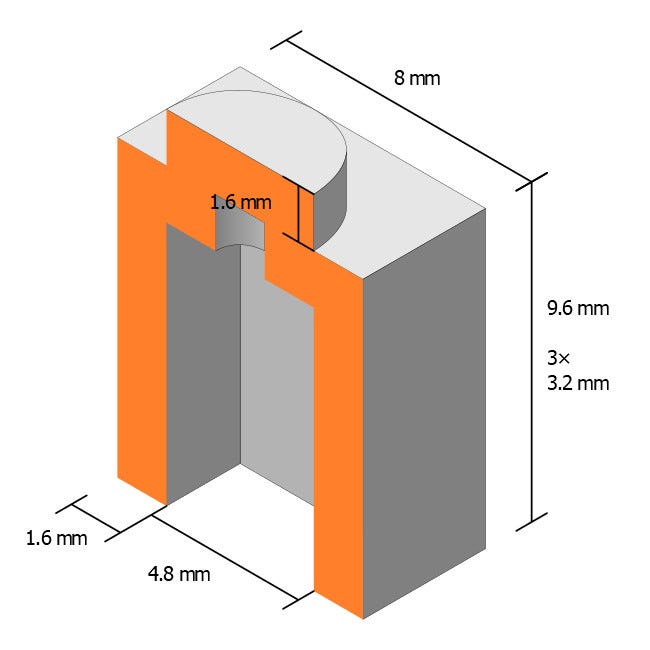
Studs are small, cylindrical bumps that are on top of most LEGO bricks that hold together the brick above it. All studs of LEGO Bricks have the word “LEGO” printed on them. Not all LEGO bricks have studs (from https://lego.fandom.com/wiki/Stud)
Gear
Clutch Gear
Worm Gear Reducers
Hoisting
Lego Serious Play
Recommended from ReadMedium