avatarJillian Enright

Free AI web copilot to create summaries, insights and extended knowledge, download it at here

7328

Abstract

erent reasons: We may use this as a form of social practice, or a way of using information from other sources to help us with social interactions when we feel anxious, uncomfortable, or don’t know what to say.</p><p id="71c5">It can also be a form of <a href="https://leader.pubs.asha.org/do/10.1044/echoes-of-language-development-7-facts-about-echolalia-for-slps/full/">echolalia</a>, which is repeating words and word sounds we hear, a type of verbal imitation. Please do not let anyone tell you echolalia is “meaningless”: it is most certainly not.</p><p id="c370">Echolalia is <a href="https://doi.org/10.1044/2015_AJSLP-14-0166">meaningful, self-generated speech with communicative intent</a>. Although the actual words or sounds being said may not be in line with what the person is intending to communicate, echolalia absolutely serves a purpose and should not be ignored, nor discouraged.</p><p id="a753">Echolalia can be a form of <a href="https://readmedium.com/stimminy-cricket-8b6e38323a2b">vocal-stimming</a>, self-stimulatory behaviour, that increases when a person is stressed or excited. <a href="https://readmedium.com/stimminy-cricket-8b6e38323a2b">Stimming</a> is a very important part of the human experience, and is particularly important for autistics.</p><h2 id="ccc5">Stimming</h2><p id="b2dc"><a href="https://www.spectrumnews.org/news/repetitive-behaviors-and-stimming-in-autism-explained/">Stimming</a> is self-stimulatory behaviour and is often a way autistics regulate our emotions. It can be calming, it can be enjoyable, and sometimes it can signal to others that something is wrong.</p><p id="c9a2">Stimming can be extremely important for autistics and should not be prevented unless it is harmful or dangerous, in which case a safer alternative should be found.</p><blockquote id="f2a3"><p><i></i>Stimming is most commonly understood as serving essential functions of self- regulation and integration<i>.” — Dr. Nick Walker</i></p></blockquote><h2 id="d60f">Everybody stims</h2><p id="54b1">Yes, <i>everybody</i> stims — Some more obviously than others, and for many stimming is a very important part of our daily lives.</p><p id="a535">Some behaviours which <i>can</i> be forms of stimming are:</p><ul><li>Pacing, walking back and forth</li><li>Biting nails</li><li>Picking at skin</li><li>Biting lip or inside of cheek</li><li>Cracking knuckles</li><li>Tapping pen</li><li>Tapping on one’s body (for example, some people tap their finger to their lips or chin when they’re trying to remember something)</li><li>Rocking</li><li>Jumping up and down</li><li>Hand flapping or wiggling fingers</li><li>Humming, singing, or vocalizing</li><li>Wiggling feet or rubbing them together*</li></ul><p id="06b4">This is where I came up with the phrase “<i>stimminy cricket</i>!” One of my stims is rubbing my feet together. Someone referred to this as “cricket feet”, which then evolved (or <i>devolved</i>, depending on your perspective) into <a href="https://readmedium.com/stimminy-cricket-8b6e38323a2b">Stimminy Cricket</a>.</p><figure id="c29a"><img src="https://cdn-images-1.readmedium.com/v2/resize:fit:800/1*3F-3FzG1hMIyYG6iaJSSGw.png"><figcaption>Created by author</figcaption></figure><h2 id="df3b">Emotional intensity</h2><p id="7c3a">There’s a stereotype that characterizes autistics as some kind of <a href="https://readmedium.com/autistic-people-are-not-emotionless-robots-91ae8df7c05c">automaton</a>, as though we don’t have feelings, even described in previous versions of <a href="https://readmedium.com/the-dsm-vs-autism-criteria-sucks-25abf668139e">the DSM</a> as “blunted affect” or flat affect.</p><p id="6e6f">Although autistics may <a href="https://readmedium.com/autistic-people-are-not-emotionless-robots-91ae8df7c05c">struggle to understand or empathize</a> with <i>certain</i> emotional responses in particular situations, this is more often due to cultural and communication differences, rather than lack of emotion or empathy.</p><p id="16c4">Autistic researchers have described this as the <a href="https://doi.org/10.3389/frym.2021.554875">double empathy problem</a>.</p><p id="a5bb">Many neurodivergent people, especially children, experience <a href="https://readmedium.com/adhd-autism-and-emotions-25984d5b01e2">intense emotions</a> and may struggle with <a href="https://readmedium.com/exploring-emotional-co-regulation-ec56d43dbebe">emotional regulation</a>.</p><figure id="5f47"><img src="https://cdn-images-1.readmedium.com/v2/resize:fit:800/1*vVA_VSvjQcsbLDwWI66f5A.png"><figcaption>Image created by author</figcaption></figure><h2 id="cc20">Inflexibility</h2><p id="b195">Nearly all neurodivergent people struggle with <a href="https://readmedium.com/executive-functions-for-parents-kids-ec71f38bb383">executive functions</a> of some form or another, these include emotional regulation, but also impulse control, working memory, organization, and <a href="https://readmedium.com/executive-functions-for-parents-kids-ec71f38bb383#fd16">cognitive flexibility</a>.</p><p id="712c">Adaptability and <a href="https://readmedium.com/teaching-kids-cognitive-flexibility-5389fb07109c">flexibility</a> can be major struggles for a lot of autistic children. Many autistics struggle with last-minute or abrupt changes in plans and routine. We find predictability comforting and unpredictability can make us very anxious.</p><h2 id="a941">Their senses are extremely sensitive</h2><p id="a192">Many autistic children have intense responses to certain sensory stimuli, yet strangely dulled responses to others. For example, they may feel overwhelmed in a loud, busy environment, yet have an unusually pain tolerance.</p><p id="897d">Some autistics have extreme sensory sensitivities to light, textures, certain sounds, tastes, etc.</p><figure id="7a5e"><img src="https://cdn-images-1.readmedium.com/v2/resize:fit:800/1*j1zdV5F-wKnDTh5FrGIKvQ.png"><figcaption>Created by author</figcaption></figure><p id="f100">Most autistics aren’t exclusively <a href="https://doi.org/10.1007/s10803-021-05186-3">sensory seekers or avoiders</a>. Most people are a combination of the two, depending on our stress and tolerance levels, the environment, personal preferences, and nervous systems.</p><h2 id="472a">Individual differences</h2><p id="dd48">It’s very important to remember that, while we will share similar traits, every autistic is an individual. As you expand your understanding of autism, you’ll be able to tailor the information to suit your child, tailoring it to fit their unique personality and needs.</p><p id="fc52">The most important thing is to show your child unconditional acceptance and love, and not to try to mold them into someone they are not. Your autistic child is awesome just as they are.</p><p id="cd20">© Jillian Enright, Neurodiversity MB</p><h1 id="8364">Related Stories</h1><div id="ecb9" class="link-block"> <a href="https://readmedium.com/how-to-know-if-youre-autistic-644ea6050596"> <div> <div> <h2>How To Know If You’re Autistic</h2> <div><h3>Step one: learn from the experiences of actually autistic people</h3></div> <div><p>medium.com</p></div> </div> <div> <div style="background-image: url(https://miro.readmedium.com/v

Options

2/resize:fit:320/1*ZQ8fZEMEn74yzjR2WmUA0Q.png)"></div> </div> </div> </a> </div><div id="9ca3" class="link-block"> <a href="https://readmedium.com/my-anti-behaviourism-series-b0cbff1abf82"> <div> <div> <h2>My Anti-Behaviourism Series</h2> <div><h3>My stories explaining the many problems with behaviourism, backed by extensive research</h3></div> <div><p>medium.com</p></div> </div> <div> <div style="background-image: url(https://miro.readmedium.com/v2/resize:fit:320/1*TBZMqZ0-zw3v5sFlumSkzg.jpeg)"></div> </div> </div> </a> </div><div id="01b6" class="link-block"> <a href="https://readmedium.com/stimminy-cricket-8b6e38323a2b"> <div> <div> <h2>Stimminy Cricket</h2> <div><h3>Stimming, or “self-stimulatory” behaviours are human behaviours</h3></div> <div><p>medium.com</p></div> </div> <div> <div style="background-image: url(https://miro.readmedium.com/v2/resize:fit:320/1*0fgvVeCDj7fmrBw78LI_gQ.jpeg)"></div> </div> </div> </a> </div><h2 id="bbb6">Ways to support my work</h2><p id="836f">You can leave a “tip” on Ko-Fi at <a href="https://Ko-Fi.com/NeurodiversityMB">https://Ko-Fi.com/NeurodiversityMB</a></p><p id="1faf">Become a paid subscriber to <a href="https://twoemb.substack.com">my SubStack publication</a>.</p><p id="f5dc">Check out my online store at <a href="https://NeurodiversityMB.ca/shop">https://NeurodiversityMB.ca/shop</a></p><p id="c437">Read and share my articles from <a href="https://twoemb.medium.com">twoemb.medium.com</a></p><h2 id="b7e9">Learn more</h2><div id="5017" class="link-block"> <a href="https://readmedium.com/books-about-autism-b285dabf0fda"> <div> <div> <h2>Books About Autism</h2> <div><h3>My reading recommendations for learning about autism</h3></div> <div><p>medium.com</p></div> </div> <div> <div style="background-image: url(https://miro.readmedium.com/v2/resize:fit:320/1*eQ_IfaJEVn_wgP2QnLKHgA.png)"></div> </div> </div> </a> </div><div id="20ed" class="link-block"> <a href="https://readmedium.com/adhd-autism-and-emotions-25984d5b01e2"> <div> <div> <h2>ADHD, Autism, And Emotions</h2> <div><h3>Why neurodivergent folks often struggle with dysregulation</h3></div> <div><p>medium.com</p></div> </div> <div> <div style="background-image: url(https://miro.readmedium.com/v2/resize:fit:320/1*wwllnZbST90Cu5tGXB_WYg.png)"></div> </div> </div> </a> </div><div id="6f93" class="link-block"> <a href="https://readmedium.com/teaching-kids-cognitive-flexibility-5389fb07109c"> <div> <div> <h2>Teaching Kids Mental Flexibility</h2> <div><h3>Helping our children see shades of grey and improve cognitive adaptability</h3></div> <div><p>medium.com</p></div> </div> <div> <div style="background-image: url(https://miro.readmedium.com/v2/resize:fit:320/1*c1UsVF6FLrP7blEHmESymQ.png)"></div> </div> </div> </a> </div><div id="2432" class="link-block"> <a href="https://readmedium.com/autistic-people-are-not-emotionless-robots-91ae8df7c05c"> <div> <div> <h2>Autistic People Are Not Emotionless Robots</h2> <div><h3>Untangling and explaining alexithymia</h3></div> <div><p>medium.com</p></div> </div> <div> <div style="background-image: url(https://miro.readmedium.com/v2/resize:fit:320/1*807lOGIz8eCHI5FMdU8Mlw.png)"></div> </div> </div> </a> </div><div id="cfa2" class="link-block"> <a href="https://readmedium.com/autism-q-a-e6f2d006fb40"> <div> <div> <h2>Frequently Asked Questions About Autism</h2> <div><h3>Answering the most common questions I receive about Autism</h3></div> <div><p>medium.com</p></div> </div> <div> <div style="background-image: url(https://miro.readmedium.com/v2/resize:fit:320/1*Vj3R7Ux1SaxZdQ9WCri0tg.png)"></div> </div> </div> </a> </div><h2 id="94c7">I created a brand new eBook!</h2><p id="6e74"><a href="https://neurodiversitymb.ca/shop/ols/products/what-does-it-mean-to-be-autistic">What does it mean to be Autistic</a>? A guide for youth, teens, parents, and caregivers who are new to autism, or want to learn more deeply about being Autistic from a <a href="https://readmedium.com/finding-neurodiversity-affirming-support-b57bae9b5b20">neurodiversity-affirming</a> perspective.</p><p id="93f7">An <a href="https://neurodiversitymb.ca/shop/ols/products/what-does-it-mean-to-be-autistic">85-page book</a> along with a workbook in both printable and fillable formats.</p><figure id="a19d"><img src="https://cdn-images-1.readmedium.com/v2/resize:fit:800/1*YUC-UI6HjfqH9IpaQXpKXw.png"><figcaption>Created by author</figcaption></figure><h2 id="b9da">References</h2><p id="0525">Casanova, E. L., Baeza-Velasco, C., Buchanan, C. B., & Casanova, M. F. (2020). The Relationship between Autism and Ehlers-Danlos Syndromes/Hypermobility Spectrum Disorders. <i>Journal of personalized medicine</i>, <i>10</i>(4), 260. <a href="https://doi.org/10.3390/jpm10040260">https://doi.org/10.3390/jpm10040260</a></p><p id="49e0">Crompton, C., DeBrabander, K., Heasman, B., Milton, D., Sasson N. (2021). Double Empathy: Why Autistic People Are Often Misunderstood. <i>Frontiers for Young Minds, 9</i>, 554875. <a href="https://doi.org/10.3389/frym.2021.554875">https://doi.org/10.3389/frym.2021.554875</a></p><p id="c906">MacLennan, K., O’Brien, S., Tavassoli, T. (2021). In Our Own Words: The Complex Sensory Experiences of Autistic Adults. <i>Journal of Autism and Developmental Disorders.</i> <a href="https://doi.org/10.1007/s10803-021-05186-3">https://doi.org/10.1007/s10803-021-05186-3</a></p><p id="9e39">Milton, D. (2012) On the ontological status of autism: the ‘double empathy problem’. <i>Disability & Society, 27</i>(6), 883–887. <a href="https://doi.org/10.1080/09687599.2012.710008">https://doi.org/10.1080/09687599.2012.710008</a></p><p id="1ee4">Stiegler, L. N.. (2015). Examining the Echolalia Literature: Where Do Speech-Language Pathologists Stand? <i>American Journal of Speech-Language Pathology, 24</i>(4). <a href="https://doi.org/10.1044/2015_AJSLP-14-0166">https://doi.org/10.1044/2015_AJSLP-14-0166</a></p><p id="ba13">Walker, N. (2021). <i>Neuroqueer Heresies: Notes on the neurodiversity paradigm, Autistic empowerment, and postnormal possibilities</i>. Autonomous Press.</p></article></body>

Explaining Autism to Kids

If you’re not autistic, learn from autistic adults
Created by author

Welcome!

If you’re a parent who has recently learned your child is autistic, take a little time to process the information, and to learn about what this means for your child.

When seeking advice regarding how to best support your child, your best source of information will be actually autistic adults*, and professionals who embrace a neurodiversity-affirming philosophy.

*What I mean when I say learn from autistic adults, is learn from those who have already shared their experiences, and/or are offering to do so. Not everyone has the emotional energy to mentor and teach others, so it’s important to seek out those who are already doing this.

What does neurodiversity-affirming mean?

How a professional can support you or your child in a child-centred, neurodiversity-affirming way:

  • Get to know your child and your family to understand individual needs, goals, and strengths.
  • Learn what accommodations or supports might be helpful to enhance those existing strengths.
  • Provide tools and strategies for managing challenges, as identified by your child.
  • Educate and provide information about specific divergent neurotypes, how they impact people’s lives, and what accommodations and adaptations may be most helpful.
  • Advocate for your family to ensure your needs are being met: at school, home, in your community, and in the workplace.
  • With your family’s permission, network and communicate with any other professionals involved with your family, to provide consistent, collaborative services.
  • Provide services in a manner that respects each person’s autonomy, individuality, and freedom of expression.

What do avoid:

  • Services which utilize reward-and-punishment behaviour therapies, or any type of coercive and manipulative approaches.
  • Services which aim to teach neurodivergent children how to “act” neurotypical, who claim they can “cure” autism (they can’t), or “train autistic behaviours” out of a child.
  • When the needs of the institutions are prioritized over the needs of children, this is harmful and traumatizing.

Explaining Autism to Kids

A lot of parents wonder if they should even tell their child about their diagnosis, especially if they are quite young.

While each family will have to make their own decision based on what they think is best for their child, my short answer is: yes. Absolutely, yes.

A lot of parents ask if they should even tell their child about their diagnosis. My short answer is: yes.

Once you’ve had an opportunity to process the information yourself, and are confident in your knowledge about their diagnosis, tell your child. Chances are they already feel different and don’t understand why. This could help put things into perspective for them.

Many children blame themselves for being different, especially if they have been getting into trouble at school, at home, or in social situations. It’s important for neurodiverse children to understand they are not less than anyone else.

It is not their fault that they’ve been struggling, they were simply born with a brain that works differently from the majority of others — In fact, sometimes this will be a strength, as a unique brain can bring gifts as well as difficulties.

The good news is now that we know more about our differences, we can develop strategies to let our strengths shine through. Remember to explain that our differences come with both challenges and gifts; there will be both pros and cons to having a differently wired brain.

It is not their fault that they’ve been struggling, they were born with a brain that works differently from others.

Autistic traits

Autism looks and feels different for each person, so there is no one way to be autistic, and no one way to identify autism. That said, there are many common traits amongst those of the same neurotype.

It’s also important to remember that autism presents differently in male-presenting children compared to female-presenting children, and may be harder to identify in marginalized genders, marginalized racial and ethnic groups, and in children who have learned to mask (or hide) their autism well.

Physical differences

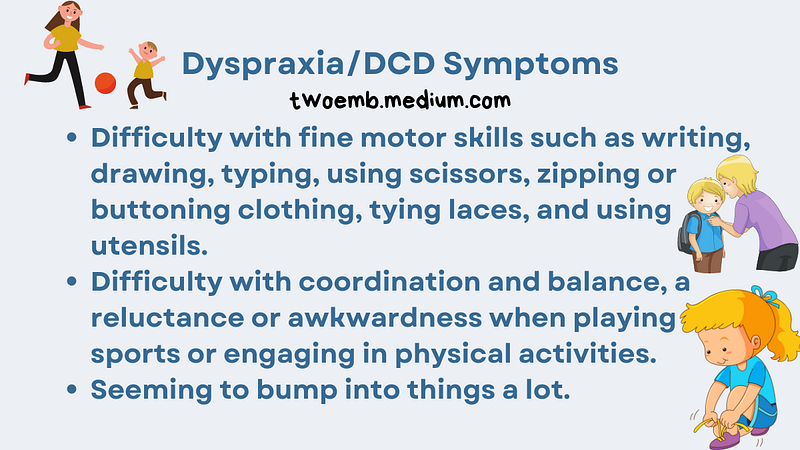
Many neurodivergent children struggle with fine and gross motor skills. They may appear uncoordinated or dislike certain types of physical activities. They may struggle with tasks such as buttoning up shirts, using zippers and scissors, or writing neatly.

A lot of autistics feel uncoordinated for a variety of reasons. Developmental Coordination Disorder (DCD, or dyspraxia), commonly co-occurs with autism. A recent study found that 88% of autistic children were at risk for motor impairments, such as dyspraxia.
Created by author

Many autistics also have hyper-mobility in their joints, some having been diagnosed with Ehlers-Danlos syndrome (EDS), a condition which affects the body’s connective tissues — primarily skin, joints and blood vessel walls. People who have Ehlers-Danlos syndrome usually have overly flexible joints and stretchy, fragile skin.

Children with EDS may bruise easily, sprain joints (especially rolling ankles) frequently, or dislocate joints easily.

They frequently repeat sentences or words

There are two reasons for this.

Many autistics do something called scripting, where we repeat lines we’ve heard from television shows, read in books, or have heard others say.

This can be for a few different reasons: We may use this as a form of social practice, or a way of using information from other sources to help us with social interactions when we feel anxious, uncomfortable, or don’t know what to say.

It can also be a form of echolalia, which is repeating words and word sounds we hear, a type of verbal imitation. Please do not let anyone tell you echolalia is “meaningless”: it is most certainly not.

Echolalia is meaningful, self-generated speech with communicative intent. Although the actual words or sounds being said may not be in line with what the person is intending to communicate, echolalia absolutely serves a purpose and should not be ignored, nor discouraged.

Echolalia can be a form of vocal-stimming, self-stimulatory behaviour, that increases when a person is stressed or excited. Stimming is a very important part of the human experience, and is particularly important for autistics.

Stimming

Stimming is self-stimulatory behaviour and is often a way autistics regulate our emotions. It can be calming, it can be enjoyable, and sometimes it can signal to others that something is wrong.

Stimming can be extremely important for autistics and should not be prevented unless it is harmful or dangerous, in which case a safer alternative should be found.

Stimming is most commonly understood as serving essential functions of self- regulation and integration.” — Dr. Nick Walker

Everybody stims

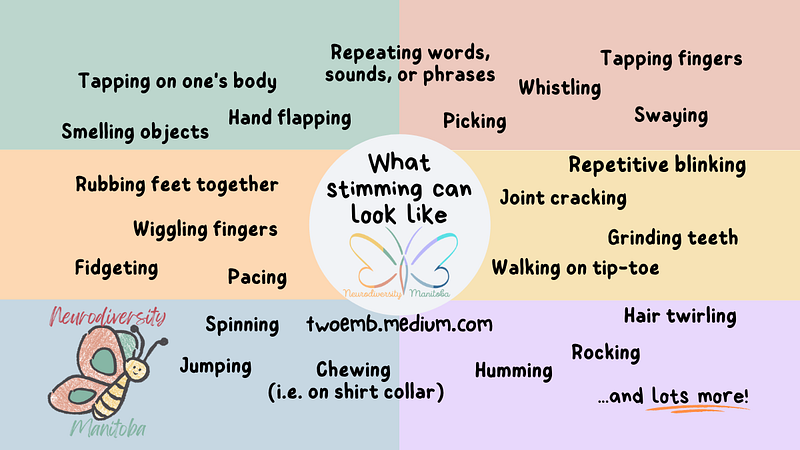
Yes, everybody stims — Some more obviously than others, and for many stimming is a very important part of our daily lives.

Some behaviours which can be forms of stimming are:

  • Pacing, walking back and forth
  • Biting nails
  • Picking at skin
  • Biting lip or inside of cheek
  • Cracking knuckles
  • Tapping pen
  • Tapping on one’s body (for example, some people tap their finger to their lips or chin when they’re trying to remember something)
  • Rocking
  • Jumping up and down
  • Hand flapping or wiggling fingers
  • Humming, singing, or vocalizing
  • Wiggling feet or rubbing them together*

This is where I came up with the phrase “stimminy cricket!” One of my stims is rubbing my feet together. Someone referred to this as “cricket feet”, which then evolved (or devolved, depending on your perspective) into Stimminy Cricket.
Created by author

Emotional intensity

There’s a stereotype that characterizes autistics as some kind of automaton, as though we don’t have feelings, even described in previous versions of the DSM as “blunted affect” or flat affect.

Although autistics may struggle to understand or empathize with certain emotional responses in particular situations, this is more often due to cultural and communication differences, rather than lack of emotion or empathy.

Autistic researchers have described this as the double empathy problem.

Many neurodivergent people, especially children, experience intense emotions and may struggle with emotional regulation.
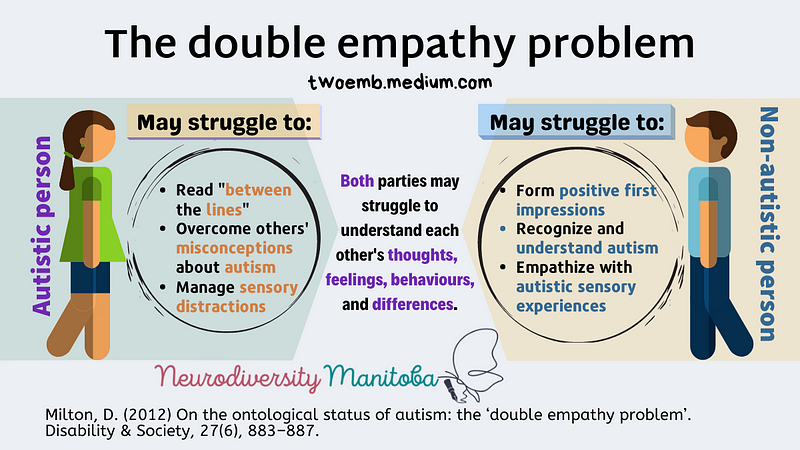
Image created by author

Inflexibility

Nearly all neurodivergent people struggle with executive functions of some form or another, these include emotional regulation, but also impulse control, working memory, organization, and cognitive flexibility.

Adaptability and flexibility can be major struggles for a lot of autistic children. Many autistics struggle with last-minute or abrupt changes in plans and routine. We find predictability comforting and unpredictability can make us very anxious.

Their senses are extremely sensitive

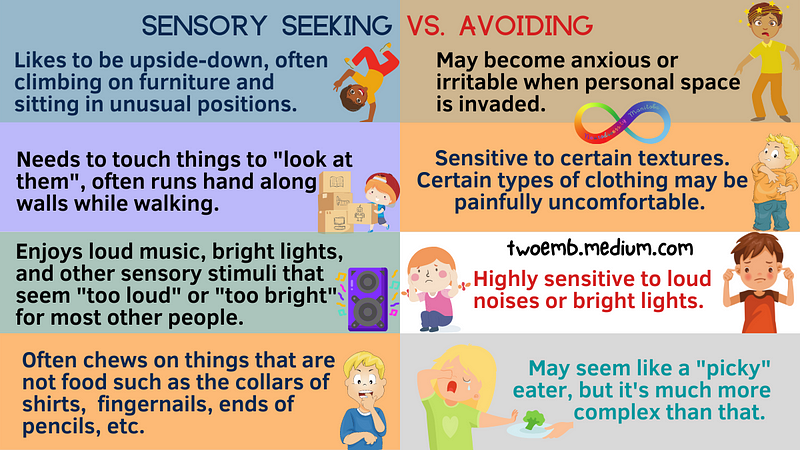
Many autistic children have intense responses to certain sensory stimuli, yet strangely dulled responses to others. For example, they may feel overwhelmed in a loud, busy environment, yet have an unusually pain tolerance.

Some autistics have extreme sensory sensitivities to light, textures, certain sounds, tastes, etc.
Created by author

Most autistics aren’t exclusively sensory seekers or avoiders. Most people are a combination of the two, depending on our stress and tolerance levels, the environment, personal preferences, and nervous systems.

Individual differences

It’s very important to remember that, while we will share similar traits, every autistic is an individual. As you expand your understanding of autism, you’ll be able to tailor the information to suit your child, tailoring it to fit their unique personality and needs.

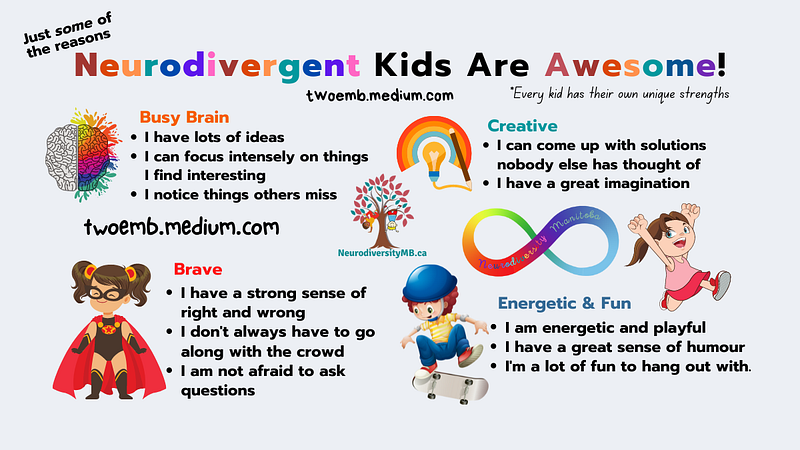
The most important thing is to show your child unconditional acceptance and love, and not to try to mold them into someone they are not. Your autistic child is awesome just as they are.

© Jillian Enright, Neurodiversity MB

Related Stories

Ways to support my work

You can leave a “tip” on Ko-Fi at https://Ko-Fi.com/NeurodiversityMB

Become a paid subscriber to my SubStack publication.

Check out my online store at https://NeurodiversityMB.ca/shop

Read and share my articles from twoemb.medium.com

Learn more

I created a brand new eBook!

What does it mean to be Autistic? A guide for youth, teens, parents, and caregivers who are new to autism, or want to learn more deeply about being Autistic from a neurodiversity-affirming perspective.

An 85-page book along with a workbook in both printable and fillable formats.
Created by author

References

Casanova, E. L., Baeza-Velasco, C., Buchanan, C. B., & Casanova, M. F. (2020). The Relationship between Autism and Ehlers-Danlos Syndromes/Hypermobility Spectrum Disorders. Journal of personalized medicine, 10(4), 260. https://doi.org/10.3390/jpm10040260

Crompton, C., DeBrabander, K., Heasman, B., Milton, D., Sasson N. (2021). Double Empathy: Why Autistic People Are Often Misunderstood. Frontiers for Young Minds, 9, 554875. https://doi.org/10.3389/frym.2021.554875

MacLennan, K., O’Brien, S., Tavassoli, T. (2021). In Our Own Words: The Complex Sensory Experiences of Autistic Adults. Journal of Autism and Developmental Disorders. https://doi.org/10.1007/s10803-021-05186-3

Milton, D. (2012) On the ontological status of autism: the ‘double empathy problem’. Disability & Society, 27(6), 883–887. https://doi.org/10.1080/09687599.2012.710008

Stiegler, L. N.. (2015). Examining the Echolalia Literature: Where Do Speech-Language Pathologists Stand? American Journal of Speech-Language Pathology, 24(4). https://doi.org/10.1044/2015_AJSLP-14-0166

Walker, N. (2021). Neuroqueer Heresies: Notes on the neurodiversity paradigm, Autistic empowerment, and postnormal possibilities. Autonomous Press.

Autism
Neurodiversity
Parenting
Psychology
Mental Health
Recommended from ReadMedium