
Life Strategy: The Domain Discovery Activity
Define a new type of Second-order Activity
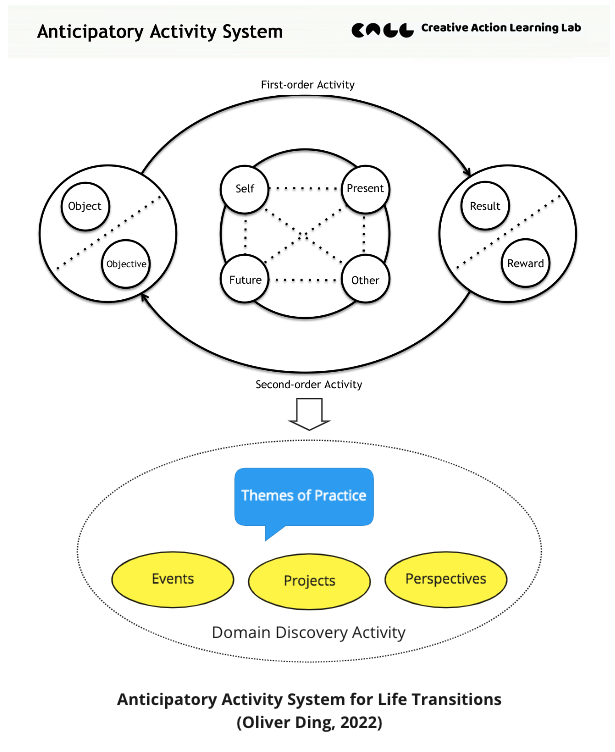
This article aims to define a new type of Second-order Activity for the Anticipatory Activity System (AAS) framework: Domain Discovery Activity.
The above diagram highlights four keywords for Domain Discovery Activity: Events, Projects, Perspectives, and Themes of Practice. These keywords are adopted from the Epistemology of Domain.
This article will turn The Epistemology of Domain into the Domain Discovery Toolkit for future development.
1. “Discovery” as Second-order Activity
I have written articles about Life Discovery, Knowledge Discovery, and Concept Discovery. From the perspective of the AAS framework, all “Discovery” activities belong to Second-order Activity.
The AAS framework claims that an AAS is formed by two parts: First-order Activity and Second-order Activity. The major difference is the objective of Second-order Activity is all about defining objectives for the next activities while First-order Activity only focuses on producing results.
If you ask the following questions and you can easily answer them. Then, you can just do it.
What should I do with the rest of my life? What should we do next year?
If you can’t answer them easily, you probably need time to do something in order to figure out the answers. The something means Second-order Activity. You can find more details in Life Discovery: The “Tacit” Type of Second-order Activity and CALL for LIFE: Oliver Ding @ 2021 and Second-order Activity.
For Domain Discovery, we start with the following question:
What should I do with this Domain?
The above question leads to the second perspective. I consider all “Discovery” activities to happen in a container that connects YOU and Thing from the perspective of the Ecological Practice Approach.
For example, Domain Discovery is about the following three containers:
- Container X: YOU
- Container Y: Domain
- Container Z: Domain Discovery
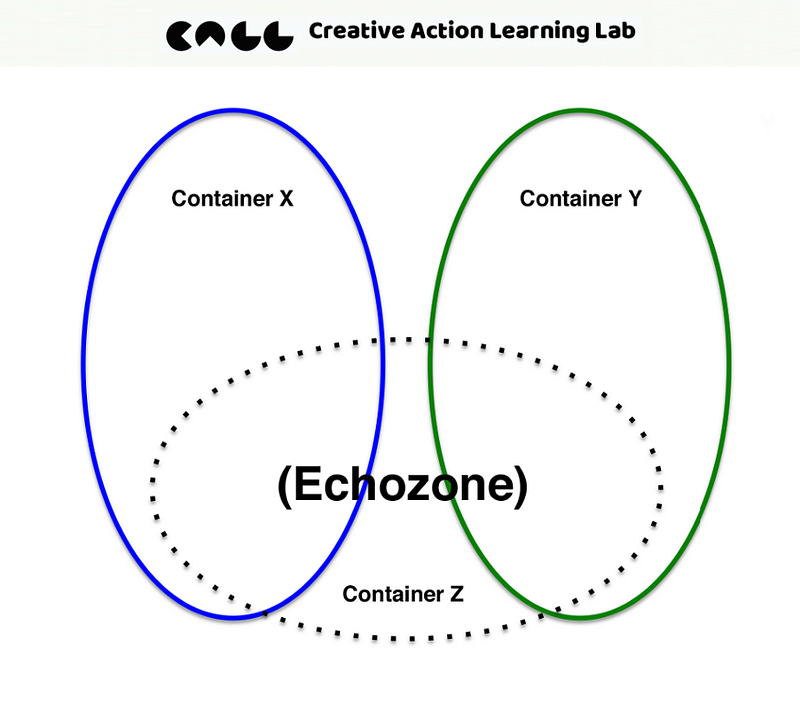
The above three containers are part of the ECHO Way framework, you can find more details on applying the framework to Life Discovery Activity.
Finally, I define “Significant Insights” as the outcome of all “Discovery” activities from the following framework which connects Second-order Activity and First-order Activity.
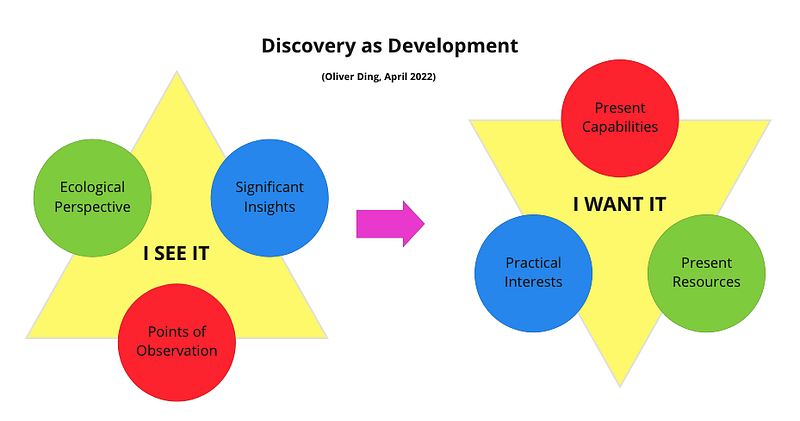
Some Significant Insights will lead to a new “Production” activity which is about present performance, so we need to consider at least the following three things:
- Practical Interests: our motivation for running a development project.
- Present Capabilities: our skills and knowledge for running a development project.
- Present Resources: our material and other things that could support our performance.
You can find more details about the “Discovery — Insights — Production” connection in Life Discovery: “Points of Observation” and “Significant Insights” and Life Discovery: Running A Developmental Project.
2. The Event[Enterprise(Project)] Framework
What’s the core of the Epistemology of Domain? It is “Event [Enterprise(Project)]”. See the diagram below.
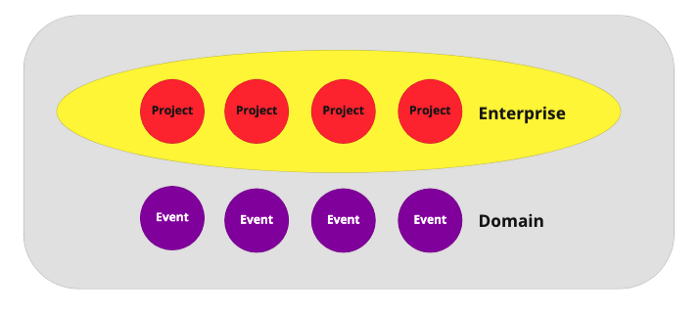
I use “Event [Enterprise (Project)]” for the Epistemology of Domain. My notion of Project refers to Project-oriented Activity Theory which is a branch of Activity Theory.
I have discussed the “Events — Projects” Mapping in a previous article. My approach uses “events” and “projects” to present social context and individual biography. The difference between “events” and “projects” is individual involvement. If the person directly gets involved in an activity — it means she is the subject of the activity or part of the community of the activity — then the activity is a project of her biography. If the person doesn’t directly get involved in the activity, then the activity is an event of her biography.
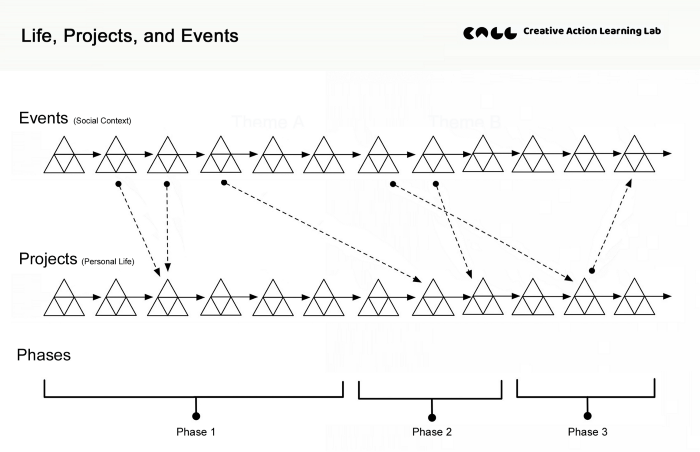
The term “Enterprise” is adopted from Howard E. Gruber’s approach Networks of Enterprise. Howard E. Gruber’s approach is titled the evolving systems approach to the study of creative work (1974,1989). It has a nickname called “Networks of Enterprise” because this is the core concept of the approach.
Gruber’s approach uses “Task — Project — Enterprise — Network of Enterprise” as a structure to understand a creative person’s work. It is different from Activity Theory’s “Operation — Action — Activity” hierarchy.
- Task
- Project
- Enterprise
- Networks of Enterprise
The concept of “Networks of Enterprise” refers to the pattern of work in the life of a creative individual. Gruber said, “We use the term enterprise to stand for a group of related projects and activities broadly enough defined so that (1) the enterprise may continue when the creative person finds one path blocked but another open toward the same goal and (2) when success is achieved the enterprise does not come to an end but generates new tasks and projects that continue it.” (1989, p.11) You can find more details here.
For the Epistemology of Domain, I consider Enterprise as a set of Projects.
The term “Event” also can be understood from the perspective of Event System Theory which is an event-oriented approach to the organizational sciences. According to the authors of Event System Theory, “Organizations are dynamic, hierarchically structured entities. Such dynamism is reflected in the emergence of significant events at every organizational level. Despite this fact, there has been relatively little discussion about how events become meaningful and come to impact organizations across space and time. We address this gap by developing event system theory, which suggests that events become salient when they are novel, disruptive, and critical (reflecting an event’s strength). Importantly, events can originate at any hierarchical level and their effects can remain within that level or travel up or down throughout the organization, changing or creating new behaviors, features, and events. This impact can extend over time as events vary in duration and timing or as event strength evolves. Event system theory provides a needed shift in focus for organizational theory and research by developing specific propositions articulating the interplay among event strength and the spatial and temporal processes through which events come to influence organizations.”
Though Event System Theory was originally developed for organizational sciences, their perspective is also useful for the Epistemology of Domain.
In summary, the “Event [Enterprise(Project)]” refers to the following three theoretical resources:
- Event System Theory
- Howard E. Gruber’s approach Networks of Enterprise
- Project-oriented Activity Theory
3. Four Perspectives for Domain Discovery
One component of the Epistemology of Domain is Practical Perspectives. The diagram below shows four perspectives. In fact, you can use three, five, six, or other numbers.
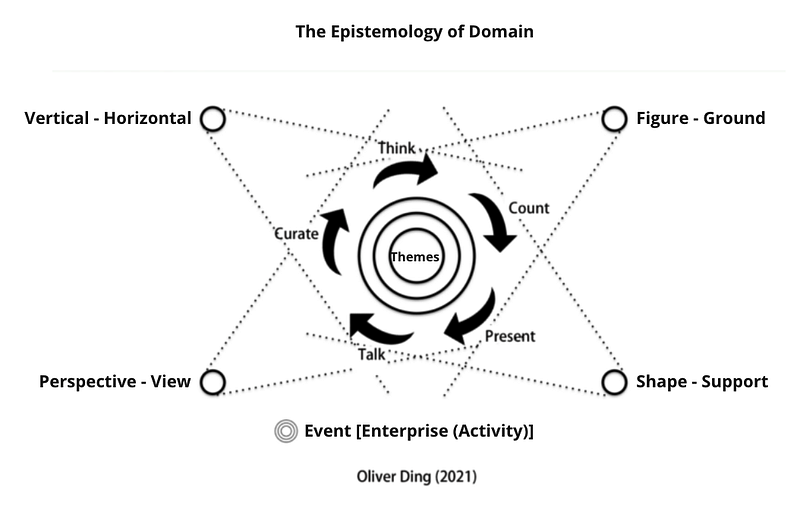
My thesis The Epistemology of Domain focuses on developing the following four perspectives:
- The Vertical — Horizontal perspective
- The Figure — Ground perspective
- The Perspective — View perspective
- The Shape — Support perspective
These four perspectives can be understood from the following 2x2 matrix.
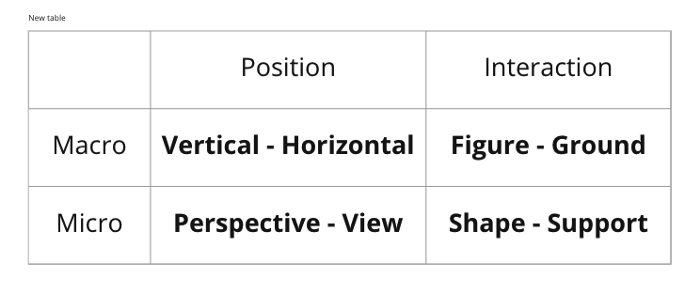
The Vertical — Horizontal perspective refers to two types of practical domains: horizontal domains and vertical domains.
- Horizontal domains refer to general functions in society such as “organization, strategy, and innovation”.
- Vertical domains refer to specific industries, for example, farm (agriculture), bus (transportation), and movies (entertainment).
The Figure — Ground perspective refers to the main activities and the side activities of a practical domain. For example:
- Main activities refer to Large Enterprises, Small-medium Businesses, Professional Service Firms, Technological Platforms, etc.
- Side activities refer to Educational Service Organizations, Media, Trade Associations, Communities, etc.
The Perspective — View perspective refers to Offline Perspectives and Embedded Stance.
- Offline Perspectives only consider cognitive thinking without considering a person’s social position and practical benefits.
- Embedded Stance primarily considers a person’s social position and practical benefits.
The Shape — Support perspective refers to two types of social actions. We can roughly understand them as Self-determined and Support Others.
4. The Themes of Practice Framework
The center of the Epistemology of Domain: Themes. This refers to my concept of Themes of Practice. You can find more details here.
I started developing the concept of Themes of Practice in 2019 for Curativity Theory. I have mentioned the concept in my previous articles many times. The purpose of the concept is to connect the “life theme” and “culture theme”.
Anthropologist Morris Opler (1945) developed a theoretical “theme” for studying culture. Career counseling therapists and psychologists also developed a theoretical concept called “life theme.” If we put cultural themes and life themes together, we see a great debate in social science: “individual — collective”.
I consider Themes of Practice as a process type of concept, not a substance type of concept. Thus, it is not a new category of themes, but a transformational process between individual life themes and collective culture themes. It refers to both concept and action. It connects mind and practice. It indicates the transformation of both person and society.
For the Epistemology of Domain, we can identify a set of themes for understanding a particular domain.
The Themes of Practice Framework is a concrete model for case studies. See the diagram below.
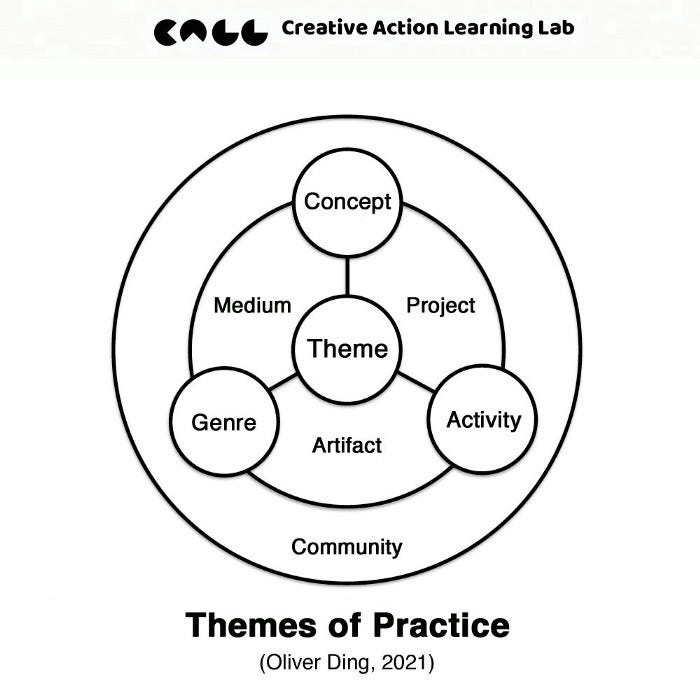
The framework is inspired by Activity Theory, Genre theories, and other theoretical approaches. As a concrete model, the framework is perfect for case studies because it offers a structure for observing and evaluating the “Practice” part of “Themes of Practice”.
For a particular theme, we can ask the following questions:
- Concept: What are related concepts for this theme?
- Project: What are related projects for this theme?
- Genre: What are related Genres for this theme?
- Media: What are related media for this theme?
- Activity: What are related activities for this theme?
- Artifact: What are related artifacts for this theme?
- Community: What are related communities for this theme?
- Who: who is the person behind this case study?
- When: when is the career duration behind this case study?
- Where: Where did these career events of this case study happen?
The above diagram only presents the general information for a theme. It doesn’t offer information on “who/when/where”. For a real case study, we need to collect personal information from the above ten dimensions.
You can find more details in The Career Theme Canvas.
5. The Model of Developmental Project
I developed a model to describe the general structure of Development Projects. Based on the model, we can design, improve, evaluate, select, reflect, and act on Developmental Projects.
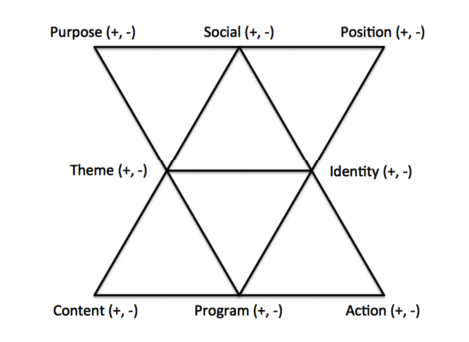
The above picture is the standard diagram of the Developmental Project Model. It uses eight elements to describe a developmental project:
- Purpose: Why do you want to initiate or join the project?
- Position: What’s the social structure of the project?
- Program: Does the project have formal organizational processes?
- Social: How do you connect with others due to joining the project?
- Content: How do you acquire new information and knowledge due to joining the project?
- Action: What actually do you do due to joining the project?
- Theme: Do you find some new and interesting themes for your career development?
- Identity: How do you perceive your identity before and after joining the project?
In the past few years, the Activity U project (2020–2022) is one of my Developmental Projects. I started the Activity U project on August 19, 2020. Initially, I just made a diagram called “Activity U” which is a test of the “HERO U” framework. I wrote a post to explain the diagram “Activity U”. The original title of the post is Activity U: The Landscape of Activity Theory. Later, I added “(Part I)” to the end of the title. It expanded from one post to a series of articles.
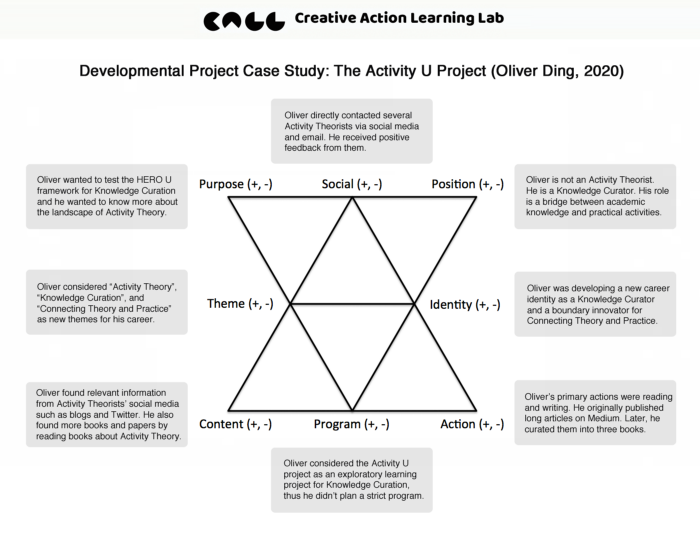
My primary actions were reading and writing. I originally published long articles on Medium. Later, I curated them into three books.
While the Activity U project is a three-year journey, a Developmental Project can be a three-week project. It depends on your goals. You can find more details in Developmental Project Canvas.
6. Mapping Networks of Enterprise
I have mentioned Howard E. Gruber’s evolving systems approach to the study of creative work (1974,1989) many times. The approach has a nickname called “Networks of Enterprise” because this is the core concept of the approach.
Gruber’s approach uses “Task — Project — Enterprise — Network of Enterprise” as a structure to understand a creative person’s work. It is different from Activity Theory’s “Operation — Action — Activity” hierarchy.
- Task
- Project
- Enterprise
- Networks of Enterprise
The concept of “Networks of Enterprise” refers to the pattern of work in the life of a creative individual. Gruber said, “We use the term enterprise to stand for a group of related projects and activities broadly enough defined so that (1) the enterprise may continue when the creative person finds one path blocked but another open toward the same goal and (2) when success is achieved the enterprise does not come to an end but generates new tasks and projects that continue it.” (1989, p.11)
Inspired by Gruber’s approach, I used it to manage my own creative work.
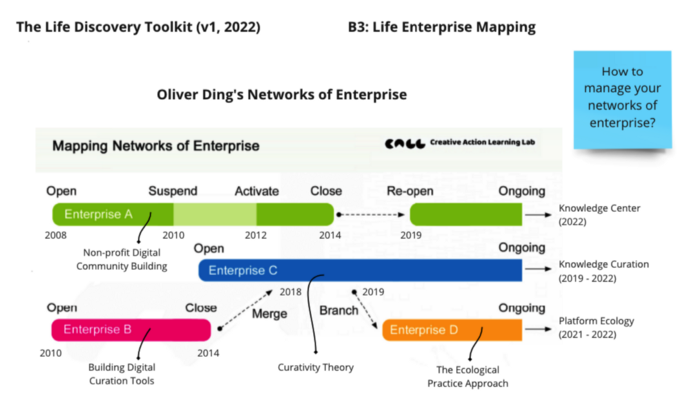
In Feb 2022, I shared a post about “Mapping Networks of Enterprise”. See the diagram above. Gruber didn’t develop a method of visualization for his approach. I had to do it by myself.
Now we can consider this method as a tool for Domain Discovery Activity.
7. The Model of Project Network
The newest development of Domain Discovery is the model of Project Network. This new piece is not part of the original thesis The Epistemology of Domain.
This model adopts Network Analysis to the Epistemology of Domain. I define a multiple-level network. See the diagram below.
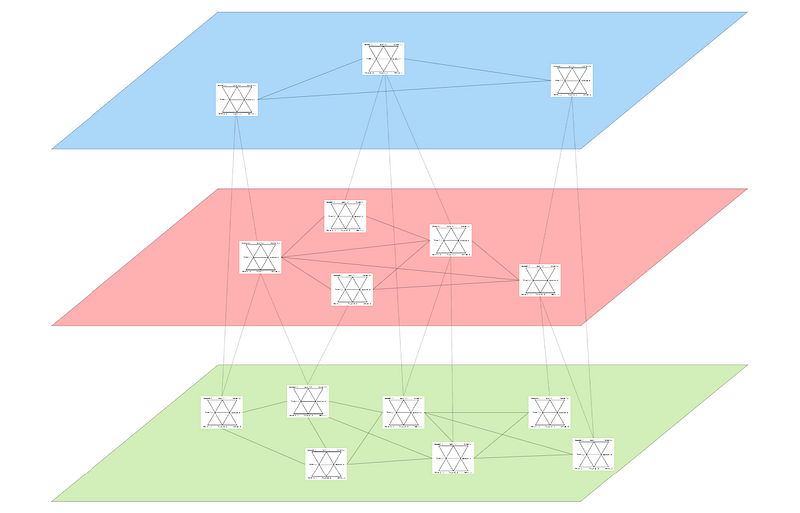
It’s a multiple-level network, not a one-level network.
- Level 1: A network of Themes
- Level 2: A network of Projects
- Level 3: A network of People
The network of People is the traditional idea of social network analysis. The network of projects refers to the network analysis of the landscape of Projects. The network of themes refers to the network analysis of the landscape of Themes.
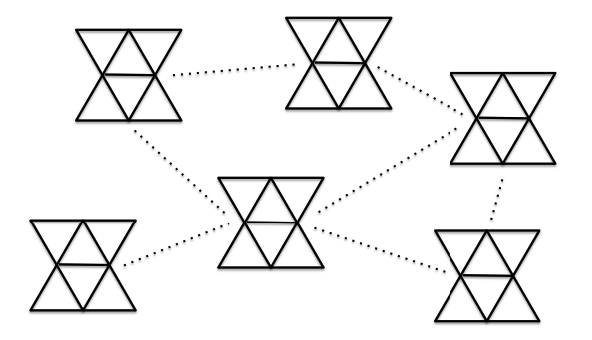
There are many connections inside each level and between these three levels.
8. Summary
The above discussion develops a toolkit for Domain Discovery Activity. The toolkit is defined by the following seven keywords:
- Themes
- Projects
- Events
- People
- Perspectives
- Enterprises
- Networks
The Domain Discovery Toolkit offers a solution for understanding the “Person — Domain” relationship. The solution is designed with the following seven modules.
- The Discovery as Development Framework
- The Event[Enterprise(Project)] Framework
- The Themes of Practice Framework
- The Model of Developmental Project
- The Model of Project Network
- Mapping Networks of Enterprise
- Four Practical Perspectives
The Domain Discovery toolkit is a multiple-perspective approach that curates the following perspectives together:
- The Lifespan perspective of human development
- The Network perspective of social analysis
- The Activity perspective of cultural practices
- The Container perspective of modern environments
On July 27, 2021, I finished a 71-page thesis titled The Epistemology of Domain which offers a brand new theory about Domain.
The subtitle of the thesis The Epistemology of Domain is Themes of Practice, The Landscape of Domains, and Niche Construction. The core idea of the Themes of Practice framework is about the transformation between individual life themes and collective culture themes. Niche Construction Theory is about the individual—environment relationship. The thesis focuses on the “Person — Domain” relationship, not only on the concept of Domain.
Now the Domain Discovery Toolkit offers a practical approach to understanding the “Person — Domain” relationship. It is a wonderful milestone.
Related articles
- Life Discovery: The AAS Framework
- CALL for LIFE: Anticipatory Activity System for Life Transitions
- CALL for LIFE: Modeling A Developmental Project
- The Project Engagement Toolkit (2022)
- Life Discovery: The Life-as-Project Approach
- The Life Discovery Toolkit (v1)
- CALL for LIFE: Oliver Ding @ 2021 and Second-order Activity
- Life Discovery: Twelve Significant Insights from Four Months
- Life Discovery: “Points of Observation” and “Significant Insights”
- Life Discovery: Significant Insights Analysis
- Life Discovery: The “Tacit” Type of Second-order Activity
- Life Discovery: The Unfoldness of Activity
- Life Discovery: Running A Developmental Project
- Life Strategy: The “Possible Journey”
I am also working on building a new website for the Platform Ecology project. You can save the following links:
- PlatformEcology.org
- Twitter: @PlatformEcology
- Linkedin: @PlatformEcology
You are most welcome to connect via the following social platforms:
Linkedin: https://www.linkedin.com/in/oliverding Twitter: https://twitter.com/oliverding Polywork: https://www.polywork.com/oliverding Boardle: https://www.boardle.io/users/oliver-ding


