
Life Strategy: The “Possible Journey”
A technique for designing a Developmental Project

I am recently working on the AAS4LT 1:1 life coaching program. AAS stands for the Anticipatory Activity System framework while LT refers to Life Transitions.
As an application of AAS, the AAS4LT was developed with eight steps for guiding a life transition coaching program. You can find more details about the AAS framework and the AAS4LT program here.
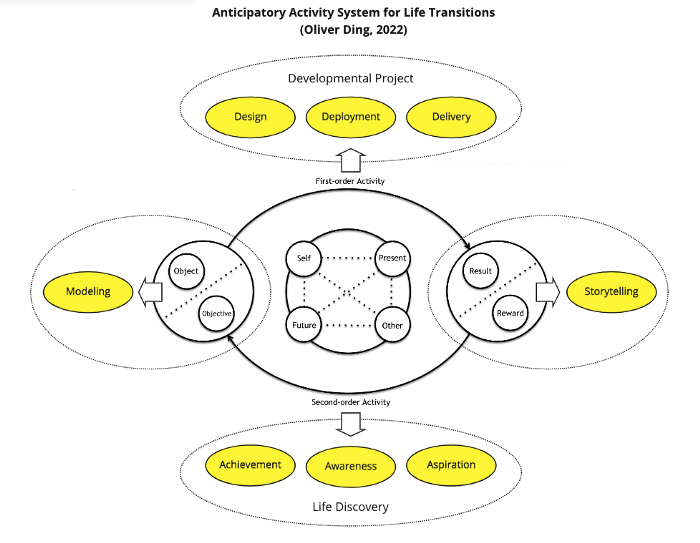
The second part of the AAS4LT program is Running A Developmental Project.
The diagram below is the basic model of the Developmental Project Model which offers a general model for understanding the structure and dynamics of Developmental Projects. You can find more details here.
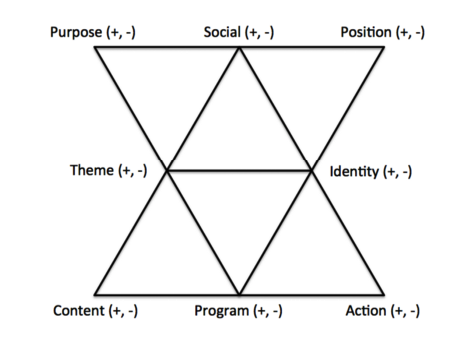
Step 4 (Design) of the AAS4LT program can be formal or informal. Once we have one or more significant insights, we have to connect them with our present situations and future possible selves.
While the above Developmental Project Model is a good starting point for designing a Developmental Project, we need some creative ideas and strategic ideas to improve our design.
Today I am going to share a technique for designing a Developmental Project. I also use “Life Strategy” as a tag for this article because the AA44LT program is a prototype of the “Life Strategy” coaching program.
1. Possible Journey
Today I’d like to introduce the “Possible Journey” technique which means curating real events into imagined journeys.
There are several related terms to the technique:
- Real Events
- Actual Journeys
- Possible Journeys / Imagined Journeys
Real Events refer to things that happen in our life while Actual Journeys refer to planned activities that contain several actions as real events.
2. Curativity as Creativity
For example, I wrote four articles that are part of different projects before Dec 22, 2021. Thus, real events and actual journeys don’t refer to one journey, but several journeys.
On Dec 22, 2021, I found an idea to curate these four articles together for presenting a new theme about diagramming for my book Diagram Blending: Building Diagram Networks (Table of Contents).
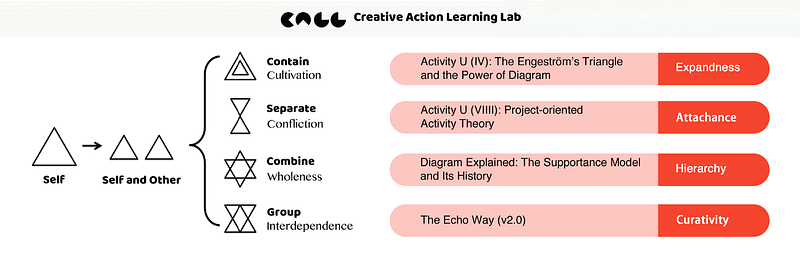
The above diagram is the idea for curating the possible journey. The left side of the diagram displays a diagram about the “self — other” relationship that is my original inspiration. The right side lists four articles and four themes.
Inspired by the four types of “self — other” relationships, I selected four articles and considered them as four stories of a journey. Each story has a theme. Together, they form a meaningful whole that describes a possible journey from a single diagram to diagram networks.
The theme of my book Diagram Blending: Building Diagram Networks is about more than one diagram. So these four stories are perfect for representing this theme.
3. Deep Analogy
Though the four articles belong to different projects, if we put them together, they present a journey of moving from one single diagram to a diagram network. The above picture shows a deep analogy between four graphics, four articles, and four themes.
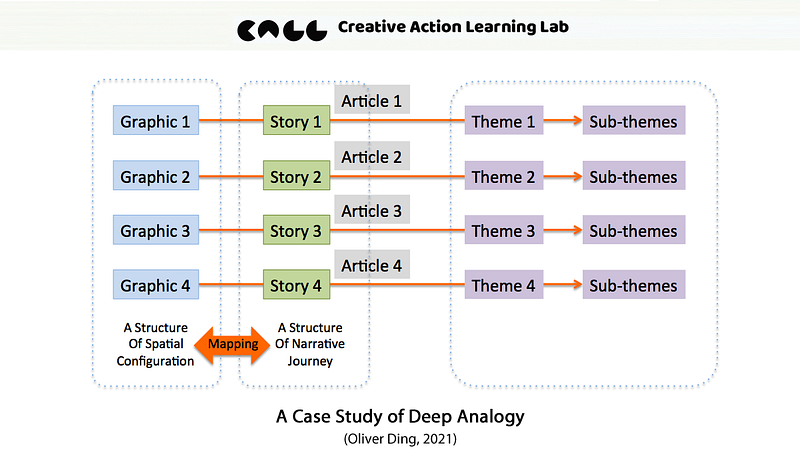
The four types of “Self — Other” relationships diagram was formed by four graphics with a special structure of spatial configuration. Though the original diagram has words such as Contain(Cultivation), Separate(Confliction), Combine(wholeness), and Group (Interdependence), I just ignored these words and considered it as a meta-diagram.
Originally, the four articles are not a whole because they were written for different projects. However, I reconsidered them as four stories with a structure of narrative journey.
The most important key of deep analogy for this case is the mapping between a structure of spatial configuration and a structure of narrative journey.
How is it possible?
4. The Event-Structure Metaphor
I think we can find an answer from the notion of Cognitive Metaphor which is a core theory of cognitive linguistics. From the perspective of Cognitive Metaphor theory, the metaphor behind the journey is the Event-Structure metaphor. According to George Lakoff and Mark Johnson, Journeys are long-term activities:
A journey takes an extended period of time, covers a lot of ground, and usually involves stopping at a number of destinations along the way before one reaches a final destination, if there is one.
Given the rest of the Event — Structure metaphor, journeys correspond to long-term activities, usually with a number of intermediate purposes. The intermediate purposes are intermediate destinations, the ultimate purpose is the ultimate destination, the actions performed are movements, progress is movement toward a destination, the initial state is the initial location, and achieving the purpose is reaching the ultimate destination.
Every aspect of the source domain of the Event — Structure metaphor may occur in some kind of journey, and hence journeys are very useful for talking about long-term activities of many kinds. (Philosophy in the Flesh, 1999, pp.193–194)
For my case, I use the term “possible journey” to discuss the “narrative journey” because the four original stories are not part of a real journey.
A narrative journey gives us the freedom to curate real events into imagined journeys that are different from real journeys in our life.
A possible journey needs a reasonable structure to curate several intermediate purposes into a new meaningful whole. I adopted the structure from the four graphics and I found it matched the four stories I selected.
- I wrote the article Activity U (IV): The Engeström’s Triangle and the Power of Diagram on Sept 3, 2020. This is a complete story of a famous diagram from Activity Theory. It refers to the theme of Expandness: a simple diagram tends to expand to a complex diagram.
- The article Activity U (VIIII): Project-oriented Activity Theory was published on Jan 3, 2021. I introduced Andy Blunden’s Project-oriented theoretical approach to Activity with a series of diagrams. The theme behind this story is Attachance which refers to Attach, Detach, and Opportunities of Attaching and Detaching. Andy Blunden detached from the Activity System model and attached to the Goethe-Hegel-Marx-Vygotsky approach of “Unit of Analysis”. The result is a brand new theoretical approach to Activity Theory. I attached to Andy Blunden’s theoretical approach, then detached from the field of words and attached to the field of diagrams. I use Andy Blunden’s idea of “germ-cell” to develop a diagram system in order to translate his ideas from text to visual.
- The third story is not an article but a Miro board and a 108-page thesis titled Diagram Explained which was written in 2018. One part of the thesis is a framework for understanding multiple layers of diagrams. Obviously, the theme behind the story is Hierarchy. A meta-diagram can generate new diagrams at different degrees of abstraction.
- The fourth story The ECHO Way (v2.0) was published on June 30. The article introduced a practical framework for Knowledge Curation and Boundary Innovation. The core of the ECHO Way (v2.0) framework is blended from three diagrams. This case inspired me to coin the term Diagram Blending. This story refers to the theme of Curativity which means turning pieces into a meaningful whole.
The above four articles belong to different projects. However, if we put them together, they present a journey of moving from one single diagram to a diagram network.
In the process of conceptualization, the second key movement is generating themes from stories.
After selecting the above four stories, I discovered four themes from them:
- Expandness
- Attachance
- Hierarchy
- Curativity.
The above description of Deep Analogy seems complicated. It was not an aha moment, but an emergent transformative process. For me, this is a simple intuitive insight, however, I want to share this technique with you.
Once we have a model, then we can design programs of deliberate practice for accelerating the development of tacit knowledge.
5. The Curated Mind
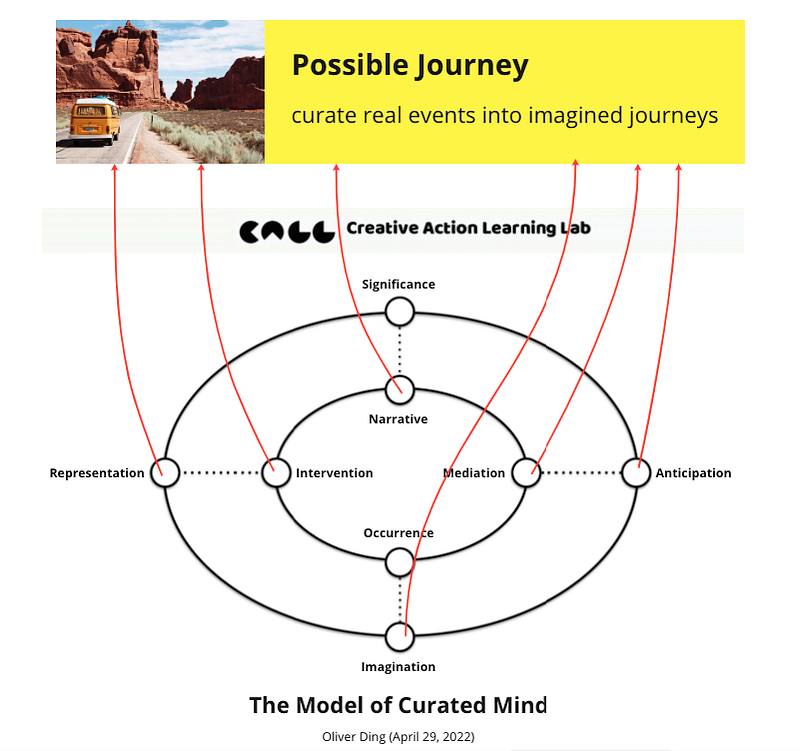
Finally, we can discuss the following diagram which connects the model of Curated Mind and the “Possible Journey” strategy.
The basic model of Curated Mind considers two loops:
- Inner: Proximal Mind
- Outer: Pervasive Mind
The term “Curated Mind” refers to the following three types of Curativity:
- The Curativity of Proximal Mind: Turning pieces of experiences into a meaningful whole at the loop of Proximal Mind.
- The Curativity of Pervasive Mind: Turning pieces of experiences into a meaningful whole at the loop of Pervasive Mind.
- The Curativity of Mind: Turning “Proximal Mind” and “Pervasive Mind” into a meaningful whole.
I also use eight Operational Concepts to expand Pervasive Mind(Proximal Mind). You can find more details in Slow Cognition: The Model of Curated Mind.
I use several single words to name eight operational concepts. The loop of Proximal Mind is represented with the following four operational concepts:
- Occurrence: It refers to a “Natural Situation” which means non-designed situations and environments.
- Intervention: It refers to “Artificial Situation” which means designed situations and environments.
- Mediation: It refers to “Mediating Instrument” which means material objects and other tools for human activities and social practices.
- Narrative: It refers to “Actual Narrative” which means storytelling.
I also use the following four operational concepts for the loop of Pervasive Mind:
- Significance: It refers to “Cultural Significance” which means the dynamic historical development of cultural signs and other symbolic cultures.
- Representation: It refers to “Cognitive Representation” which means objects for solving cognitive tasks. For example, Diagrams, models, theories, floor plans, etc.
- Imagination: It refers to imagining some novel things that could guide dramatic experiences and creative actions.
- Anticipation: It refers to predicting the future and managing the complexity of anticipation and performance.
The “Possible Journey” Strategy is related to the following operational concepts:
- Representation
- Imagination
- Anticipation
- Intervention
- Mediation
- Narrative
Though I offer the above eight operational concepts for understanding the Curated Mind, It doesn’t mean that the Curated Mind is only about these ideas. I’d like to keep the openness of the model of Curated Mind and explore more ideas with it for further development.
Also, the connection between these ideas and the “Possible Journey” strategy is pretty rough. However, I believe this connection has its value of guiding readers to pay attention to the Curated Mind for making creative Life Curation.
Related articles
- Life Discovery: The AAS Framework
- CALL for LIFE: Anticipatory Activity System for Life Transitions
- CALL for LIFE: Modeling A Developmental Project
- The Project Engagement Toolkit (2022)
- Life Discovery: The Life-as-Project Approach
- The Life Discovery Toolkit (v1)
- The Life Discovery Canvas (v1.0) — Part 1: Theoretical Background
- The Life Discovery Canvas (v1.0) — Part 2: Spatial Structure
- The Life Discovery Canvas (v1.0) — Part 3A: Concepts (THINK and LEARN)
- The Life Discovery Canvas (v1.0) — Part 3B: Concepts (SAY and DO)
- The Life Discovery Canvas (v1.0) — Part 4: Inspirations
- Life Discovery: The “Being by Doing” Principle
- Life Discovery: The “Performance as Experiment” Principle
- Life Discovery: The “Engagement as Projection” Principle
- Life Discovery: The “Discovery as Development” Principle
- CALL for LIFE: Oliver Ding @ 2021 and Second-order Activity
- Life Discovery: Twelve Significant Insights from Four Months
- Life Discovery: “Points of Observation” and “Significant Insights”
- Life Discovery: Significant Insights Analysis
- Life Discovery: The “Tacit” Type of Second-order Activity
- Life Discovery: The Unfoldness of Activity
- Life Discovery: Running A Developmental Project
I am also working on building a new website for the Platform Ecology project. You can save the following links:
- PlatformEcology.org
- Twitter: @PlatformEcology
- Linkedin: @PlatformEcology
You are most welcome to connect via the following social platforms:
Linkedin: https://www.linkedin.com/in/oliverding Twitter: https://twitter.com/oliverding Polywork: https://www.polywork.com/oliverding Boardle: https://www.boardle.io/users/oliver-ding


