
Life Discovery: Mapping Networks of Enterprise
Introduce a method for Howard E. Gruber’s approach Networks of Enterprise

I have mentioned Howard E. Gruber’s evolving systems approach to the study of creative work (1974,1989) for the Life as Activity (v0.3) framework on Nov 29, 2020. Last week I launched the Life Discovery Toolkit (v1.0) and adopt Gruber’s approach to understanding the structure of a creative person’s work.
The Hierarchy of Creative Life
Howard E. Gruber’s approach is titled the evolving systems approach to the study of creative work (1974,1989). It has a nickname called “Networks of Enterprise” because this is the core concept of the approach.
Gruber’s approach uses “Task — Project — Enterprise — Network of Enterprise” as a structure to understand a creative person’s work. It is different from Activity Theory’s “Operation — Action — Activity” hierarchy.
- Task
- Project
- Enterprise
- Networks of Enterprise
The concept of “Networks of Enterprise” refers to the pattern of work in the life of a creative individual. Gruber said, “We use the term enterprise to stand for a group of related projects and activities broadly enough defined so that (1) the enterprise may continue when the creative person finds one path blocked but another open toward the same goal and (2) when success is achieved the enterprise does not come to an end but generates new tasks and projects that continue it.” (1989, p.11)
Inspired by Gruber’s approach, I used it to manage my own creative work. For example, I use the following diagram to visualize my Networks of Enterprise.
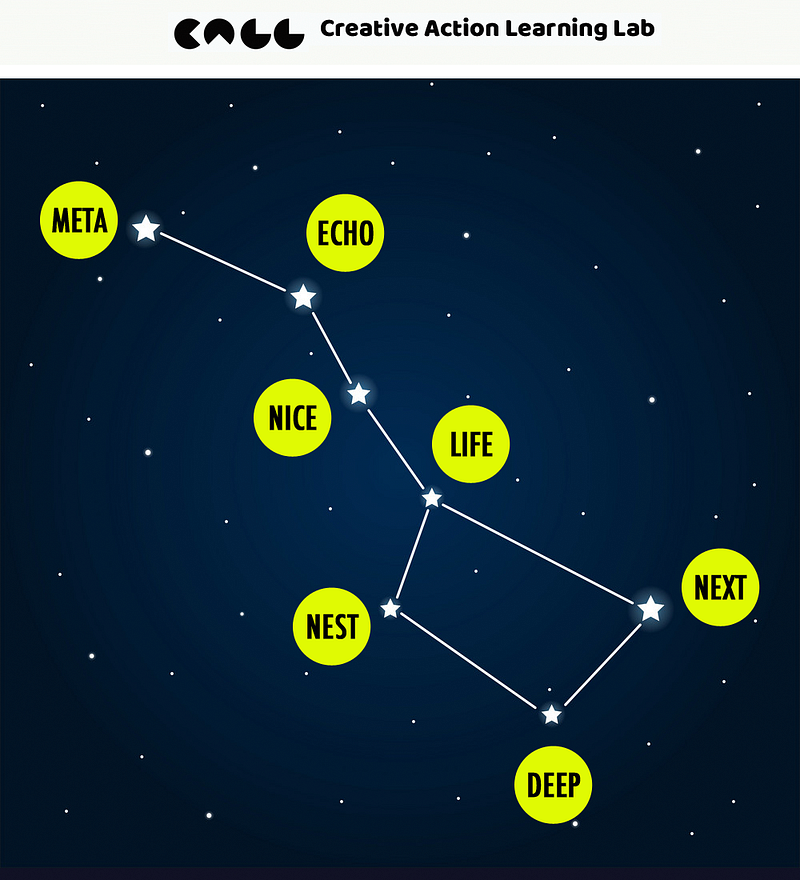
I sort my frameworks into seven enterprises. Each enterprise has a short nickname.
- CALL for ECHO → Boundary Innovation
- CALL for LIFE → Creative Life
- CALL for NICE → Creative Action
- CALL for NEST → Part — Whole
- CALL for DEEP → Supportive Development
- CALL for NEXT → Present — Future
- CALL for META → Meta-knowledge
Each enterprise has its primary theme. Each theme refers to a core framework and a set of related concepts, diagrams, and sub-frameworks. You can find more details here: CALL: Annual Review (2020–2021).
Network of Enterprise
One of the core concepts of Gruber’s approach is Networks of Enterprise which refers to the pattern of work in the life of a creative individual. Gruber said, “We use the term enterprise to stand for a group of related projects and activities broadly enough defined so that (1) the enterprise may continue when the creative person finds one path blocked but another open toward the same goal and (2) when success is achieved the enterprise does not come to an end but generates new tasks and projects that continue it.” (1989, p.11)
Our approach also uses “projects” to refer to individual biography. Thus, we can consider Gruber’s “enterprise” as a tool for organizing “projects” within the temporal activity chains. According to Gruber, the enterprise has some characteristics such as variety, longevity and durability, and tradeoffs (1989, p.11–12).
- First, “Enterprises rarely come singly. The creative person often differentiates a number of main lines of activity…The person has an agenda, some measure of control over the rhythm and sequence with which different enterprises are activated.” This is also an outstanding characteristic of contemporary knowledge workers.
- Second, an enterprise takes a long time. For example, “Milton began the work that led to Paradise Lost in 1640 but did not complete it until 1667.” For contemporary knowledge workers, this depends on their purpose on ambitious goals.
- Third, “In constructing the network of enterprise the individual faces a tradeoff between density and breadth…The fact that different kinds of activity entail different sorts of risk adds to the usefulness of a diversified network of enterprise, allowing the creator to be by turns daring and secure, as emotional needs wax and wane.” This is also significant to contemporary knowledge workers.
Though Gruber’s study focuses on creative people, I think his approach can be applied to contemporary knowledge workers.
Mapping Networks of Enterprises
Gruber didn’t provide a schema for analyzing networks of enterprises. In order to incorporate the concept into the Life-as-Project approach, I create the diagram below as a tool for mapping networks of enterprises. I highlight several possible operations within organizing various enterprises: open, close, suspense, activate, re-open, ongoing, merge, and branch.
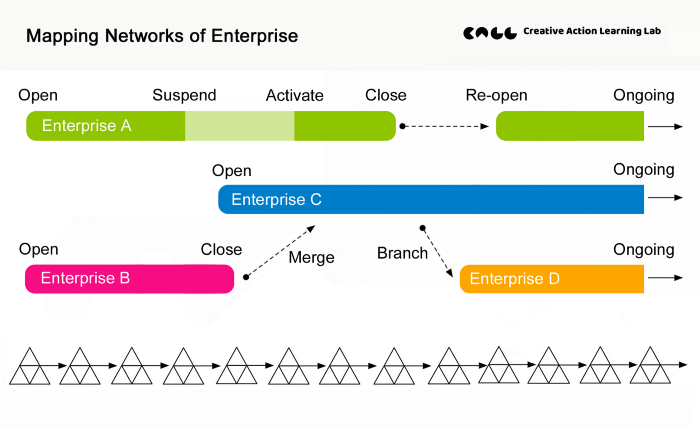
I’d like to share my own experience in discussing the above diagram. For example, Enterprise A can refer to my identity as a digital activist in virtual community building. I started this enterprise in 2008 when I co-founded a nonprofit online project with a friend. In 2010, my first son was born. Thus I suspended it around 2010 and activated it around 2012 when I co-founded another nonprofit project focusing on social learning. In 2013, my second son was born. Later, I decided to close the enterprise around 2014. I recently reopened this enterprise by founding CALL (Creative Action Learning Lab) in 2019.
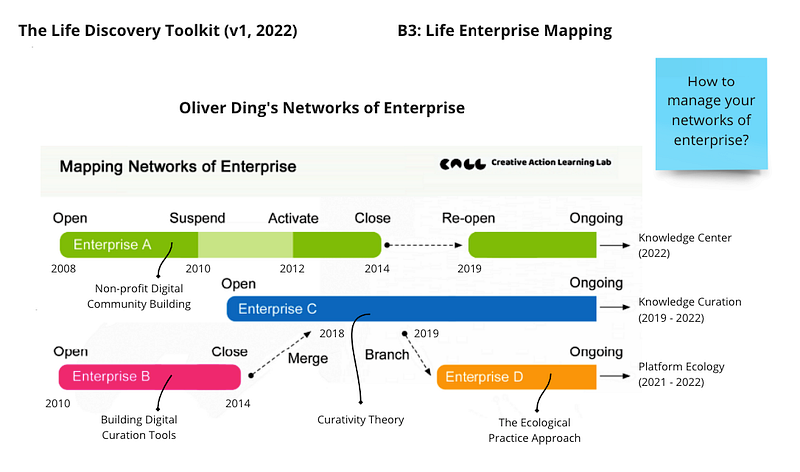
Enterprise B refers to my activities in creating digital curation tools. Enterprise C refers to my activities in building a theory about curation. After the team decided to close the digital curation tool project, I merged my activity on this project into building a theory about curation. I adopted theories from ecological psychology and other fields and used them to reflect on my practice in building digital curation tools and other activities. One of the major projects of Enterprise C is writing a book titled Curativity. One of the by-products of writing the book is the Ecological Practice approach. I started writing the book in Sept 2018 and finished its draft in March 2019. In May 2019, I branched the Ecological Practice approach from Enterprise C and created a new room for it: Enterprise D.
Gruber also pointed out the relationship between the Self and Network of Enterprise,
- “First, and most important, by constituting the person’s organization of purpose, it defines the working self. Each creative person has certain conceptions of his or her life tasks. Although we think of the creative person as highly task-oriented rather than ego-oriented, it is also true that the set of tasks taken as a whole constitutes a large part of the ego: to be oneself one must do these things; to do these things one must be oneself.
- Second, the network of enterprises provides a structure that organizes a complex life. In the course of a single day or week, the activities of the person may appear, from the outside, as a bewildering miscellany. But the person is not disoriented or dazzled. He or she can readily map each activity onto one or another enterprise.
- Third, the network provides an organization of goals within which the person can set different levels of aspiration.
- Finally, the network of enterprise helps the creative person to define his or her own uniqueness.”(1989, p.13)
Based on my own experience of Mapping Networks of Enterprise, the challenge is defining multiple levels of aspiration. It requires a person to think about four levels of hierarchy. I personally suggest that we can use “Themes” to grasp “Enterprises”.
By-product and Purpose
Gruber’s approach also highlights the concept of “By-product”.
By-product is a normal phenomenon for experienced individual workers and teams. In his study of Charles Darwin, Howard Gruber (1974) showed that even a great scientist embraces by-productive thinking in his creative work process. Gruber said, “In his beautiful book Productive Thinking, Max Wertheimer, founder of Gestalt psychology, focused his attention on the kind of direct thinking that goes to the heart of the problem under attack. In Darwin’s long and twisting path, however, there are several striking examples of important steps toward the theory of evolution through natural selection being taken as by-products of efforts that seemed to move in other directions…The theory of coral reefs was based on an extrapolation from what Darwin has learned about the formation of continental mountain chains; if mountains are up-raised, he reasoned, the adjacent sea bed must sink; from this slow subsidence of the sea bed, the coral-reef theory followed. That theory does not deal at all with organic evolution, but it does provide a formal model quite analogous to Darwin’s eventual theory. Darwin did not have a five-year plan to move through this important sequence of ideas. It evolved. The monad theory, itself short-lived in Darwin’s thought and not entirely original, led him to his branching model of evolution. This became a cornerstone of his thought.” (1974, p.112) In contemporary knowledge work activities, there are many ways to generate by-products. Activity theorists also claim that a mediating instrument of an activity can be transformed into an object of a new activity.
Gruber also introduces another concept to explain how the individual maintains his sense of direction with the by-product effect: purpose.
According to Gruber, it refers to a person’s ability to imagine himself outside the perspective of the moment, to see each sub-task in its place as part of the larger task he has set himself. He said, “This abstract purposefulness and perspective, this standing outside, is an activity undertaken in quite a different spirit from that in which the creative person immerses himself, lose himself in the material of nature. To accomplish his great synthesis Darwin had to be able to alternate between these two attitudes. To see more deeply into nature, he needed the perceptual, intuitive direct contact with the material. To understand what he had seen, and to construct a theory that would do it new justice, he had to re-examine everything incessantly from the varied perspectives of his diverse enterprises.”(1974, p.113)
Life Curation
Gruber’s Purpose is different from other scholars’ definitions. For example, Angela Duckworth writes a chapter about Purpose in her 2016 book Grit: The power of passion and perseverance. She defines Purpose as “the intention to contribute to the well-being of others” in her “grit lexicon” (p.146)
If we connect Gruber’s approach with my work, Curativity Theory, then we can use Life Curation to discuss “the abstract purposefulness”:
- a person’s ability to imagine himself outside the perspective of the moment,
- to see each sub-task in its place as part of the larger task he has set himself.
The concept of Curativity refers to turning pieces into a meaningful whole. The Life Curation Framework is an application of Curativity Theory. From the perspective of Life Curation, a person tends to curate his or her pieces of life experience into a meaningful whole such as an insight, a project, a creative work, etc.
In 2019 I developed Curativity Theory for understanding general curation practice and wrote a book. In 2020, I started the Knowledge Curation project which aims to apply Curativity Theory to connect Theory and Practice. From the perspective of Curativity Theory, ordinary people need to add “Curation” to develop their minds.
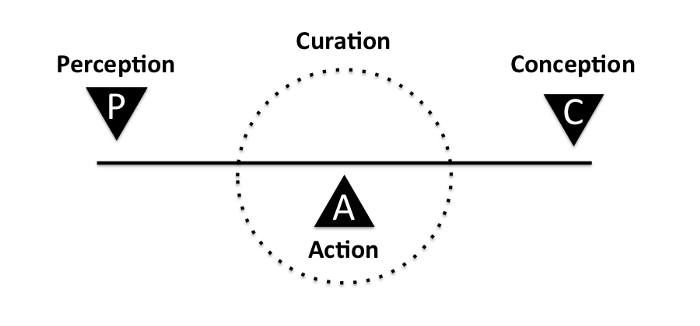
Traditionally, researchers tend to use “perception, conception, and action” as three keywords to discuss mind-related topics. From the perspective of Curativity Theory which is about turning pieces into a meaningful whole, I want to expand the foundation of mind-related topics from three keywords to four keywords.
So, I’d like to adopt “Curativity”, “Life Curation”, and “Curation” to expand Gruber’s approach.
A great creator is a great curator of his or her own creative life.
You are most welcome to connect via the following social platforms:
Linkedin: https://www.linkedin.com/in/oliverding Twitter: https://twitter.com/oliverding Polywork: https://www.polywork.com/oliverding Boardle: https://www.boardle.io/users/oliver-ding


