Life Strategy: Taking Opportunities and Long-term Response
Using the Strategic Curation model to discuss the concept of “Opportunity”
This article is part of a possible book Advanced Life Strategy: Anticipatory Activity System and Life Achievements. I consider the Strategic Curation model as a part of the possible book.
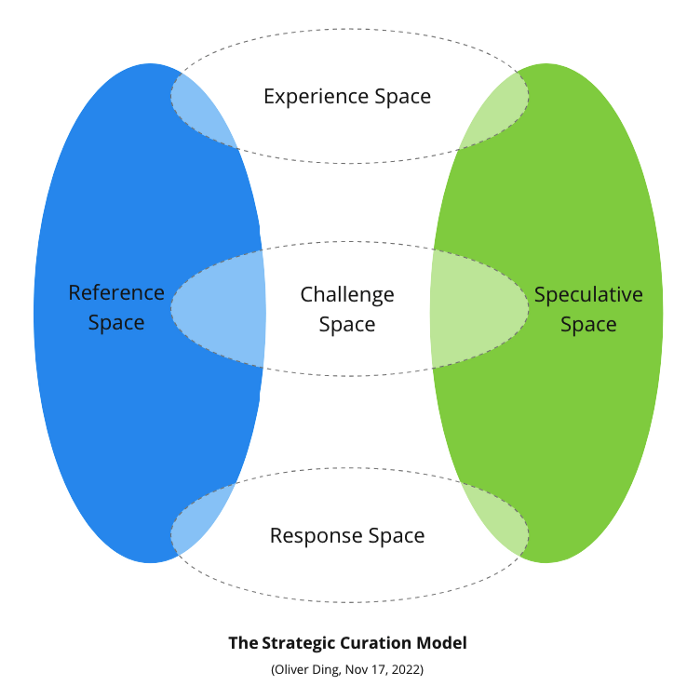
The Strategic Curation Model is a five-space model.
- Experience Space: It refers to the facts of the Past.
- Challenge Space: It refers to the problems in the Present
- Response Space: It refers to the solutions for the Future
- Reference Space: It refers to reliable and validated knowledge for thinking
- Speculative Space: It refers to imaginative thinking such as Counterfactual Thinking about the Past and Prefactual Thinking about the Future.
What does Strategic Curation mean?
It refers to using a specific strategy to curate pieces of experience, knowledge, and resources into a meaningful whole for a better future.
You can find more details about the model in the following links
- Life Strategy: A Five-space Model for Strategic Curation
- Life Strategy: Ecological Strategic Cognition
- Life Strategy: Three Meta-knowledge of Strategic Curation
- Life Strategy: Turning Potential Knowledge into Actual Knowledge
- Life Strategy: Conceptual Change and Developmental Resources
This article will discuss the concept of “Opportunity” with the Strategic Curation model.
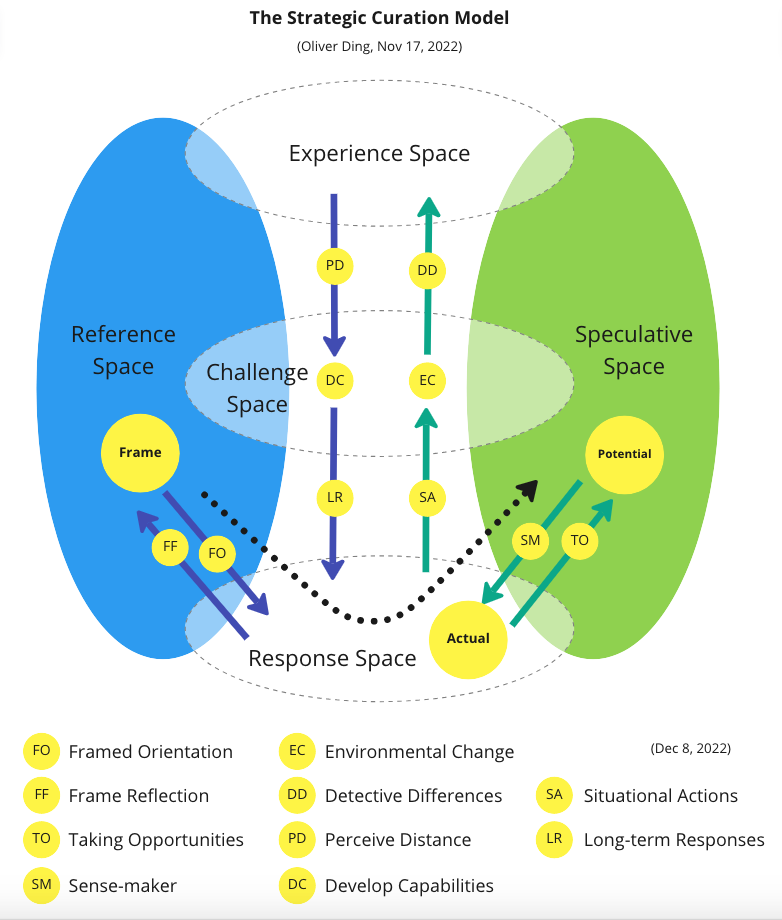
The difference between some strategic frameworks and the Strategic Curation model is the latter is a “Map”.
The Strategic Curation model doesn’t offer a particular framework for Strategic Cognition.
However, you can use it to visualize some strategy-related concepts and issues and develop a particular framework for your situation.
For example, “Opportunity” is an important concept of Strategic Cognition. The above diagram is an example of using the Strategic Curation model to discuss the concept of “Opportunity”.
Let’s start the tour with the idea of “EC” (Environmental Change)!
Opportunity starts with Environmental Change
What’s the significant difference between Enterprise Management Research and Entrepreneurship Research?
The answer is Opportunity Recognition. While Enterprise Management Research is about Management, the primary theme of Entrepreneurship Research is founding new enterprises.
From the perspective of strategic cognition, Opportunity Recognition is both important for starting new enterprises and new strategies for established enterprises.
In 2006, Robert A. Baron published a paper titled Opportunity Recognition as Pattern Recognition: How Entrepreneurs “Connect the Dots” to Identify New Business Opportunities. His idea really echoes the Strategic Curation model.
Robert A. Baron suggests that entrepreneurs use cognitive frameworks to perceive connections between seemingly unrelated events or trends in the external world. By connecting the dots between changes in technology, demographics, markets, government policies, and other factors, entrepreneurs could discover potential business opportunities.
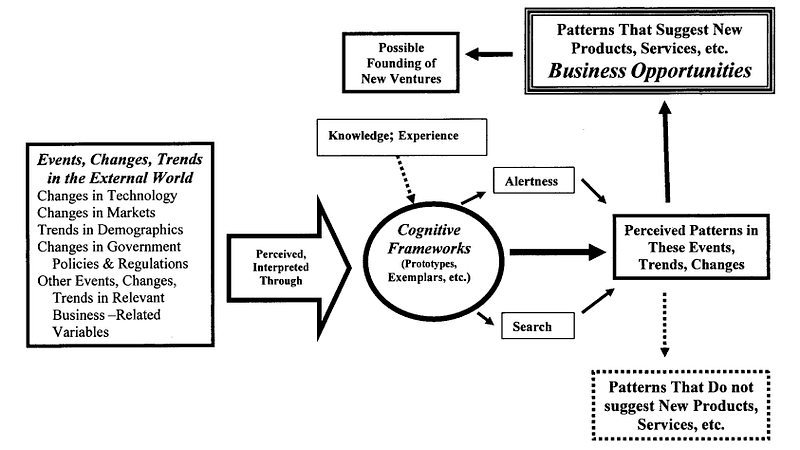
The above diagram is the framework of Robert A. Baron’s approach. The starting point is Events, Changes, and Trends in the External World.
In the field of Strategic Management, Opportunity and Resource are a pair of concepts. Scholars often associate them with the external world and the internal world. While Opportunity refers to the External World, Resource refers to the Internal World.
For the Life Strategy project, I hold the Ecological Strategic Cognition view which doesn’t see the world as an external world and an internal world. There is only one world. The boundary between what you can work on and what you can’t work on is more important than the between self and the world. I use a new term called the World of Activity to describe the space of what you can work on. You can find more details in Lifescope: The World of Activity for Creative Life Curation.
Though we use different terms, I agree with Robert A. Baron on his approach. If we use the Strategic Curation model to discuss the concept of Opportunity, we can start with the diagram below.
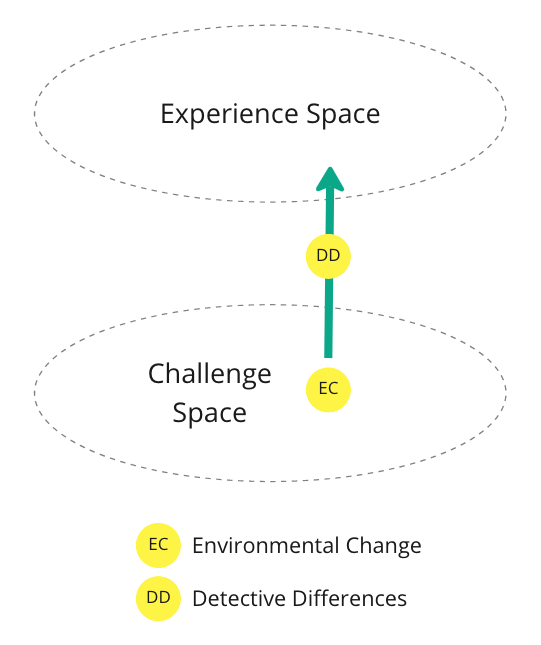
The starting point is Environmental Change (EC) which echoes Robert A. Baron’s Events, Changes, and Trends in the External World. Moreover, we can use Proximal Contexts and Pervasive Contexts to define a simple typology of environments. It is clear that Robert A. Baron’s approach is more about Pervasive Contexts.
For the Life Strategy project and knowledge creators, Environmental Change (EC) within Proximal Contexts is also an important source of opportunities.
Let’s use an accident as an example of proximal Environmental Change (EC). See the diagram below.
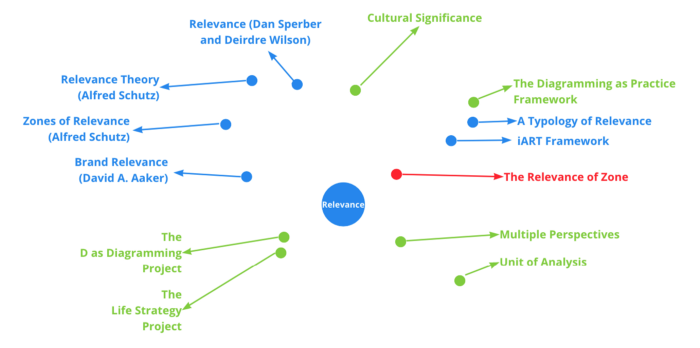
I made the above picture accidentally on May 26, 2022. The untended action led to a new significant insight: the free version of “Mapping Thematic Space”. It also inspired me to reflect on the concept of “Space” for the “Thematic Space” project.
Originally, I wanted to design a new diagram for the Platform Ecology project. If you pay attention to my Medium articles and my Linkedin posts, you will notice my activities about the Platform Ecology project which is a master project of my 2021 book Platform for Development: The Ecology of Adult Development in the 21st Century (2021).
I duplicated a Frame in a miro board and used it for the new idea. See the screenshot below.
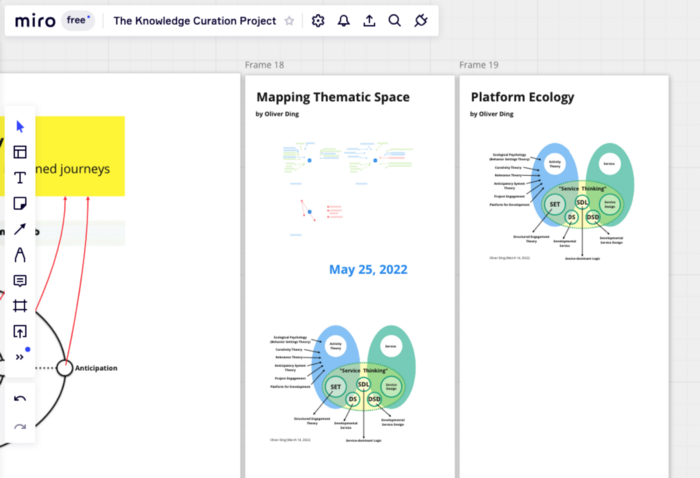
The Frame has two things, one is a set of diagrams of Mapping Thematic Space, and the other one is the model of “Service Thinking” which was made with the Echo Way diagram.
Since I only wanted to use the Echo Way diagram for making a typology of platform players, I decided to remove the set of Thematic Space Canvas. However, I didn’t successfully remove them. Miro only removed the original Thematic Space Canvas but kept the following picture which shows some notes.
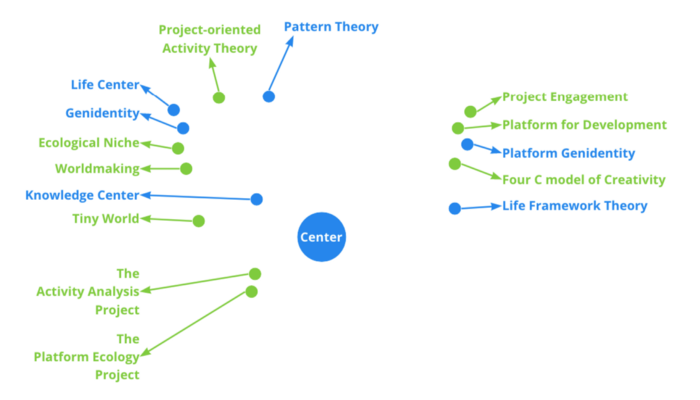
Wow! This was an accident!
But, the result is not bad. I realized that this indicates a new version of Mapping Thematic Space. I named it “Mapping Thematic Space (Free version)”.
The original version was renamed “Mapping Thematic Space (Guided version)”. For example, the picture is the guided version of the above picture. You can find the original Thematic Space Reflection Report here.
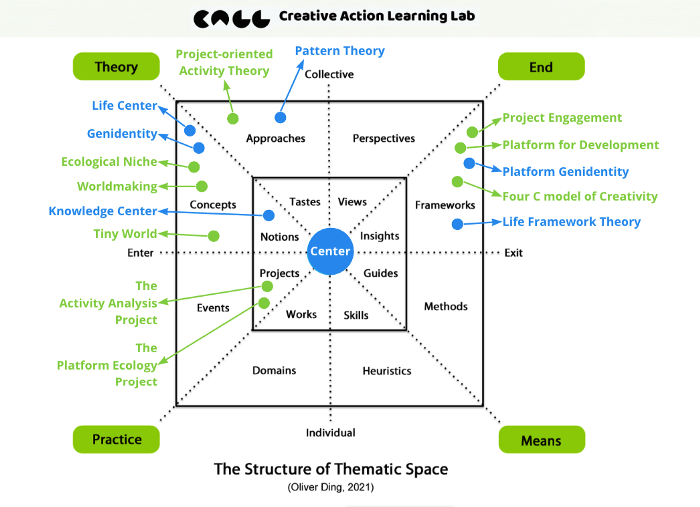
This is a tiny Environmental Change (EC) within Proximal Contexts! The original Thematic Space Canvas was removed, but the original notes were kept. This is a change of environment.
You can find more details about this example in Slow Cognition: This is just an accident.
I also use Detective Differences (DD) for the Strategic Curation model. This refers to a move from Challenge Space to Experience Space. There is a technique called Ecological Awareness behind this move.
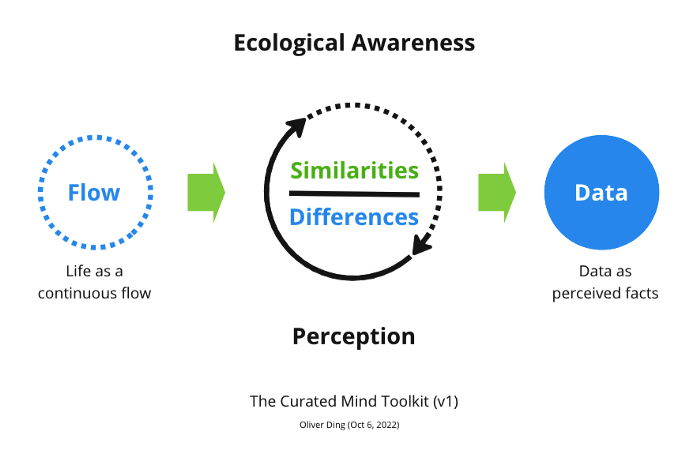
Ecological Awareness refers to making sense of the spatial aspect of environments, including stable status and changes in environments.
Life is a continuous flow, a strategist could see many things and events in a particular situation. However, she has to perceive significant and relevant things and events. She has to discover Similarities and Differences from the continuous flow and defines some perceived facts as data that may refer to opportunities.
For example, we can record an online meeting. However, the video is not the data, but the raw material for making data for a research project. The strategist has to watch the video again and again until she can perceive some data.
How can we know Similarities and Differences? We can compare the newest information with our experience space.
Ordinary people don’t often intend to run strategic curation projects in their real-life world, they tend to miss significant opportunities to perceive important facts and generate useful insights.
Ecological Awareness requires paying attention to tiny changes in the environment anytime anywhere. It takes effect to do this job in the everyday life world.
Taking Opportunities requires Capabilities
After perceiving opportunities, we could take action to actualize opportunities. This usually happens in Response Space.
However, we rely on Experience Space to evaluate the Potentials — Capability fit. Our performance in the past offers useful evidence for judging if we can take new opportunities.
Usually, we have the following three options:
- Can: we definitely have the capability to take this opportunity.
- Try-and-Luck: we are not sure if we can take this opportunity, but we should try it. Maybe we are lucky to take it.
- Lack: we don’t have the capability to take this opportunity.
In a classic theoretical monograph titled The Psychology of Interpersonal Relations (1958), Fritz Heider established a theory about the Native Analysis of Action. He used the following diagram to describe the concept of Can.
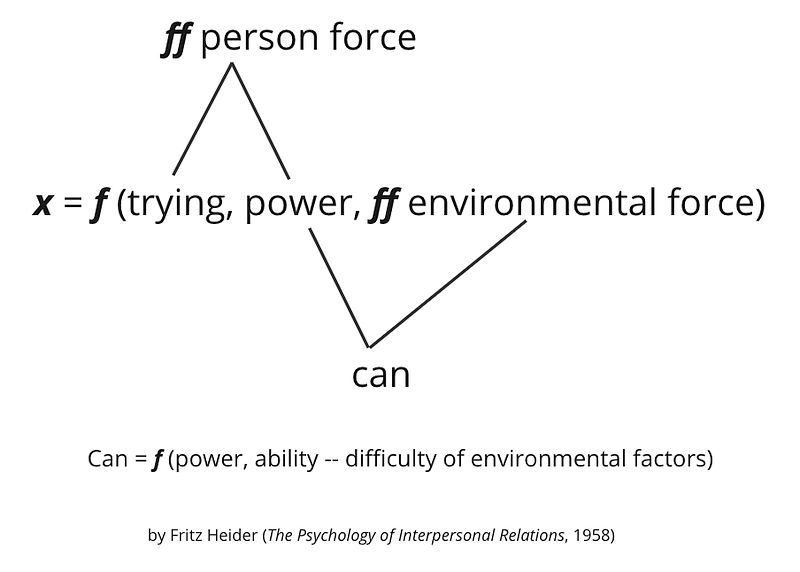
According to Heider, the action outcome, x, may then be said to be dependent upon a combination of effective person force and effective environmental force. The effective personal force is also analyzed into two contributing factors: a power factor and a motivational factor which refers to what a person is trying to do (his intention) and how hard he is trying to do it (exertion).
Heider pointed out that the concept of Can is a dispositional concept that refers to a relatively stable relationship between the person and the environment. However, though “Can” is a result of two contributing sources, it is sometimes ascribed more to the person and sometimes more to the environment. This notion lead to the concept of “Difficulty”, an important dispositional property of the environment.
According to Heider, “As with difficulty, there is a diversity of conditions that lead to the cognition of luck. One of these is consistency, or conversely, variability, of performance. If a person succeeds only once in a great number of trials we will attribute the success to luck, especially if it is followed by a number of failures so it cannot be interpreted as ‘He has learned it at last.’ If he fails only once and succeeds at other times, the failure is attributed to bad luck (sometimes temporary personal factors are held accountable).” (1958, p.91)
Heider’s discussion echoes our notion of the Potentials — Capability fit. If we only need to take an opportunity once, we could choose the Try-and-Luck option if we don’t want to miss the opportunity.
The Lack-in-Capability option leads to a new move from Experience Space to Challenge Space. I called this move “Perceive Distance (DD)” which means there is a gap between what we can do and what we want to do.
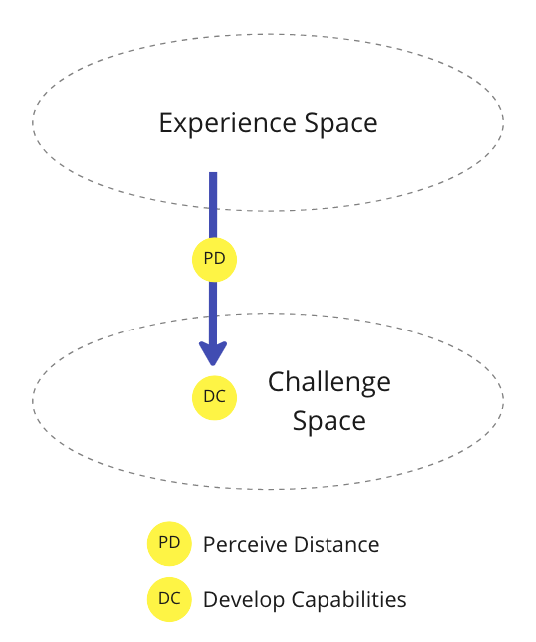
Once we return to Challenge Space, we detach our focus from Taking Opportunities and attach it to a new Learning Challenge: Develop Capabilities.
The resource-based view (RBV) and Dynamic Capability theories form an established school of thought in the field of strategic management. The resource-based view (RBV) claims that a firm accumulates valuable resources to achieve a competitive advantage. Dynamic Capability theories emphasize that there is a need to turn resources into dynamic capabilities.
For the Life Strategy project, it’s clear that Develop Capabilities is a learning activity for long-term life development. In contrast, the Try-and-Luck mindset is more about short-term life development.
Long-term Response as Strategic Action
Now we can move to Response Space. There are two moves between Challenge Space and Response Space.
- Long-term Responses
- Situational Actions
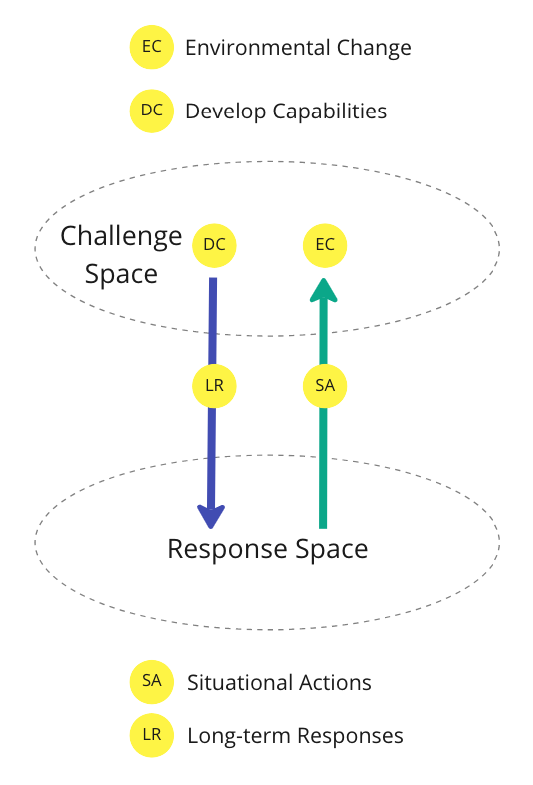
For the Life Strategy project, the Develop Capabilities challenge needs Long-term Responses because learning new knowledge, improving skills, and expanding resources are not short-term tasks.
As mentioned above, we could take action to actualize opportunities after perceiving opportunities. This usually happens in Response Space.
The Can option and the Try-and-Luck option lead to Situational Actions which cause new changes in the environment. Eventually, we move to Challenge Space again because the new Environmental Change (EC) could bring us new opportunities.
What does Long-term Response look like?
It can be a one-year journey of improving a behavioral habit. Martin E.P. Seligman is an American psychologist, educator, and author of several books about positive psychology and well-being. Seligman was elected President of the American Psychological Association for 1998. In his autobiography The Hope Circuit (2018), Seligman uses “Tessitura” as the title of Chapter Eleven which describes his journey of Develop Capabilities from 1973 to 1974.
“Tessitura” is a term for a singer’s most comfortable vocal range — the range in which she will make her most beautiful music. A mezzo-soprano can hit a high C, but she has to strain to stay there, and you can hear it. Tessitura is the place where you find your true voice, where you can have a long and healthy career. The quest for my tessitura in psychology was a search in three dimensions: style, tempo, and content. (2018, p.129)
Seligman asked a friend called Ed Pugh to teach him being slow, “After we hired Ed, he took me under his wing and taught me how to be slow. For a year we met once a week in my office to read Kierkegaard’s Fear and Trembling. We did only one page each week. I became slower.” (2018, p.132)
By 1974, Seligman found his tessitura, “In style, I was comfortable writing plainly: few big words, short sentences, brief paragraphs, and straightforward arguments. In tempo, I was becoming slower. I was more deliberate in speech as well as thought. My pace had improved. Though imperfect it was closer to right than it had ever been.” (2018, p.138)
Long-term Response can be a temporal distributed activity too. It means we can respond to a challenge in different time durations. For example, my journey of Develop Capabilities in Diagramming took Try-and-Luck several times in the past several years.
Diagramming is one of my essential three knowledge units. I love to dwell in thought with diagramming. I even wrote a 108-page thesis titled Diagram Explained which develops a theory about diagrams and diagramming in 2018. I consider two groups of ideas for my theory about diagrams. The first group is “meta-diagram, diagram, and diagram system” and the second group is “diagramming as an activity of knowing, theorizing and reflecting”.
However, I stopped working on the Diagram Explained project in 2018 because I moved to develop Curativity Theory which is about general curation practice. The “Curativity” journey led to the project of developing the Ecological Practice approach from 2019 to 2021.
On April 26, 2021, I wrote an article and reviewed three versions of the Ecological Practice approach. At that time, I thought that the project is almost done. Then, I detached my mind from a three-year journey of theoretical development. I returned to the Diagram Explained project in April 2021 and worked on the D as Diagramming project from April 2021 to December 2021.
Sense-makers for Taking Opportunities
From the perspective of the Ecological Practice approach, Taking Opportunities means the “Potential — Actual” transformation. If we use the Strategic Curation model to visualize it, it refers to moves between Speculative Space and Response Space.
- Speculative Space (Potential)
- Response Space (Actual)
- The Potential — Actual Transformation = Moves between Speculative Space and Response Space
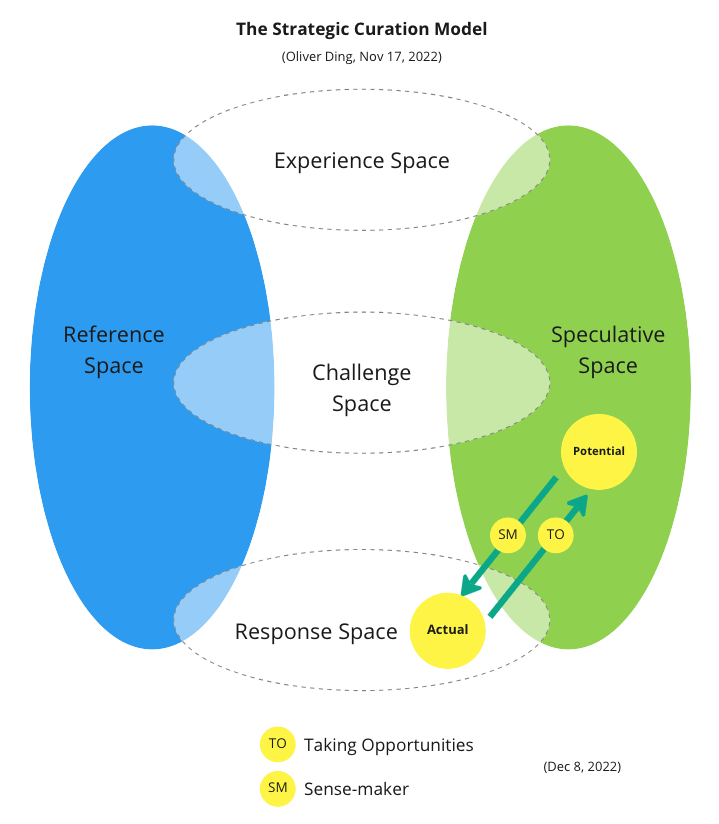
The above diagram represents two important notions for the present discussion:
- Taking Opportunities
- Sense-maker
Taking Opportunities means moving to Speculative Space from Response Space to select one Like-to-take opportunity from many potential opportunities.
We should notice that selecting one Like-to-avoid opportunity also means Taking Opportunities. In this way, a Threat can be understood as a Like-to-avoid Opportunity.
Though the above discussion mentions capabilities, we didn’t touch a key of the mechanism of Taking Opportunities.
How do we perceive and detect opportunities?
The Ecological Practice Approach uses the notion of “Sense-maker” to answer this question. See the diagram below.
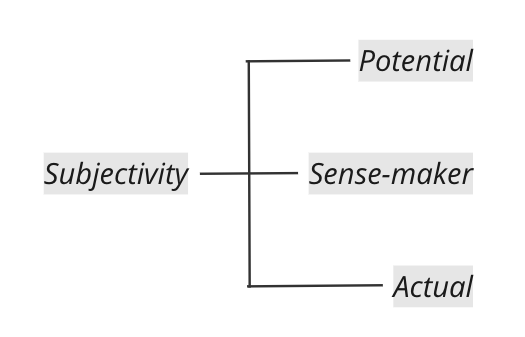
I work on several theoretical approaches. Each approach has its own way to define Subjectivity. I used the Ecological Practice approach to guide the Creative Life Curation project.
The primary theme of the Ecological Practice approach is the “Actualization of Opportunities”. Inspired by Ecological Psychology, the Ecological Practice Approach defines a set of Potential Action Opportunities:
- Affordance
- Projectivity
- Attachance
- Supportance
- Curativity
For the Creative Life Curation framework, I also define three types of “Curativity” which mean “turning pieces into a meaningful whole”.
- Curativity 1: Turning pieces of Projects into a Journey as a meaningful whole
- Curativity 2: Turning pieces of Projects into a Landscape as a meaningful whole
- Curativity 3: Turning pieces of Actions and Projects into a Lifescope as a meaningful whole
How does a creator or curator perceive Potential Action Opportunities? They rely on Sense-makers.
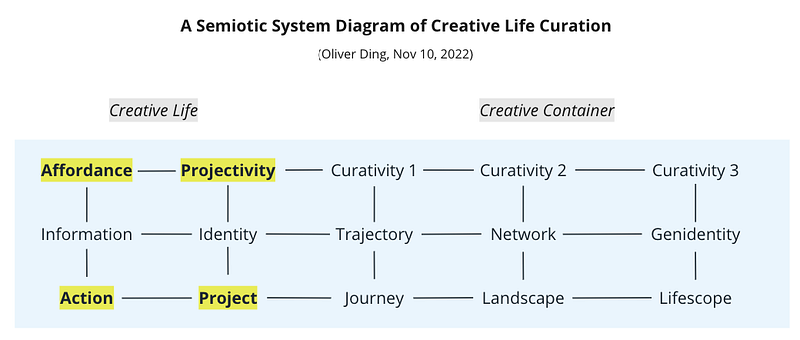
The above diagram is part of the Creative Life Curation framework. It only discusses Affordance, Projectivity, and Curativity. It is an example of the Potential — Sense-maker — Actual structure.
For example, if we focus on Affordance which is a type of physical environmental opportunity, we can use “Information” as the sense-maker.
Perceiving affordances is for taking actions, taking actions has an impact on the environment and changes the affordances of the environment. I draw the diagram below to visualize this loop.
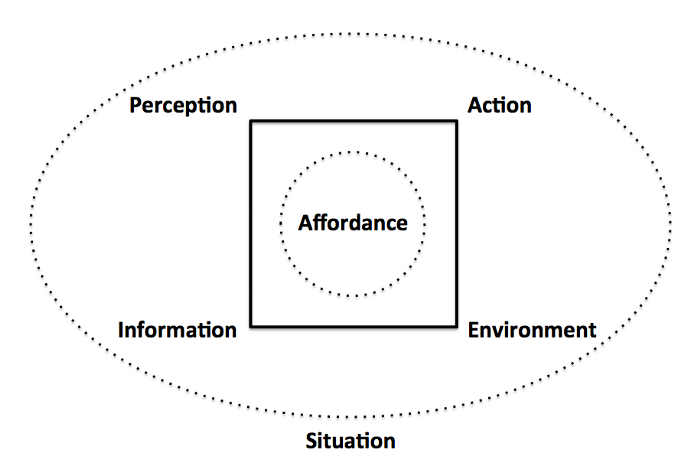
If we adopt Gibson’s version of Affordance, then we can pay attention to the Immediate Experience of human—material engagement.
We should notice that Gibson’s view on Information is part of his Information Pickup theory which is different from traditional Information Processing theory.
The term information cannot have its familiar dictionary meaning of knowledge communicated to a receiver. This is unfortunate, and I would use another term if I could. The only resource is to ask the reader to remember that picking up information is not to be thought of as a case of communicating. The world does not speak to the observer. Animals and humans communicate with cries, gestures, speech, pictures, writing, and television, but we cannot hope to understand perception in terms of these channels; it is quite the other way around. Words and pictures convey information, carry it, or transmit it, but the information in the sea of energy around each of us, luminous or mechanical or chemical energy, is not conveyed. It is simply there. The assumption that information can be transmitted and the assumption that it can be stored are appropriate for the theory of communication, not for the theory of perception (p.231).
Gibson’s Information is not Shannon and Weaver’s Information. For Gibson, the qualities of objects are specified by information. The information in ambient light, along with sound, odor, touches, and natural chemicals, is inexhaustible.
From the perspective of Gibson’s ecological approach, the “Organism-Environment” relationship is explained by a “perception-action” loop. In a particular situation, there is information specifying the structure of the environment; by picking ecological information, people perceive the affordances of the environment; people select one or more affordances and take real actions.
Thus, I believe the ecological information should tie to affordance and action. In other words, Ecological Information is Action-centered Information. If a piece of information points to potential actions for people, then we can claim it as Ecological Information. If a piece of information doesn’t point to any potential action, then we can call it Content. See the flowchart below.
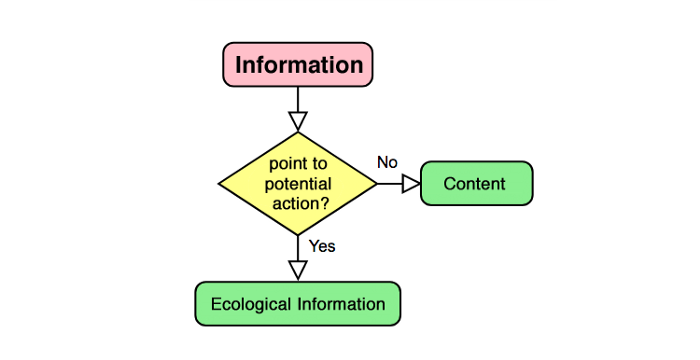
This principle helps us bypass the complex academic debate between Gibson’s Information Pickup theory and traditional Information Processing theory and adopt an ecological approach to researching digital environments.
You can find more details in ReEngagement with Twitterville: An Introduction to Ecological Physics Method.
Each type of opportunity has its own specific sense-makers. For example, Activity Theory has the key concept of Object which is a sense-maker of the theory. So, I think we can assign similar sense-makers to Project and Event. For example, I think the primary sense-maker of a Project can be Identity and the primary sense-maker of an Event can be Theme.
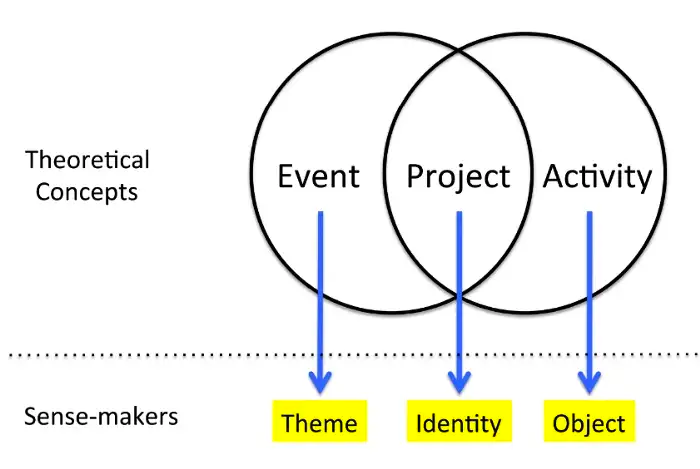
Projects refer to both events and activities and it shares some aspects with them. Project’s primary sense-maker is Identity and its secondary sense-makers are Theme and Object.
Dance with Frame
The last piece of the mechanism of Taking Opportunities is Frame which is located in Reference Space. See the diagram below.
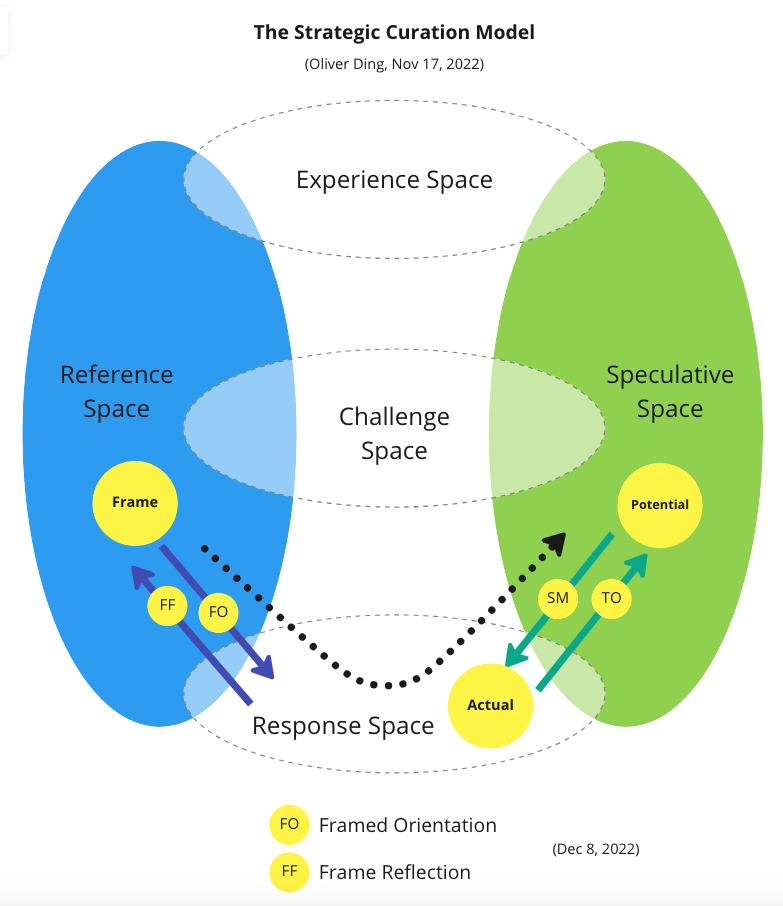
Though Reference Space is defined as a cognitive container that contains reliable and validated knowledge for thinking, I have to point out that the quality of “reliable and validated knowledge” depends on individual differences.
Different people have their own skills and attitudes to judge if a piece of knowledge is reliable and validated for their life development.
For example, I often use my own theoretical frameworks as a reference to guide my knowledge projects.
In the past three years, I worked on developing the Ecological Practice approach. During the long journey, the theoretical approach is the primary frame for the knowledge enterprise.
One task of the Ecological Practice approach is expanding Ecological Psychology from physical environments to digital environments. I applied the Ecological Physical Method to discuss Twitter, a digital platform, in June 2020. You can find more details in ReEngagement with Twitterville: An Introduction to Ecological Physics Method.
However, I found the method too hard for ordinary readers to understand. Then, I moved to search for an ideal opportunity to showcase the concept of Affordance which is the core concept of Ecological Psychology. Also, my work on the Ecological Practice approach is not only about the concept of Affordance, but also about other theoretical concepts.
So, I decided to adopt a framework called Infoniche which is part of the Ecological Practice approach to discuss platforms. The result is the Platform-for-Development framework (v2.0) which was published on March 31, 2021.
This is an example of Determined Opportunities.
In April 2021, I realized that digital whiteboards are a perfect object for studying Affordance in digital environments. At that time, a friend of mine invited me to join a two-month online workshop program. I realized that was a perfect opportunity for testing the Platform-for-Development framework (v2.0). So, I started the Once Upon A Whiteboard project.
Then, I created several sub-projects for the Once Upon A Whiteboard project. One of these sub-projects is the D as Diagramming project which led to two books about diagrams and diagramming.
This is an example of Situational Opportunities.
It’s clear that there are at least two types of Framed Orientation.
- Determined Opportunities: a Frame is used for guiding self-determined opportunities.
I could use the Infoniche framework to discuss Platforms, City Development, Adult Learning, and other topics. Since the Ecological Practice approach also has other sub-frameworks, I could use another sub-framework to study Platforms too. In other words, I have many choices to make applications for the Ecological Practice approach.
- Situational Opportunities: a Frame is used to review opportunities offered by other people.
However, the two-month online workshop program was hosted by my friend. For me, this is a situational opportunity. My friend didn’t know that I was searching for an opportunity for studying digital whiteboards with the ecological practice approach. He just invited me to join the program as a normal guest. I told him that I perceived his program as a new opportunity for my creative work.
Frames can be good or bad. While we can use Frames to guide us in taking opportunities, we have to keep awareness of the Frames we are using. I called this Frame Reflection.
Though I use theoretical approaches as an example of “Frame”, we can understand the term “Frame” in a broad sense. Frames can be Laws, Rules, Roles, Values, Perspectives, Themes, etc.
- Laws: If we take opportunities without considering laws, we may do something criminal.
- Rules: Some communities and organizations have their formal or informal rules. If their members take opportunities without obeying these rules, they may be punished.
- Values: Values are personal preferences and shared preferences by a group of people. If an opportunity doesn’t match our values, we may don’t have the motivation to take action.
- Perspectives: It’s clear that our perception is related to our perspectives. From one particular perspective, we may don’t perceive a change as an opportunity. If we adopt another perspective, we may perceive the change as an opportunity.
- Themes: Themes are personal preferences too. If we use themes to curate our creative work and life experience, we may use them to frame opportunities.
In 1994, Donald A. Schon and Martin Rein published Frame Reflection: Toward the Resolution of Intractable Policy Controversies. They claim that human beings can reflect on and learn about the game of policy making even as they play it, and, more specifically, that they are capable of reflecting in action on the frame conflicts that underlie controversies and account for their intractability. (1994, p.37)
While Schon and Rein purposes the frame-reflective approach to policy practice, we can use the term Frame Reflection to discuss Taking Opportunities.
The Opportunity Formula
In 2021, I made a heuristic tool called the Opportunity Formula. Now we can adopt it for the Strategic Curation model.
In order to explain the value of the ecological practice approach, I adopt the concept of Opportunity as mediation and redefined it as the formula below:
Opportunity = From a perspective (X), You (U) could do things (Y) with an object (Z).
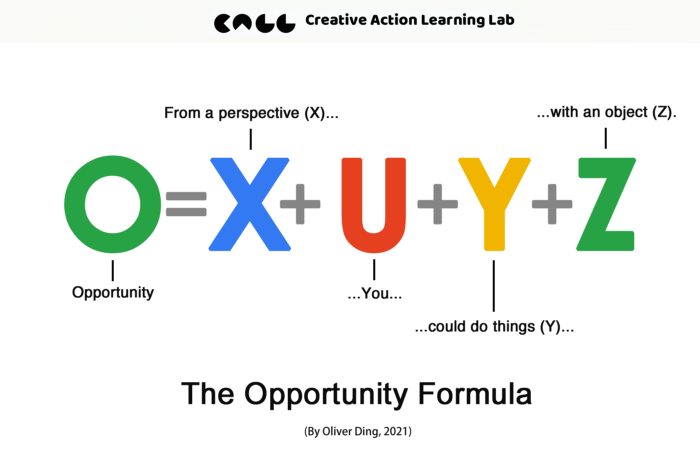
The X formula is a way of building heuristic tools. Some authors also use this method to name their books. For example, the physicist Albert-László Barabási is best known for his work in the research of network theory. He published a book titled The Formula: The Universal Laws of Success in 2018. Ronald F. Ferguson and Tatsha Robertson published The Formula: Unlocking the Secrets to Raising Highly Successful Children in 2020. Though these two books are based on scientific research, they are intended to be written for ordinary readers.
From the perspective of the Ecological Practice approach, the concept of Opportunity is both subjective and objective. The objective aspect refers to the ecological context which means an objective reality. The subjective aspect refers to a person’s attitude, knowledge, skills, and situation.
While the concept of Affordance which is a core concept of Ecological Psychology refers to physical environments and material objects, the Ecological Practice approach offers more concepts that could be applied to non-material objects such as a picture, a tweet, a theory, an experience, etc.
That means we have a lot of work to do…It is a long journey worthwhile!
The Strategic Curation Model and The Ecological Practice Approach
Some readers may notice that I use some ideas from the Ecological Practice Approach for the above discussion.
The Ecological Practice Approach is inspired by Ecological Psychology, Activity Theory, and Social Practice theories. In a broad sense, the Ecological Practice approach has its philosophical roots in traditional Pragmatism and contemporary embodied cognitive science.
I consider the Strategic Curation model as a new approach to Strategic Cognition which is about strategy-related thinking and doing. The new approach emphasizes the “thinking-doing” connection, spatial cognition, and temporal structure. Since the approach is based on the concept of “Thematic Spaces” which is a core idea of the Ecological Practice approach, I name it Ecological Strategic Cognition.
On May 17, 2022, I edited a TOC for a possible book: Ecological Practice Design: The Lifesystem Approach to Everyday Life Innovation. The primary focus of the book is the Lifesystem Framework. However, I expand it with more relevant other frameworks and theoretical concepts from the Ecological Practice Approach.