Life Strategy: Conceptual Change and Developmental Resources
A discussion about Resources for the Strategic Curation model
This article is part of a possible book Advanced Life Strategy: Anticipatory Activity System and Life Achievements. I consider the Strategic Curation model as a part of the possible book.
The Strategic Curation Model is a five-space model.
- Experience Space: It refers to the facts of the Past.
- Challenge Space: It refers to the problems in the Present
- Response Space: It refers to the solutions for the Future
- Reference Space: It refers to reliable and validated knowledge for thinking
- Speculative Space: It refers to imaginative thinking such as Counterfactual Thinking about the Past and Prefactual Thinking about the Future.
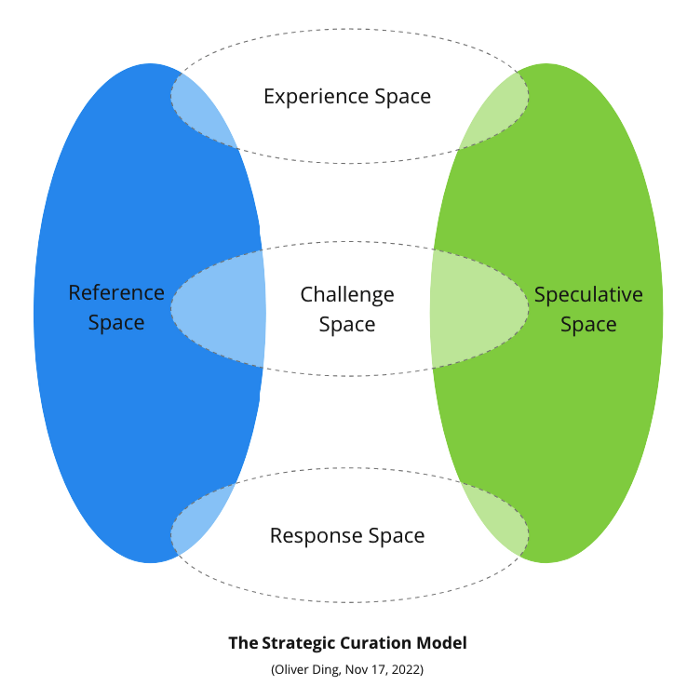
What does Strategic Curation mean?
It refers to using a specific strategy to curate pieces of experience, knowledge, and resources into a meaningful whole for a better future.
You can find more details about the model in the following links
- Life Strategy: A Five-space Model for Strategic Curation
- Life Strategy: Three Meta-knowledge of Strategic Curation
- Life Strategy: Turning Potential Knowledge into Actual Knowledge
This article will discuss the concept of Developmental Resources with the Strategic Curation model.
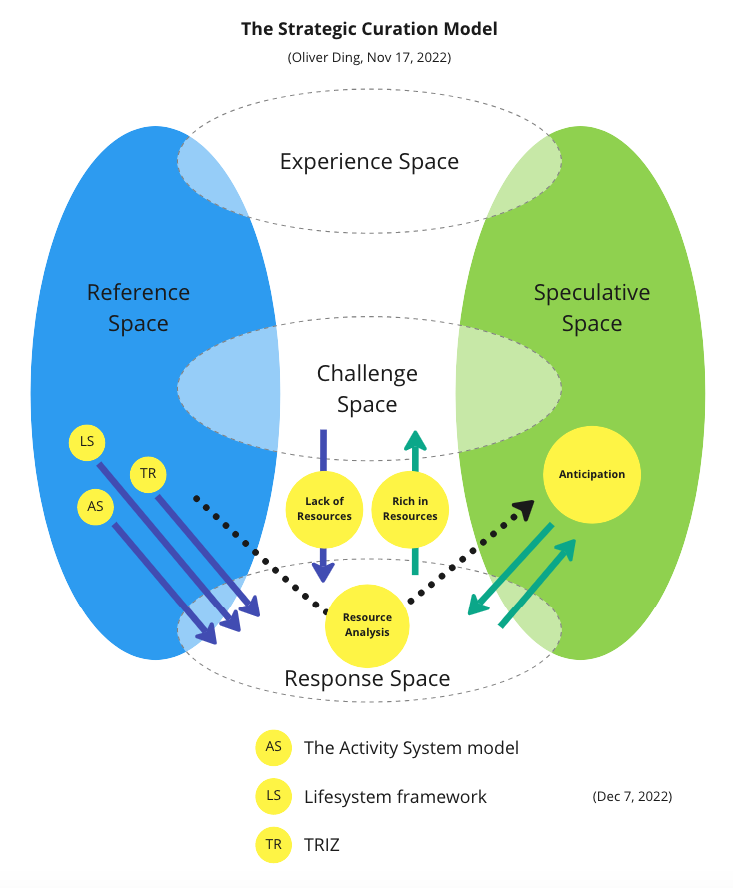
The concept of Developmental Resouces is inspired by the field of strategic management. Strategic management thinkers tend to think of Resouces from the perspective of organizational economic activities.
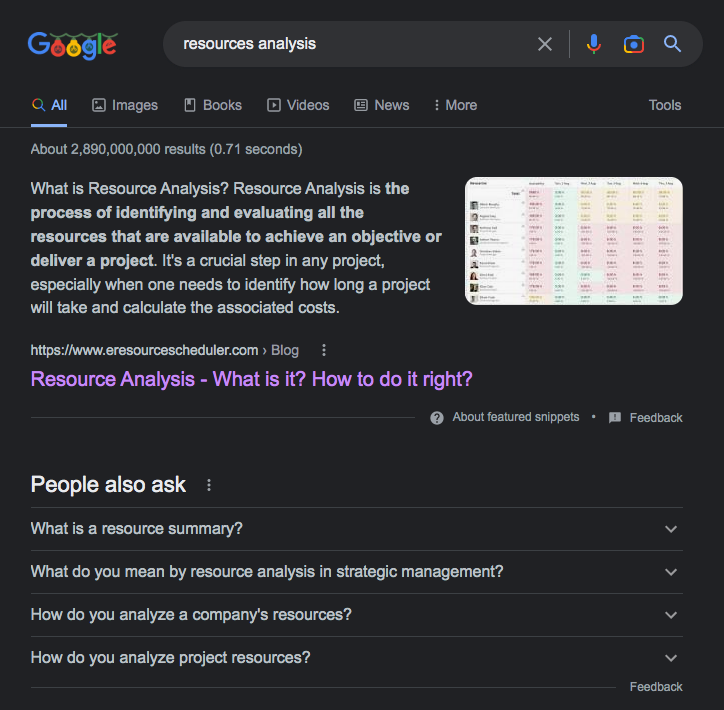
For the Life Strategy project, I focus on personal development and life achievement. My definition of Developmental Resources is quite broad.
Anything that can be used for a person’s life development can be understood as Developmental Resources for the person.
I used normal words such as “Resources”, “Results”, “Challenge”, “Responses”, and “Opportunities” as operational concepts for the Strategic Curation model. I also offered some new perspectives for understanding these words in order to make more creative spaces for life development.
Each perspective brings new meaning to a normal word. In this way, we develop a personal version of a concept.
For example, I used the following three theoretical perspectives to reflect on the word “Resouces”.
- The Activity System Model (AS)
- The Lifesystem framework (LS)
- TRIZ (TR)
Each time I engaged the concept of “Resources” in a frame that was defined by a theoretical approach. I also detached my mind from one perspective and attached my mind to other perspectives. The whole process forms a journey of Rethinking Developmental Resources.
The power of Conceptual Change is amazing. I changed my mindset about “Resource Analysis” and a series of related concepts such as “Lack of Resources’ and “Rich in Resouces”.
Activity System and Resources
The concept of “Resouces” is an important concept for strategic thinking. However, I didn’t find it in a popular framework of Activity Theory: Yrjö Engeström’s Activity System model.
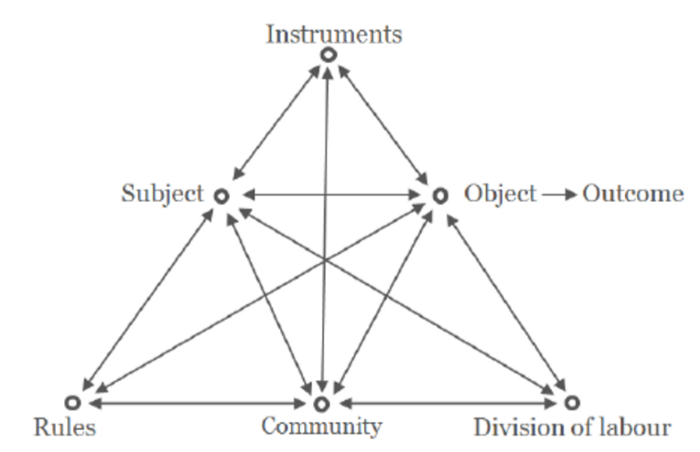
From the perspective of Activity Theory, human activity or ‘what people do’ represents the basic unit of analysis when studying human behavior. The most important aspect of Activity Theory is understanding both individual and collective aspects of human practices from a cultural and historical perspective.
Yrjö Engeström upgraded the activity theory from the individual activity level to the collective activity level with a conceptual model of “activity system” in order to apply activity theory to educational settings, organizational development, and other fields (Engeström,1987).
The above Engeström’s triangle is based on the cultural-historical psychologists’ notions of mediation as individual action (subject — instruments — object) at the top of the diagram.
Engeström (1987) considered “a human activity system always contains the subsystems of production, distribution, exchange, and consumption.”(p.67), thus, he added the bottom of the triangle to the original individual triangle in order to include other people (community), social rules (rules), and the division of labor between the subject and others.
Engeström tracked back human activity to the animal form of activity. He said, “A central tenet embedded in this model is the immediately collective and populational character of animal activity and species development (see Jensen 1981).”(p.91)
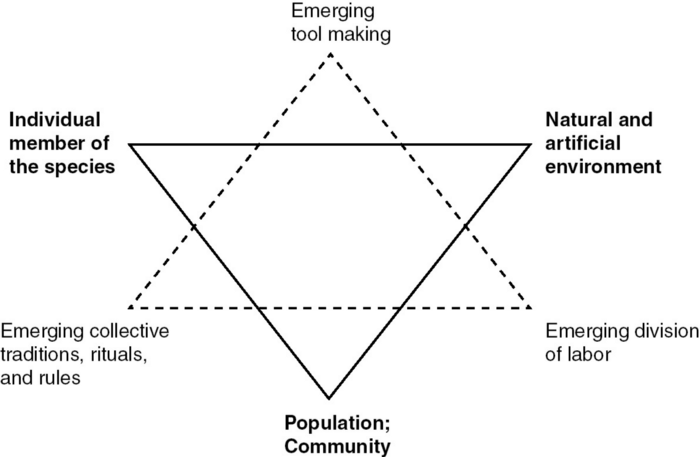
The next stage is the evolution from animal to human. Engeström pointed out three major changes which are represented within the following diagram.
- Doing alone: the emerging utilization of tools.
- Being together: collective traditions, rituals, and rules.
- Doing together: division of labor between the sexes and more.
The next stage is transforming from “ecological and natural” to “economic and historical”. Engeström said, “What used to be adaptive activity is transformed into consumption and subordinated to the three dominant aspects of human activity — production, distribution, and exchange (or communication). The model suggests the possibility of analyzing a multitude of relations within the triangular structure of activity. However, the essential task is always to grasp the systemic whole, not just separate connections.”
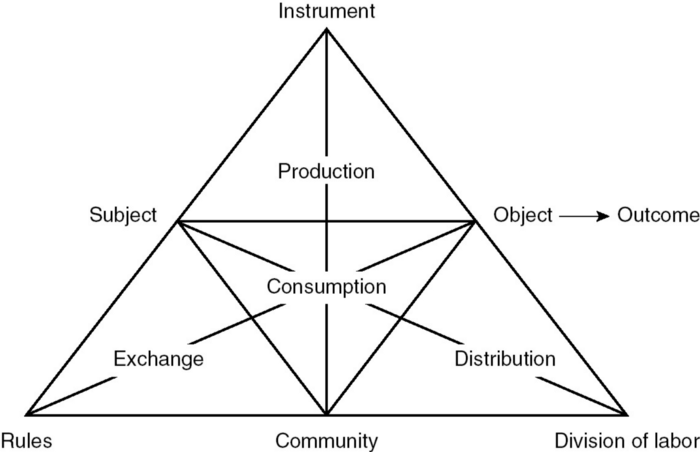
This is a perfect example of “Diagramming as Theorizing”!!!
However, the ideal form of the diagram doesn’t give creative spaces to emerging theoretical concepts. For example, the Activity System model doesn’t have the concept of “Environment” and the concept of “Resource”.
Since the model doesn’t have the concept of Resource, I have to apply some data to Mediation or Object which are two “official” concepts of the model.
Each diagram only can display several concepts. Knowledge creators have to make a distinction between primary concepts and secondary concepts.
For the Activity System Model, “Mediation” is a primary concept. “Resources” and “Environments” are secondary concepts. If you want to deal with “Resources” and “Environments” in your research projects, you can understand them as “Mediation”. Some types of Resouces can be understood as “Raw Materials” which are part of “Object”.
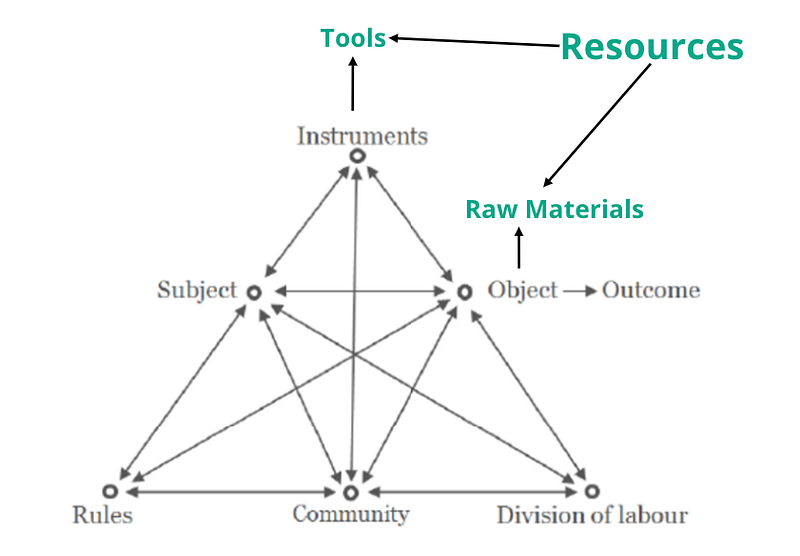
If you want to use “Resources” and “Environments” as primary concepts in a knowledge framework, you have to explore other options or make something for yourself.
Later, I created a new diagram called Activity System Plus which adds “Resource” to the original model for private discussions with my friends.
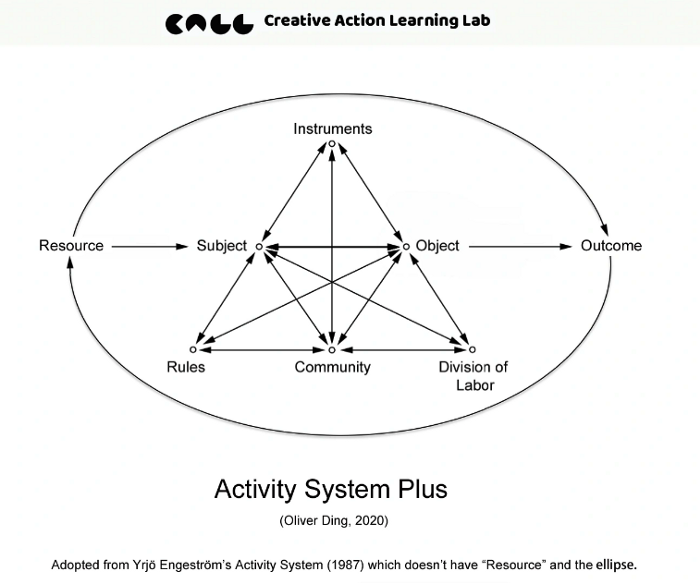
I also added an ellipse to connect “Outcome” and “Resource”. This connection refers to the notion of “Reproduction of Activity” which means an outcome of one activity could be a resource of another activity.
Lifesystem Framework and “Double R” Analysis
In 2019, I developed a framework called Life Curation which contains a module called the “Resources — Results” (Double R) Analysis. The framework suggests that a person could build his or her creative containers to curate pieces of resources into meaningful results.
Later, I used the Double R analysis for the Lifesystem framework. See the diagram below. You can find more details here.
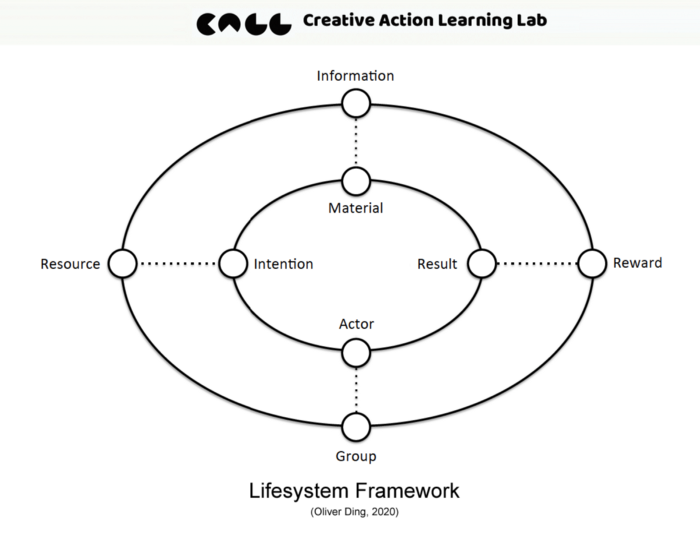
The Lifesystem framework is an application of the Ecological Practice approach which is inspired by Ecological Psychology. You can find more details in Ecological Practice Design: The Lifesystem Approach to Everyday Life Innovation.
I’d like to point out that the most important value of the Ecological Practice approach is its perspective indicates the ecological meaning of objects and environments. It is very useful for rethinking Resources and Opportunities.
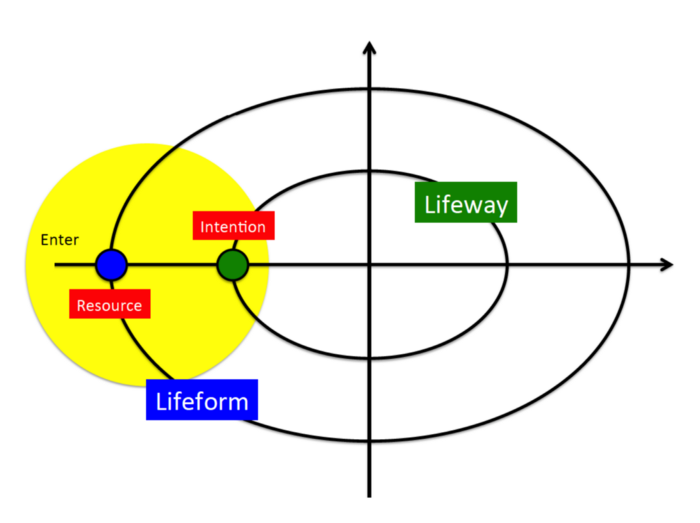
The pair of concepts of “Resource — Intention” is also related to Activity Theory’s concept “Object”. However, there is a difference between the Ecological Practice approach and Activity Theory. Since Activity Theory is a goal-oriented action theory, it only considers performatory actions. While remaining the importance of performatory actions, the Ecological Practice approach also emphasizes exploratory actions.
The concept of Intention refers to an actor’s motivation and objective. The Lifesystem framework suggests Strong Intention and Weak Intention. Also, the Lifesystem framework uses Given Intention and Emergent Intention to discuss the dynamics of intention.
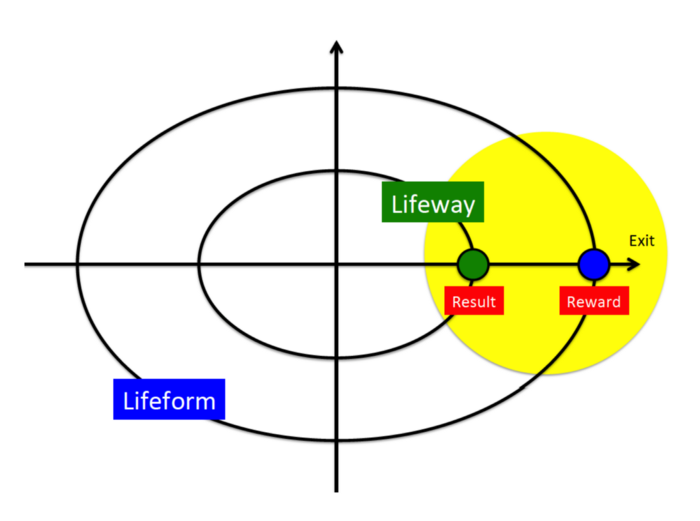
The concept of Result refers to the final outcome of a Lifesystem. One useful way is to distinguish between three types of outcomes: product, by-product, and meta-product.
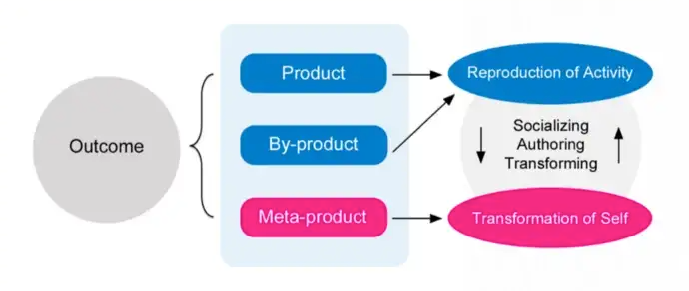
The product refers to the intended outcome within the original objective of Lifesystem and the by-product refers to the unintended outcome beyond the original objective of Lifesystem. The meta-product refers to the transformation of self as the outcome of Lifesystem.
On Feb 18, 2022, I also discussed the Result — Reward gap and achievement from the perspective of the Anticipatory Activity System. You can find more details in the original article.
TRIZ
The concept of “Resource” is also inspired by the following diagram which is a model of TRIZ.
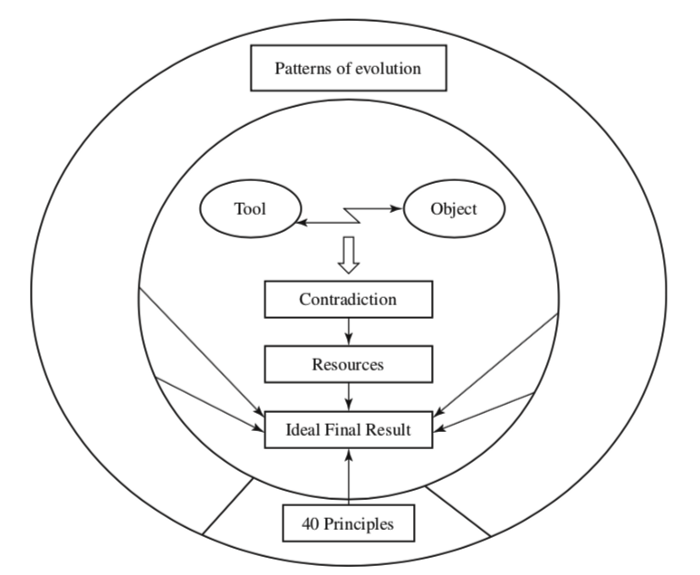
TRIZ comes from the Russian phrase teorija rezhenija izobretatelskih zadach. The English translation is the “theory of inventive problem solving.” It was developed by the Soviet inventor and science-fiction author Genrich Saulovich Altshuller (1926 -1998) and his colleagues, beginning in 1946.
I found the above diagram from Kalevi Rantanen and Ellen Domb’s 2007 book Simplified TRIZ: New Problem Solving Applications for Engineers and Manufacturing Professionals.
The book uses one chapter titled Mapping Invisible Resources to discuss the topic of Resources.
According to the authors, “Resouces abound. Actually, we can make an endless list of resources if we examine the problem from greater and greater distances.” They also offer a simple diagram for mapping primary resources.
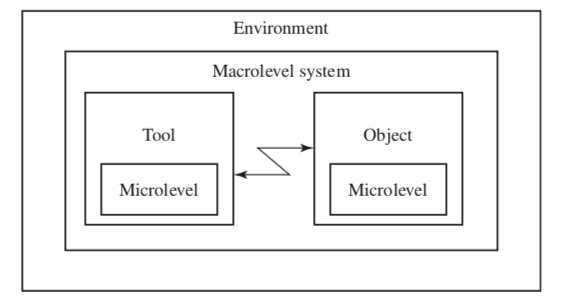
The above diagram shows a structure of a system. Based on the structure, we can find resources from different system levels.
- Tool
- Object
- Environment
- Macrolevel system
- Microlevel system
The authors also emphasize that a variety of resources are available:
- Substances and Things
- Modified substances and things
- Voids
- Interactions and the energy to make them happen
- Form
- Features or properties
- Space
- Time
Other resources include the following:
- Information
- Harmful substances and interactions
- People’s skills and abilities
Resources for Knowledge Creators
TRIZ is really useful for Engineers and Manufacturing Professionals.
How about Knowledge Creators? Do we have a list of resources for Knowledge Creators?
In 2016, Information Science scholar Diane H. Sonnenwald edited a book titled Theory Development in the Information Sciences, she presented a three-stage framework for understanding the theory development process. At the center of the diagram she drew, Resource is the core of theory development.
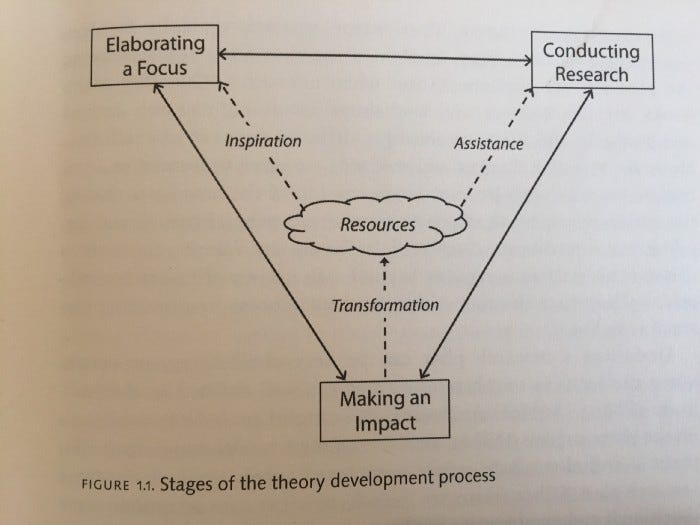
According to Sonnenwald, the Resources mentioned by chapter authors are literature, personal experiences, their own research, colleagues, technology, institutions, and societal issues.
- Literature: read literature deeply, dissatisfaction and disagreement, etc.
- Personal experiences: observations, work experiences, personal challenges, etc.
- Own research: positive and negative results, tests, real-world applications, etc.
- Colleagues: inspiration, valuable feedback, disseminate and apply, etc.
- Technology: new behavior and phenomena, new types of data, etc.
- Institutions: guide of research focus, funding, expert network, etc.
- Societal issues: social problems, funding, evaluation, impact, etc.
Though the above list is for understanding theory development, it is also useful for knowledge curation and knowledge creation in general.
The Lack-of-Resouces Mindset
The above review of my engagement with the theme of “Resources” inspired me to reflect on the typical “Lack-of-Resources” mindset.
We often believe that we don’t have enough resources for doing what we want to do.
By learning and making different theoretical approaches, I realized that there is an important issue called “Lack of Concept” behind the issue of “Lack of Resources”.
While precise concepts are significant for a knowledge enterprise such as a theory or a framework, it is possible to keep the Flexibility of Concepts for practices such as life development.
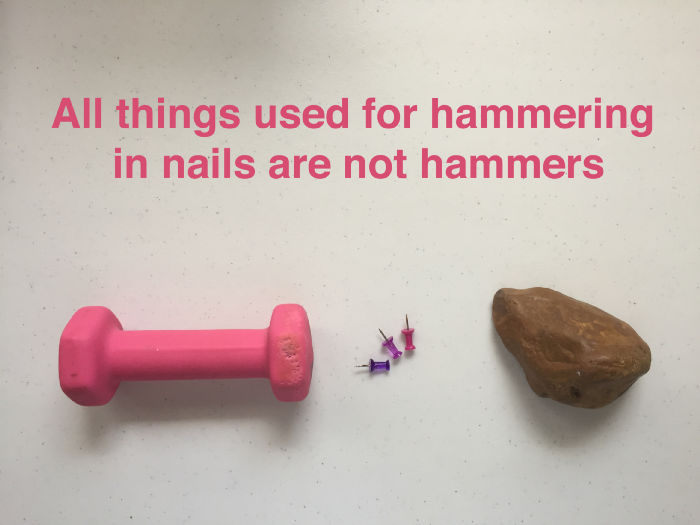
I got the inspiration for the above picture when I was reading Erving Goffman’s book Frame Analysis. He wrote a note about the meaning of an object on p.39, “Here again, I argue that the meaning of an object (or act) is a product of social definition and that this definition emerges from the object’s role in the society at large, which role then become for smaller circles a given, something that can be modified but not totally re-created. The meaning of an object, no doubt, is generated through its use, as pragmatists say, but ordinarily not by particular users. In brief, all things used for hammering in nails are not hammers.”
What Goffman talked about is normativity since he paid attention to “ordinarily” not “particular users.” As a particular user, I always use the stone and the small pink dumbbell for hammering. Of course, we don’t call stones and dumbbell hammers.
Goffman didn’t give a specific definition of “object”, but we know he intended to use a general term because he said “an object (or act)”. If we restrict the scope of “object” to concrete physical objects, then we can adopt an innovative view of the meaning of an object from Ecological psychologist James J. Gibson.
Gibson was the first to bring the ecological perspective to psychology, especially in the study of visual perception. He proposed the Affordance theory to describe the mutual relationship between animals and environments in his last book, The Ecological Approach to Visual Perception (Gibson, 1979/2015). He said, “We have thousands of names for such objects, and we classify them in many ways: pliers and wrenches are tools; pots and pans are utensils; swords and pistols are weapons. They can all be said to have properties or qualities: color, texture, composition, size, shape and features of shape, mass, elasticity, rigidity, and mobility. Orthodox psychology asserts that we perceive these objects insofar as we discriminate their properties or qualities. Psychologists carry out elegant experiments in the laboratory to find out how and how well these qualities are discriminated.” (p.125)
Traditionally, psychologists assumed that objects are composed of their qualities. Gibson rejected this view, “…But I now suggest that what we perceive when we look at objects are their affordances, not their qualities…The fact that a stone is a missile does not imply that it cannot be other things as well. It can be a paperweight, a bookend, a hammer, or a pendulum bob. It can be piled on another rock to make a cairn or a stone wall. These affordances are all consistent with one another. The differences between them are not clear-cut, and the arbitrary names by which they are called do not count for perception. If you know what can be done with a graspable detached object, what it can be used for, you can call it whatever you please.” (p.126)
The radical aspect of affordance theory is that it challenges the traditional view on the meaning of objects “concept first” and turns it to “percept first”.
Concept is about linguistic meaning and ordinary classes of objects.
Gibson argued, “To perceive an affordance is not to classify an object…The theory of affordances rescues us from the philosophical muddle of assuming fixed classes of objects, each defined by its common features and then given a name. As Ludwig Wittgenstein knew, you cannot specify the necessary and sufficient features of the class of things to which a name is given. They have only a ‘family resemblance.’ But this does not mean you cannot learn how to use things and perceive their uses. You do not have to classify and label things in order to perceive what they afford.” (p.126)
In fact, affordance theory doesn’t only consider objects but considers objects as our environment. For Gibson, “objects, other persons and animals, places and hiding places” are our surrounding environment.
If we can escape from the frame of concepts, we can develop a new mindset: Rich-in-Resources.
The Power of Conceptual Change
The above discussion also points out a technique for Advanced Life Strategy: Conceptual Change.
According to Wikipedia, “Conceptual change is the process whereby concepts and relationships between them change over the course of an individual person’s lifetime or over the course of history. Research in four different fields — cognitive psychology, cognitive developmental psychology, science education, and history and philosophy of science — has sought to understand this process. Indeed, the convergence of these four fields, in their effort to understand how concepts change in content and organization, has led to the emergence of an interdisciplinary sub-field in its own right. This sub-field is referred to as ‘conceptual change’ research.”
I use the following Concept Dynamic framework to understand Conceptual Change. You can find more details in Knowledge Discovery: The Concept Dynamics Framework.
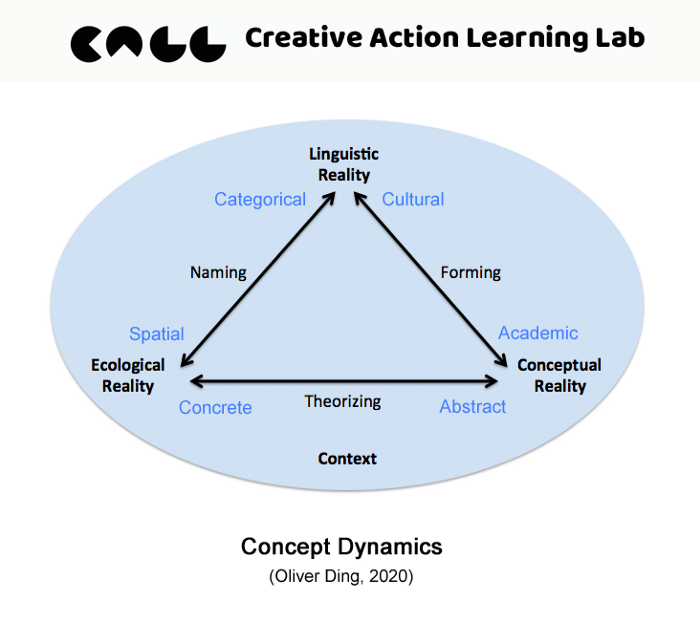
The Concept Dynamics Framework emphasizes that every theoretical concept has three basic aspects: ecological reality, conceptual reality, and linguistic reality.
- Ecological Reality refers to the real experience of discovery in the real world from the perspective of researchers.
- Conceptual Reality refers to the outcome of the creative conceptualization process.
- Linguistic Reality refers to expressional form with verbal and rhetorical effects.
Though the original purpose of the framework is about theoretical concepts, we can use the framework to discuss Conceptual Change.
We can pay attention to the following four types of changes:
- The change of Context: Where do we use it?
- The change of Name: What is the name of it?
- The change of Fact: What is it?
- The change of Meaning: What does it mean?
If we can perceive these changes, we can perceive our conceptual change.
The Strategic Curation Model and Knowledge Discovery
Some readers may notice that I use some ideas from Knowledge Discovery for the above discussion.
Since Reference Space refers to reliable and validated knowledge for thinking, it is related to developing tacit knowledge.
On May 19, 2022, I edited a TOC for a possible book: Knowledge Discovery: Developing Tacit Knowledge with Thematic Space Canvas.