
Ecological Practice Design (Book)
The Lifesystem Approach to Everyday Life Innovation
The above picture is designed for a possible book about the Ecological Practice Approach and the Lifesystem framework.
I started developing the Ecological Practice Approach in 2019 and the Lifesystem framework was born in Oct 2020. In the past four years, I wrote several books (in drafts) about the approach:
- Curativity: The Ecological Approach to General Curation Practice (2019)
- After Affordance: The Ecological Approach to Human Action (2020)
- Platform for Development: The Ecology of Adult Development in the 21st Century (2021)
Each year I write a book and each book establishes an important theoretical concept for the Ecological Practice approach. Curativity introduces the concept of Curativity and develops the toolkit version of the approach. After Affordance introduces the concept of Attachance and develops the germ-cell version of the approach. Platform for Development introduces the concept of Supportance.
Both Curativity and After Affordance were written in Chinese. In fact, they are still unpublished drafts. Curativity is a 615-page Google Doc file while After Affordance is a 371-page file. Platform for Development is written in English. If you want to know more details about Platform for Development, you can click here to find more details.
My passion behind the approach is developing a theoretical framework in order to use it to reflect on my over 20 years of work experience in various fields such as curation, design, strategy, learning, etc.
In 2020, I applied Curativity Theory to the field of Knowledge Building and started the Knowledge Curation project. In the past three years, I developed a series of frameworks and tools. In addition, I also edited or wrote the following books in drafts:
- Themes of Practice: The Information Architecture of Social Life (2021, edited, 440 pages, Chinese)
- Career Curation: Curativity Theory for Personal Innovation (2021, draft, 106 pages, Chinese)
- Diagramming as Practice (2021, English)
- Diagram Blending: Building Diagram Networks (2021, English)
- Knowledge Discovery: Developing Tacit Knowledge with Thematic Space Canvas (2022, English)
Some readers may know that Creative Design is one of my career themes. My early career was designing newspaper ads and corporate identity. Later, I moved to digital interaction design. Now, I am working on activity analysis and service design.
Several days ago, a friend of mine who works in the direction of social innovation asked me for some perspectives on Activity Theory and the Ecological Practice approach. Later, I realized that I should collect my articles about the approach, the Lifesystem framework, and related theoretical concepts together and edit a new book.
Though the Ecological Practice Approach and the Lifesystem framework were not developed for discussing Design, they could apply to the field of Design, especially everyday life innovation.
The new book is a collection of my articles, thus, this is also a knowledge curation project. While the object is the piece of my ideas, the outcome is a meaningful whole that is presented in a book.
The Name
The name of the new book is Ecological Practice Design: The Lifesystem Approach to Everyday Life Innovation. This name is a concept curation of six concepts. Each concept refers to a special meaning.
- Ecological: It refers to the original source of the Ecological Practice Approach approach: Ecological Psychology.
- Practice: It refers to a major theoretical resource of the Ecological Practice Approach: Activity Theory and social practice theories in general.
- Design: It refers to a social practice of making something new creatively.
- Lifesystem: It refers to the Lifesystem Framework.
- Approach: It refers to a knowledge enterprise that contains theoretical concepts, operational concepts, frameworks, methods, etc.
- Everyday Life Innovation: It refers to the innovation of improving the quality of individual daily life.
The above six keywords define the boundary of the new book. I am not going to deal with complex system thinking since we have CAS (Complex adaptive system), Systems Dynamics, Activity System Model, etc.
The primary focus of the book is the Lifesystem Framework. However, I expand it with more relevant other frameworks and theoretical concepts from the Ecological Practice Approach. Thus, I use “the Lifesystem approach” for the subtitle of the book.
The Purpose
The Ecological Practice Approach was developed as a meta-theory for general social analysis from the perspective of ecological psychology. The term “Ecological” refers to the following meanings:
- It considers the “organism-environment” relationship as a whole.
- It considers the “action—experience” dynamics as an engagement.
- It considers the “potential — actual” transformation as a reality.
As a meta-theory, the Ecological Practice Approach was formed by the following theoretical concepts:
- Affordance
- Attachance
- Supportance
- Curativity
- Relevancy
- Genidentity
- etc
In order to connect Theory and Practice, I developed the Lifesystem Framework as an intermediate instrument of the knowledge enterprise. As a tool for guiding research and reflection, a knowledge framework is a whole that contains concepts, diagrams, and methods. An ideal knowledge framework should contain two types of concepts:
- Theoretical Concepts
- Operational Concepts
The Lifesystem Framework adopts theoretical concepts from the Ecological Practice Approach and develops several operational concepts which are inspired by Activity Theory and other social practice theories.
I also developed some methods for conducting relevant research and reflection.
The new book aims to curate all of these pieces together. Though I didn’t intend to write the book as a systematic monograph, I hope the new book could present a meaningful whole for readers who want to know more about the Ecological Practice approach and connect it with their own design practice and everyday life innovation.
The Structure
The new book Ecological Practice Design: The Lifesystem Approach to Everyday Life Innovation is curated with the following parts:
- Part 1: The Framework
- Part 2: The Toolkit
- Part 3: The Theory
- Part 4: The Method
- Part 5: The Innovation
This book is expected to introduce a new theoretical approach and a set of tools to practitioners such as designers, product managers, innovation consultants, UX researchers, strategists, policymakers, etc. Thus, its starting point is the Lifesystem framework because it offers a unique way to model social practices.
Part 2 expands the Lifesystem framework at the operation level. It focuses on several operational concepts of the framework and curates several relevant frameworks together. The final outcome is a toolkit.
Part 3 expands the Lifesystem framework at the theoretical level. In fact, it is an introduction to the Ecological Practice Approach. Readers could know more details about the historical development of the approach and understand each major theoretical concept of the approach.
Part 4 introduces methods for conducting research projects with the Lifesystem framework and the Ecological Practice Approach. Readers can also use these methods for their informal study or life reflection.
Part 5 focuses on Everyday Life Innovation. I will collect my articles about Creative Actions and Possible Practices and define a new concept of “Everyday Life Innovation”.
The Number
Some numbers about the possible book:
- 5 parts
- 22 chapters
- 26 articles
- Total 463 min read
- Total 122, 695 words (about 245 single-spaced pages)
Part 1: The Framework
The primary focus of the book is the Lifesystem Framework which is an application of the Ecological Practice Approach.
The word “Life” is inspired by the term “Lifeworld” from Alfred Schutz while the word “System” is inspired by Anticipatory System Theory.
The term “Lifeway” is inspired by the ecological psychologist James. J. Gibson’s writing: “The natural environment offers many ways of life, and different animals have different ways of life.” I use the term “Lifeway” to refer to the “human—material” engagement which is related to physical environment and affordance.
The term “Lifeform” is inspired by the philosopher Ludwig Wittgenstein’s writing: “It is easy to imagine a language consisting only of orders and reports in battle…And to imagine a language means to imagine a form of life…Here the term ‘language game’ is meant to bring into prominence the fact that the speaking of language is part of an activity or a form of life.” I use the term “Lifeform” to refer to the “human-human” engagement which is related to social environment and supportance.
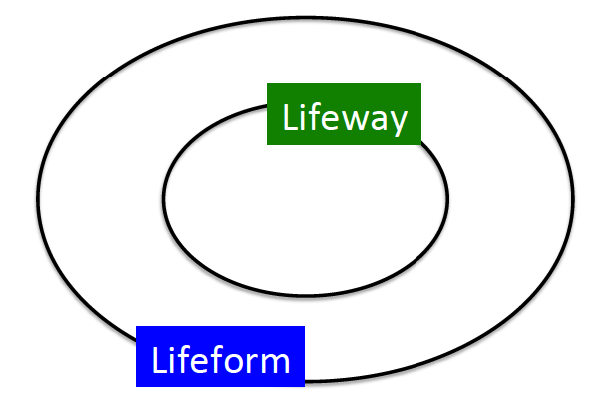
The pair of concepts of “Lifeway — Lifeform” was developed in 2019 when I was working on the book Curativity: The Ecological Approach to General Curation Practice. In 2020, I developed the concept of “Supportance” and the “Affordance — Supportance” hierarchical loops.
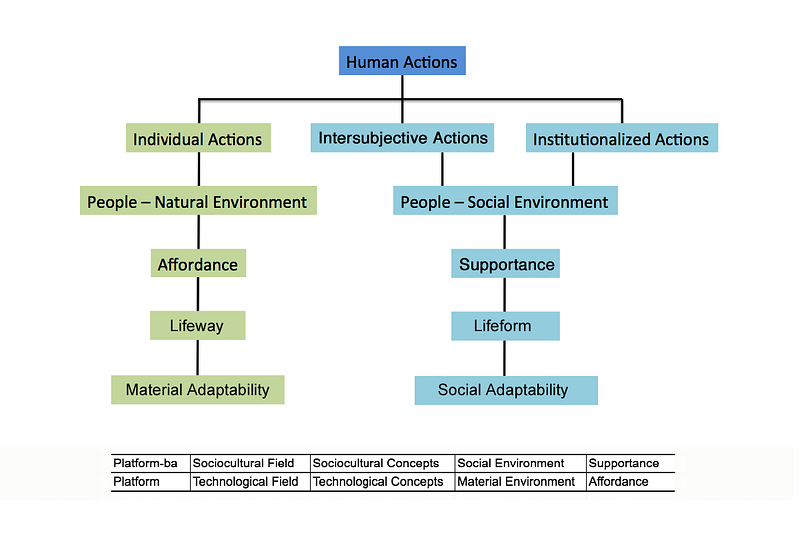
The above diagram presents my design for the “Affordance — Supportance” hierarchical loops.
The Lifesystem framework considers the “Lifeway — Lifeform” hierarchical loop and the “Affordance — Supportance” hierarchical loop as a whole system that defines a new unit of analysis.
Part 1 collects the following articles about the Lifesystem Framework.
Chapter 1: Modeling Ice Skating and Other Social Practices (28 min read)
Chapter 2: Theory-based Reflection (16 min read)
Chapter 3: Operation-based Reflection (14 min read)
Chapter 4: Design for A Meaningful Journey (10 min read)
Part 1 is the foundation of the whole book. Other parts are expanded from Part 1. While Chapter 2 defines Part 3, Chapter 3 echoes Part 2. Chapter 4 is related to Part 5.
Part 2: The Toolkit
As mentioned above, an ideal knowledge framework should contain two types of concepts:
- Theoretical Concepts
- Operational Concepts
The Lifesystem framework considers the following eight operational concepts:
- Actor
- Group
- Material
- Information
- Resource
- Intention
- Result
- Reward
The diagram below is the standard model of the Lifesystem Framework.
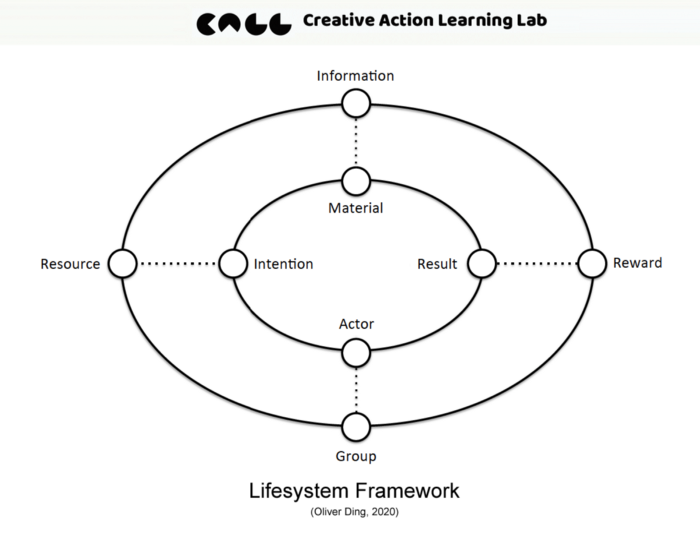
Part 2 expands the Lifesystem Framework at the operational level. I curate several relevant frameworks for understanding the eight operational concepts. Together, they form a toolkit.
- Object: Artifact-centered Interaction Framework (ACI)
- Information: Action-centered Information Framework (AIF)
- Subject (Actor/Group): Structured Engagement Theory (SET)
- Achievement (Result/Reward): Value Engagement Canvas (VEC)
- Attachment (Resource/Intention): Activity System Plus (ASP)
- Anticipatory (Present/Future): Anticipatory Activity System (AAS)
The following articles offer more details about the toolkit:
Chapter 5: Design for Material Engagement
(Original article: Hammer, Hammering, and Affordance: The Materiality Turn and Artifact-centered Interaction — 30 min read)
Chapter 6: Design for Social Engagement
(Original article: The SET Framework)
Chapter 7: Design for Value Engagement
(Original articles: 1. The “Result — Reward” Gap and Achievement — 11 min read; 2. The Achievement Chain — 9 min read; 3. The Value-fit Framework and Canvas — 9 min read)
Chapter 8: Design for Resource Engagement
(Original article: Activity System Plus — 2 min read)
Chapter 9: Design for Future Engagement
(Original article: Strategy as Anticipatory Activity System — 16 min read)
There are two types of knowledge frameworks: Descriptive and Prescriptive. The descriptive frameworks tend to tell us what the thing is while the prescriptive frameworks tend to tell us how to do it. Researchers tend to use descriptive frameworks to explain what they care about while designers tend to use prescriptive frameworks to guide their design processes.
The Lifesystem framework is descriptive, not prescriptive. However, we can expand the Lifesytem framework at its operational level and adopt other related frameworks to build a toolkit for various design activities.
A framework is a tool for thinking. To appreciate a new framework is to adopt a new perspective. This is a small step in developing our tacit knowledge.
Part 3: The Theory
The primary theoretical approach behind the Lifesystem framework is the Ecological Practice Approach.
In Oct 2020, I wrote an article titled The Ecological Practice Approach Toolkit and shared my work on a new approach for practice studies. This approach was originally called the Gibson — Lakoff — Schön approach because I adopted theoretical concepts from James J. Gibson, George Lakoff, and Donald Schön.
From Sept 2018 to March 2019, I wrote a book titled Curativity: The Ecological Approach to Curatorial Practice to reflect on one of my life themes: Curation. The Ecological Practice Approach was born from the process of writing Curativity.
After March 2019, I continuously worked on revising Curativity and developing the Ecological Practice Approach as a new project. In May 2020, I wrote another book titled After Affordance: The Ecological Approach to Human Action in which I proposed several new theoretical ideas for expanding ecological psychology to the modern digital environment.
A major development of the Ecological Practice approach is the concept of Supportance. I have been searching for a concept for expanding Ecological Psychology from perception-centered psychological analysis to social practice analysis for about two years after I finished the draft of Curativity.
The concept of Supportance means the Ecological Practice approach has transformed from a curated toolkit to an original theoretical framework. This is a major milestone of the approach.
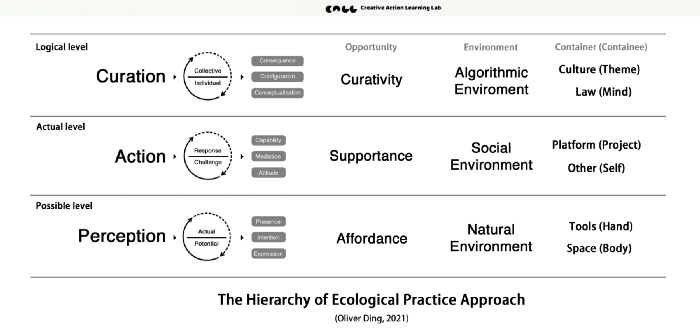
Part 3 introduces the historical development of the approach and several major theoretical concepts of the approach. I collect the following articles for Part 3:
Chapter 10: The Development of Ecological Practice Approach (15 min read)
Chapter 11: The Notion of Affordance Analysis (14 min read)
Chapter 12: The Attachance Perspective (11 min read)
Chapter 13: The Concept of Supportance (38 min read)
Chapter 14: Curativity (18 min read)

Readers can also pay attention to the concept of Container and the concept of Genidentity.
Part 4: The Method
In general, the Lifesystem framework adopts qualitative research as its primary method and it relies on ecological observation, participant observation, fieldwork, etc.
There are three methods behind the Ecological Practice Approach:
- Ecological Physics Method
- Ecological Interaction Analysis
- Creative Action Analysis
The Ecological Physics Method is based on Ecological psychologist James J. Gibson’s book The Ecological Approach to Visual Perception (1979/2015).
The Ecological Physics Method incorporates the following seven aspects into a unified whole framework:
- Ecological Environment
- Ecological Mechanics
- Ecological Invariant
- Ecological Events
- Ecological Perspective
- Ecological Affordance
- Ecological Information
Gibson didn’t use the term Ecological Physics Method, he only used the term Ecological Physics. After reading Gibson’s book, I realized he used a brand new method to build his theory. In order to summarize his method for cross-disciplinary application, I called the method the Ecological Physics Method.
In 2020, I developed the Ecological Interaction Analysis framework to reflect my reading experience of a book titled Frame Analysis. The method can be used for the Lifesystem framework.
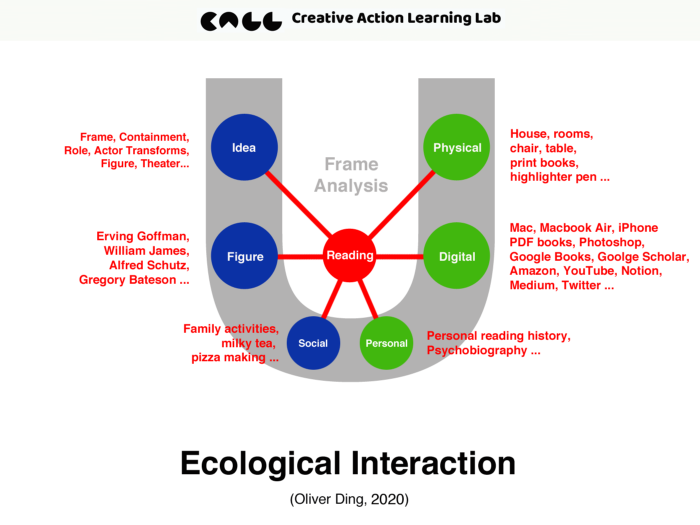
Part 4 collects the following articles for reference:
Chapter 15: #SocialPxD — ReEngagement with Twitterville: An Introduction to Ecological Physics Method (29 min read)
Chapter 16: The Method of Affordance Analysis
(original articles: 1. The Notion of Affordance Analysis — 14 min read; 2. Physical Space Affordances and Graphic Space Affordances — 16 min read; 3. Digital Space Affordances and the Opportunity of Objectification — 14 min read)
Chapter 17: Frame Analysis in Context: An Example of Quasi-social Interaction and Ecological Interaction Analysis (26 min read)
My other books also contain some methods for adopting specific concepts and frameworks. For example, Thematic Analysis is a primary method in the book Themes of Practice.
Part 5: The Innovation
The notion of Everyday Life Innovation is understood as the notion of “Possible Practice (Creative Actions)” from the perspective of the Ecological Practice approach.
Since 2001, a group of philosophers, sociologists, and scientists have rediscovered the practice perspective and used it as a lens to explore and examine the role of practices in human activity. Researchers called it The Practice Turn in Contemporary Theory. As Schatzki pointed out, “there is no unified practice approach”(2001, p.2). Davide Nicolini introduced the following six different ways of theorizing practice in his 2013 book Practice Theory, Work, & Organization:
- Praxeology and the Work of Giddens and Bourdieu
- Communities of Practice (Lave & Wenger, 1991)
- Activity Theory / Cultural-historical activity theory (the Marxian/Vygotskian/Leont’evian tradition)
- Ethnomethodology (Harold Garfinkel, 1954)
- The Site of Social (contemporary developments of the Heideggerian/Wittgensteinian traditions, by Theodore R. Schatzki)
- Conversation Analysis / Critical Discourse Analysis (the Foucauldian tradition)
Nicolini also pointed out, “Practice theories are fundamentally ontological projects in the sense that they attempt to provide a new vocabulary to describe the world and to populate the world with specific ‘units of analysis’; that is, practice. How these units are defined, however, is internal to each of the theories, and choosing one of them would thus amount to reducing the richness provided by the different approaches.” (2012, p.9)
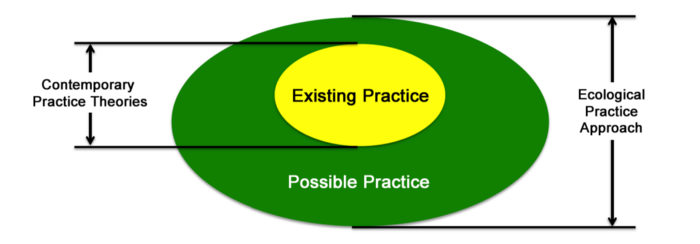
I suggest “Possible Practice” as a new term that expands the scope of contemporary practice theories from “actual actions and existing practice” to “possible actions and possible practice”. I consider “Possible Practice” as the special unit of analysis for my approach “Ecological Practice”. Again, the Ecological Practice Approach is not an alternative to contemporary practice theories, but expands their scope and contains more theoretical concepts such as James J. Gibson’s Affordance.
The ecological practice approach claims that the original source of all human actions is affordance and imagination. Affordance refers to material engagement while imagination refers to linguistic engagement. If we accept the ideas from cognitive linguistics which claims that the source of linguistic conceptual metaphor is embodied experience, we can reduce linguistic engagement (imagination) to material engagement (affordance). In fact, we can learn more from philosophists of embodied cognitive science. They consider affordance as an essential concept for rethinking the mind from the perspective of embodied cognitive science.
My focus is action and practice, not mind and cognition. The ecological approach aims to build a new unit of analysis for discussing action and practice. The “Possible Practice” is just the beginning.
Part 5 connects the Creativity U project and the Ecological Practice approach together through the “Methods — Phenomena” connection.
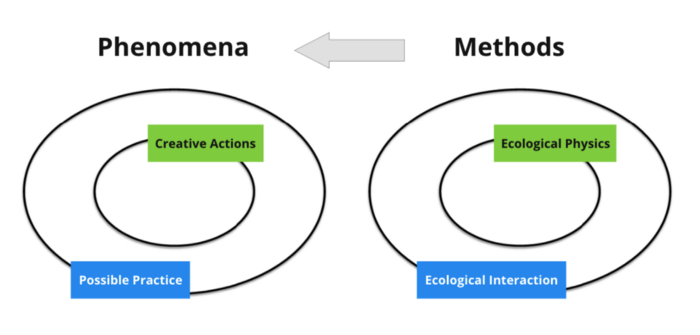
The Creativity U project produced the notion of “Possible Practice (Creative Actions)” and it developed the Creative Action Analysis method which is originally called the 3i model (Idea — Initiator — Initiatee — Act — React).
The Ecological Practice approach produced two methods: Ecological Physics Method and Ecological Interaction Analysis.
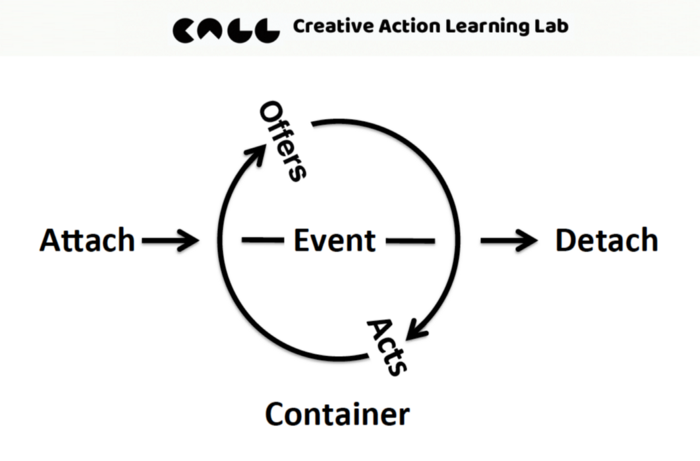
They can connect together through the notion of Opportunity. See the diagram below. Now the “Act” part of the 3i model can be understood as “Giving Opportunity” while the “React” part of the 3i model can be understood as “Taking Opportunity”. The “Idea” part of the 3i model refers to “Opportunity”.
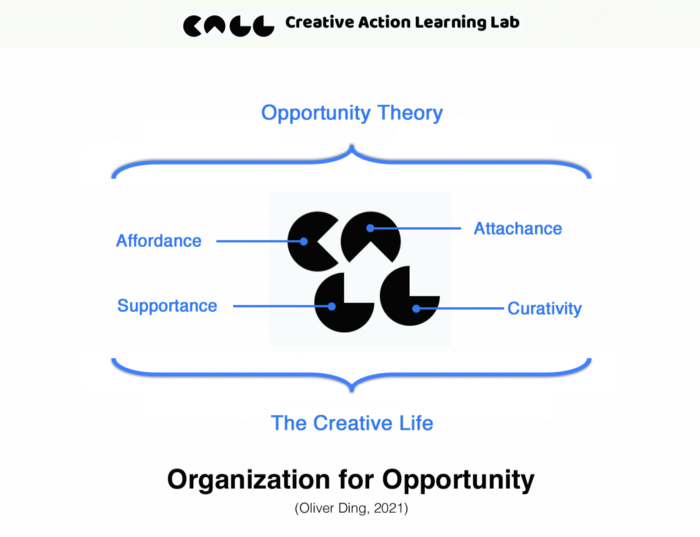
This new perspective goes beyond the original perspective of creativity study, it is more about creative actions for achieving a creative life for an individual and making possible practice for the collective society.
Part 5 collects articles about the Creative U project and the notion of “Possible Practice (Creative Actions)”.
Chapter 18: The NCIE Way and Creative Actions (40 min read)
Chapter 19: Attach, Detach, and Opportunities (16 min read)
Chapter 20: The Creative Action Analysis Method (21 min read)
Chapter 21: The Creative Work Canvas (31 min read)
Chapter 22: The Shaman’s Mandala (19 min read)
Chapter 22 introduces a diagram called Shaman’s Mandala for discussing life strategy and related issues.
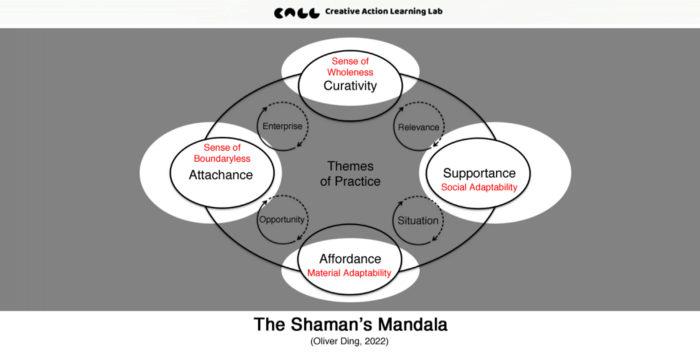
These four theoretical concepts have some heuristic orientations for thinking.
- Affordance: Material Adaptability
- Supportance: Social Adaptability
- Attachance: Sense of Boundaryless
- Curativity: Sense of Wholeness
These heuristic orientations refer to the benefits of learning these concepts and mastering related skills.
Material Adaptability refers to a person’s competence in the actualization of affordance and material engagement while Social Adaptability refers to a person’s competence in the actualization of supportances and human engagement. There is a gap between potential possibilities, a person has to develop his skills and capabilities in order to take Affordances and Supportances.
Attachance leads to the Sense of Boundaryless because actions of Attaching and Detaching reduce the boundary’s impact on a person. Curativity leads to the Sense of Wholeness because actions of turning pieces into a meaningful whole increase the skill of making sense of wholeness.
I think these four benefits are important for life strategy and discovery, and everyday life innovation.
I am also working on building a new website for the Platform Ecology project. You can save the following links:
- PlatformEcology.org
- Twitter: @PlatformEcology
- Linkedin: @PlatformEcology
You are most welcome to connect via the following social platforms:
Linkedin: https://www.linkedin.com/in/oliverding Twitter: https://twitter.com/oliverding Polywork: https://www.polywork.com/oliverding Boardle: https://www.boardle.io/users/oliver-ding


