
Lifesystem: The Notion of Affordance Analysis
How to pay attention to Human — Material Engagement?

I have mentioned the Affordance Analysis Project in Knowledge Discovery: The Concept Dynamics Framework.
The Affordance Analysis Project was designed with the following two parts:
- Empirical Analysis
- Conceptual Analysis
The Empirical Analysis focuses on my five years of observation of my two sons’ childhood. I have been watching them for many years in various environments. They often use objects in “unofficial” ways. From the perspective of ecological psychology, they are “officially” taking affordances of objects. I took many photos to record these “creative” moments in our life.
The Concetua Analysis focuses on my reading of academic papers about the concept of Affordance since it has been influencing many psychologists, philosophers, artists, architects, designers, interaction scholars, information system researchers, etc. Many followers have been developing affordance-inspired concepts and forming a web of concepts that I called Concept Ecology.
In fact, I didn’t work on the Affordance Analysis project in 2020. You can find more details here. Today I’d like to discuss the notion of Affordance Analysis from the perspective of the Lifesystem framework.
Lifeway + Lifeform = Lifesystem
The Lifesystem framework is designed with two ideas: the pair of concepts of “Lifeway — Lifeform” and Life Coordinate.
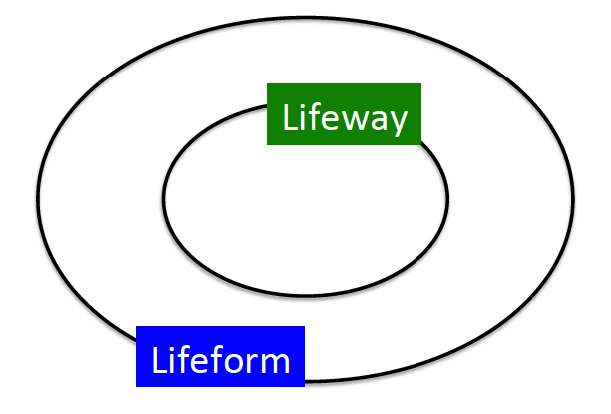
The term “Lifeway” is inspired by the ecological psychologist James. J. Gibson’s writing: “The natural environment offers many ways of life, and different animals have different ways of life.” I use the term “Lifeway” to refer to the “human—material” engagement which is related to physical environment and affordance.
The term “Lifeform” is inspired by the philosopher Ludwig Wittgenstein’s writing: “It is easy to imagine a language consisting only of orders and reports in battle…And to imagine a language means to imagine a form of life…Here the term ‘language game’ is meant to bring into prominence the fact that the speaking of language is the part of an activity or a form of life.” I use the term “Lifeform” to refer to the “human-human” engagement which is related to social environment and supportance.
The Lifesystem framework considers the “Lifeway — Lifeform” hierarchical loops and the “Affordance — Supportance” hierarchical loops as a whole system that defines a new unit of analysis.
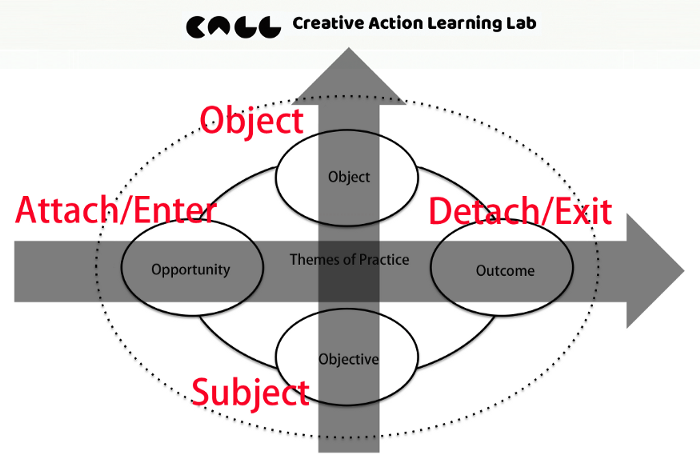
The above diagram is called Life Coordinate which is inspired by the Life-as-Activity (v1.5) diagram. You can find more details here. The pair of concepts of “Subject-Object” is adopted from Activity Theory while the pair of concepts of “Attach/Enter-Detach/Exit” is adopted from the Ecological Practice approach.
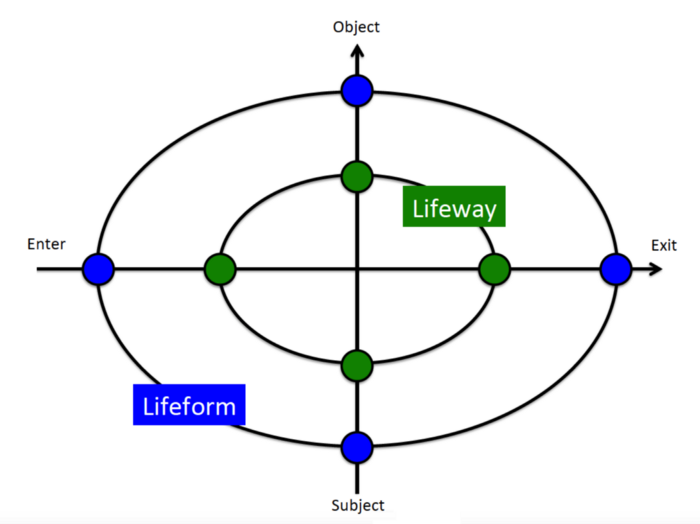
The above diagram is the basic model of the Lifesystem framework. Based on the model, I developed several Operational Concepts for the framework. You can find more details here.
The Perspective of Affordance
The concept of Affordance is an important theoretical concept for understanding human—material engagement.
What’s Affordance? Let’s have a look at the original definition made by Gibson:
The affordances of the environment are what it offers the animal, what it provides or furnishes, either for good or ill. The verb to afford is found in the dictionary, but the noun affordance is not. I have made it up. I mean by it something that refers to both the environment and the animal in a way that no existing term does. It implies the complementarity of the animal and the environment. (p.119)
Though the core of Gibson’s theory is visual perception, we can see the whole “Perception-Affordance-Action” loop as a theory of action and apply it to new fields. Perceiving affordances is for taking actions, taking actions has an impact on the environment and changes the affordances of the environment. I draw the diagram below to visualize this loop.
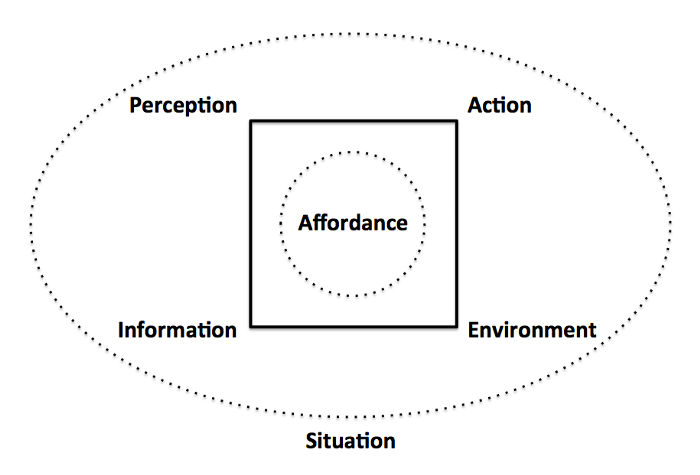
If we adopt Gibson’s version of Affordance, then we can pay attention to the Immediate Experience of human—material engagement. For the Lifesystem framework, we can use the perspective of Affordance to guide our observation of real-life research.
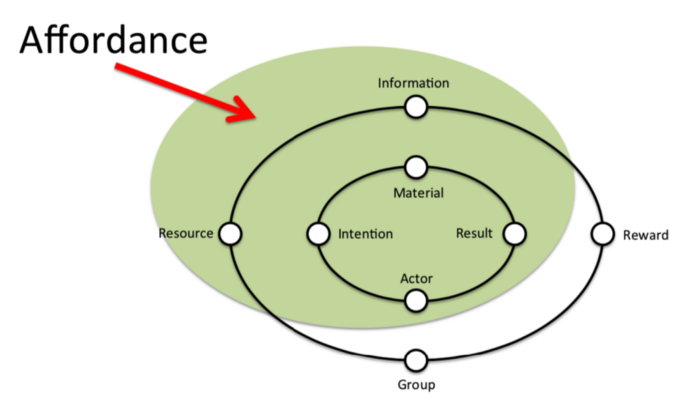
The above diagram shows the perspective of Affordance Theory for Lifesystem study. The perspective focuses on an Actor, not the Group which is defined as the social context of the Actor. It doesn’t consider Reward because Immediate Experience is about a particular moment while Reward is about an outcome of a long-term activity.
We can start with the following simple question:
How does a person use a material thing and act with a partucular environment?
I use “material thing” because I want to remove cultural meaning from the thing. This is the essential point of Affordance theory because it is about the Perceive-Affordances-Action loop.
The Human—Material Engagement
Anthropologist Tim Ingold (1993) argued a distinction between tools and artifacts: “A tool, in the most general sense, is an object that extends the capacity of an agent to operate within a given environment; an artefact is an object shaped to some pre-existent conception of form” (p.433) Ingold’s view focused on “non-designed” or “designed”.
Ecological psychologist Harry Heft (2001) suggested that it’s better to use “Found Tools” to refer to “non-designed” tools. He gave many examples, “…found tools, are identified and selected because of the suitability of their affordance properties in support of some action. Long grasses or stripped branches employed as probes in feeding at insect nests; broad, rigid leaves used to shovel insects into the mouth; stones used as hammers for cracking hard shells of nuts are examples. ” (p.341)
Another distinction is “Immediate use” and “Conventional use” as suggested by Heft, “…in addition to learning about how to use an object, the individual learns the meaning of the object itself within the practices of the culture. To the extent that this possibility has merit, it is an important step in understanding how objects take on conventional or culturally prescribed meaning beyond their immediate use functions.”(p.345)
“Immediate use” can be “designed use” or “found use”. I think the most important idea behind “immediate use” is resourcefulness or everyday creativity while Heft used the distinction to highlight the aspect of social learning. A designer can get an insight from his own creative “immediate use” or observe others’ creative “immediate use” and turn the insight into a “designed use” which could be turned into a “conventional use” by the distribution of a newly designed artifact.
For example, the following photos are about a carpool hangtag.
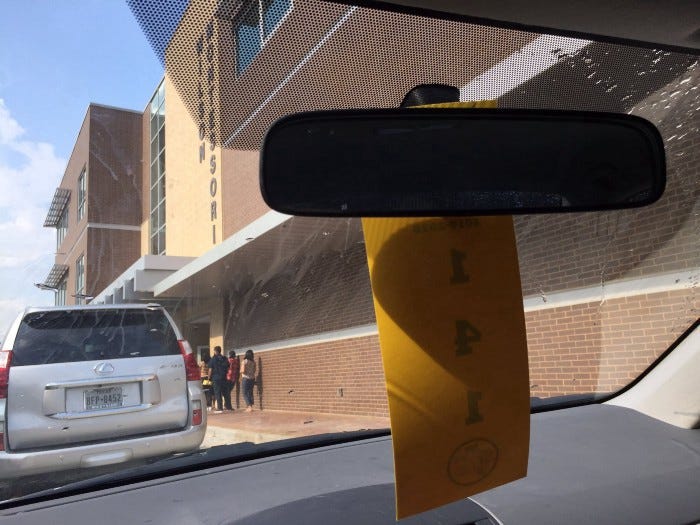
From the perspective of affordance, the part of the mirror (not the mirror) affords hanging something.
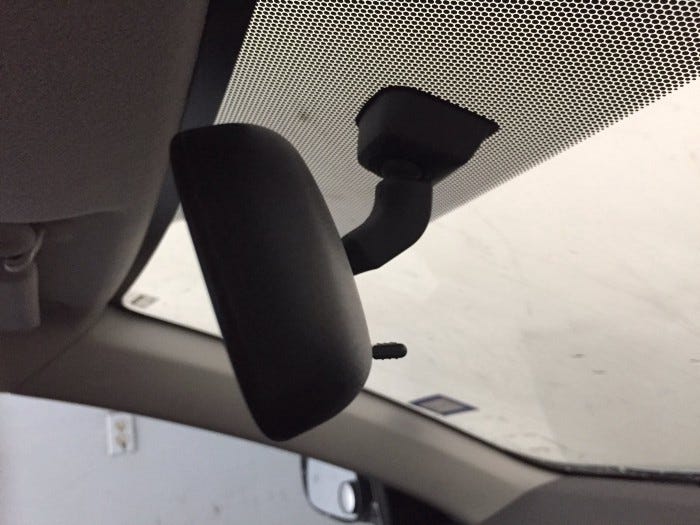
I don’t know the first person who found this “found use” and made a carpool hangtag.
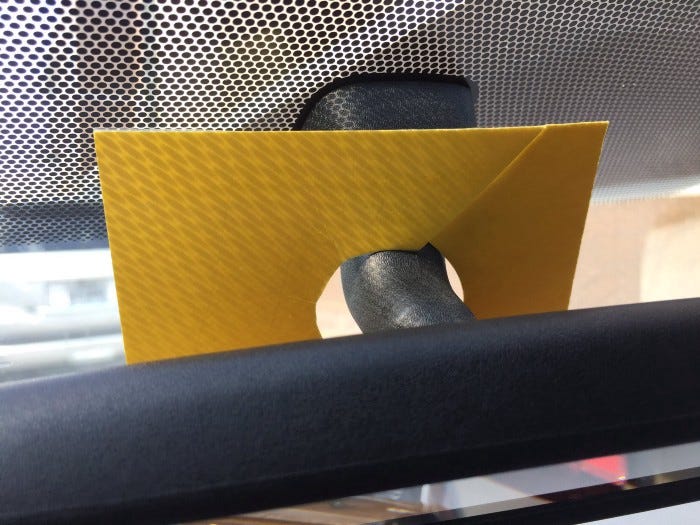
Now it is a “conventional use” by many of us. For some people, it is a meaningful business.
A simple way to adopt the perspective of Affordance is by taking pictures in a real-life world and writing notes. I roughly call this approach Ecological Interaction Analysis. You can find an example of Ecological Interaction Analysis here.
What’s Affordance Analysis?
Though I use the term “Affordance Analysis” to refer to my project, the notion can be used for general purposes.
Let’s start defining a working concept for the notion of “Affordance Analysis”. A working concept offers a starting point for a project or a practice. We can modify the definition of the working concept while the project is unfolding.
Affordance Analysis adopts the perspective of Affordance Theory to analyze human-material interactions.
I use the above definition as the v1.0 of the working concept of “Affordance Analysis”. It has three aspects:
- Perspective: Affordance Theory
- Object: Human—Material Interactions
- Method: Percept-first Analysis
Affordance Theory is the core of James J. Gibson’s ecological approach to visual perception. Though the theory focuses on the organism-environment relationship, it considers spaces, objects, and even the human body as environments too. For Gibson, “objects, other persons and animals, places and hiding places” are our surrounding environment. I roughly use “Material” to refer to such notions about material environments.
The radical aspect of affordance theory is that it challenges the traditional view on the meaning of objects “concept first” and turns it to “percept first”. The concept is about linguistic meaning and ordinary classes of objects. Gibson argued, “To perceive an affordance is not to classify an object…The theory of affordances rescues us from the philosophical muddle of assuming fixed classes of objects, each defined by its common features and then given a name. As Ludwig Wittgenstein knew, you cannot specify the necessary and sufficient features of the class of things to which a name is given. They have only a ‘family resemblance.’ But this does not mean you cannot learn how to use things and perceive their uses. You do not have to classify and label things in order to perceive what they afford.” (p.126)
I use “Percept-first Analysis” to refer to the notion of “To perceive an affordance is not to classify an object”. For example, “Teapot” is an object. If you adopt “Concept-first Analysis”, you can start from a Wikipedia item:
A teapot is a vessel used for steeping tea leaves or a herbal mix in boiling or near-boiling water, and for serving the resulting infusion which is called tea. It is one of the core components of teaware. Dry tea is available either in tea bags or as loose tea, in which case a tea infuser or tea strainer may be of some assistance, either to hold the leaves as they steep or to catch the leaves inside the teapot when the tea is poured. Teapots usually have an opening with a lid at their top, where the dry tea and hot water are added, a handle for holding by hand and a spout through which the tea is served. Some teapots have a strainer built-in on the inner edge of the spout. A small air hole in the lid is often created to stop the spout from dripping and splashing when tea is poured. In modern times, a thermally insulating cover called a tea cosy may be used to enhance the steeping process or to prevent the contents of the teapot from cooling too rapidly.
However, the “Percept-first Analysis” method starts from a part of an object, not the whole of the object. For example, the picture below shows four parts of a teapot. We will ask the following question:
What can a particular person do with a part of this teapot in a particular situation?
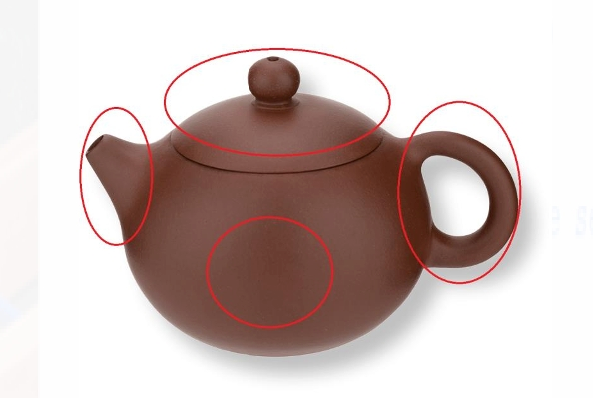
The notion behind the above question is “Ecological Structure and Dynamics” which refers to the following elements:
- A particular part of a particular object
- A particular person
- A particular situation
- A particular action
While Affordance means action possibilities, the Affordance Analysis considers the “Affordance (potential) — Action (actual)” loop as the primary unit of analysis.
What’s not Affordance Analysis?
As mentioned above, Affordance Analysis is defined by 1) the perspective of Affordance Theory, 2) Human—Material Interactions, and 3) Percept First Analysis.
If we adopt Activity Theory to analyze human-material interactions, we should call it Activity Analysis. The major difference between Affordance Theory and Activity Theory is they adopt different units of analysis. While Affordance Theory focuses on body-scale human-material interactions, Activity Theory focuses on cultural-historical activity.
I am also working on Activity Theory. If you want to know more about Activity Analysis, you can visit this website: https://www.activityanalysis.net/
If your primary subject is language, information, and communication, then Affordance Analysis is not suitable for you. You can choose other theoretical approaches such as Social Representation (Serge Moscovici, 1961), SCOT — Social Construction of Technology (Pinch & Bijker, 1984), Topsight: A Guide to Studying, Diagnosing, and Fixing Information Flow in Organizations (Clay Spinuzzi, 2013), and Narrative Economics (Robert J. Shiller, 2019).
I am also working on a project about language, information, and communication. You can find more details about the Themes of Practice project here.
The hardest part is the distinction between Concept-first and Percept-first. As discussed above, Concept-first Analysis is not Affordance Analysis.
So, what’s Concept-first Analysis? The picture below is a good example.

Though it’s a material object, the creative idea can be understood from the perspective of Conceptual Blending.
Bread + Shoe
According to Wikipedia, “In cognitive linguistics, conceptual blending, also called conceptual integration or view application, is a theory of cognition developed by Gilles Fauconnier and Mark Turner. According to this theory, elements and vital relations from diverse scenarios are “blended” in a subconscious process, which is assumed to be ubiquitous to everyday thought and language.”

The above picture is a digital poster I designed for the BED Talks project in July 2020. The BED Talk challenge was initiated by the speaker and author David Rendall and Stan Phelps. The idea behind a BED Talk is to share a short, unscripted video sharing something helpful…recorded from your bed since you’re (hopefully) at home.
What’s the idea behind my design? The technique is called Objectification of Concepts which is part of the following framework from Project-oriented Activity Theory.
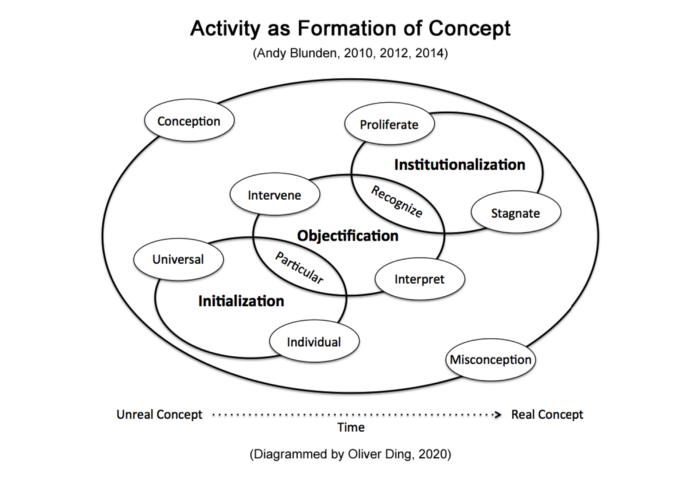
From the perspective of Project-oriented Activity Theory, there are three aspects of Objectification of Concept: symbolic, instrumental, and practical. My design refers to both the symbolic aspect and the instrumental aspect. While the picture is a digital material, the primary idea of my design is to make a new symbol. The throw pillow can be a concrete instrument of the concept of BED Talks.
Objectification of Concepts is also a method of Concept-first analysis, not Affordance Analysis.
Why Do We Do It?
Affordance Analysis is for acquiring Ecological Knowledge, not Conceptual Knowledge.
Any piece of Spatial Structure and Dynamics of material environments should be considered Ecological Knowledge.
According to the ecological psychologist Harry Heft, “…some of the things we have come to understand about the effects of certain actions on the environment we have subsequently built into environmental structures themselves. These latter constructed embodiments of what is known — which include tools, artifacts, representations, social patterns of actions, and institutions — can be called ecological knowledge.” (2001, p.330)
What can we do with Ecological Knowledge? I roughly identify the following ways:
- Ecological Awareness
- Ecological Attachance
- Ecological Intervention
The rest of the article will offer some examples for further discussion.
Ecological Awareness
Ecological Awareness refers to acquiring Ecological Knowledge to understand your surrounding material environments.
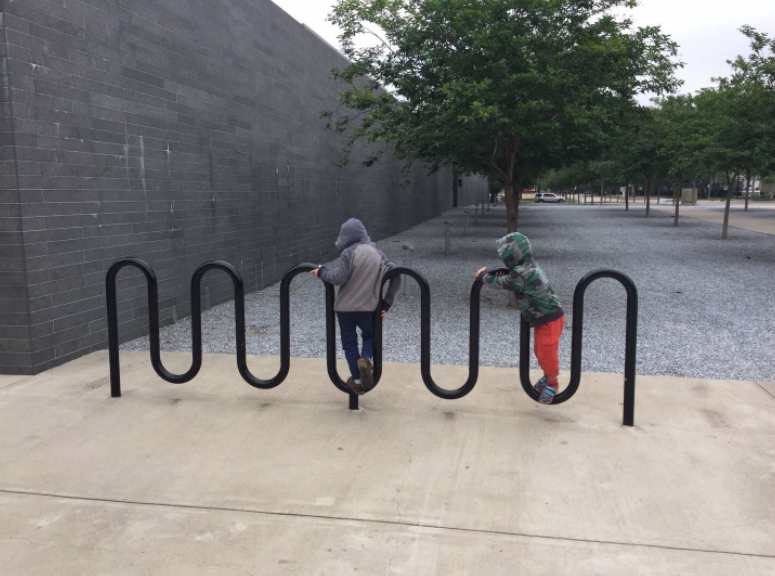
It can be just for fun. For example, the picture below shows a “creative action” of play. My two sons often play this game. What I learned from observing their childhood life is deeply understanding of Affordance Theory.
It can be serious too. One day in April 2020, I played with my sons at the place between our house and the next house. The picture shows my son Peiphen.

He stood close to a distribution box and played a game of throwing a small ball with me.

I realized the distance between a sharp corner of the distribution box and Peiphen’s head.

At that moment, I perceived a Negative Affordance that could make a huge impact on our life. I told Peiphen about this particular Ecological Knowledge and the theory of Affordance in general. Then, we stopped playing the game.
Affordances can be negative and positive. It all depends on the consequences of actions.
Ecological Attachance
Affordances are perceived in some particular situations. After perceiving some affordances, these Affordances became our Ecological Knowledge.
The advanced way of using Ecological Knowledge is detecting it from its original situation and attaching it to a new situation. For Conceptual Knowledge, people use the term “Knowledge transfer”. I personally use “Ecological Attachance” to emphasize “the opportunity of attaching and detaching” which is part of my work the Ecological Practice approach. If you don’t like the term “Ecological Attachance”, you can use “Knowledge transfer”.
The essential point of Ecological Attachance is discovering the same spatial structure and dynamics between different situations. If you need an abstract term, you can call it Isomorphism.
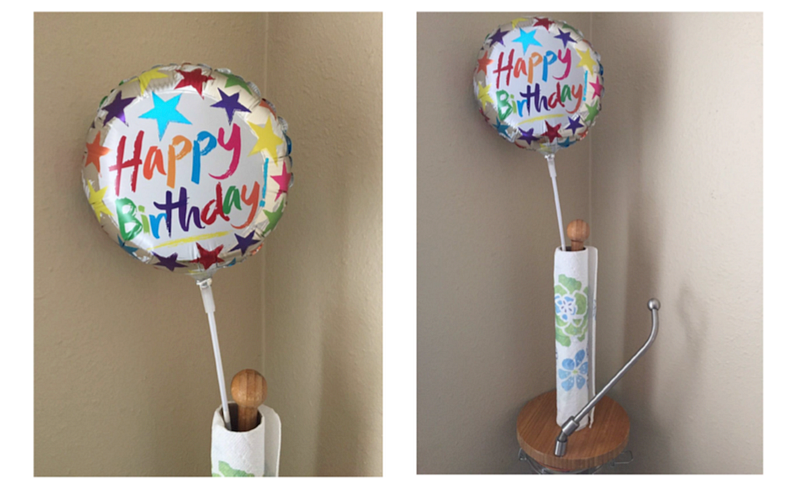
The above pictures are taken in my house two years ago. Now let’s look at the picture below.
Do you find the same spatial structure in these pictures?
Starting from Isomorphism, you can curate several Affordances together to make new things.
Ecological Intervention
For the Lifesystem framework, I use the term “Lifeway” to refer to human-material engagement. A Lifeway is formed by several Affordances. Ecological Intervention means changing Lifeways.
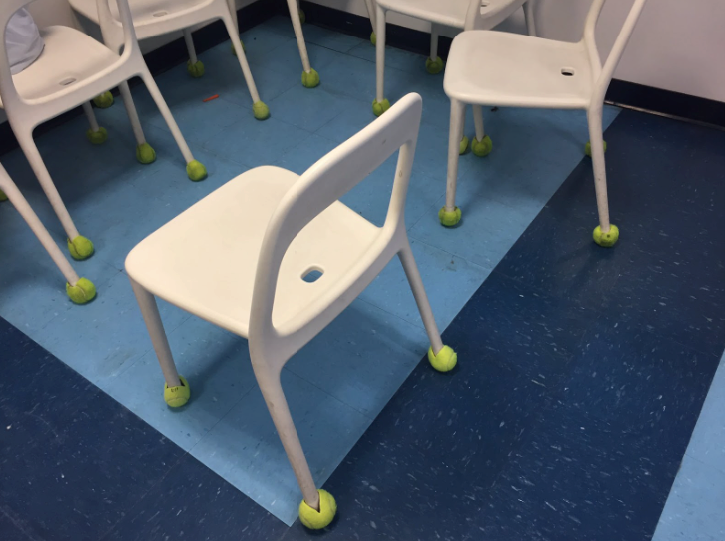
The above picture was taken in a swimming school’s observation room. The owner of the swimming school cut tennis balls and used them as chair foot sleeves in order to protect the floor.

The original Lifeway is formed by two things: floor+chairs. The owner perceived a negative affordance within the Lifeway. The new Lifeway is formed by three things: floor+tennis balls+chairs. The original negative affordance is replaced by a new positive affordance.
From the perspective of the Lifesystem framework, I developed the pair of concepts of Material Adaptability and Social Adaptability. Material Adaptability refers to a person’s competence in the actualization of affordance and material engagement while Social Adaptability refers to a person’s competence in the actualization of supportances and human engagement.
Affordance Analysis is for improving a person’s competence in the actualization of affordance. By practicing Affordance Analysis, a person can take positive affordances and avoid negative affordances.
Related articles:
- Lifesystem: Modeling Ice Skating and Other Social Practices (9/20/2021)
- Lifesystem: Theory-based Reflection (3/6/2022)
- Lifesystem: Operation-based Reflection (3/7/2022)
- Lifesystem: Design for A Meaningful Journey (3/8/2022)
- #SocialPxD — ReEngagement with Twitterville: An Introduction to Ecological Physics Method (6/19/2020)
- Frame Analysis in Context: An Example of Quasi-social Interaction and Ecological Interaction Analysis (7/21/2020)
- Hammer, Hammering, and Affordance (7/31/2020)
- The Development of Ecological Practice Approach (4/26/2021)
- D as Diagramming: Ecological Complexity (8/29/2021)
- Mapping Thematic Space #7: The Center of the “Ecological Interaction” Thematic Space (2/25/2022)
- D as Diagramming: Physical Space Affordances and Graphic Space Affordances (12/9/2021)
- D as Diagramming: Digital Space Affordances (12/11/2021)
- Knowledge Discovery: The Concept Dynamics Framework (4/5/2022)
You are most welcome to connect via the following social platforms:
Linkedin: https://www.linkedin.com/in/oliverding Twitter: https://twitter.com/oliverding Polywork: https://www.polywork.com/oliverding Boardle: https://www.boardle.io/users/oliver-ding


