
D as Diagramming: Ecological Complexity
How to use a diagram to find a path of discovery
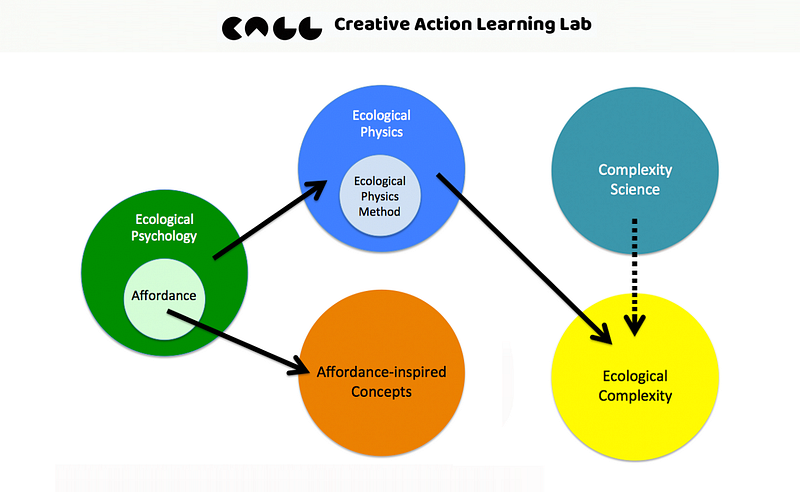
This post is for the D as Diagramming project which aims to explore the power of diagrams diagramming. This post is a section of a previous article Curativity: The Ecological Approach to General Curation Practice. The article introduces the basic ideas of Curativity Theory. In order to offer a background about the “ecological practice” approach, I wrote the section with a diagram. At that time, I wanted to use the term of “ecological complexity” to highlight a path of my ecological approach.
What I want to explore is not re-defining the concept of Affordance which is a primary theoretical concept of James J. Gibson’s Ecological Psychology, but adopting Gibson’s philosophical stance to understand the relationship between the dynamics of human actions and the structure of human environments.
The article was published on April 1, 2020. One year later, I published an article to review the historical development of the Ecological Practice approach. This article doesn’t mention the term of “ecological complexity” since I was not sure if I should adopt complexity science for my ecological approach.
However, I think we can still use the term of “ecological complexity” to refer to the complex relationship between the dynamics of human actions and the structure of human environments without introducing new ideas from complexity science.
The Concept of Ecological Complexity
The term “ecological” of “ecological practice” refers to Gibson’s scientific research on the relationship between organism and environment and his philosophical stance “ecological realism.” According to Edward S. Reed(1988), “Gibson’s psychology united experience and action, whereas James’s psychology had applied only to experience and Holt’s only to action…For Gibson, the pragmatists’ extension of the concept of experience to include activity and knowing as well as the simpler forms of feeling had to be accompanied by an extension of the concept of reality to include more than physical entities.”(pp.53–54)
The term “practice” of “ecological practice” refers to Donald Schön’s distinction between action and practice. Schön refers reflecting-in-action to immediate situations while reflecting-in-practice means cross-situation level.
Thus, the “ecological practice” is inspired by ecological psychology but goes beyond it in order to cover both immediate situational actions and cross-situational practices.
The above diagram describes the evolution of my idea. After reviewing many Affordance-inspired concepts and related works in various domains, I went back to Ecological Physics which is behind the ecological psychology. I developed a method based on Ecological Physics two months ago. Later, I realized I found my own path of discovery.
Baggs and Chemero (2020) argues the meaning of “ecological psychology” is not clear, they suggested that ‘“… Gibson’s ecological approach can perhaps be read as an unprecedented account of the conditions of mental life: it is an account of the structure of things ‘out there’ — the structure that an animal can potentially come into contact with. What it generally is not is an account of what animals actually do when they come into contact with their surroundings.”
I hope the concept of ecological complexity can solve this issue. Under the umbrella of “Ecological Complexity”, we can explore the structure of things out there, and more ideas behind the structure. We can also discuss both potentially and actually. We can even study both physical surroundings and digital surroundings with the same approach and method.
Complexity, Creativity, and Competence
As Baggs and Chemero (2020) pointed out, “The success of a behavioral science research should ultimately be measured by what it can be used for…two ways in which the ecological approach can inform practical interventions in everyday life. First, we can reconfigure the habitat in order to make it easier for actors to carry out some task. Second, we can reconfigure the animal by educating them to attend to their surroundings…”
For practical ecological interventions, we can use 3C to organize our plan:
- Complexity: Understand the ecological complexity with special theoretical concepts and frameworks.
- Creativity: Encourage creative approaches to cope negative ecological complexity and engage with positive ecological complexity
- Competence: Educate actors and improve their knowledge and skills for mastering ecological complexity
One unique aspect of ecological complexity is that it is observable in the daily real life world. For example, I took many pictures to record real life situations about affordance. These pictures became my research materials and can be used for educational purposes in future.
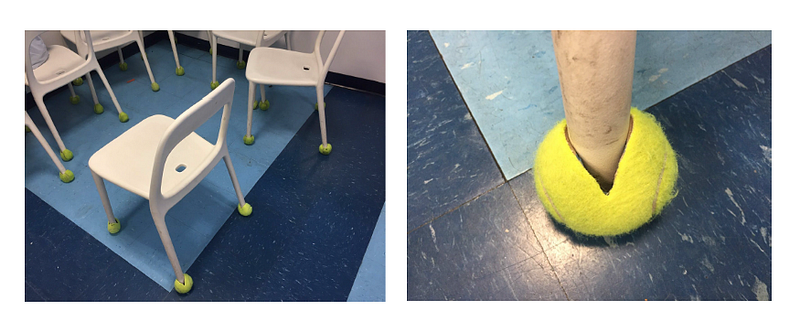
The above picture was taken in a swimming school’s observation room. The owner of the swimming school cut tennis balls and used them as chair foot sleeves in order to protect the floor.
No one likes complexity. However, complexity is something we can no longer ignore. Also, it can be positive too.
You are most welcome to connect via the following social platforms:
Polywork: https://www.polywork.com/oliverding Twitter: https://twitter.com/oliverding Boardle: https://www.boardle.io/users/oliver-ding Linkedin: https://www.linkedin.com/in/oliverding
License
This work is licensed under the Creative Commons Attribution-NonCommercial-ShareAlike 4.0 International (CC BY-NC-SA 4.0) License. Please click on the link for details.