
Life Strategy: Three Meta-knowledge of Strategic Curation
Near History, Possible Selves, and Predictive Models

This post is a short discussion about the Strategic Curation Model.
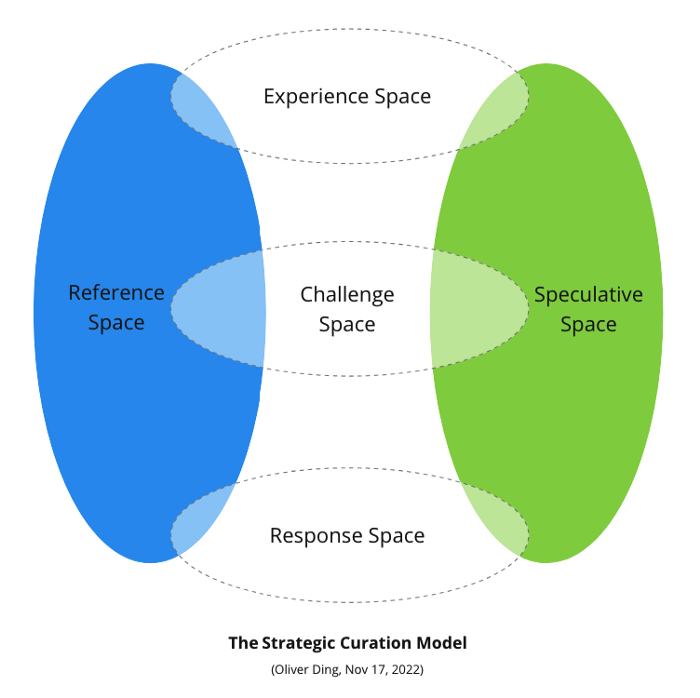
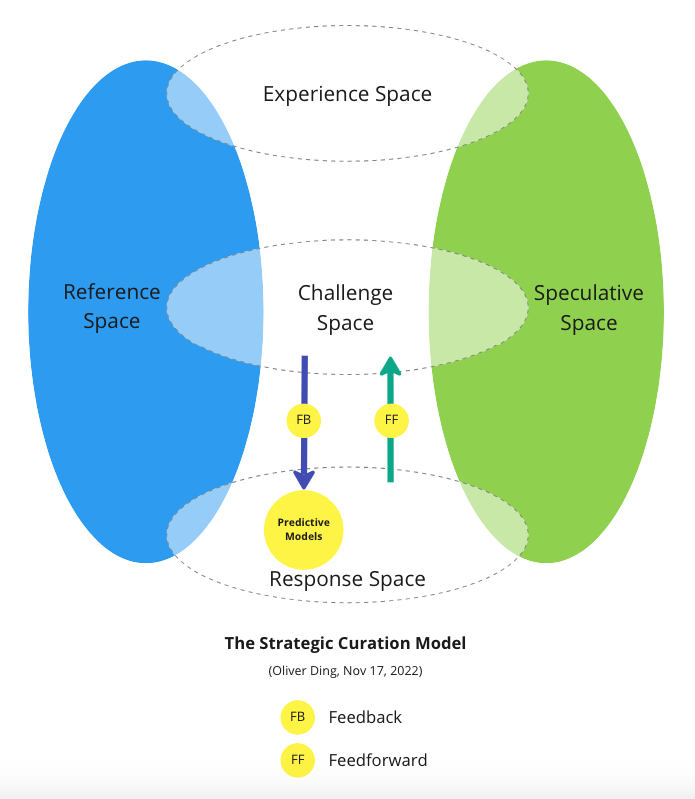
The Strategic Curation Model is a five-space model.
- Experience Space: It refers to the facts of the Past.
- Challenge Space: It refers to the problems in the Present
- Response Space: It refers to the solutions for the Future
- Reference Space: It refers to reliable knowledge for thinking
- Speculative Space: It refers to imaginative thinking such as Counterfactual Thinking about the Past and Prefactual Thinking about the Future.
What does Strategic Curation mean?
It refers to using a specific strategy to curate pieces of experience, knowledge, and resources into a meaningful whole for a better future.
For the life strategy project, this type of specific strategy is called Advanced Life Strategy.
What does “Advanced” mean? It is not for everyone because it requires spending time and effort to learn and master it.
On the contrary, the Instant Life Strategy takes easy-to-understand heuristics as thinking tools for developing life strategy.
What does Advanced Life Strategy look like? For example, “Learn Meta-Knowledge behind Knowledge Frameworks” is an advanced life strategy.
Today we are going to apply this strategy to the Strategic Curation Model.
Meta-Knowledge about Strategic Curation
If a piece of knowledge is about the Strategic Curation model, then it’s a meta-knowledge for the model.
As mentioned above, Reference Space refers to reliable knowledge for thinking. We should place meta-knowledge in Reference Space.
The diagram below is an example of Meta-knowledge about Strategic Curation.
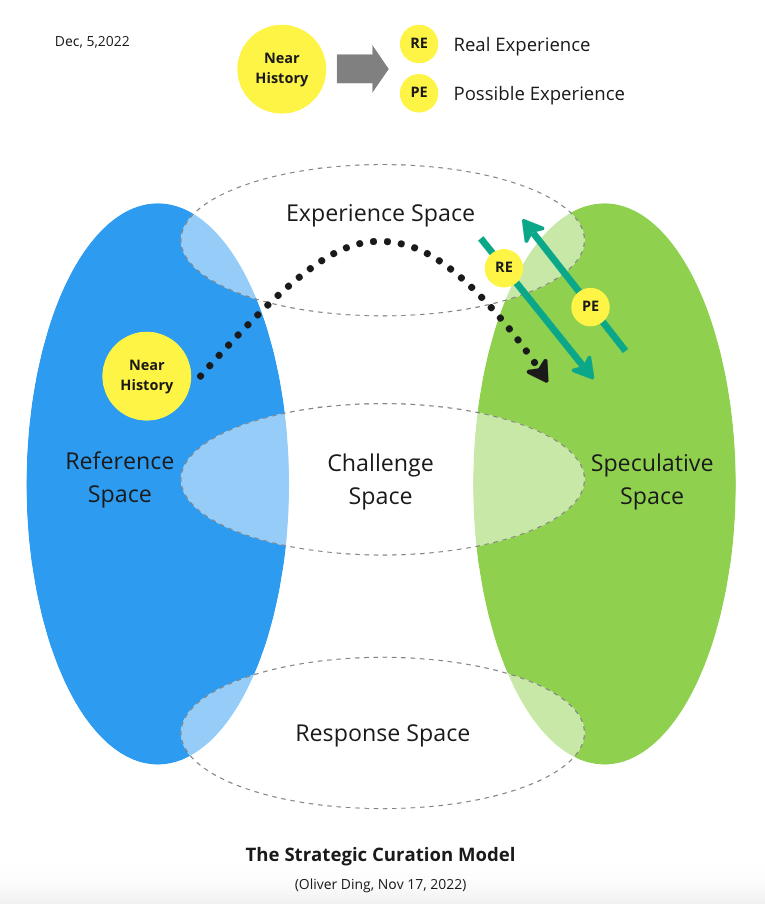
The above diagram places “Near History” in Reference Space.
I also add “RE (Real Experience)” to Experience Space. In addition, “PE (Possible Experience)” is placed in Speculative Space.
“Near History” is a meta-knowledge of the strategic curation model. It leads to “RE (Real Experience)” and “PE (Possible Experience)”.
Near History
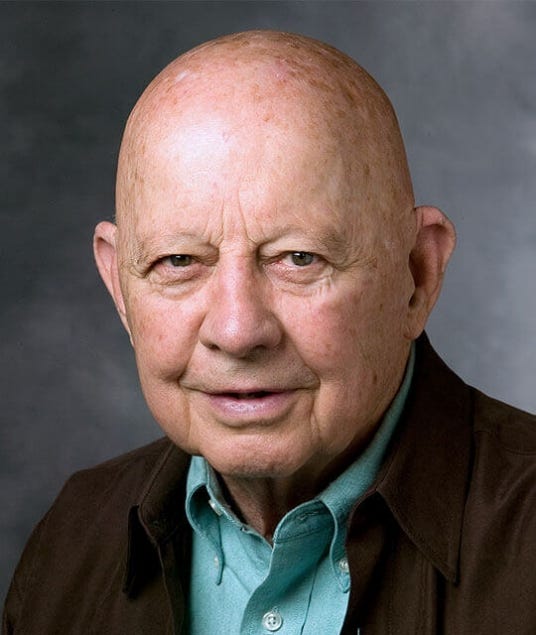
I learned the concept of “Near History” from James G. March several years ago.
In his seminal book, The Ambiguities of Experience, James March explores the role of experience in organizational intelligence. He argued that “If there is one lesson to be gleaned from the explorations in this book, it is that learning from experience is an imperfect instrument for finding the truth…Experience may possibly be the best teacher, but it is not a particularly good teacher. ” (2010, p.114)
However, March suggested some approaches for turning experience into general knowledge, for example, multivariate statistics which relies on generic models and large databases. For small sample sizes of ordinary experience, March also recommended case studies, “thick description” (Geertz, 1973), “near histories (March, Sproull, and Tamuz 1991)”, and Literature as sources of knowledge.
The concept of “near histories” refers to the virtual experience which could happen but didn’t really happen in the past.
Marche pointed out, “It is probably necessary to consider events from the perspective of multiple preferences. It is probably necessary to supplement the data of history with the data of virtual experience, using ‘near histories’ and hypothetical histories. In this way, the process of translating experience into understanding and understanding into action will often be an exercise of imagination that supplements or replaces data-based inference and logical derivation (March, Sproull, and Tamuz 1991).” (2010, p.117)
In fact, near histories are a special case of a more general approach -the construction of hypothetical histories. March and other authors discussed this issue deeply in a 1991 paper titled Learning from samples of one or fewer. They said, “We explore how organizations convert infrequent events into interpretations of history, and how they balance the need to achieve agreement on interpretations with the need to interpret history correctly. We ask what methods are used, what problems are involved, and what improvements might be made. Although the methods we observe are not guaranteed to lead to consistent agreement on interpretations, valid knowledge, improved organizational performance, or organizational survival, they provide possible insights into the possibilities for and problems of learning from fragments of history.” (1991)
RE (Real Experience) and PE (Possible Experience)
What does “Near History” means for the Strategic Curation model?
It points out specific moves between Experience Space and Speculative Space.
RE (Real Experience) is located in Experience Space while PE (Possible Experience) is located in Speculative Space.
According to some academic scholars, “Speculative thinking refers to thinking about past or future possibilities; it includes counterfactual thinking, prefactual thinking, and other types.”
In daily life, people often consider how things could have been different in the past and might be different in the future. Imagine, for example, the following scenario: you rush to the train station, only to discover that your train departed 5 min ago. You may think about how things could have gone differently, such as “If I hadn’t gotten caught in that traffic jam, I would have arrived at the train station on time.” You may also think about how to ensure a different outcome in the future: “If I leave home earlier next time, I’ll arrive at the train station on time.” Imagining how events could have been different is called counterfactual thinking (e.g., Kahneman and Tversky, 1981; Roese, 1997; Byrne, 2002).
Kahneman and Tversky (1981) proposed this concept in a paper on heuristic simulation. They described heuristic simulation as a conscious reactivation of past behavior stored in memory. Imagining how things might or will differ in the future represents prefactual thinking (e.g., Schacter et al., 2007; Epstude et al., 2016). Counterfactual and prefactual thinking are two types of speculative thinking; they involve consideration of past or future possibilities, respectively.
Source: A Review of Functions of Speculative Thinking (Lun Huang, Yibo Xie, and Xiaolin Chen, 2021)
It’s clear that “Near History” is a technique of counterfactual thinking.
Possible Selves
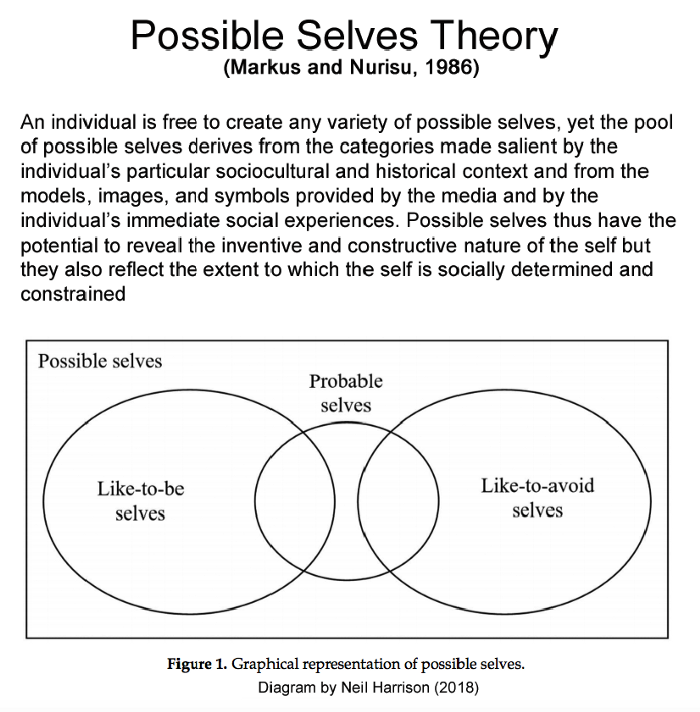
“Possible Selves” is a meta-knowledge about specific moves between Response Space and Speculative Space.
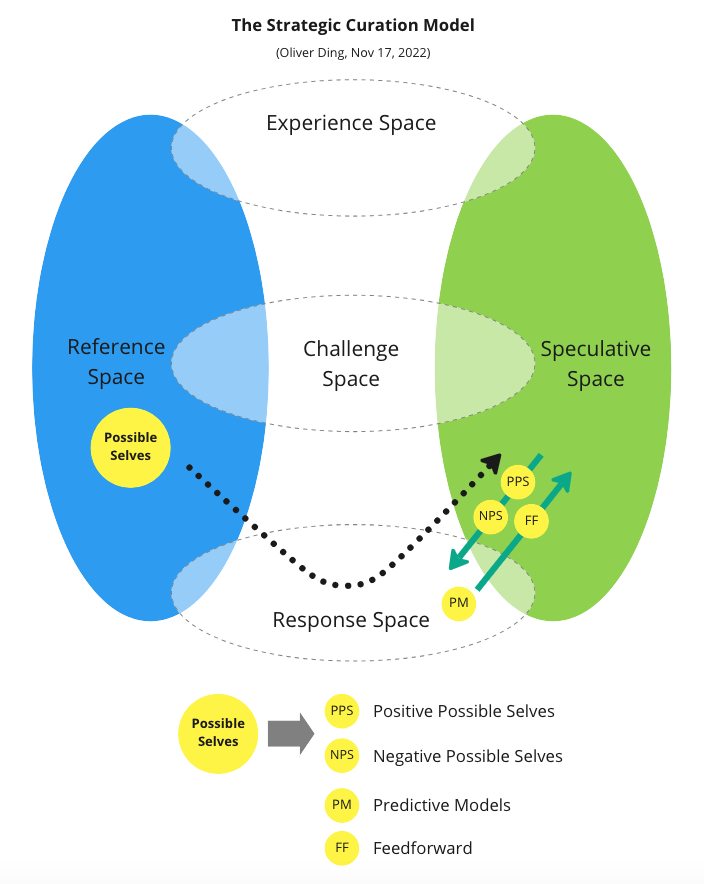
I learned the concept of “Possible Selves” from Hazel Rose Markus’ Possible Selves Theory (1986). PPS (Positive Possible Selves) refers to like-to-be selves while NPS (Negative Possible Selves) refers to like-to-avoid selves.
PM (Predictive Models)
I also use PM (Predictive Models) and FF (Feedforward) for the above diagram.
These two terms are inspired by Anticipatory system theory. According to Robert Rosen, the theory's creator, “An anticipatory system is a natural system that contains an internal predictive model of itself and of its environment, which allows it to change state at an instant in accord with the model’s predictions pertaining to a later instant.” In contrast, a reactive system only reacts, in the present, to changes that have already occurred in the causal chain, while an anticipatory system’s present behavior involves aspects of the past, present, and future.
The core idea is the “internal predictive model” and the model can predict the Self and the Environment.
Where are Predictive Models in the strategic curation model?
They are located in both Reference Space and Response Space.
Robert Rosen’s theory is a general theory. Since my framework also considers Activity Theory and other theoretical resources, I have to develop my own ideas of Predictive Models.
I made a distinction between General Predictive Model and Particular Predictive Models for the Life Strategy project.
The General Predictive Model refers to a person’s mind and knowledge. It is located in Reference Space.
For a particular project, a person will develop a particular model to help her model the development of the project. In other words, she will use a model to predict the future of the project.
The model can be explicit, such as a diagram with a document. However, the model can be tacit, the person just uses her mind without any instruments to display the model.
What I found from my empirical research is that sometimes the person would like to visualize or write her model about the project because this way is a great way of thinking. But the person would like to keep the model as private information unless the project needs the public version of the model for storytelling.
The model is the outcome of the “objective—subjective” knowledge curation. For example, a friend of mine adopts some psychological knowledge and the OKR method to build a model and use the model to develop her life development program. She modified her model several times in order to match the change of her clients.
Particular Predictive Models are located in Reference Space.
FF (Feedforward)
People tend to have an expectation of their ideal life in the future. It’s called Anticipation. For example, my friend made a vision for her ideal life in general and a life plan for the coming three years.
This anticipation inspires her to make some decisions that lead to some actions. This is called Feedforward. Her life vision and short life plan guide her to design the adult development program.
Feedforward can impact Speculative Space and Challenge Space.
For example, if some actions don’t work well. She will move to Speculative Space and modify her life vision by re-selecting possible selves again.
Challenge — Predictive Models — Response
The concept of “Predictive Models” also impacts the relationship between Challenge Space and Response Space.
As mentioned above, a predictive model of a project is located in Response Space. A person has to modify the predictive model if the project changes. The new predictive model will lead to new feedforward of his or her behaviors.
For example, a friend of mine changed her projects several times in the past 12 months. Each time, she built a model of a new service. After running the new service for one month or two months, she perceived some new challenges of the new service.
Thus, she modified the old predictive model of the service and reflected on the gap between the present status and her vision of the future. This led her to launch a new version of the service.
The Strategic Curation Model and the AAS framework
Some readers may notice that I use some ideas from the Anticipatory Activity System (AAS) framework for the above discussion.
I am editing a new book about the AAS framework. The Strategic Curation model is considered a part of the book for discussing Advanced Life Strategy.
More about the Life Strategy project:


