Life Strategy: Turning Potential Knowledge into Actual Knowledge
A discussion about the Strategic Curation model
This article is part of a possible book Advanced Life Strategy: Anticipatory Activity System and Life Achievements. I consider the Strategic Curation model as a part of the possible book.
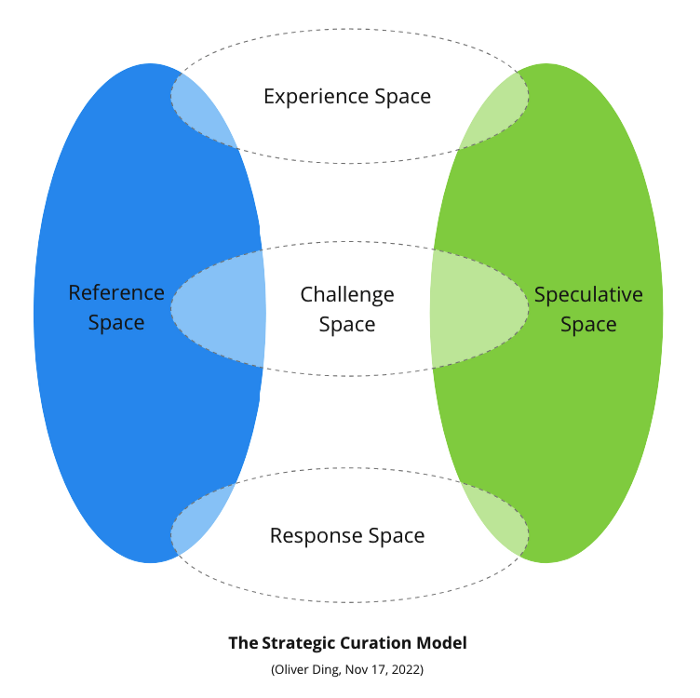
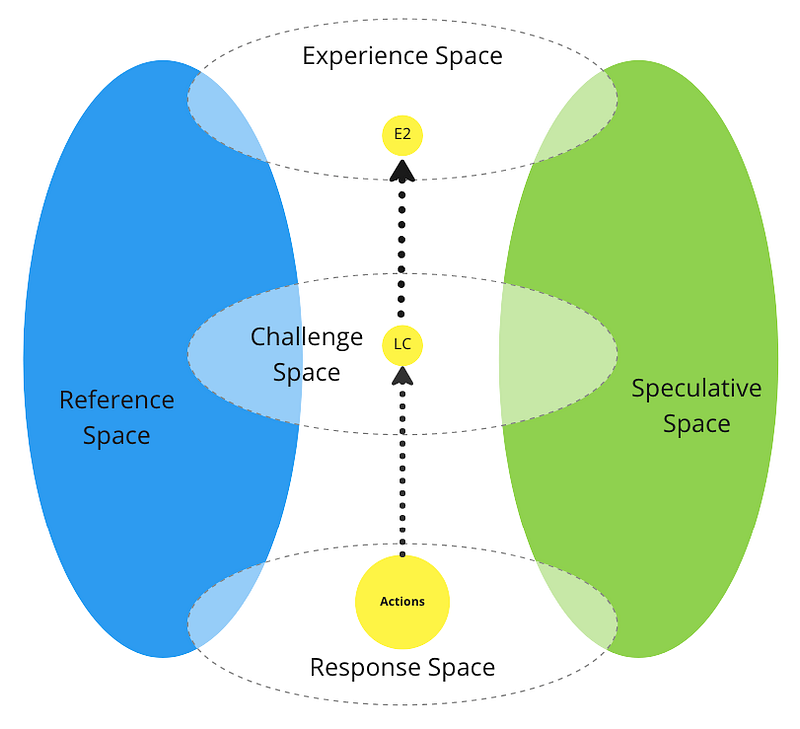
The Strategic Curation Model is a five-space model.
- Experience Space: It refers to the facts of the Past.
- Challenge Space: It refers to the problems in the Present
- Response Space: It refers to the solutions for the Future
- Reference Space: It refers to reliable knowledge for thinking
- Speculative Space: It refers to imaginative thinking such as Counterfactual Thinking about the Past and Prefactual Thinking about the Future.
What does Strategic Curation mean?
It refers to using a specific strategy to curate pieces of experience, knowledge, and resources into a meaningful whole for a better future.
You can find more details about the model in the following links
- Life Strategy: A Five-space Model for Strategic Curation
- Life Strategy: Three Meta-knowledge of Strategic Curation
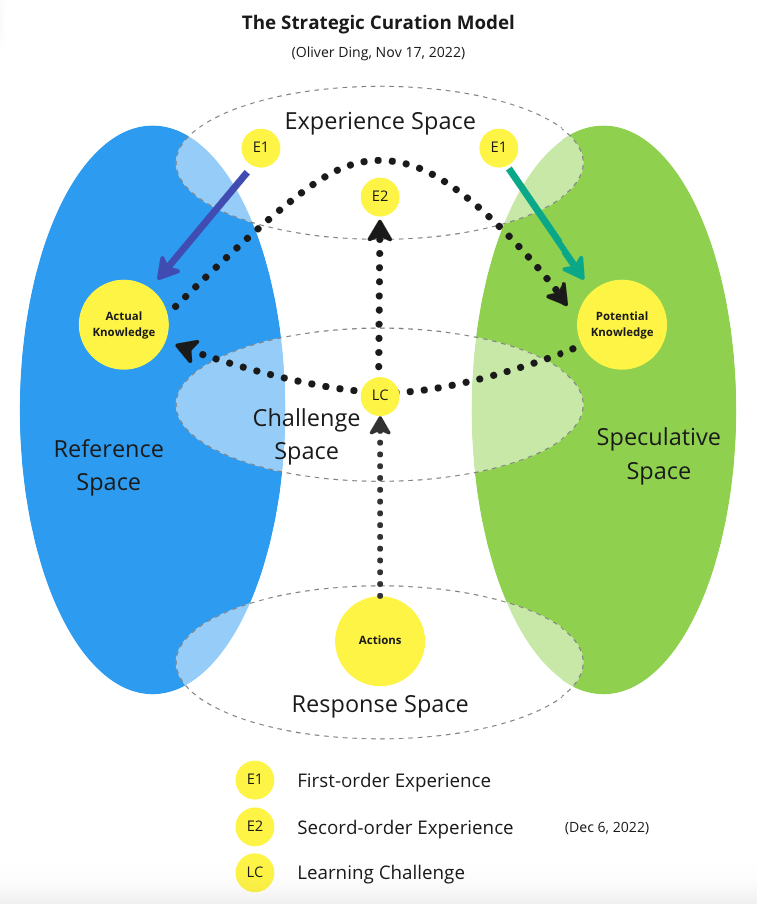
This article will discuss the following concepts with the Strategic Curation model:
- Actual Knowledge
- Potential Knowledge
- First-order Experience (E1)
- Second-order Experience (E2)
- Learning Challenge (LC)
See the diagram below.
The Dynamics of Tacit Knowledge
One year ago, I wrote an article titled The Dynamics of Tacit Knowledge and developed a model of Tacit Knowledge with a pair of concepts: Actual Knowledge and Potential Knowledge.
The term Tacit Knowledge was coined by Michael Polanyi in his 1958 book Personal Knowledge which is a book about the philosophy of science.
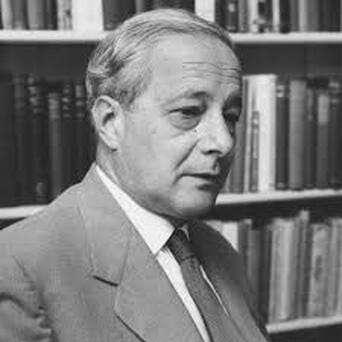
Polanyi emphasized the importance of skillful knowing and intellectual passions for the development of scientific knowledge, “…I regard knowing as an active comprehension of the things known, an action that requires skill. Skillful knowing and doing is performed by subordinating a set of particulars, as clues or tools, to the shaping of a skillful achievement, whether practical or theoretical.” (1958, p.vii)
In a later book, The Tacit Dimension (1966), Polanyi claimed that “we can know more than we can tell.” This affirmation leads to a popular typology of knowledge:
- Tacit Knowledge
- Explicit Knowledge
The essential aspect of the typology is the expression of knowing. If a person can express his knowing about something, then other people can see his knowledge which is confirmed as explicit. If a person can’t express his knowing about something, then the knowing is his tacit knowledge.
This definition leads to an unsolved problem.
If a person can’t express his knowing, how can he claim that he knows something and how can others confirm that he accurately knows something?
Contemporary philosophers are still busy debating the definition of the concept and its value.
After Polanyi, many scholars and researchers outside the field of philosophy of science adopted the typology for their study and research. They usually claimed that skills, ideas, and experiences are part of tacit knowledge. For example, organizational management researchers Ikujiro Nonaka and Hirotaka Takeuchi developed the SECI model of knowledge dimensions for discussing organizational innovations.
I reviewed this line in 2020 and suggested adopting Harry Heft’s notion of “Ecological Knowledge” to describe the knowledge about the structure and other aspects of environments. See his 2001 book Ecological Psychological in Context.
There is a transformation between Ecological Knowledge and Tacit Knowledge. Both types of knowledge don’t require language and semiotic expression.
You perceive it, then you get it.
You get it, then you act with it.
Others can perceive your acts and get it too.
The process doesn’t need language as mediation.
There is a transformation between Ecological Knowledge and Explicit Knowledge too.
You perceive it, then you get it.
If you have a talent of using words to name things, you can use words to describe what you perceived.
Actual Knowledge and Potential Knowledge
While Harry Heft’s notion of “Ecological Knowledge” emphasizes the spatial dimension of knowledge, I returned to Polanyi’s initial notion of “an active comprehension of the things known” and used it as a starting point to explore the temporal dimension of knowledge.
In order to discuss the dynamics of tacit knowledge, I suggest the following typology of tacit knowledge:
- Actual Knowledge: A present thing known.
- Potential Knowledge: A future thing unknown based on a present thing known.
The diagram below offers a model of the transformation between Potential Knowledge and Actual Knowledge.
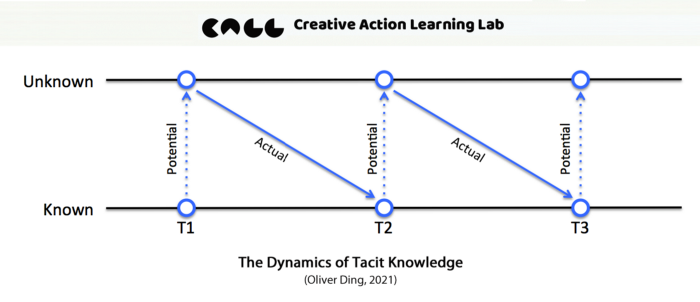
For example, I made a diagram called Theme Plus on Dec 30, 2021. It’s a beautiful diagram. But I didn’t know the value of Theme Plus. What could I do with it? However, I knew I can do something with it in the future.
This led to a notion of “the Dynamics of Tacit Knowledge” which is about “Present, Future, Known, Unknown”.
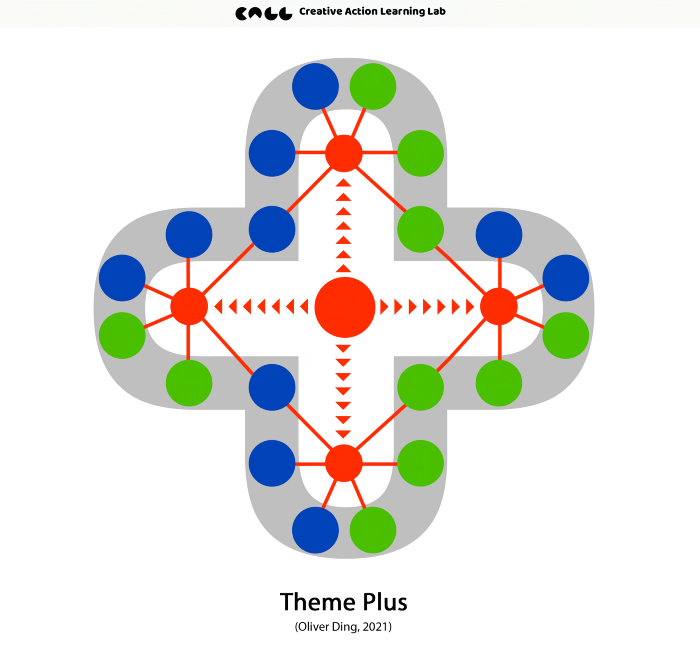
Let’s use Theme Plus as an example to test the above model.
- T1: Dec 30, 2021
- Actual Knowledge (T1): I knew I design the Theme Plus diagram.
- Potential Knowledge (T1): I knew I could use the Theme Plus diagram for some things, but I didn’t know the actual things.
- T2: Dec 31, 2021
- Actual Knowledge (T2): I knew I can use Theme Plus as an example for this article.
- Potential Knowledge (T2): I knew I could use the Theme Plus diagram for this article and other things, but I don’t know what the other things are.
- T3: Future
- …
You can find more examples of the above model in the original article: The Dynamics of Tacit Knowledge.
Now we can connect the Dynamics of Tacit Knowledge with the Strategic Curation Model.
- Actual Knowledge: it is located in Reference Space.
- Potential Knowledge: it is located in Speculative Space.
Both Actual Knowledge and Potential Knowledge are based on First-order Experience.
- Actual Knowledge: A present thing known. This refers to normal First-order Experience with the thing. For example, I made the Theme Plus diagram.
- Potential Knowledge: A future thing unknown based on a present thing known. Since this is based on the thing, it is based on First-order Experience too.
However, Potential Knowledge also requires some knowledge about the thing even if the knowledge can’t directly give concrete answers about the value of the thing. For example, I have some knowledge of using diagrams.
- Actual Knowledge > Potential Knowledge: I knew I could use the Theme Plus diagram for some things, but I didn’t know the actual things.
How does Potential Knowledge transform into Actual Knowledge?
In The Dynamics of Tacit Knowledge, I mentioned a technique for turning potential knowledge into actual knowledge: Deep Analogy.
The notion of Deep Analogy is one of the techniques for actualizing potential knowledge. There are many techniques for such creative cognitive development.
Learning these techniques and mastering them is a Learning Challenge.
Learning Challenge
In Life Strategy: A Five-space Model for Strategic Curation, I introduced the concept of Challenge Space and three types of challenges. See the diagram below.
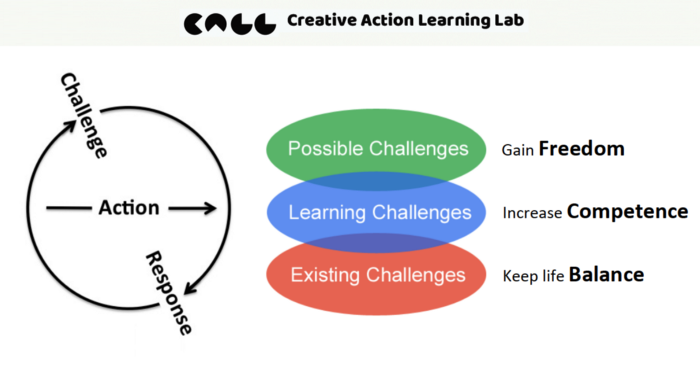
The Existing Challenges are about keeping life balanced. I adopted Ellen Skinner and Kathleen Edge’s motivational model of Context, Self, Action, and Outcomes (2002) as a resource. I defined the Positive Existing Challenges as the actions which respond to aggressive tasks while the Negative Existing Challenges as the actions which respond to defensive tasks. The Positive Existing Challenges refer to Engagement which is a concept of Skinner and Edge’s model. The Negative Existing Challenges refer to Coping.
Based on the approach, I defined two types of Learning Challenges. The Positive Challenges refer to actions that respond to positive incongruity (understanding the complexity of the situation) while the Negative Challenges refer to actions that respond to negative incongruity (transforming the complexity of ability). Based on my own experience, I thought the negative incongruity could lead to learning too. However, it refers to transforming the complexity of ability. For example, an expert faces a negative incongruity if the complexity of a situation is lower than the complexity of his mental model. However, if he wants to teach others how to cope with the same type of situation, he needs to learn communicative skills in order to reduce the complexity of the ability for others to learn. My suggestion expanded Rauterberg’s model from an individual perspective to an interpersonal perspective.
Now we can detach the concept of “Learning Challenge” from Skinner and Kathleen Edge’s approach and consider it as a general type of challenge.
Turning Potential Knowledge into Actual Knowledge belongs to Learning Challenge.
First-order Experience and Second-order Experience
Once you take real actions to respond to a Learning Challenge such as turning Potential Knowledge into Actual Knowledge, you create a new experience. Since the action requires some techniques, I called it Second-order Experience (E2).
The distinction between First-order Experience and Second-order Experience is an important notion of the Creative Life Curation framework. While First-order Experience is directly given, it requires using Techniques to detective Second-order Experience.
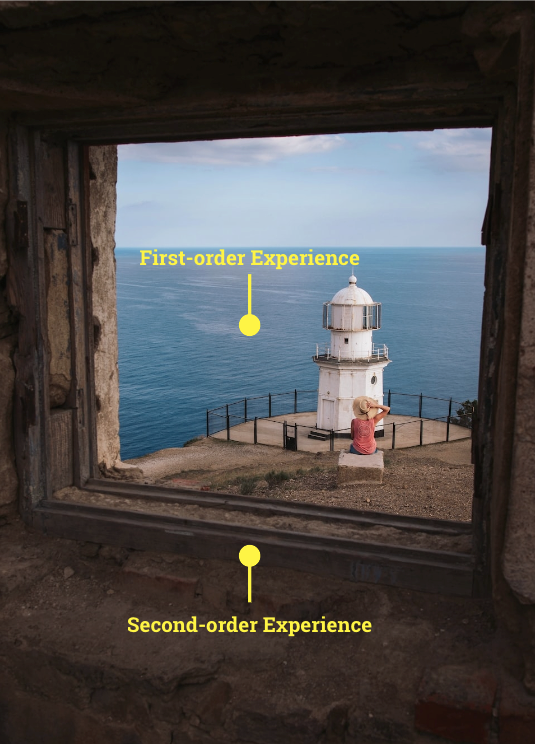
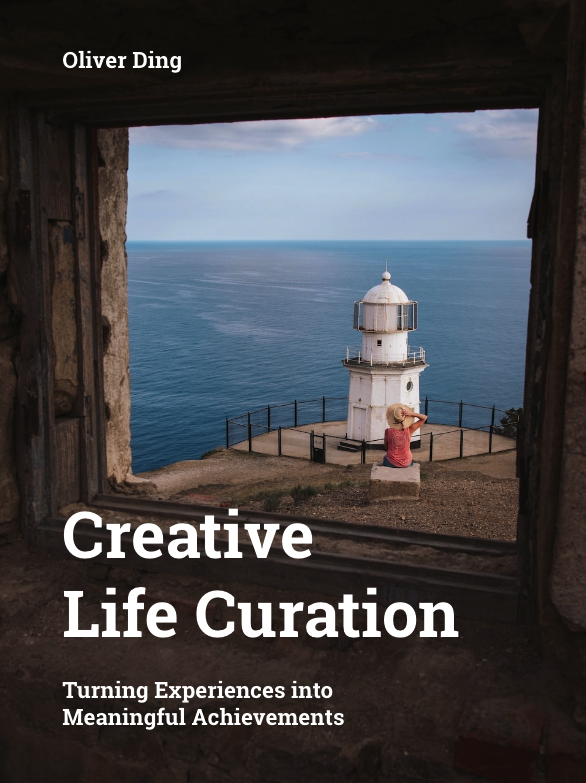
The above picture is a metaphor. First-order Experience refers to normal life experiences. The girl sees the ocean.
Second-order Experience refers to Creative Life Curation. We need to curate pieces of normal life experiences into a meaningful whole.
How can we do it?
According to Curativity Theory, we need a container to turn pieces into a meaningful whole.
We need a frame to frame life experiences.
The frame brings us Second-order Experience.
I also developed five units of analysis for the Creative Life Curation project:
Action > Project > Journey > Landscape > Lifescape
I have developed a Creative Life Curation framework containing five analysis units.
1. Creative Actions 2. Creative Projects 3. Creative Journey 4. Creative Landscape 5. Creative Lifescope
The framework also highlights the following three types of “Curativity”:
- Curativity 1: Turning pieces of Projects into a Journey as a meaningful whole
- Curativity 2: Turning pieces of Projects into a Landscape as a meaningful whole
- Curativity 3: Turning pieces of Actions and Projects into a Lifescope as a meaningful whole
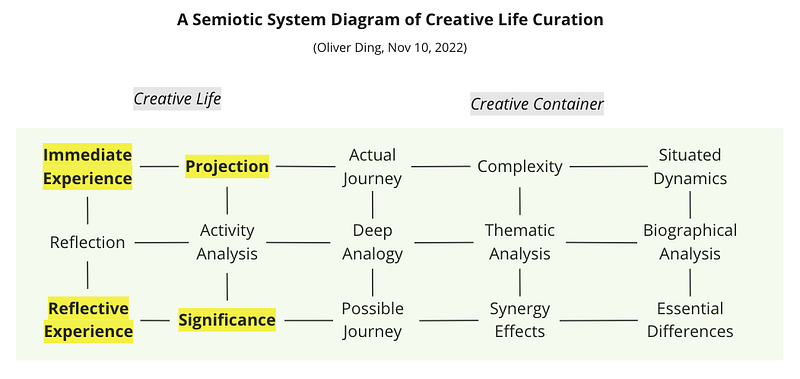
For example, Immediate Experience is directly given by everyday life events and actions. It belongs to First-order Experience.
If we don’t reflect on Immediate Experience intently, we can’t acquire deep meaning and knowledge under Immediate Experience. The Reflection brings us Reflective Experience which belongs to Second-order Experience.
In fact, we can see this process as the transformation between Potential and Actual.
Since we have rich life experiences, we can do more than we can think.
The Strategic Curation Model and the Creative Life Curation framework
Some readers may notice that I use some ideas from the Creative Life Curation framework for the above discussion.
Both the Strategic Curation model and the Creative Life Curation framework are applications of Curativity Theory.
I am editing a possible book: Creative Life Curation: Turning Experiences into Meaningful Achievements.