
Life Discovery: Twelve Significant Insights from Four Months
Some sparks could lead to a life-changing movement

The Life-as-Project Approach is inspired by Project-oriented Activity Theory, Anticipatory Systems Theory, Curativity Theory, and other theoretical resources, it was developed with the following six basic principles:
- Being by Doing
- Engagement as Projection
- End as Means
- Discovery as Development
- Performance as Experiment
- Curativity as Creativity
This article focuses on the notion of “Significant Insight” that echoes the “Discovery as Development” principle.
Part 1: The Notion of Significant Insight
I am recently working on the Life Discovery project. The notion of Significant Insight is considered an idea of the project.
1.1 Significant Insight for Life Discovery
In Life Discovery: The “Discovery as Development” Principle, I roughly identified the following essential actions for the Life Discovery Activity:
- Exploration: detach from the Produce status and attach to the Play status
- Detection: pay attention to cues from experiences and environments
- Recognition: identify significant insights
I also mentioned three types of significant insights:
- Potential Contradictions
- Potential Themes
- Potential Opportunities
I also emphasized that the Life Discovery Activity is not only for Life Transitions. Life Discovery is for both settled life stages and unsettled life stages.
Today I’d like to discuss the notion of Significant Insight with some examples.
1.2 What’s a Significant Insight?
The notion of Significant Insight is inspired by Leon Liu’s Life Framework Theory. Leon Liu is a software engineer and an independent researcher of self-directed education and open-source learning theories and practice. He has been reading Alexander’s books for many years. Several years ago, he started adopting “Life Center” which is a core concept of Alexander’s ideas to develop a new approach to learning. You can find more details about the approach in the following post on Linkedin.
The post shares a 202-page file about Life Framework Theory. You can find the term “Significant Experiences” on p.166. See the screenshot below.
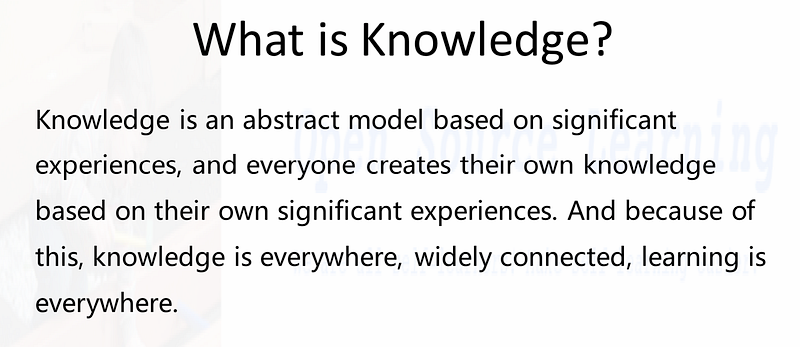
Many years ago, Leon developed a note-taking tool that is based on the concept of “Significant experiences”. I had discussed the software with him several times. I asked him the definition of Significant Experiences. The answer was that it is a subjective sense. Every user defines his or her own significant experiences and captures notes.
I used the notion of “Significant Insights” for the Life Discovery Activity and consider it an important outcome of the activity. This is a major difference between my notion and Leon’s idea.
From the perspective of the Anticipatory Activity System (AAS) framework, a Second-order Activity leads to the Objective and the Object of a First-order Activity. If we consider Life as an Anticipatory Activity System, then the Life Discovery Activity is a Second-order Activity.
Thus, a Significant Insight could directly or indirectly lead to a new activity. We don’t have to claim an insight as a significant insight when we are capturing an insight. We can reflect on our past experiences and identify significant insights if they lead to activities that change our life.
Part 2: Twelve Examples of Significant Insights
In the past four months, I captured several significant insights. This part shares 12 examples of these insights.
- Jan 5, 2022 — The notion of “Thematic Space”
- Jan 25, 2022 — The “Mandala“ thematic space and “Pair of Themes”
- Jan 29, 2022 — The notion of “Life Strategy”
- Feb 10, 2022 — The notion of “Service Thinking”
- Feb 13, 2022 — The Project-centered Approach
- Feb 27, 2022 — The notion of “Being by Doing”
- March 15, 2022 — The Curated Mind Framework
- March 19, 2022 — The “Thematic Spirit” activity
- March 27, 2022 — The AAS4LT Framework
- April 14, 2022 — The Landscape of Project Network
- April 20, 2022 — The “Domains — Works” Mapping and “Domains(Works)”
- April 22, 2022 — The notion of “Activity as Project Engagement”
If you don’t want to know details about these significant insights, you can directly jump to Part 3 which is my reflection on these insights.
2.1 The Notion of “Thematic Space” (Jan 5)
The notion of “Thematic Space” dominated the first season of my 2022.
Originally, I used “Conceptual Space” for the Model of Knowledge Curation and its canvas. See the diagram below:
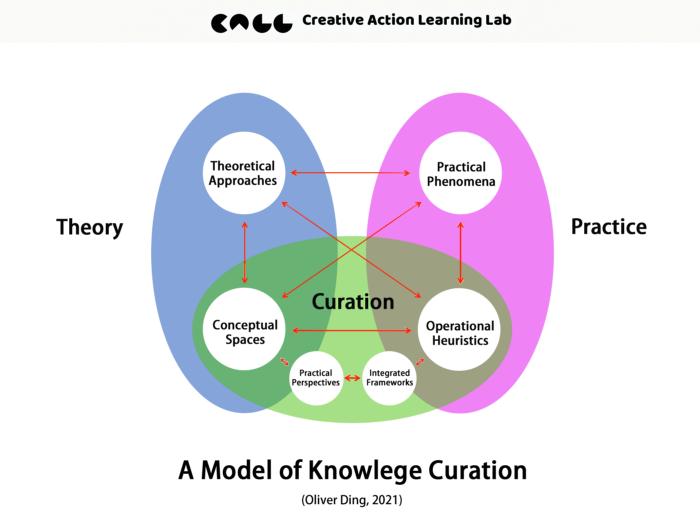
The model presents six types of “Objects of Curating” for a knowledge curation work:
- Theoretical Approaches
- Conceptual Spaces
- Practical Perspectives
- Integrated Frameworks
- Operational Heuristics
- Practical Phenomena
You can find more details from The Diagramming as Practice Framework.
The term Conceptual Spaces is inspired by Peter Gardenfors’ 2004 book Conceptual Space: The Geometry of Thought. However, I roughly use it to describe large cognitive containers for curating similar theoretical approaches together.
I published the model and the canvas on Dec 16, 2021. In the past weeks, I realized that I should use a new term to replace Conceptual Spaces.
- First, what I am talking about is not the original meaning of Peter Gardenfors’ concept of Conceptual Spaces.
- Second, I use the word “theme” for Theme U, Theme Plus, and Themes of Practice. I think it is better to use Thematic Space for the model and the canvas.
From the perspective of Curativity Theory, building and developing a Thematic Space means the Objective — Subjective knowledge curation.
You need to connect established theories with your own life/work experience. There is a lot of work to do for this type of knowledge curation. You have to select theoretical approaches and identify the similarities and differences between various theories. You have to reflect on your own experience and imagine your future work to find relevant themes to curate theoretical approaches. Finally, you need to name your thematic spaces.
This significant insight led to the Thematic Space Canvas. You can find more details here.
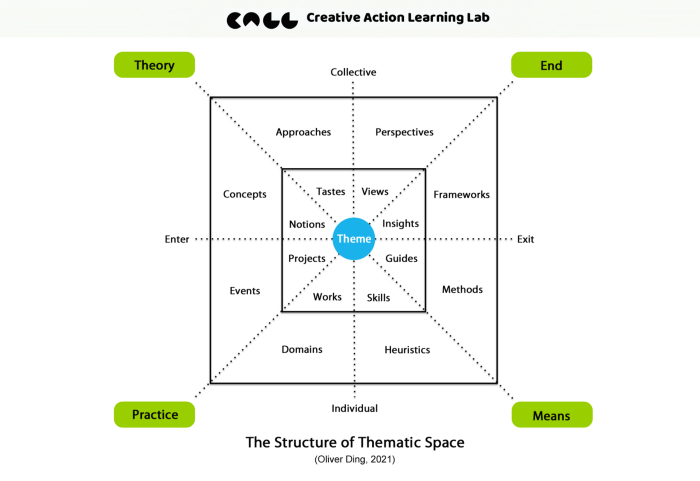
On March 11, 2022, I used “Knowledge Discovery Canvas” to rename the original canvas. The name “Thematic Space Canvas” is used to name a meta-canvas.
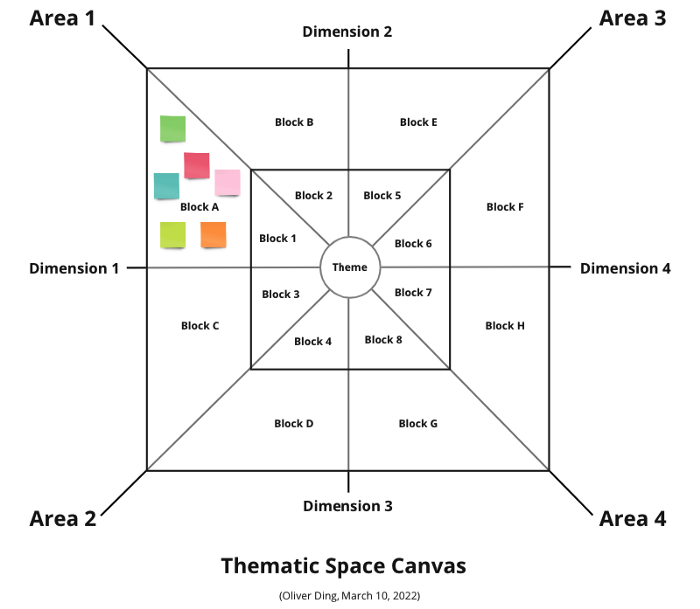
The above meta-canvas has been producing the following six canvases:
- The Thematic Space Canvas
- The Spark Space Canvas
- The Statue Space Canvas
- The Life Discovery Canvas
- The Optimal Context Canvas
- The Lifesystem Development Canvas
As the primary canvas of the Slow Cognition project, the Thematic Space Canvas also defines the spatial structure of the other five canvases. You can find more details here.
2.2 The “Mandala“ thematic space and “Pair of Themes” (Jan 25)
The first season of my 2022 started with a diagram called Mandala.
The Mandala Diagram Network was developed with the Personas approach. Each time, I select a professional persona and develop a Mandala diagram to represent the persona’s mental model in general.
All Mandala diagrams are based on the Hubhood meta-diagram. I use one Twitter thread to publish these Mandala diagrams.
- Dec 21, 2021 — The Founder’s Mandala
- Dec 23, 2021 — The Creator’s Mandala
- Dec 24, 2021 — The Curator’s Mandala
- Jan 1, 2022 — The Strategist’s Mandala
- Jan 3, 2022 — The Designer’s Mandala
- Jan 4, 2022 — Sailor’s Mandala
- Jan 24, 2022 — Shaman’s Mandala
Since all Mandala diagrams are based on the Hubhood meta-diagram, they share the same structure.
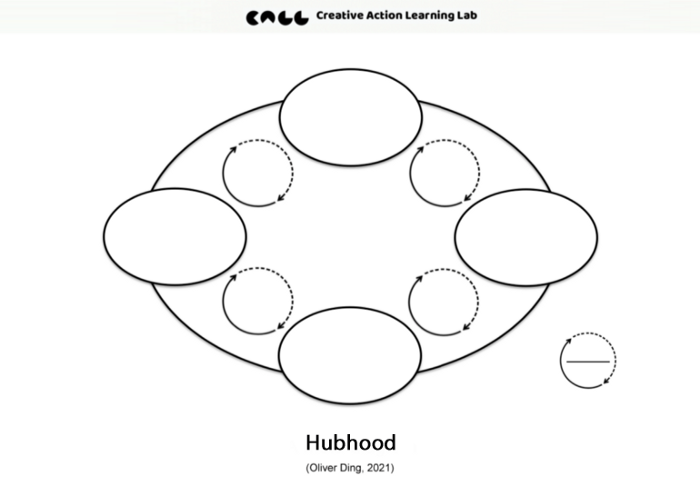
The above diagram is the Hubhood meta-diagram. The Hubhood meta-diagram was formed by four thematic spaces and four connected hubs. There are many ways to develop a Mandala diagram from the Hubhood meta-diagram. There are five challenges during the developing process:
- Challenge 1: Identify Four Thematic Spaces for a Particular Task
- Challenge 2: Arrange these Four Thematic Spaces with a particular logic
- Challenge 3: Identify Four Connected Hubs between Four Thematic Spaces
- Challenge 4: Identify a pair of themes for each connected hub
- Challenge 5: Name the new Mandala diagram which is the final product
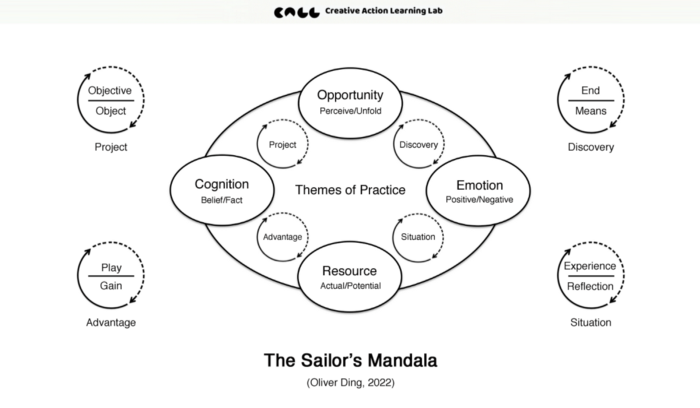
The above diagram is called Sailor’s Mandala which was designed with the following two dimensions:
- Individual Psychological Intervention
- Social Practice Acceleration
Based on the above two dimensions, I identified four thematic spaces:
- Psychological: Cognition and Emotion
- Social Practice: Opportunity and Resource
It also connects to four frameworks:
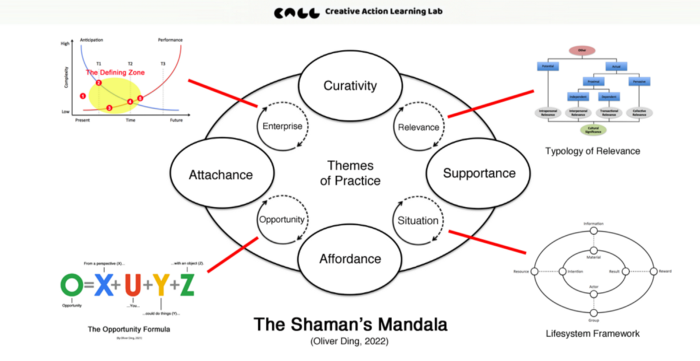
I discovered a notion called “Pairs of Themes” from designing several Mandala diagrams. Eventually, I wrote a long list of “Pairs of Themes” on Jan 25, 2022. You can find more details here.
In Feb 2022, I used some pairs of themes to write articles. Finally, I wrote an article titled Knowledge Discovery: The “Double Theme” Strategy on April 2, 2022.
I didn’t use “Significant Insights” to talk about the notion of “Pairs of Themes” or “Double Theme”. I just recognized it and used it.
2.3 The Notion of “Life Strategy” (Jan 29)
I took the following picture at 5:09 PM, Jan 29, 2022, when I was in the parking lot of Costco with my two sons while my wife was shopping inside the store.

After casually flipping through Jordan B. Peterson’s book 12 Rules for Life for a few minutes, I put it down and started writing a list of things that happened from Jan 27 to Jan 29. See the below:
- Jan 27 (morning), read Ed Morrison’s book about Strategic Doing.
- Jan 27 (afternoon), used the iART framework as an example to test the canvas of “the Dialogue approach of Knowledge Curation”.
- Jan 27 (night), curated “Anticipatory Activity System” and other frameworks together to design the first version of “Life Strategy Toolkit”.
- Jan 28 (morning), talked about the “Life Strategy Toolkit” with a friend.
- Jan 28 (morning), joined a webinar about Strategic Doing and Startup Ecosystem.
- Jan 28 (noon), shared a post about Platform for Development on Linkedin.
- Jan 28 (afternoon), designed the final version of “the Dialogue approach of Knowledge Curation”.
- Jan 28 (afternoon), my iMac couldn’t turn on due to a sudden power outage.
- Jan 28 (night), read printed pages about Strategic Doing and wrote some notes.
- Jan 29 (morning), text-chatted with a friend about the “Anticipatory Activity System” framework.
- Jan 29 (morning), went to the Apple Store.
- Jan 29 (noon), replied to comments about Platform for Development on Linkedin.
- Jan 29 (afternoon), went to a local library.
- Jan 29 (afternoon), went to Costco.
After finishing the above list, I suddenly had the above idea about “Life Strategy”. Originally, I was busy dealing with friends’ requests for practical suggestions about strategy. So, I framed the notion of “Life Strategy” as a practical toolkit. However, I realized that I could detach from the “toolkit” and attach it to the “dialogue” which is mentioned above.
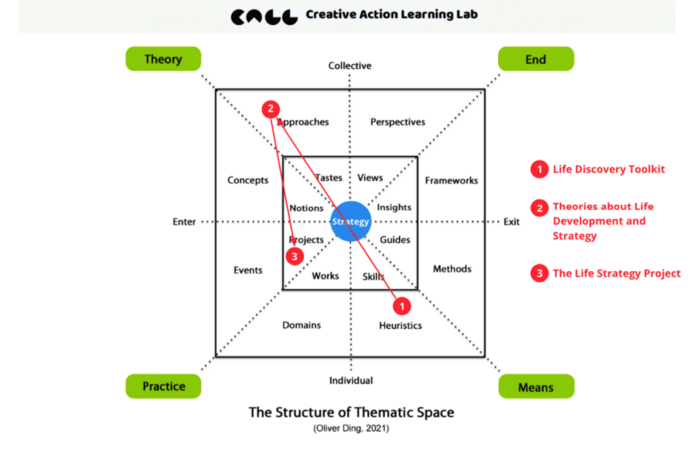
Now we can use the Thematic Space Canvas to visualize this moment.
- Before: the focus of my mind is on the “Heuristics” block which belongs to the Practice Field.
- After: the focus of my mind moves to the “Approaches” block which belongs to the Theory Field.
- Then: the new focus led to a new project which is on the “Projects” block.
This insight led to the following Notions:
- Architecture > Strategic Thinking
- Relevance > Strategic Discourse
- Activity > Strategic Acting
- Opportunity > Strategic Awareness
I thought about applying the epistemological framework to curate theoretical approaches to Strategy on Jan 28. However, I didn’t produce any Practical Perspective as an outcome on Jan 28.
You can find more details here.
2.4 The Notion of “Service Thinking” (Feb 10)
On Feb 9, 2022, I talked with a friend who is a Service Designer. We talked about various topics such as design thinking, service design, strategic thinking, system thinking, cross-boundary thinking, Activity Theory, the Theory-Practice gap, etc.
The conversation inspired me to connect Activity Theory and Service Design by creating a new thematic space called “Service Thinking”. I used it as an example of a “Connected Hub” and wrote an article on Feb 10, 2022.
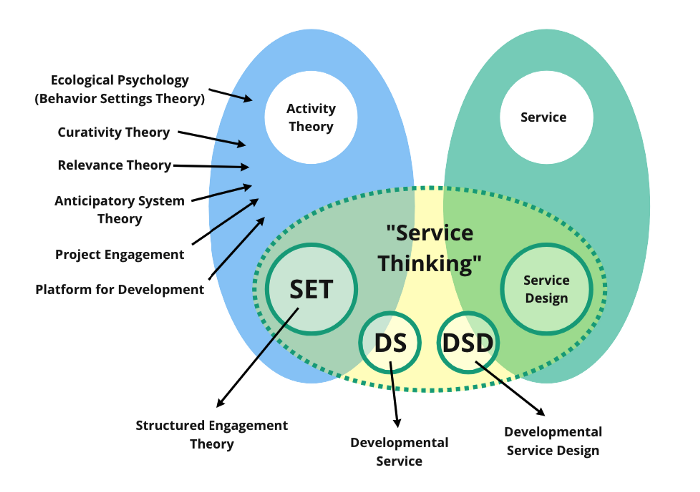
The above diagram represents the process of connection. My first spark is SET which stands for “Structured Engagement Theory”. To be honest, it is just a framework, not a theory. However, I want to keep the name “SET” because it points out the core of the framework. In order to keep the name “SET”, I have to keep the word “Theory”. Anyway, let’s call it SET or the SET framework.
In 2019, I started adopting some theories to reflect on my experience and thoughts about “Social (Digital) Design” which refers to digital products for interpersonal communications. Eventually, I developed the SET framework and used it for my projects later.
The notion of “Developmental Service” is the newest idea. I just made it last night! It refers to a special type of service such as educational services, summer camps, adult life development programs, life discovery activities, etc. This notion refers to my perspective of individual development. It also echoes the concept of “Developmental Platform” and the “Developmental Project Model”.
In 2021, I used the SET framework to study Digital Whiteboard Platforms to test my book Platform for Development. I recently used the SET framework to study an adult developmental program. This change encourages me to think about the connection between my theoretical frameworks and service design.
Finally, I found the notion of “Developmental Service Design” is a great connector.
Now, we see a set of ideas within the “Service Thinking” thematic space:
- SET: Structured Engagement Theory
- DS: Developmental Service
- DSD: Developmental Service Design
- SD: Service Design
This is version 1.0 of the meaning of the “Service Thinking” thematic space. You can find more details here.
2.5 The Project-centered Approach (Feb 13)
In Feb 2022, I worked on the Life Discovery project and developed a toolkit and a canvas for the project. I also developed the Project-centered approach.
On Jan 18, 2022, I created the new version of the Project Engagement Toolkit (2022) which is a project-oriented toolkit for theory-based reflection and study. It is a major outcome of the Activity U project because it connected the following two theoretical approaches of Activity Theory and offers a series of tools for practitioners.
- The Activity System Model (Yrjö Engeström, 1987)
- Activity as Formation of Concept (Andy Blunden, 2010, 2012, 2014)
Originally, I used “Project Engagement” as the name of Part 3 of the book Project-oriented Activity Theory and it refers to a set of my ideas for expanding Andy Blunden’s original approach about Project as a unit of analysis of Activity and Activity as Formation of Concept. The most important difference between Blunden’s original approach and my interpretation is that his vision is developing a general interdisciplinary theory of Activity as a meta-theory. However, my vision is to adopt his meta-theory and develop some frameworks and models for practical studies. You can find more details here.
In 2021, I moved in the direction of supporting knowledge workers and creators. I realized that the Project Engagement Toolkit has significance for practitioners. It is not a pure application of Activity Theory.
In Thematic Space: The Project Engagement Toolkit for Creators, I discussed my “Project” thematic space and highlighted the following three points:
- First, the Developmental Project Model is an independent framework.
- Second, there is a concept called Projectivity behind the module 4 Zone of Project and the module 5 Developmental Project Model.
- Third, I also adopted Howard E. Gruber’s Evolving Systems Approach to the study of Creative Work (1974,1989) for module 6.
Originally, the Project Engagement toolkit was born from the work of Project-oriented Activity Theory. Now, it is an instrument for practitioners.
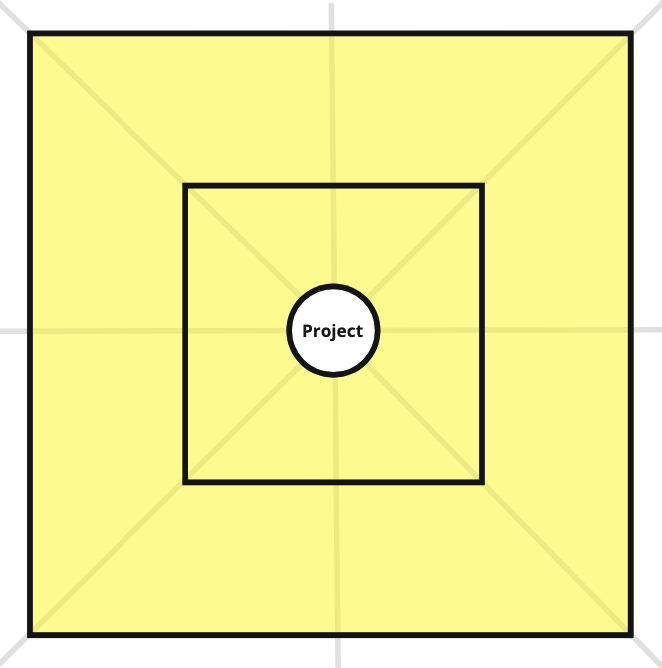
The Life-as-Project approach continuously expands my “Project” thematic space. It seems that I am building a Project-centered approach. You can find more details here.
2.6 The notion of “Being by Doing” (Feb 27)
On Feb 27, 2022, I wrote an article titled The Life Discovery Canvas (v1.0) — Part 1: Theoretical Background and introduced six basic principles of the Project-centered approach:
- Being by Doing
- Engagement as Method
- End as Means
- Discovery as Development
- Performance as Experiment
- Curativity as Creativity
I used the term “Being by Doing” for the article Life Discovery: The Life-as-Project Approach which was published on Feb 13, 2022. However, I didn’t write any detail about it in the article.
On Feb 17, 2022, I wrote a piece about “Life” and “Freedom” in Mapping Thematic Space #6: The “Life” thematic space. The piece mentioned an idea for the Life Discovery Toolkit. See the diagram below.
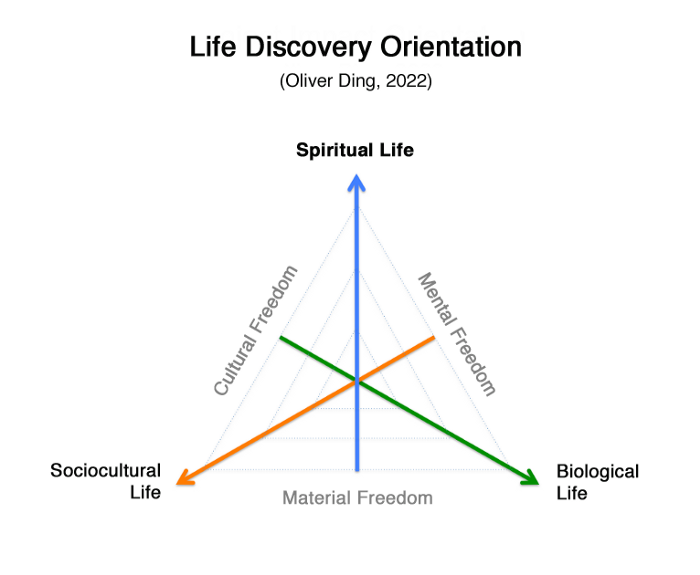
On Jan 23, 2022, I used three dimensions of the concept of “Life” to develop the above model. There are at least three ways to understand the concept of “Life”.
- Life as Organism: this is the perspective of biological theories.
- Life as Practice: this is the perspective of social theories.
- Life as Ideal Type: this is the perspective of humanities.
These three perspectives can be called Biological Life, Sociocultural Life, and Spiritual Life. I also defined three types of Freedom.
Why did I choose “Freedom” as a core concept for this idea? On Jan 1, 2022, I designed the Strategist’s Mandala and used “Degrees of Freedom” as its primary theme. I learned the term from the Japanese strategy consultant Kenichi Ohmae’s writings.
However, “Degrees of Freedom” is a traditional term for strategic thinking in the context of business competitions. For individual life development, I don’t consider competition as the first thing.
- Material Freedom: Independence of both Sociocultural Life and Biological Life.
- Mental Freedom: Independence of both Spiritual Life and Biological Life.
- Cultural Freedom: Independence of Sociocultural Life and Spiritual Life.
This model leads to a challenge: What’s Freedom? My rough answer is the following diagram. I use a simple formula to define “Freedom”. The pair of concepts of “Supply — Demand” is inspired by economics. Also, I was inspired by the developmental psychologist Robert Kegan’s 1994 book In Over Our Heads: The Mental Demands of Modern Life.
In Over Our Heads focuses on the fit or lack of fit between what the culture demands of our minds and our mental capacity to meet these demands. According to Robert Kegan, “The psychological phenomenon is the evolution of consciousness, the personal unfolding of ways of organizing experience that are not simply replaced as we grow but subsumed into more complex systems of mind…The cultural phenomenon is the ‘hidden curriculum,’ the idea that to the list of artifacts and arrangements a culture creates and the social sciences study we should add the claims or demands the culture makes on the minds of its constituents.”(1994, p.9)
Kegan’s “psychological — cultural” dialogue approach is the seed of my ideas about the above three types of freedoms. I want to expand the “psychological — cultural” dialogue to the “psychological — biological” dialogue and the “cultural — biological” dialogue.
On Feb 27, 2022, I offered details about the “Being by Doing” principle. You can find more details here.
The Project-centered approach is a new theoretical approach for Activity Analysis. In a broad sense, the Project-centered approach is inspired by the Hegel-Marx-Vygotsky Activity Theories and the American Pragmatism tradition.
I use the slogan “Being by Doing” to highlight the philosophical roots of the Project-centered approach.
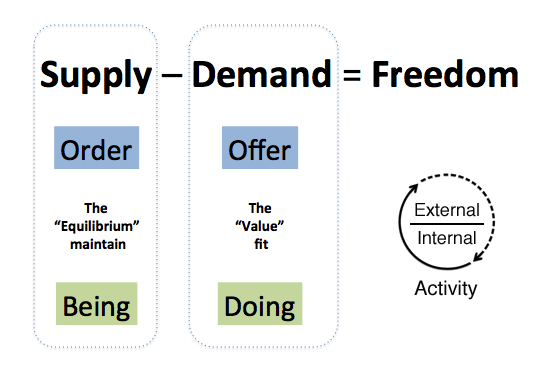
The above diagram is my intuitive idea about the slogan “Being by Doing”. It looks like this is a dialogue between Humanistic Psychology and Activity Theory/Ecological Psychology.
- Activity Theory/Ecological Psychology: Doing means delivering “Value” as Offers to others.
- Humanistic Psychology: Being means maintaining “Equilibrium” as Order for self.
If a person wants to offer values to satisfy others’ demands, he or she should keep a good order for internal equilibrium to maintain the supply system. This is an interesting idea. However, it requires more deep work.
I use “Supply — Demand” as a pair of concepts for the Life Discovery Canvas. This is the starting point of the Life Discovery Activity and its canvas.
Finally, I published an independent post about the “Being by Doing” principle on March 27, 2022.
2.7 The Curated Mind Framework (March 15)
On April 14, 2022, I sent a long email about the Curated Mind framework to a friend of mine.
The “Curated Mind” framework is a significant insight in the past three months.
A significant insight could connect the past of your life and the future of your life. If we use “Thematic Space” to understand the connection between the notion of “Curated Mind”, then we can see the following two “Thematic Space”:
- The “Curativity” theme space
- The “Mind” theme space
I have been working in the curation field for over ten years. I was the Chief Information Architect of BagTheWeb which was an early tool for content curation (We launched the site in 2010). This experience inspired me to make a long-term commitment to the Curation theme. After having 10 years of various curation-related practical work experience and theory learning, I coined a term called Curativity and developed Curativity Theory which became a book.
I wrote the book Curativity in 2019 and started applying it to the Knowledge Curation project. You can find more details in Curativity Theory: The Ecological Approach to General Curation Practice and Curativity Theory: Table of Contents and Related Articles.
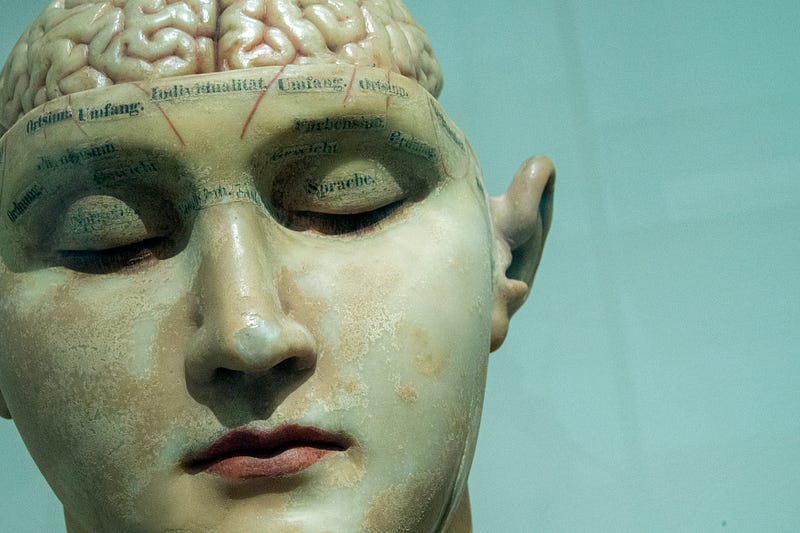
I’ve been a fan of psychology and cognitive science since 2015. My journey of learning psychological theories was inspired by Mr. Seldon who is a friend of mine and his startup Andmind Group.
Mr. Seldon is an ambitious serial entrepreneur with a unique educational background in psychological science. In 2015, Mr. Seldon moved to the educational field and started his third business: Andmind Group. Mr. Seldon didn’t use “Andmind Group” as a name for his business. I just use this term to refer to various activities of his enterprise.
In 2014, Andmind Group started as a social media group with about 250 members who are PhDs in psychological science or professional workers. Some members are students of leading academic researchers such as the founders of SDT(Self-determination theory).
This private group is a wonderful learning environment for me. For about two years, I learned various approaches to psychological science and cognitive sciences from the continuous conversation within the group. Finally, I found my favorite is ecological psychology.
Moreover, I didn’t want to become a researcher in psychological sciences. I wanted to expand the ecological approach to social practice studies such as knowledge curation, digital design, platform development, etc.
Then, I worked on my theoretical approach: the Ecological Practice approach. One year ago, I review the three versions of the approach and its historical development. You can find details here.
In the past several months, I slowly returned to the topic of Mind. On April 14, 2022, I realized that there are three triggers for this transformation.
1) The D as Diagramming Project
In order to summarize the insights from the D as Diagramming project, I returned to a framework I developed in 2017 and used it to frame the D as Diagramming project.
2) The Life Discovery Project
In order to conduct the Life Discovery Project, I returned to the “life transition” theme and the “career development” theme.
3) The Change of “Self — Other” Relevance
In a Linkedin post, I mentioned the insights of “Collective Network of Enterprise” and “Project Network” which are driven by the change of my “Self — Other” relevance. In the past three months, many friends gave me wonderful feedback which guided the direction of my creative work.
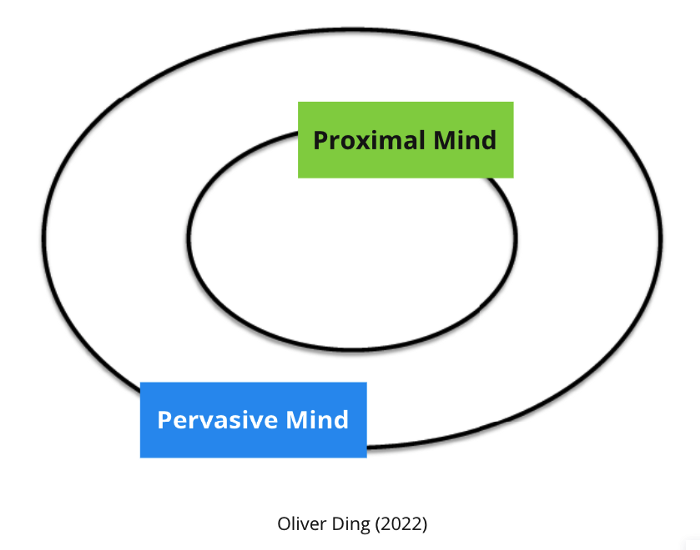
Eventually, I started detaching from Ecological Psychology and attaching my mind to a more broad space: the whole landscape of psychological science and cognitive science.
In other words, I returned to 2015 with the perspective of Curativity Theory.
2.8 The “Thematic Spirit” Activity (March 18)
On March 18, 2022, Daiana Zavate and I run the first Thematic Spirit for one hour.
Daiana Zavate was in Rome while I was in Houston. We started our tiny real-time global collaboration on Miro at 1:30 pm.
Daiana Zavate has been following my writing for several months. After reading and reproducing her version of the canvas, I was sure that she understood the spatial structure of the Thematic Space Canvas. I also read her creations of concept development about strategic design thinking. I believe she is a talent for conceptual thinking.
Since we share the same knowledge about Thematic Space Canvas and Concept Development, our first collaboration went quite well.
Our first task is setting a new framework that frames the three-step flow for our three diagrams.
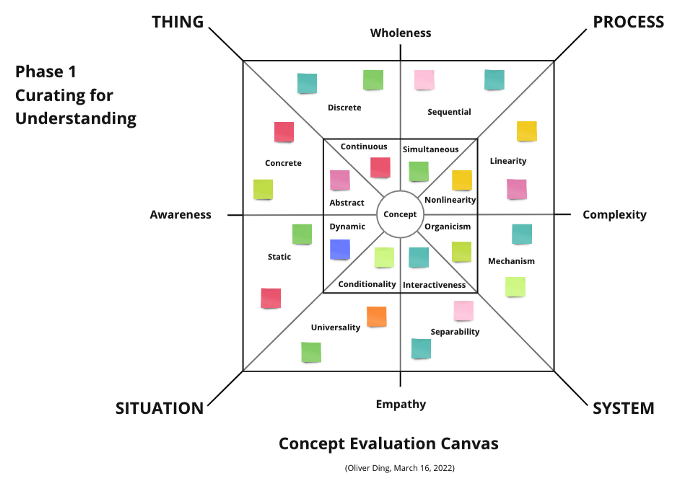
- Phase 1 — Curating for Understanding > my original Concept Discovery Canvas (v1.0)
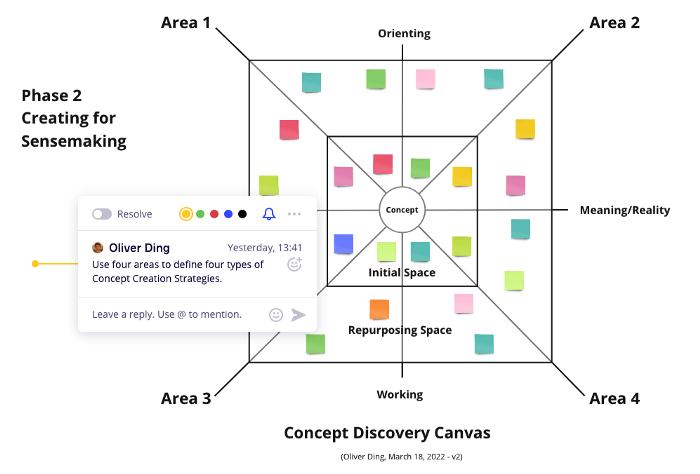
- Phase 2 — Creating for Sensemaking > my second version of Concept Discovery Canvas (v2.0)
- Phase 3 — Improving for Communicating > Daiana’s version of Concept Discovery Activity
Phase 1 is defining learning and understanding Others’ concepts. It’s for building a knowledge base for a particular topic or an issue. We directly used my original Concept Discovery Canvas (v1.0) for it and didn’t make any changes. I renamed it Concept Evaluation Canvas.
Phase 2 is about creating a brand new concept. This is the core of the whole flow. So we decided that we use Concept Discovery as a name for this phase. Since we can use the third canvas for communication, I removed “four orders of design” from the Concept Discovery Canvas. I thought we can emphasize Concept Creation Strategies for this canvas, we can use Four Types of Strategies to define four areas. However, we don’t have enough time to find and decide on the content of the Four Types of Strategies.
Thus, the major task of the collaboration is redesigning the third canvas.
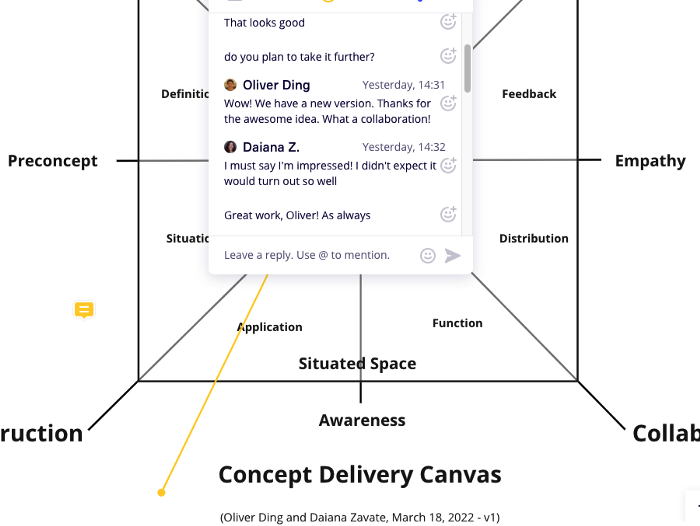
At 2:30 p.m., we completed the whole canvas. This is an awesome collaboration. We did it in just an hour!!! You can find more details here.
After six hours, I realized that we also created a new activity about the Thematic Space Canvas. I called it Thematic Spirit.
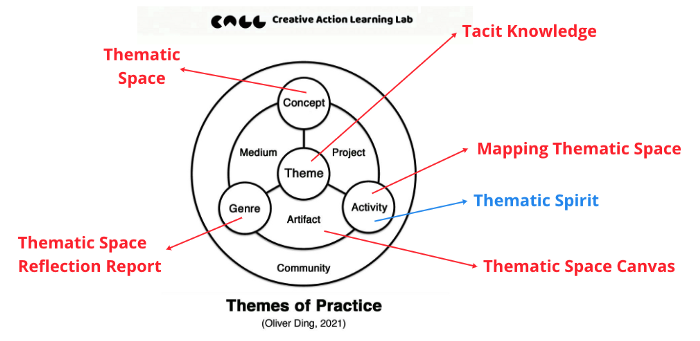
In Feb 2022, I reviewed the Developing Tacit Knowledge project and used the above diagram to curate my creations about Thematic Space. Now I can add “Thematic Spirit” to the diagram.
2.9 The AAS4LT Framework (March 27)
One major milestone of my creative life in the past three months is the AAS4LT Framework (AAS4LT stands for “Anticipatory Activity System for Life Transitions”).
The AAS4LT framework is born from curating insights from both theoretical development and empirical research.
Though most of the ideas are adopted from the Anticipatory Activity System framework and other knowledge frameworks, the whole structure is inspired by an empirical research project about a person’s one-year life transitions.
If you read my articles about the iART Framework, you probably know that The Anticipatory Activity System is an expanded version of the iART Framework which was born from an empirical research project about an adult development program.
I’d like to call the program SSL which stands for Shaper & Supporter Lab. Anyway, it is just a codename. SSL was founded by a friend of mine in April 2021.
My friend started the journey in Feb 2021. Last month, we worked on reflecting on her life transition in the past 12 months. In the process of reflection, I realized that she did two activities during the one-year journey.
- Second-order Activity: She spent several months on Life Discovery.
- First-order Activity: She started the Shaper & Supporter Lab program as a Developmental Project.
I also observed that she also worked hard on modeling her project and storytelling about her life discovery.
This insight inspired me to create the AAS4LT framework on March 22, 2022. This is an awesome discovery!
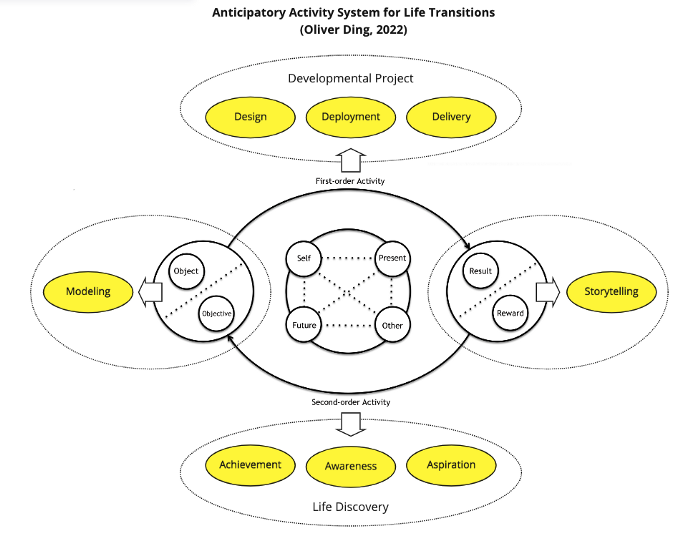
On March 27, 2022, I and my friend had a 90-minute video conversation about her project and the AAS project. It was a wonderful movement for both of us. We were super excited to SEE a real connection between Theory and Practice.
The conversation also inspired me to create a sub-framework for the AAS4LT framework on March 28, 2022.
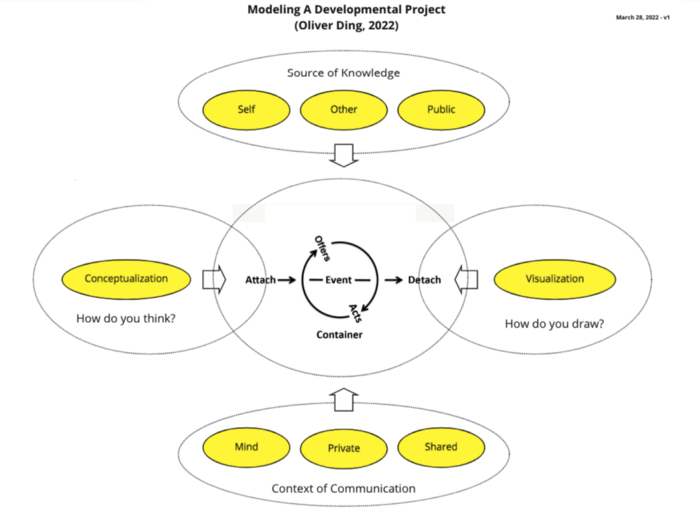
The AAS4LT is an 8-step practical framework. I also design a cyber coaching room for the program on Milanote with one master board and eight sub-boards. Each sub-board focuses on one step.
Step 7 is about Modeling A Developmental Project. To showcase the framework of Step 7, I decided to use the Activity U project as an example.
I spent three days making a board with 315 cards for a three-year reflection. The board collects 74 diagrams, 10 book covers, and 38 links. It’s a biography of the Activity U project (2020–2022).
I shared the board on Linkedin on March 31, 2022.
2.10 The Landscape of Project Network (April 14)
On April 14, 2022, I wrote a short post about “Collective Network of Enterprise” and “Project Network” on Linkedin.
CALL stands for Creative Action Learning Lab which is my personal studio.
Inspired by Howard E. Gruber’s Evolving Systems Approach to the study of Creative Work (1974,1989), I use his idea “Network of Enterprise” to manage my creative work.
On Oct 31, 2021, I used the following picture to curate various projects of CALL. From Oct 2020 to Oct 2021, CALL became a Knowledge Curation Studio that produced a set of knowledge frameworks and built an ecology of ideas. I also wrote seven books which are drafts. In addition, I worked on four independent research projects to test concepts and frameworks.
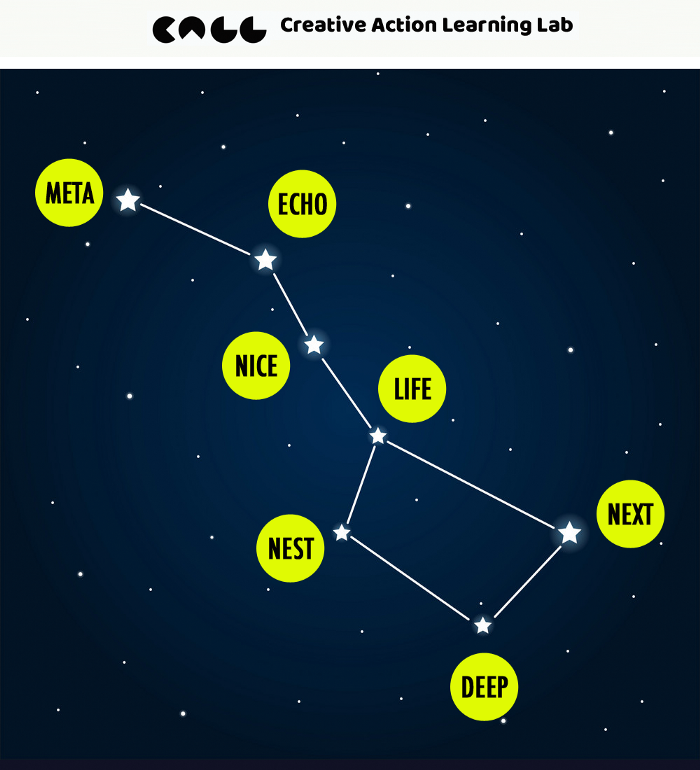
I sort my frameworks into seven enterprises. Each enterprise has a short nickname.
- CALL for ECHO → Boundary Innovation
- CALL for LIFE → Creative Life
- CALL for NICE → Creative Action
- CALL for NEST → Part — Whole
- CALL for DEEP → Supportive Development
- CALL for NEXT → Present — Future
- CALL for META → Meta-knowledge
Each enterprise has its primary theme. Each theme refers to a core framework and a set of related concepts, diagrams, and sub-frameworks.
In the past 6 months, CALL entered a new phase which could be called “Collective Network of Enterprise” or “Project Network”.
Why do I want to use a new term to describe the new phase?
Though my vision is connecting Theory and Practice, I spent the most time on the Theory side in the past years. After Oct 2021, I moved to the Practice side and started working on developing some practical applications.
This decision led to a new life container for me because the “Self — Other” Relevance is changed to “Practice-first”. In the past 6 months, many friends gave me feedback and their feedback guided my creative projects.
Last week I reflected on the new phase and realized that it’s time to detach from Howard E. Gruber’s approach or expand his approach.
Howard E. Gruber’s approach has two aspects: 1) his resources are creators’ private notebooks, documents, and other files, and 2) his focus is individual creators’ cognition development.
The new phase of CALL has two different aspects: 1) CALL’s creative work is live. I shared the whole process of CALL’s creative work on the social web, 2) CALL’s creative work was driven by the “Self — Other” Relevance, not the individual mind.
Maybe we could use “Collective Network of Enterprise” to expand Howard E. Gruber’s approach since his approach was developed in 1974.
Or we can directly use “Project Network” for the Project-centered approach?
The Project-centered approach is based on the two major theoretical resources:
1. Project-oriented Activity Theory (Oliver Ding, 2021) 2. Howard E. Gruber’s Evolving Systems Approach to the study of Creative Work (1974,1989)
I should mention one more thing about the difference between Howard Gruber’s approach and the Project-centered approach.
While Howard Gruber’s approach focuses on great creators such as Charles Darwin, the Project-centered approach aims to focus on professional workers.
In 2009, James C. Kaufman and Ronald A. Beghetto proposed the Four-C model of creativity. The aim of “Pro-c” is to give credit to “amateur” creators and professional creators who are successful but have not reached a level of prominence as eminent creators achieved. This category is a wide spectrum.
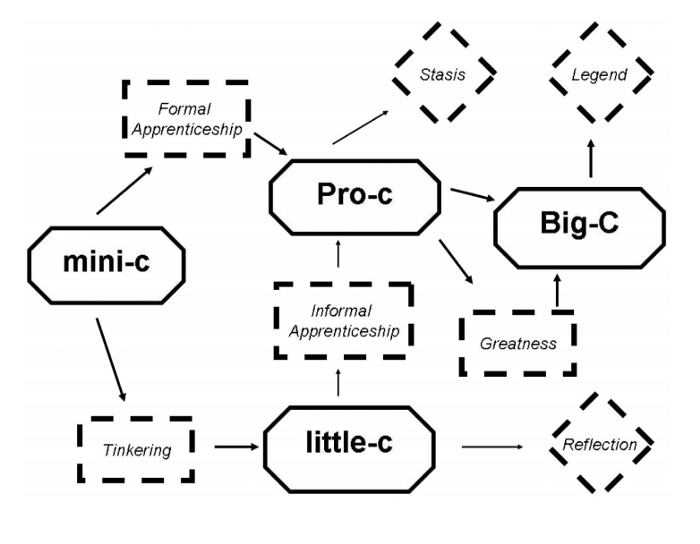
Moreover, the Project-centered approach is about “Life”, not only “Creative Work”.
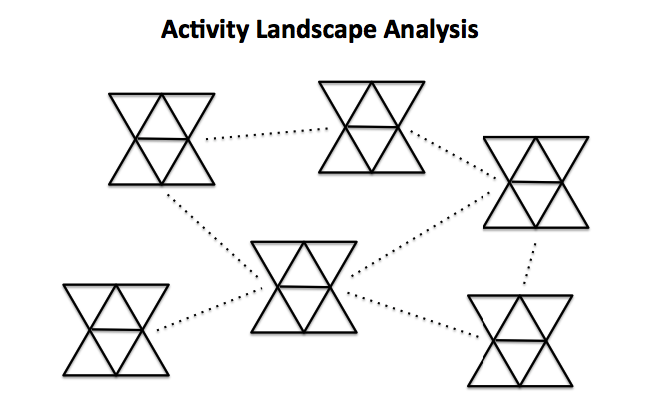
After discussing this topic with some friends on Linkedin, I decided to use “Project Network” for the Project-centered approach.
For the Project-centered approach, a Project is both a personal project and a social project. But the notion of Project Network offers more room for discussing collective impact. The notion of Project Network was inspired by Activity Network. The difference between these two is that the former uses the Developmental Project model as a basic unit while the latter uses the Activity System model as a basic unit.
2.11 The “Domains — Works” Mapping and “Domains (Works)” (April 20)
On April 20, 2022, I wrote a sentence below for an article titled Knowledge Discovery: The “Domains — Works” Mapping.
The Domains — Works mapping can be seen as a nested structure: Domains (Works).
After publishing the article, I realized that this sentence indicates a connection between the following two theoretical approaches:
- The Domains — Works mapping: Activity Theory
- Domains (Works): The Ecological Practice Approach
This is a Significant Insight!
A Significant Insight connects two parts of your life experience and creates a new meaning which could lead to a new life activity, even a life transition.
The article is about the Knowledge Discovery Activity and its canvas. See the picture below.
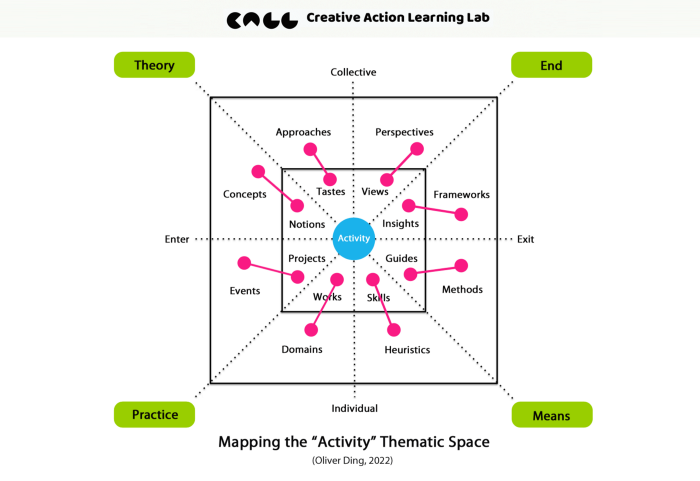
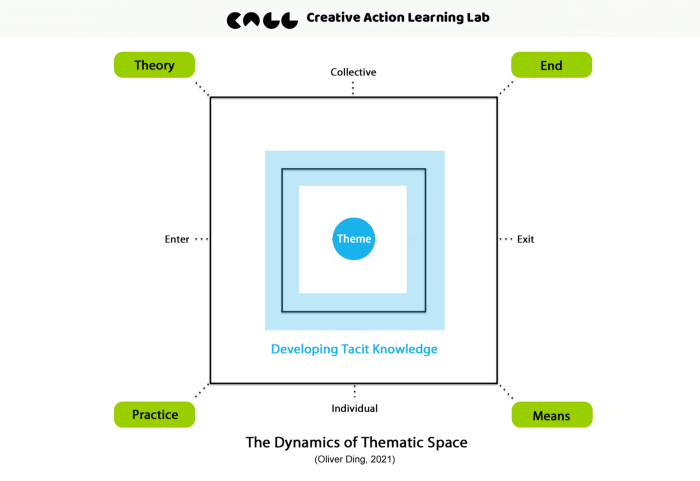
The canvas was designed with two sub-spaces. The highlights a light blue area around the boundary between the inner space and the outer space. That means the Knowledge Discovery Activity is a cross-boundary activity. You can find more details here.
According to Kaptelinin and Nardi (2006), there are five basic principles of Activity Theory:
- Object-orientedness
- Tool mediation
- Internalization — externalization
- The hierarchical structure of activity, and
- Development
We can apply these five principles to discuss the Developing Tacit Knowledge activity. You can find more details here and here. Our discussion about inner space and outer space echoes the Internalization-externalization principle.
For Activity Theorists, there is a debate on the Internalization-externalization principle. Some members pay attention to the paradigm of Internalization while others emphasize the paradigm of Externalization. I support both sides and I think the principle is a whole. We can’t only accept half of the principle.
For Developing Tacit Knowledge, I consider it a self-determined activity with social support. Also, I think there are many paths or strategies for developing tacit knowledge. It all depends on a person’s motivation, situation, and vision.
Thus, the Domains — Works mapping echoes the Internalization-externalization principle of Activity Theory.
The notion of Domains(Works) refers to the Ecological Practice approach which uses “Container” as a core concept. See the diagram below.
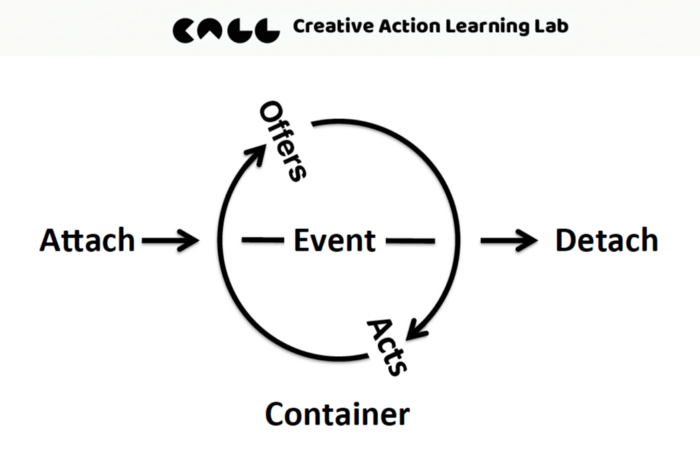
The concept of Container is inspired by George Lakoff and Mark Johnson’s conceptual metaphor Container and image schema Containment.
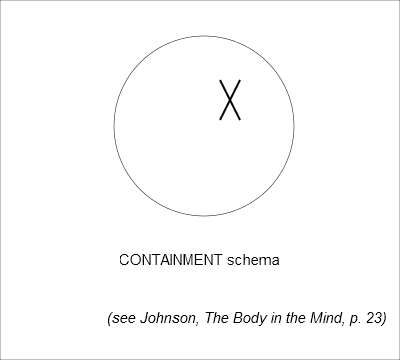
According to Mark Johnson (1987), “If we look for common structure in our many experiences of being in something, or for locating something within another thing, we find recurring organization of structures: the experiential basis for in-out orientation is that of spatial boundedness. The most experientially salient sense of boundedness seems to be that of three-dimensional containment (i.e., being limited or held within some three-dimensional enclosure, such as a womb, a crib, or a room).” He also pointed out there are at least five important entailments or consequences of these recurring experiential image-schematic structures for in-out orientation. (pp.21–22)
For Lakoff and Johnson, Container refers to the in-out orientation and boundary of space. However, I pay attention to the dynamic relationship between Container and the Things it contains. I coined a new term called “Containee” to simply represent “Things contained by Container”.
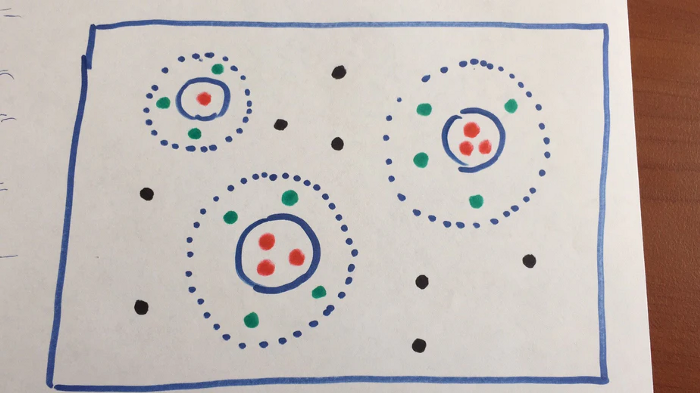
In 2018, I drew the above diagram to present a multiple container model. I used red dots, green dots, and black dots to represent three types of status:
- Red dots: the entities are located in Inside Space.
- Green dots: the entities are located in Spilling Space
- Black dots: the entities are located in Public Space which is outside the Spilling Space.
In 2019, I continuously worked on developing container thinking with the idea of the Container System. Eventually, it became the foundation of my theoretical account: the Ecological Practice approach.
In Feb 2021, I applied the Container Thinking to discuss Platform-based social practice and developed the notion of “Platformba(Platform)”. You can find more details here.
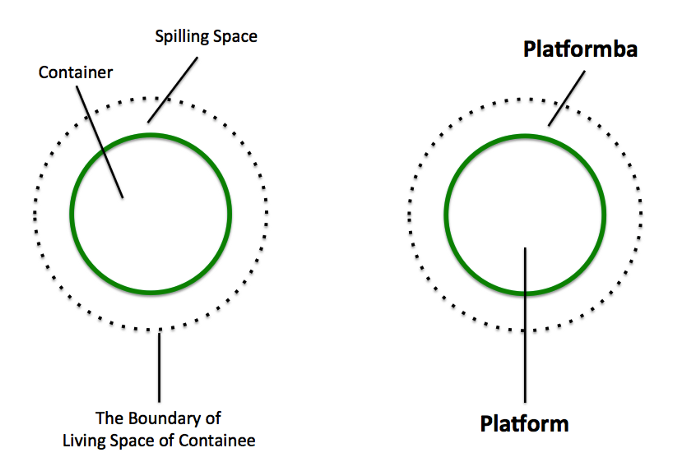
The “ba” is originally found in Japanese. The concept of “ba” has been used extensively by Japanese management researcher Ikujiro Nonaka in his SECI model of knowledge creation. The platform-ba is an emergent social substance that is formed by people who have relations to a platform. While a platform is designed, managed, and controlled by its owner, its platform-ba is determined by people, the users, and stakeholders of the platform. By using the new term Platform-ba, I can highlight the active aspect of platform practice which refers to people’s activity.
The notion of “Domains (Works)” is an application of the above Container Thinking which is the core of the Ecological Practice approach.
What’s the difference between Activity Theory and the Ecological Practice approach?
I have been working on Activity Theory and the Ecological Practice approach which is inspired by Ecological Psychology for many years. Since I know the difference between these two approaches, I carefully maintained the boundary between them.
At the general philosophical level, both Ecological Psychology and Activity Theory share the same view of the inseparability of human beings and the world. Victor Kaptelinin and Bonnie A. Nardi claimed, “In Western thought, the fundamental insight of the inseparability of subjects and objects is expressed, for instance, in the philosophical views of Hegel and Marx, Goethe’s poetry, Brentano’s ‘act psychology’, and the ecological psychology of Gibson.” (2012, p.13)
However, there is an important theoretical difference between Ecological Psychology and Activity Theory. Activity theorists define the “activity” as “object-oriented”, according to Leontiev, “Any activity of an organism is directed at a certain object; an ‘objectless’ activity is impossible” (Leontiev, 1981).
Ecological psychologists don’t use “activity” as a theoretical concept, they use “action” and “activity” interchangeably.
One of the important concepts of Ecological Psychology is the concept of Affordance.
Activity theorists use “activity — action — operation” as three levels of the hierarchy of activity theory and they tend to adopt the idea of affordance at the operation level. I suggested another way to adopt the concept of affordance to Activity Theory. Instead of matching the existing three levels of the hierarchy of activity, the concept of affordance can be considered as a new level for extending the scope of the hierarchy of activity.
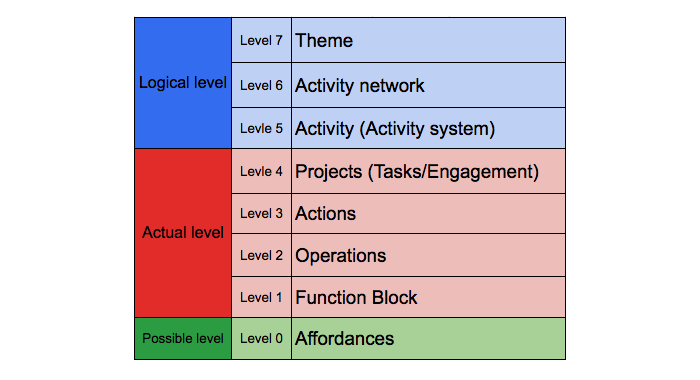
Why do I add the idea of affordance to the hierarchy of activity and practice? I think the value is it could expand the scope of the hierarchy from “actual” to “possible” because affordance refers to “action possibilities.” Eventually, I develop “logical — actual — possible” as three levels of hierarchy for the Ecological Practice approach. You can find more details here.
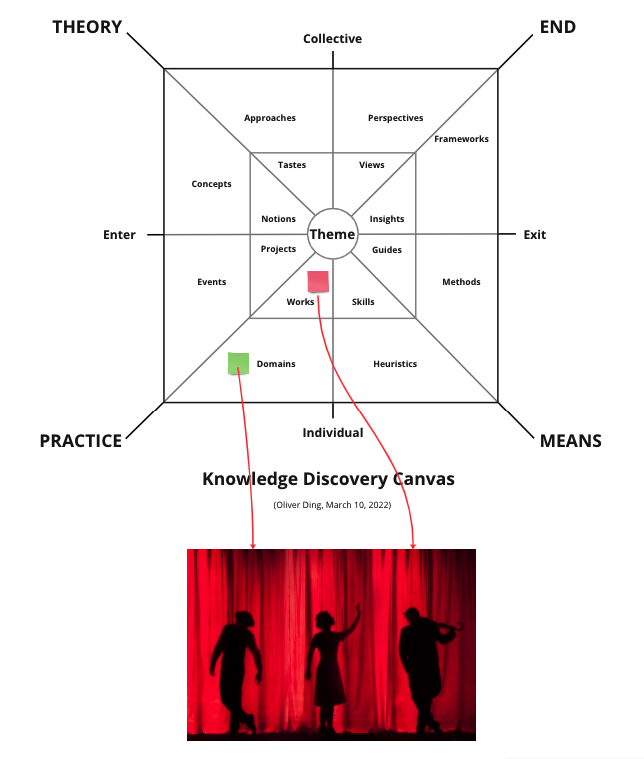
The discussion about the “Domains — Works” mapping and the notion of Domains (Works) connects the above two theoretical approaches.
2.12 The Notion of “Activity as Project Engagement”
On April 21, I worked in a room without the Internet. I read a thesis which was written by an activity theorist who is researching design.
In the past three years, I have been reading many papers and books about Activity Theory. I also wrote two books-in-drafts about Activity Theory and built a website called Activity Analysis.
However, I still can capture a significant insight while I was reading a piece about the historical development of Activity Theory in the thesis.
I started working on my notebook and drew a diagram with a technique called Deep Analogy.
On April 22, 2022, I reproduced the diagram on Milanote. See the link below.
What’s the outcome of this action?
I realized that my approach to Activity Theory should be called “Activity as Project Engagement” and my primary theme is “Engagement”, not “Project”.
This is a significant insight because it changes my view on my work: the Project Engagement approach and its toolkit. If you read my 2021 book Project-oriented Activity Theory and will find many diagrams. One set of diagrams looks like the diagram below. I developed these diagrams for the Cultural Projection Analysis method.
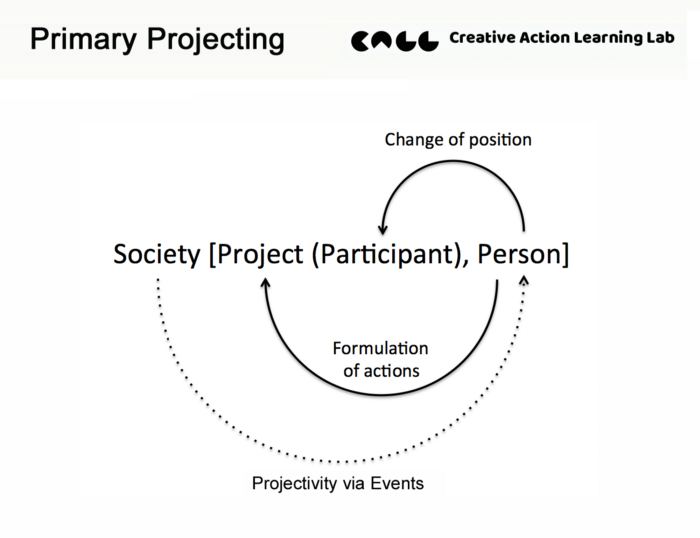
If you visit the page about the Project Engagement Toolkit, you can’t find the above diagram there because I didn’t consider it as a primary diagram for the toolkit and the whole approach.
Thus, I didn’t have a clear idea about the concept of “Engagement” when I used the word to name the Project Engagement approach in 2021.
In the past three months, I developed the “Engagement as Projection” principle for the Life-as-Project approach. You can see more details here.
Now I have a new idea for the concept of “Engagement” and it refers to the notion of “Projectivity — Projecting — Projection”.
A project is a container of cultural themes which will attract a person. By participating in the project, the person could enhance his life themes or expand his life themes.
A person is attracted by a project through its identity and his Identity could be shaped by the project. On the other side, the actions of the person also could shape the Identity of the Project.
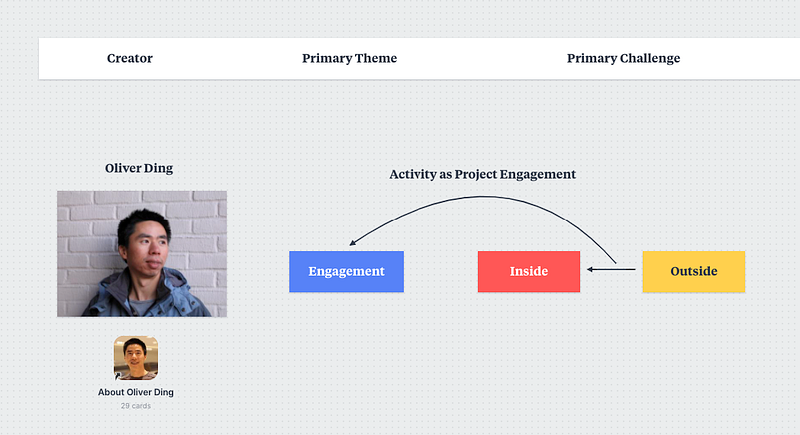
Thus, The “Engagement as Projection” Principle echos the “Internalization — externalization” principle of Activity Theory. However, I use “Outside — Inside” to highlight the boundary of social spaces.
Part 3: Reflection
Now we have 12 examples of significant insights. We can use them to develop a method for analyzing significant insights.
Let’s start with the following heuristic tool:
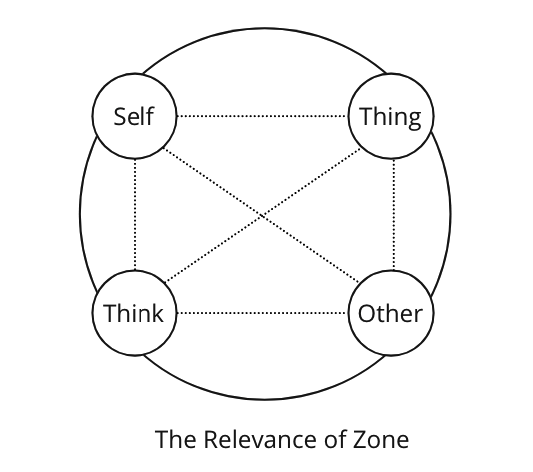
The above model is called the Relevance of Zone which considers Other as an important social context for the long-term development of thoughts. You can find more details here.
Based on the model, we can generate the following questions:
- Other: Who is the Significant Other for this insight?
- Thing: What’s the insight about? Why do I pay attention to it?
- Think: How did I get this insight? Is there a technique behind the process?
- Self: Where did I capture this insight?
- Self: When did I capture this insight?
- Activity: Is this insight part of an activity? What’s the activity?
- Activity: Has this insight led to a new action or a new activity?
There are many heuristic tools for reflections. For example, the Five Ws method answers five questions starting with an interrogative word:
- Who
- What
- When
- Where
- Why
Sometimes people also add how to the list.
Why do I choose the Relevance of Zone for this task? Because it is related to the Anticipatory Activity System (AAS) framework.
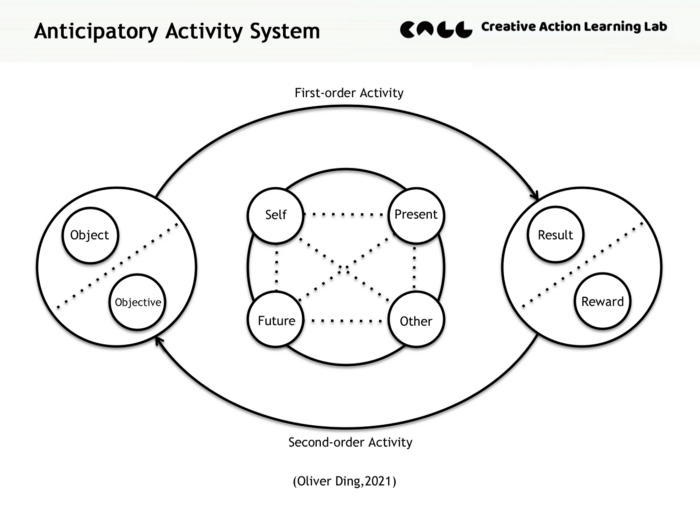
As mentioned above, I used the notion of “Significant Insights” for the Life Discovery Activity and consider it an important outcome of the activity.
From the perspective of the Anticipatory Activity System (AAS) framework, a Second-order Activity leads to the Objective and the Object of a First-order Activity. If we consider Life as an Anticipatory Activity System, then the Life Discovery Activity is a Second-order Activity.
Thus, a Significant Insight could directly or indirectly lead to a new activity. We don’t have to claim an insight as a significant insight when we are capturing an insight. We can reflect on our past experiences and identify significant insights if they lead to activities that change our life.
By using the Relevance of Zone, we can also analyze the impact of Significant Other. In this way, this task contributes to the development of the AAS framework too.
Now we have a plan for a new task. Let’s answer the above questions in the next article.
Related Articles
- The Project Engagement Toolkit (2022)
- Life Discovery: The Life-as-Project Approach
- The Life Discovery Toolkit (v1)
- The Life Discovery Canvas (v1.0) — Part 1: Theoretical Background
- The Life Discovery Canvas (v1.0) — Part 2: Spatial Structure
- The Life Discovery Canvas (v1.0) — Part 3A: Concepts (THINK and LEARN)
- The Life Discovery Canvas (v1.0) — Part 3B: Concepts (SAY and DO)
- The Life Discovery Canvas (v1.0) — Part 4: Inspirations
- Life Discovery: The “Being by Doing” Principle
- Life Discovery: The “Performance as Experiment” Principle
- Life Discovery: The “Engagement as Projection” Principle
- Life Discovery: The “Discovery as Development” Principle
- CALL for LIFE: Anticipatory Activity System for Life Transitions
- CALL for LIFE: Modeling A Developmental Project
- CALL for LIFE: Oliver Ding @ 2021 and Second-order Activity
I am also working on building a new website for the Platform Ecology project. You can save the following links:
- PlatformEcology.org
- Twitter: @PlatformEcology
- Linkedin: @PlatformEcology
You are most welcome to connect via the following social platforms:
Linkedin: https://www.linkedin.com/in/oliverding Twitter: https://twitter.com/oliverding Polywork: https://www.polywork.com/oliverding Boardle: https://www.boardle.io/users/oliver-ding


