
Python Complete Beginner to Expert Course
Master Python programming language from basic to professional level.

Before we start let me tell you that:
- You can access the complete course easily using the following list.
- This article is also available as a YouTube video here.
Introduction
First, let me congrats you because you decided to learn Python, the programming language number one in the world.
I know that the first question that is in your mind is, why do I have to learn Python?
So let me answer you,
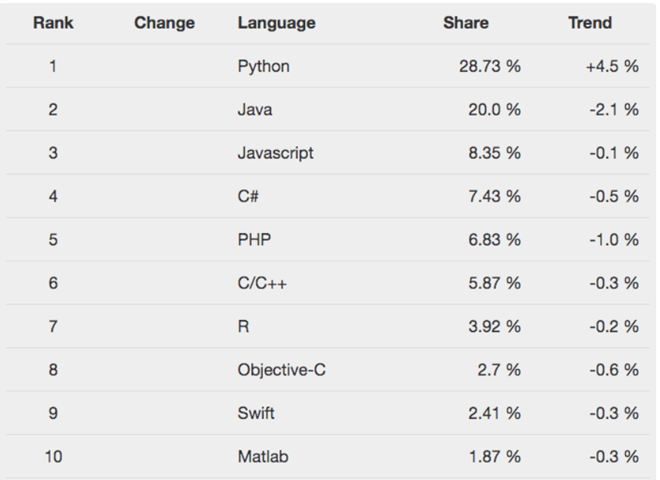
According to PYPL, the popularity of programming language index, Python is the most popular programming language, and it’s the fastest-growing language, based on search engine searches for various programming languages. Refer to Figure 1.
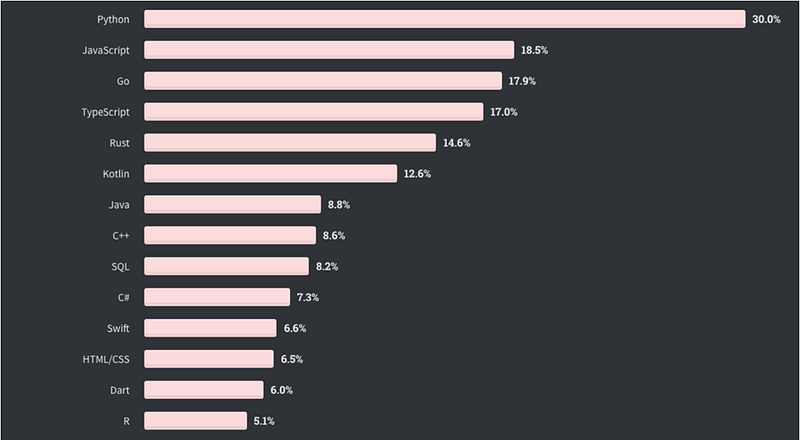
Also, according to the 2020 Stack Overflow Developer Survey, developers who are already working with other programming languages are most interested in learning Python in the future. Refer to Figure 2.
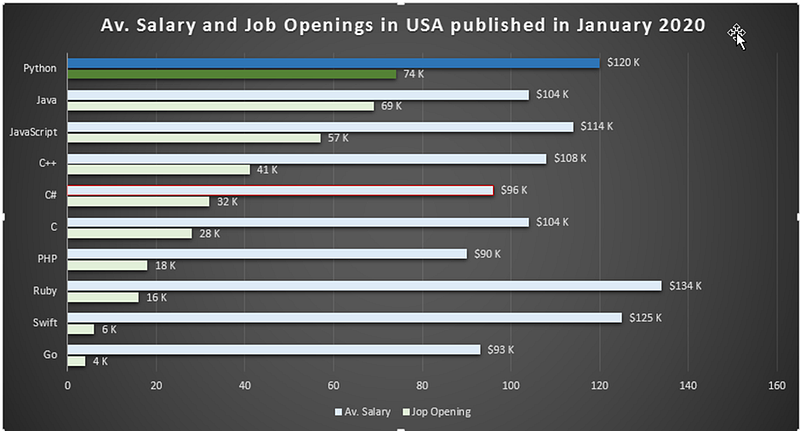
In addition to that, according to Indeed.com, one of the most famous employment websites, Python is at the top of several job openings charts with an average salary of 120k USD per year for a Python developer. Refer to Figure 3.
Above all that, Python is super easy to learn and very flexible to use.
Now the big question is, who is this course for?
This course assumes that you don’t have any previous knowledge, not only in Python but even in the programming itself.
So if you are:
- A college student who wants to better understand Python.
- An employee who wants to pursue a career in artificial intelligence, machine learning, data science, or back-end web development.
- A programmer who wants to shift from another programming language to Python programming language.
- A Python developer who wants to leverage up his skills in Python.
Therefore, this course has been perfectly designed for you and it has been packed with little-known tips, best practices to apply, and common mistakes to avoid.
In future articles, you will learn how to get Python installed and how to get PyCharm installed on your machine regardless of the operating system that you use.
After that, you will learn about:
- Basics of Python Syntax.
- Data structures.
- Flows control.
Next, you will start to learn about more advanced topics like:
- Error handling.
- Generators.
- Comprehensions.
- Date and Time.
- Project structure and the correct way to structure your project and Python.
So what are you waiting for? Join me in this course and start the exciting learning journey.
You can access the complete course easily using the following list.
In the end, I would like to thank you very much for reading this article, and I will be very glad if you join my newsletter to keep you posted about all my future articles and events.
WAIT WAIT Pls, if you like my article and would like to see more useful content in the future, would you please support me. There are several ways to do that:
- Like the post and share it with your friends.
- Follow my Medium account to receive my future stories quickly.
- Become one of my supporters in kofi (one-time donation or monthly subscription).
- Join Medium via my referral link.
Also, if you have a project or you are planning to up-skill yourself or your tech team in the field of software engineering, machine learning, data science, or industrial automation, visit our website and we will be glad to work together.
To move on to the next article, you can use the following link:
Part 1: Python Complete Course
The complete course list can be accessed here
Course Index (The article link will be active once it is published):
- Section1: Introduction to Programming
Part 1: Introduction to Programming
Part 2: Computer Algorithms
- Section2: Introduction to Python
Part 3: What Python Is
Part 4: Python Setup on Windows
Part 5: Python Setup on Linux
Part 6: Python Setup on MacOs
Part 7: Run the First Program in Python
- Section3: Basics of Python Syntax
Part 8: Python Identifiers
Part 9: Comments in Python
- Section4: Numbers in Python
Part 10: Introduction to Variables, Data Structures and Operators
Part 11: Python Numbers
Part 12: Arithmetic Operators
Part 13: Comparison Operators
Part 14: Logical Operators
Part 15: Bitwise Operators
Part 16: Assignment Operators
Part 17: Operators' Priorities
Part 18: math Module
Part 19: random Module
- Section5: Collections in Python
Part 20: Python Collections
Part 21: Python Strings
Part 22: Python Strings Functions
Part 23: String Formatting
Part 24: Python Lists
Part 25: Python Lists Functions
Part 26: Python Tuples
Part 27: Python Dictionaries
Part 28: Python Sets
Part 29: Casting in Python
Part 30: Copy in Python
Part 31: Lines in Python
- Section6: Conditional Statements in Python
Part 32: Program Execution Flow Control
Part 33: Python Conditional Statements
Part 34: The Ternary Operator
- Section7: Iteration and Loops in Python
Part 35: Loops in Python
Part 36: Iteration, Iterable, and Iterator in Python
Part 37: Loops Jump Statements
Part 38: Useful Functions with Loops
Part 39: Overall First Part Challenges
- Section8: Functions in Python
Part 40: Introduction to Functions
Part 41: Arbitrary Arguments and Keyword Arguments
Part 42: lambda Functions
Part 43: Decorators in Python
- Section9: Comprehensions in Python
Part 44: Comprehensions in Python
- Section10: Generators in Python
Part 45: Generators in Python
- Section11: Exceptions in Python
Part 46: Exceptions Handling in Python
- Section12: Files and Folders in Python
Part 47: Introduction to Files and Folders
Part 48: os Module
Part 49: os.path Module
Part 50: CRUD Files
Part 51: with Keyword with Files
- Section13: pickle Module
Part 52: pickle Module
- Sectioon14: Date and Time in Python
Part 53: Introduction to Date and Time
Part 54: datetime Module
- Section15: Modules and Packages in Python
Part 55: Introduction to Project Structure in Python
Part 56: Working With Modules and Packages in Python
Part 57: Namespaces and Scopes in Python
- Section16: Course Conclusion
Part 58: Course Conclusion


