
What Python Is: Python Complete Course — Part 3
Before we start let me tell you that:
- This article is a part of the Python Complete Beginner to Expert Course which you can find it here.
- This article is also available as a YouTube video here.
Introduction
First of all, let me ask you:
Are wondering why you have to learn Python? If the answer is yes, let me tell you that this article is going to answer exactly this question.
This article will cover the following outlines:
- What Is Python?
- History of Python
- Python Features
- Python Users
- Why You Have to Learn Python?
- Companies That Use Python
So let us get started …
1. What Is Python?

Python is a high-level programming language that is designed to be highly readable, where it uses English keywords frequently instead of using the machine language (binary language). Moreover, Python is an interpreted programming language, which means that the translator type in the case of Python is an interpreter and is not a compiler.
Also, Python supports object-oriented programming (OOP) and scripting programming.
If the term OOP is confusing for you, do not worry:
- OOP is a new style of programming where we define our program as a set of abstract classes representing abstract concepts in our life.
- Whereas scripting is the old style in which we write our program in freestyle without any kind of abstraction.
For more information about object-oriented programming in Python visit my course:
The Complete Course in Object Oriented Programming in Python.
Now let us talk a little bit about the history of this language.
2. History of Python
When we talk about Python programming language, we have to mention Guido van Rossum who is the developer of this language that had been developed in the late 18th — early 9th at the National Research Institute for Mathematics and Computer Science in the Netherlands.

Also, Python is considered relatively new compared to other older programming language as C and C++.
Next, we will talk quickly about some Python advantages.
3. Python Features

- Very easy to learn: where it uses English keywords frequently, and in some places when you write your code in Python, you will feel that you write in English, not in a programming language.
- A dynamic data type: which means that when you want to define a new data value, you don’t have to specify the type of this value (just define the value). Later on, the interpreter will take the responsibility to determine the data type from the data value itself.
- A portable programming language: For example, when you write your program on a Windows platform, you can simply take this program and run it on a Linux or Mac platform with no change.
- An extensive programming language: this feature is quite important since it allows us to write an interface to other programs written in other programming languages like C++ which we can take the benefit from the speed of C++.
- A free and open-source programming language: which means that you don’t have to pay if you want to use this language, its built-in libraries, or any of its third party developed and published online libraries.
All of these features make Python one of the most common programming languages. Now, let us see in more detail who can use Python?
4. Python Users

If you are one of the following or if you are planning to be one of the following:
- Data Engineer
- Data Analyst
- Data Scientist
- Machine Learning Engineer or Researcher
- Deep Learning Engineer or Researcher
- Web Developer
- Software Developer
Then Python is a great tool for you. It makes your life easier and it is a very great skill to shine up in your CV.
After we have seen the great features of Python and who can use it, it is time to speak about Python in numbers language.
5. Why do You Have to Learn Python?
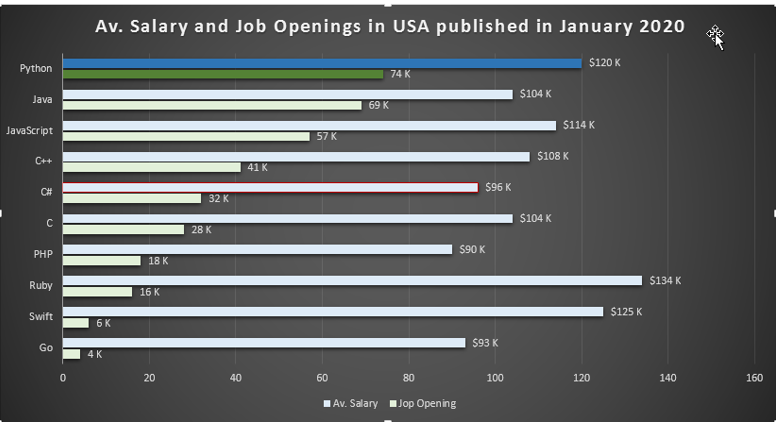
In January 2020, Python has the highest number of job openings in the United States of America around (74k) job openings, according to indeed.com (one of the biggest recruitment companies in the world).
In addition, a Python developer’s salary is one of the top (30) salaries of developers use in the USA around (120k) US dollars per year. Refer to Figure 1.
Keep in mind that today is the era of Data Science, Artificial Intelligence, Machine learning, and Deep Learning in which Python is considered the programming language number one in the world to be used in these fields.
In my opinion, High Demands and High salaries are more than enough reasons to start your journey to learn Python today.
Finally, we must know the companies that Python is one of their tech-stack languages.
6. Companies That Use Python
Nowadays many companies use Python as a programming language in their tech stack like Google, Spotify, Facebook, Dropbox, Quora Instagram, Netflix, and others. Refer to Figure 2.
Now, let us summarize what we have learned in this article:

- Python is a high-level and interpreted programming language.
- Python has been developed by Guido van Rossum.
- It has many features including easy learning, dynamic data types and many more.
- High Demands and High salaries are more than enough reasons to start your journey to learn Python today.
P.S.: A million thanks for your time reading my story. Before you leave let me mention quickly two points:
- First, to get my posts in your inbox directly, would you please subscribe here, and you can follow me here.
- Second, writers made thousands of $$ on Medium. To get unlimited access to Medium stories and start earning, sign up now for Medium membership which only costs $5 per month. By signing up with this link, you can directly support me at no extra cost to you.
To get back to the previous article, you can use the following link:
To move on to the next article, you can use the following link:


