
Public Education Needs An Adapted Learning Plan
Our education system needs remedial instruction to catch up

Our public education system needs a remedial learning plan. The way school staff are taught is so out-dated, they need a plan to help them catch up. I feel like I need to write some IEP or adapted learning goals for public schools.
Every time I meet with a family I come away shaking my head at the language and approaches still being used in our children’s classrooms. Public education is decades behind the evidence-based practices, predominately behaviour-focused, with little to no understanding of creating a sense of felt safety.
Our school staff seem to lack knowledge about relationship-based education and co-regulation. They lack even the most basic understanding of what dysregulation and stress behaviours look like, or how to respond in a way that doesn’t escalate the situation.
Please know, this is not meant to knock teachers and staff. I promise I know full well how horribly our government has mismanaged education funding, how over-worked and under-resourced our school staff are.
This is a major systemic issue with the way school staff are trained and how school funding is distributed.
I also wonder if our Minster of Education is aware that Educational Assistants (EAs) are often not offered continuing education and PD Day opportunities? (Probably not, although it’s his job to know).
I understand we have staffing shortages and there’s only so much coverage to go around. As the staff working with our most vulnerable students, there absolutely must be minimum standards for qualifications, continuing education, and professional development for all Educational Assistants (and as such, they should be compensated accordingly).
I share with you my primary concerns and learning goals for our education system, and the adaptations required to reach them.
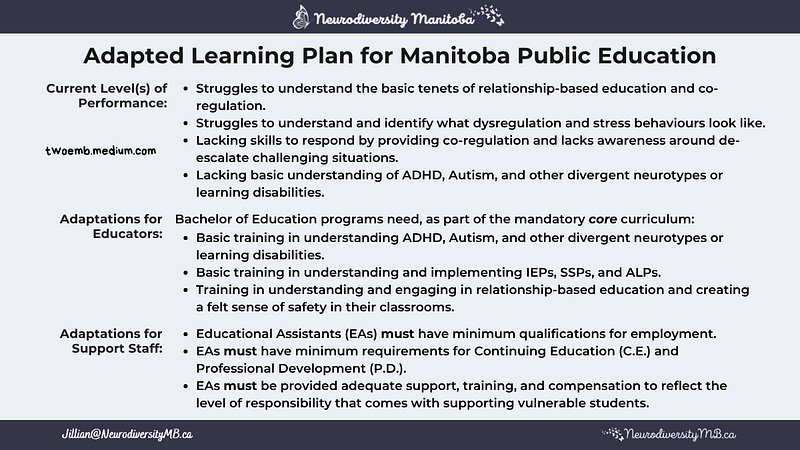
3) Struggles to understand the basic tenets of relationship-based education and co-regulation.
- Training in understanding and engaging in relationship-based and trauma-informed education, and creating a felt sense of safety in their classrooms.
- Training in understanding and addressing challenging behaviours, what stress and dysregulation look like, and how to co-regulate with and competently support students experiencing intense emotions.
2) Lacks basic understanding of ADHD, Autism, divergent neurotypes, and learning disabilities.
- Basic training in understanding and implementing Individual Education Plans (IEPs), Student-Specific Plans (SSPs), and Adapted Learning Plans (ALPs).
- This is especially important for administrators and case managers, who are responsible for overseeing the creation of these plans, sharing relevant information with colleagues, and ensuring the student’s plans are being followed and their needs are being met.
- Basic training in understanding ADHD, Autism, and other divergent neurotypes or learning disabilities.
1) Professional Development must be made available to all staff.
- Educational Assistants (EAs) must have minimum qualifications for employment.
- EAs must have minimum requirements for Continuing Education (C.E.) and Professional Development (P.D.).
- EAs must be provided adequate support, training, and compensation to reflect the level of responsibility that comes with supporting vulnerable students.
- Administrators and supervisors are responsible for ensuring their staff have adequate support and coverage to attend P.D.s relevant to their roles and responsibilities.
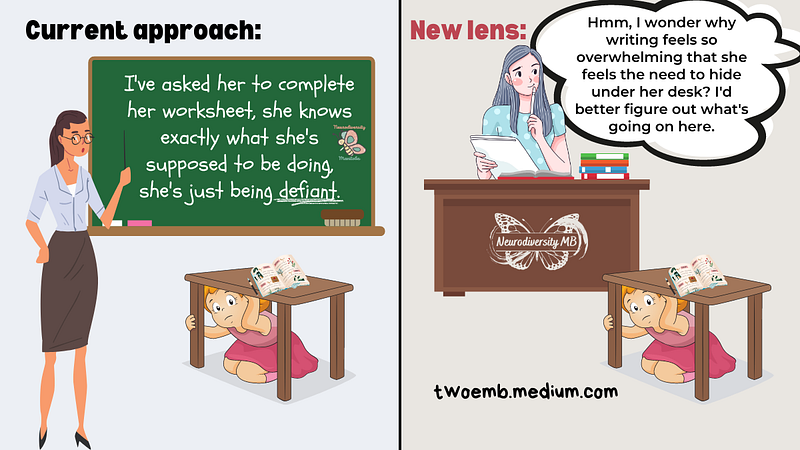
School staff desperately need a lens change
One thing that is extremely difficult to quantify is the lens through which adults view children’s behaviour. In schools there is an overwhelming attitude that “misbehaviour” is intentional and willful.
There appears to be a lack of true understanding about stress and dysregulation, and the ways they often show up in children’s behaviours.
There is still much too great a focus on modifying behaviours, gaining compliance, and teaching neurodivergent and disabled children to behave as “normally” (i.e. as non-disabled and neurotypical) as possible.
Not only does it hinder our effectiveness (and our patience and compassion) when we view children’s behaviours in the most negative possible light, it also increases our own stress and frustration levels, causing us to become dysregulated too.
Change starts at the top
I want to reiterate that any time I criticize public education and our school system, I am not intending to personally attack or disrespect individual staff members or educators. They’re the ones on the front line, working in this broken system, trying to make a difference in the lives of their students.
Many school staff are fighting for change from the inside, but are met with resistance; hindered by politics and bureaucracy. Systems are incredibly difficult to change, especially one which is functioning as intended.
The ways teachers and school staff interpret and explain children’s behaviour come from how they are educated, trained, and from the toxic culture which exists across the public education system as a whole (some schools are worse than others, but they all desperately need help to change).
Schools were not created to help children flourish, to allow them to explore their curiosity and creativity. Public education was not created to nurture our children, nor to encourage their independence and autonomy.
Quite the opposite, in fact.
Schools were primarily created as giant daycare centres when mothers began entering the workforce because all eligible men were being sent off to war. They needed somewhere for the children to go so women could contribute to the war efforts (and capitalism).
The way curriculums were developed was to indoctrinate students, and teach them how to become either good little soldiers, or good little factory workers.
Although it may seem a lot has changed in 100 years, I promise you there remain more similarities than differences.
© Jillian Enright, Neurodiversity MB
Related Articles
When you join medium, as a member you’ll have access to unlimited reads for only $5 per month. If you use my referral link, I’ll earn a small commission, and you’ll earn my undying gratitude.
If you’d prefer give a one-time tip, you can support my writing on Ko-Fi — also, it’s free to follow me on Facebook and LinkedIn!
Learn more
References
Illich, Ivan. (1970). Deschooling Society. Marion Boyars Publishing Ltd.
Shanker, S., & Barker, T. (2017). Self-Reg: How to help your child [and you] break the stress cycle and successfully engage with life. Penguin Random House LLC. https://www.goodreads.com/book/show/27774752-self-reg
Waltz, M. (2020). The production of the ‘normal’ child: Neurodiversity and the commodification of parenting. In Bertilsdotter Rosqvist, H., Chown, N., & Stenning, A. (Eds). Neurodiversity Studies: A new critical paradigm. Routledge.


