
Life Strategy: Moving between Thematic Spaces
The “Project Network” Perspective
In April 2022, I reflected on the development of CALL (Creative Action Learning Lab) from Oct 2021 to April 2022.
Though my vision is connecting Theory and Practice, I spent the most time on the Theory side in the past years. Inspired by Howard E. Gruber’s Evolving Systems Approach to the study of Creative Work (1974,1989), I used his idea “Network of Enterprise” to manage my creative work.
Before Oct 2021
On Oct 31, 2021, I used the following picture to curate various projects of CALL. From Oct 2020 to Oct 2021, CALL became a Knowledge Curation Studio that produced a set of knowledge frameworks and built an ecology of ideas. I also wrote seven books which are drafts. In addition, I worked on four independent research projects to test concepts and frameworks.
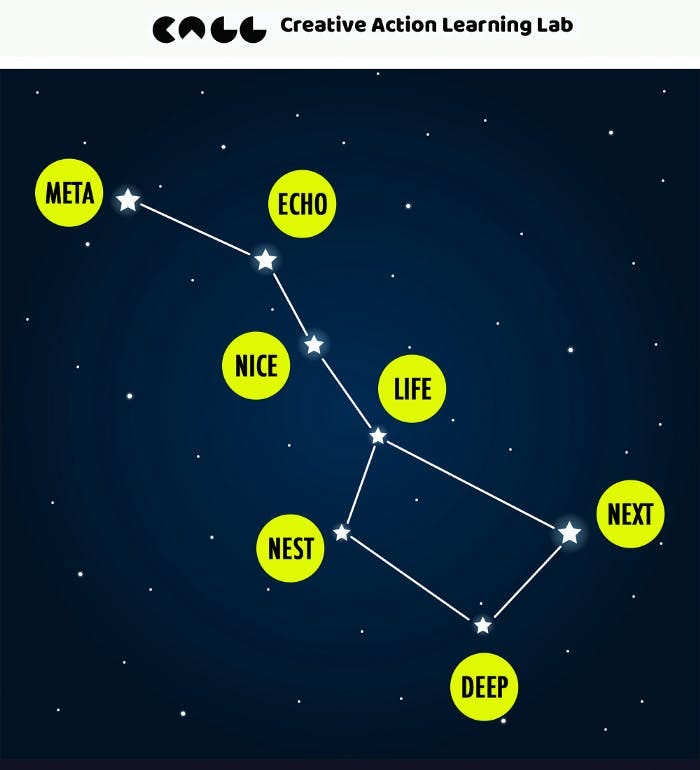
I sort my frameworks into seven enterprises. Each enterprise has a short nickname.
- CALL for ECHO → Boundary Innovation
- CALL for LIFE → Creative Life
- CALL for NICE → Creative Action
- CALL for NEST → Part — Whole
- CALL for DEEP → Supportive Development
- CALL for NEXT → Present — Future
- CALL for META → Meta-knowledge
Each enterprise has its primary theme. Each theme refers to a core framework and a set of related concepts, diagrams, and sub-frameworks.
After Oct 2021
After Oct 2021, I moved to the Practice side and started working on developing some practical applications.
This decision led to a new life container for me because the “Self — Other” Relevance is changed to “Practice-first”. From Oct 2021 to April 2022, many friends gave me feedback and their feedback guided my creative projects.
In April 2022, I reflected on the new phase and realized that it’s time to detach from Howard E. Gruber’s approach or expand his approach.
Howard E. Gruber’s approach has two aspects: 1) his resources are creators’ private notebooks, documents, and other files, and 2) his focus is individual creators’ cognition development.
The new phase of CALL has two different aspects: 1) CALL’s creative work is live. I shared the whole process of CALL’s creative work on the social web, 2) CALL’s creative work was driven by the “Self — Other” Relevance, not the individual mind.
I should mention one more thing about the difference between Howard Gruber’s approach and the Project-centered approach. While Howard Gruber’s approach focuses on great creators such as Charles Darwin, the Project-centered approach aims to focus on professional workers.
The Project-centered Approach
On Jan 18, 2022, I created the new version of the Project Engagement Toolkit (2022) which is a project-oriented toolkit for theory-based reflection and study. It is a major outcome of the Activity U project because it connected the following two theoretical approaches of Activity Theory and offers a series of tools for practitioners.
- The Activity System Model (Yrjö Engeström, 1987)
- Activity as Formation of Concept (Andy Blunden, 2010, 2012, 2014)
Originally, I used “Project Engagement” as the name of Part 3 of the book Project-oriented Activity Theory and it refers to a set of my ideas for expanding Andy Blunden’s original approach about Project as a unit of analysis of Activity and Activity as Formation of Concept. The most important difference between Blunden’s original approach and my interpretation is that his vision is developing a general interdisciplinary theory of Activity as a meta-theory. However, my vision is to adopt his meta-theory and develop some frameworks and models for practical studies. You can find more details here.
In 2021, I moved in the direction of supporting knowledge workers and creators. I realized that the Project Engagement Toolkit has significance for practitioners. It is not a pure application of Activity Theory.
In Thematic Space: The Project Engagement Toolkit for Creators, I discussed my “Project” thematic space and highlighted the following three points:
- First, the Developmental Project Model is an independent framework.
- Second, there is a concept called Projectivity behind the module 4 Zone of Project and the module 5 Developmental Project Model.
- Third, I also adopted Howard E. Gruber’s Evolving Systems Approach to the study of Creative Work (1974,1989) for module 6.
In Feb 2022, I worked on the Life Discovery project and developed a toolkit and a canvas for the project. I also developed the Project-centered approach. Originally, the Project Engagement toolkit was born from the work of Project-oriented Activity Theory. Now, it is an instrument for practitioners.
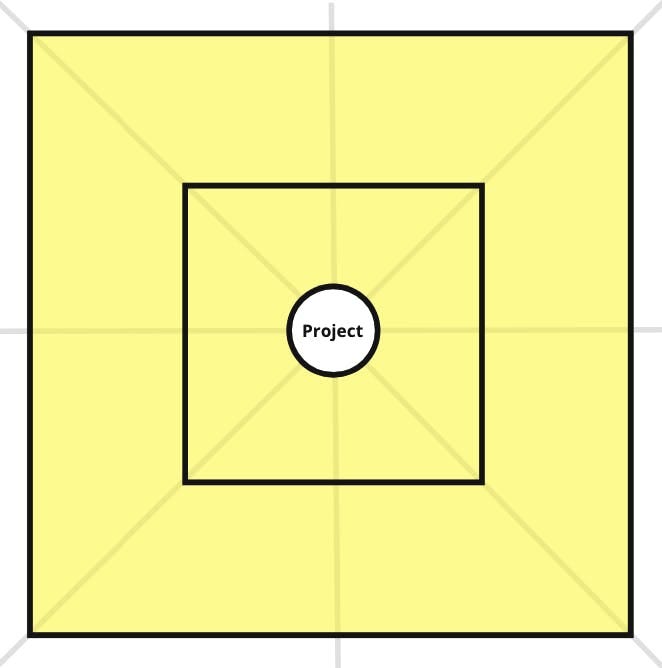
The Life-as-Project approach continuously expands my “Project” thematic space. It seems that I am building a Project-centered approach.
The Project-centered approach is based on the two major theoretical resources:
- Project-oriented Activity Theory (Oliver Ding, 2021)
- Howard E. Gruber’s Evolving Systems Approach to the study of Creative Work (1974,1989)
After discussing it with friends, I decided to use the term “Project Network” for the Project-centered approach.
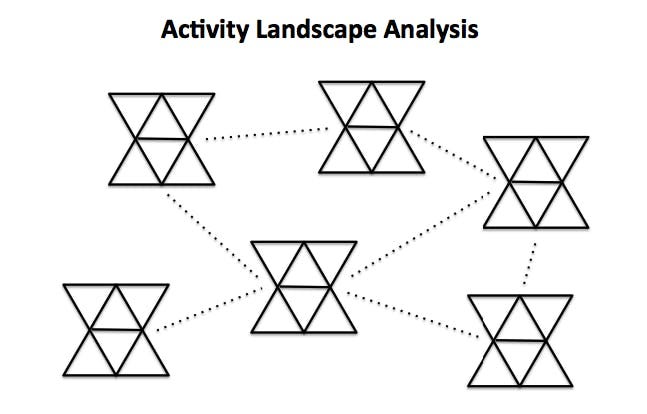
For the Project-centered approach, a Project is both a personal project and a social project. But the notion of Project Network offers more room for discussing collective impact. The notion of Project Network was inspired by Activity Network. The difference between these two is that the former uses the Developmental Project model as a basic unit while the latter uses the Activity System model as a basic unit.
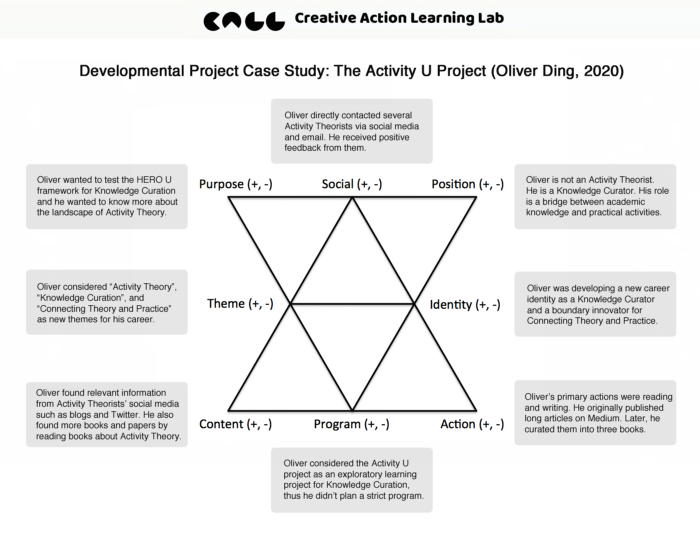
The above diagram is a case study of the Developmental Project Model.
The Model of “Project Network”
In May 2022, I started considering the Project-centered approach for CALL’s development.
On May 6, 2022, I shared the following model in CALL: How to Grow A Knowledge Enterprise.
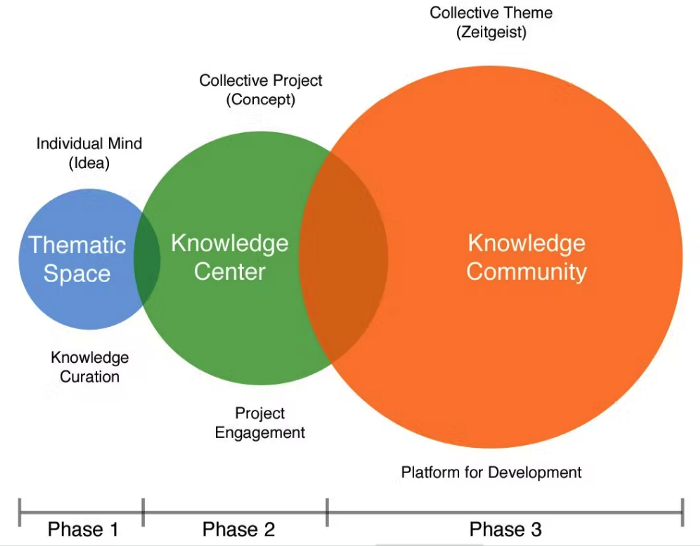
While I keep the term “Knowledge Enterprise”, the whole model goes beyond the individual creative person. It considers the developmental path of “Thematic Space > Knowledge Center > Knowledge Community” for a Knowledge Enterprise.
Howard E. Gruber’s Evolving Systems Approach to the study of Creative Work (1974,1989) is only suitable for phase 1. While Howard Gruber’s approach focuses on great creators such as Charles Darwin, the Project-centered approach aims to focus on professional workers.
The notion of “Project Network” and the above model of “Knowledge Enterprise” led to the following diagram:
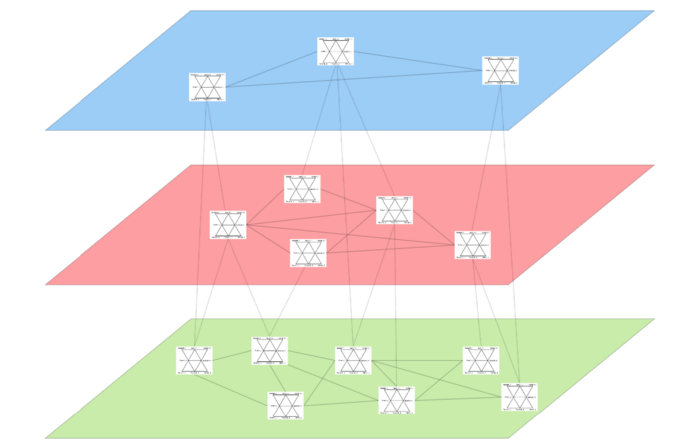
The Model of “Project Network” is for discussing the idea of “Knowledge Center”. It’s a multiple-level network, not a one-level network.
- A Network of Themes
- A Network of Knowledge Centers
- A Network of People
Each level refers to one type of Project. The “Themes” level refers to “Concept as Project”. For example, “TEDx” and “Startup Weekend” are Concepts, and the global TEDx community is a large project. The global Startup Weekend community is a large project too.
The “Knowledge Centers” level refers to “Center as Project”. For example, Each local TEDx program and each local Startup Weekend chapter are local projects.
The “People” level refers to “Engagement as Project”. For example, if a person joins a local TEDx team as a volunteer, she can consider her own experiences and actions of participating in the team as a Developmental Project for her.
These three types of Projects are also embedded in three types of networks: a network of themes, a network of centers, and a network of people.
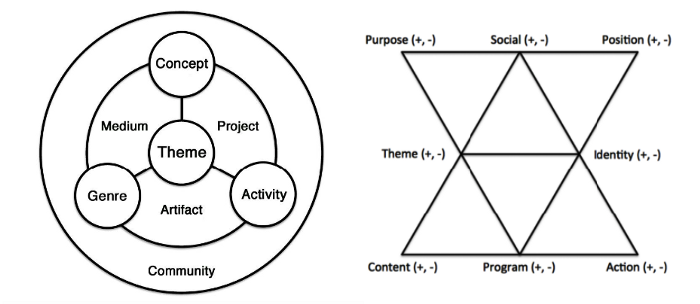
The above two diagrams are the “Themes of Practice” framework (left) and the model of Developmental Project (right). They can be used for understanding the “Themes” level (“Concept as Project”) and the “Center” level (“Center as Project”).
We can use the theme of “Tacit Knowledge” as an example to understand the “Themes of Practice” framework. From Jan to April 2022, I did several things with the Thematic Space Canvas which was designed for Developing Tacit Knowledge. For example, I run the first Thematic Spirit with a friend on March 19, 2022.
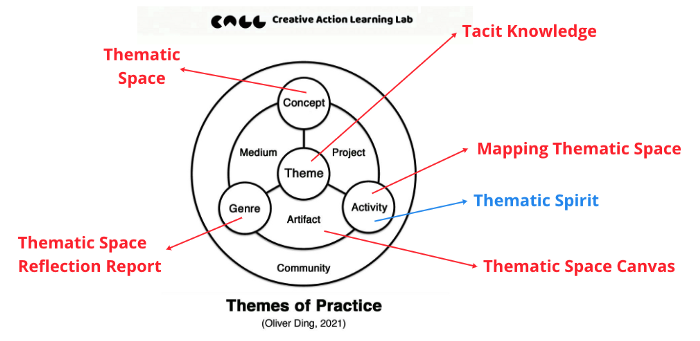
The above diagram represents the landscape of my practice around the theme of “Tacit Knowledge” and the concept of “Thematic space”. These two ideas are related to “the Objective — Subjective Knowledge Curation”.
On June 7, 2022, I published an article titled #TalkThree 04: How Does Collective Learning Work? and applied the above model of “Project Network” to discuss the model of “Knowledge Network”.
Life = Project = Thematic Space
On July 2, 2022, I reflected on my journey of developing the Life-as-Project approach from Jan to June 2022 and wrote an article titled Life Discovery: Biography, Journey, Program (and a possible book, Part 2).
From the perspective of the Slow Cognition project, Life Discovery is a particular type of Knowledge Discovery and the primary theme of Life Discovery is “My Life”.
The objective of the Life Discovery Activity is to Develop Tacit Knowledge about “My Life” and turn Tacit Knowledge into resources for actions.
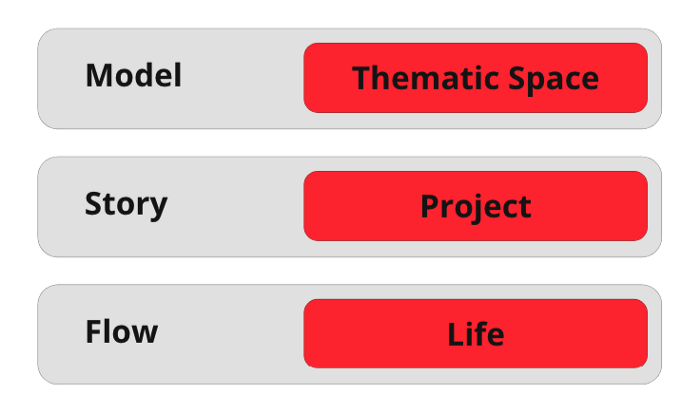
By connecting the Project-centered Approach and the concept of “Thematic Space” together, we can find the following connection:
Life = Project = Thematic Space
While Life is a chain of projects, it can be understood as a journey of moving between various thematic spaces.
Each project has its primary themes and other secondary themes. By joining projects and leaving projects, we are practicing our significant Life Themes. Thus, these projects are Thematic Spaces too.
This insight also echoes the model “Flow — Story — Model”. We can also find more details in Thematic Space: Project as Story.
In this way, I develop the 7th basic principle of the Life-as-Project approach: “Project as Thematic Space”.
Moving between Thematic Spaces
In Thematic Space: Place as Container, I mentioned that Story and Model are two types of containers. If we put them together, then one is Abstract Container and the other one is Concrete Container.
A project is an Abstract Container and their environments such as digital platforms are Concrete Containers.
Now we can use my journey of developing the Life-as-Project approach as an example of the notion of “moving between thematic spaces”. In Life Discovery: Biography, Journey, Program (and a possible book, Part 3), I list the following ten themes for the six-month journey.
- 1 — LAA — The “Life as Activity” Project
- 2 — PEA — The “Project Engagement” Approach
- 3 — LAP — The “Life as Project” approach
- 4 — LDA — The “Life Discovery Activity” Project
- 5 — AAS — The “Anticipatory Activity System” Framework
- 6 — SIA — The “Significant Insights Analysis” Project
- 7 — BIO — The Biography
- 8 — MNB — The Board @ Milanote
- 9 — SSL — The Shaper & Supporter Lab (SSL) Program
- 10 — CPN — The Complexity of “Project Network”
By using the model of “Project Network”, I designed the following diagram to visualize the complexity of the about ten themes.
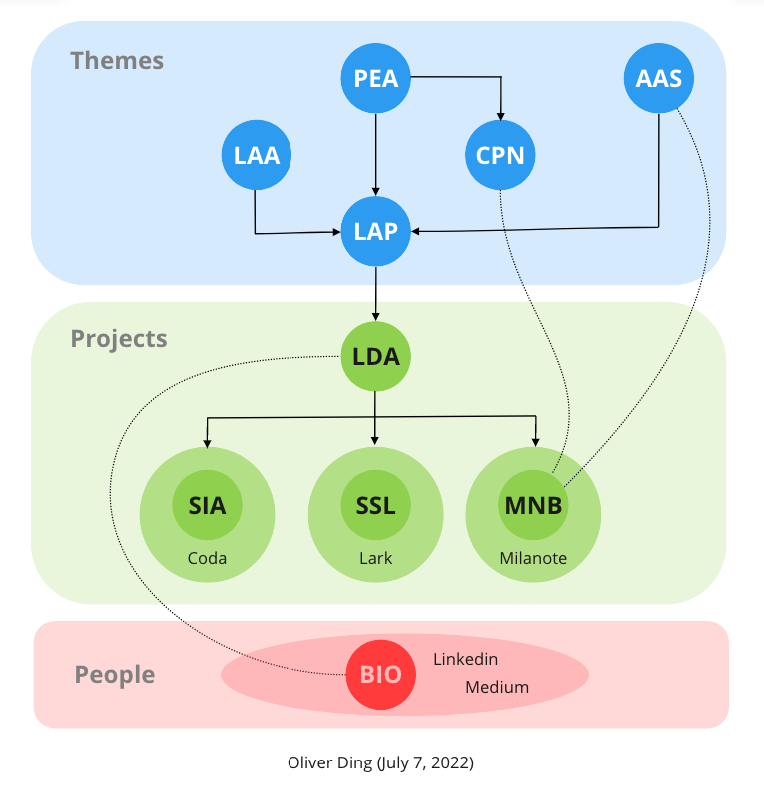
The model of “Project Network” is a multiple-level network that considers 1) a network of Themes, 2) a network of Projects, and 3) a network of People.
- All theoretical approaches and frameworks belong to the network of themes.
- All real activities such as developing a toolkit, designing a canvas, and hosting a program, are part of a network of projects.
- All things about people’s biogeography are located in the network of People.
The diagram is a map of the archive of my six-month journey in developing the Life-as-Project approach.
All theoretical approaches and frameworks belong to the network of themes. Each Theme refers to a Thematic Space.
And the network of Projects is considered as “Practices” of “Themes” from the perspective of the “Themes of Practice” framework and the perspective of Project-oriented Activity Theory. For example, the “MNB” (the AAS Board @ Milanote) is guided by the “AAS” framework. The “LDA” (the Life Discovery Activity) is guided by the “LAP” (the Life-as-Project approach).
We have to notice that the development of themes and the development of projects are intertwined in such a way that they actually all rely on each other. For example, the AAS framework was tested by watching the development of the SSL program. Some sub-frameworks are inspired by the SSL program. The MNB program was guided by a sub-framework of the AAS framework.
On June 30, 2022, I designed the Life Discovery Board (public, v2). The major difference between v1 and v2 is the following part which is about the Complexity of “Project Network”.
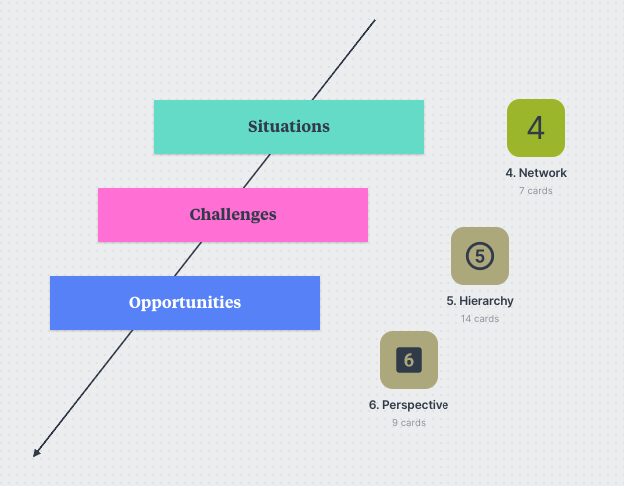
In fact, the notion of “Complexity of Project Network” (CPN) was born on June 30, 2022, when I was designing the v2 board.
Moving between various thematic spaces will impact moving between various projects and vice versa.
Life, History, and Multiverse
Finally, we reach the newest insight about the Project-centered approach.
On June 29, 2022, I adopted the perspective of sociology to reflect on the notion of “Activity as Project Engagement”. I realized that while we can understand Life as a chain of Projects, we can understand History as a chain of Events.
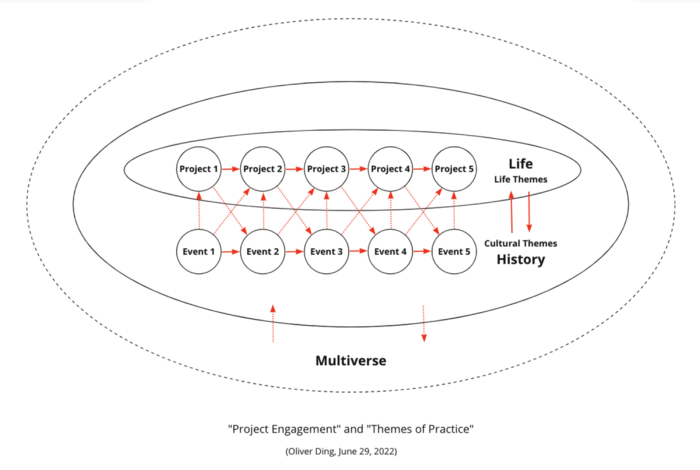
Thus, we connect “Event — Project”, “Life — History”, and “Life Themes — Cultural Themes” together. This notion echoes my idea about “Event — Project” in Life as Activity (v0.3).
The Life-as-Project approach uses “events” and “projects” to present social context and individual biography.
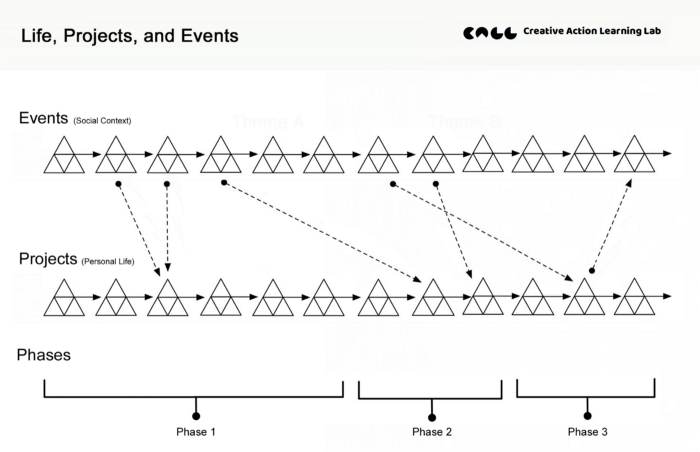
The difference between “events” and “projects” are individual involvement. If the person directly gets involved in an activity — it means she is the subject of the activity or part of the community of the activity — then the activity is a project of her biography. If the person doesn’t directly get involved in the activity, then the activity is an event of her biography.
Let’s use the biography of Yrjö Engeström as an example. According to Annalisa Sannino, there are four main phases in Engeström’s development as an activity theorist, “(1) the European student movement of the 1960s and the discovery of activity theory; (2) the study of instruction and the turn from school learning to workplace learning; (3) developmental work research and the theory of expansive learning; and (4) the formation of activity-theoretical communities aimed at changing societal practices.” (2009, p.11) We can use the above diagram to represent Engeström’s biography.
Phase 1
- Event 1: the European student movement of the 1960s.
- Project 1: Engeström wrote his first book (Engeström,1970), Education in Class Society: Introduction to the Educational Problems of Capitalism (in Finnish).
- Event 2: Leontiev’s Problems of the Development of the Mind, published in East Germany in 1973 (Leontjew,1973), and Davydov’s Types of Generalizations in Instruction, which was available in East Germany in 1977 (Dawydow, 1977).
- Project 2: Engeström discovered Activity Theory by reading Davydov’s book and II’enkov’s essay on the dialectics of the abstract and the concrete.
- Project 3: Engeström adopted Activity Theory for his thesis, The Imagination and Behavior of School Students Analyzed from the Viewpoint of Education for Peace (in Finnish) in 1979. This empirical study documents the work of nearly 2,000 students who wrote essays on war and violence.
Phase 2
- Project 1: Engeström attempted to change school instruction by bringing Davydov’s ideas to politically and pedagogically radical Finnish teachers. He published a chapter in the 1984 book Learning and Teaching on a Scientific Basis.
- Project 2: Engeström started paying attention to workplace learning and human resource development in organization. His first work-related study (1984) was concerned with janitorial cleaning, which was considered to be the occupation with the lowest prestige in Finland. The main motivation for studying the work of cleaners was to demonstrate that this work is creative and has an intellectual basis, and to show the possibilities of development.
Phase 3
- Project 1: From 1986 to 1989, Engeström led a study with the primary health care practitioners and patients of the city of Espoo, where patients were facing excessive waiting times before receiving health care and a lack of continuity of care.
- Project 2: Engeström adopted Davydov (1990)’s “learning activity” to investigate/implement radical change at work.
- Project 3: Engeström developed the triangular model of activity systems and the theory of expansive learning and published Learning by Expanding (1987).
Phase 4
- Event 1: Michael Cole directed the Laboratory of Comparative Human Cognition (LCHC) at the University of California, San Diego.
- Project 1: Engeström was invited to work at LCHC.
- Project 2: Engeström initiated communities for adopting activity theory for changing societal practices in Finland.
- Project 3: Inspired by the LCHC, Engeström founded the Center for Activity Theory and Development Work Research at the University of Helsinki.
- Event 2: Georg Rückriem worked on the translations of Leont’ev’s works in Germany.
- Project 4: Engeström suggested the idea of a conference in which scholars within Germany and elsewhere could gather to discuss ways of influencing human practices on the basis of activity theory. Subsequently, Rückriem started organizing the first conference of the International Society for Cultural Research and Activity Theory (ISCRAT), which took place in 1986.
- Event 3: LCHC published a Quarterly Newsletter titled Mind, Culture, and Activity.
- Project 5: Engeström suggested the creation of the journal Mind, Culture, and Activity, which was originally published as the Quarterly Newsletter of LCHC.
- Event 4: In 1995, Finland was struggling to overcome an economic recession, as were many other countries. The problems of the Finnish economy, however, were also connected with the collapse of the Soviet Union, which had been Finland’s main trading partner. Companies were under economic pressure and needed to find short-term solutions to the crisis.
- Project 6: Developmental work research was formulated in terms of a long developmental cycle of interventionist work lasting 3 to 5 years (Engeström & Engeström,1986). Companies in these years could not afford to engage in this kind of transformative venture. The intervention methodology of the Change Laboratory, as compressed cycles of transformation within the broader frame of developmental work research, was elaborated to meet the needs of these institutions.
- Event 5: The Center for Activity Theory and Development Work Research inspired the emergence of similar institutions, such as the Centre for Sociocultural and Activity Theory Research at the University of Bath in the United Kingdom, the Centre for Sociocultural and Activity Theory Research at the University of Oxford in the United Kingdom, and the Center for Human Activity Theory at the University of Kansai in Osaka, Japan.
The above example is just for showing the concepts of “events”, “projects”, and “concepts” within our approach.
The newest insight of “Life as moving between Thematic Space” also connects the Project Engagement approach and the Themes of Practice framework.
Finally, we see a simple model of the development of life and history:
Life = Projects = Thematic Spaces = Events = History
In this way, the Life-as-Project approach echoes Andy Blunden’s notion of “a project is a concept of both psychology and sociology” (2014,p.15).
Related Articles
- Life Discovery: Biography, Journey, Program (and a possible book, Part 1)
- Life Discovery: Biography, Journey, Program (and a possible book, Part 2)
- Life Discovery: Biography, Journey, Program (and a possible book, Part 3)
- Life Discovery: “Formation of Concepts” and “Themes of Practice”
- Life Discovery: “Project Engagement” and “Themes of Practice”
- #TalkThree 14: What’s “Thematic Space”?
- The Landscape of Project Network
- Life Discovery: The “Means-End” Spectrum and Becoming
- CALL: How to Grow A Knowledge Enterprise
- Platform Genidentity: The Movements of Unfolding Uniqueness
- The Slow Cognition Project (Phase II): Activity Analysis for Creative Work Study
- CALL: The Launch Day of Curativity Center
- #TalkThree 04: How Does Collective Learning Work?
- D as Diagramming: Challenge as Opportunity
- Life Discovery: The “Experience — Theme” Ladder and Meaning
- Life Discovery: Mapping Networks of Enterprise
- D as Diagramming: The Opportunity Formula — 9 min read — Oct 5, 2021
- The Knowledge Curation Toolkit #3: Hamburger for Contextural Curation — 16 min read — June 28, 2022
- Eight types of structures of context for Attachance — 3 min read — April 19, 2020
I am also working on building a new website for the Platform Ecology project. You can save the following links:
- PlatformEcology.org
- Twitter: @PlatformEcology
- Linkedin: @PlatformEcology
You are most welcome to connect via the following social platforms:
Linkedin: https://www.linkedin.com/in/oliverding Twitter: https://twitter.com/oliverding Polywork: https://www.polywork.com/oliverding Boardle: https://www.boardle.io/users/oliver-ding


