
Slow Cognition: The First Thematic Spirit
Using Thematic Space Canvas to Develop a new canvas about Concept Development

About 24 hours ago, Daiana Zavate and I run the first Thematic Spirit for one hour.
Thematic Spirit is a collaborative program that aims to create new canvases based on a meta-canvas, the Thematic Space Canvas, in one or more hours.
What’s the Thematic Space Canvas?
Thematic Space Canvas is a meta-canvas that is used to create new canvases for curating various data and ideas to develop tacit knowledge about particular themes.
The diagram below is the newest design of the meta-version of Thematic Space Canvas. A meta-canvas is an abstract canvas that doesn’t tie to any domain. The goal of designing a meta-canvas is to highlight a unique spatial structure for designing domain-specific canvases. I use abstract terms such as “area”, “dimension”, “block”, and “theme” for the meta-canvas.
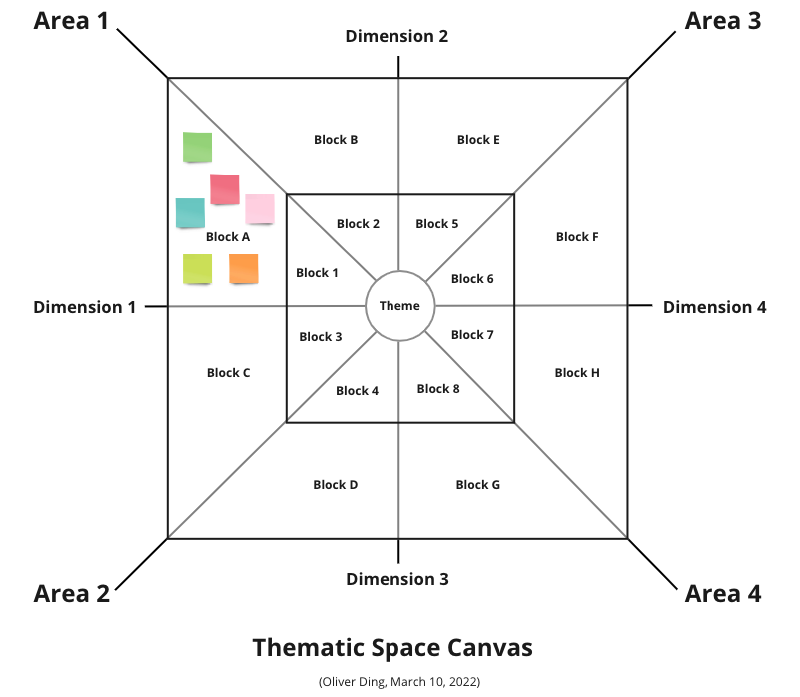
The Thematic Space Canvas is not a simple 2x2 matrix for building a typology, but a multiple-dimension model for visualizing a holistic view to sense-make a dynamic meaningful whole. You can find more details here: The Notion of Thematic Spaces.
The Thematic Space Canvas’ spatial structure is designed with the following aspects:
- Four Significant Areas
- Four Dimensions
- Two Subspaces: Inner Space and Outer Space
- Eight Pairs of Blocks
- A Primary Theme
In the past three months, I created the following canvases based on the Thematic Space Canvas:
- The Knowledge Discovery Canvas (its original name is “Thematic Space Canvas”)
- The Spark Space Canvas
- The Statue Space Canvas
- The Life Discovery Canvas
- The Optimal Context Canvas
- Lifesystem Development Canvas
Though the above domain-specific canvases share the same spatial structure which is defined by the meta-canvas, each domain-specific canvas has its purpose and content. For example, The Life Discovery Canas is developed for Life Discovery Activity.
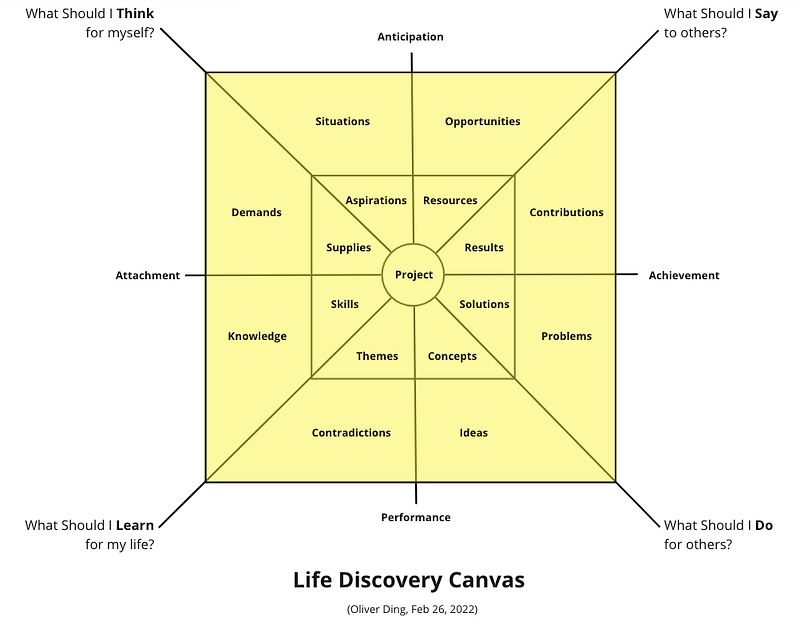
You can find more details about Thematic Space Canvas here. If you want to know more about Life Discovery Canvas, you can find links here: theoretical background, Spatial Structure, THINK and LEARN, SAY and DO Inspirations.
The Concept Discovery Canvas (v1.0)
The day before yesterday I made a new canvas called Concept Discovery Canvas (v1.0) for learning Conceptually Difficult Knowlege and Advanced Knowledge Acquisition.
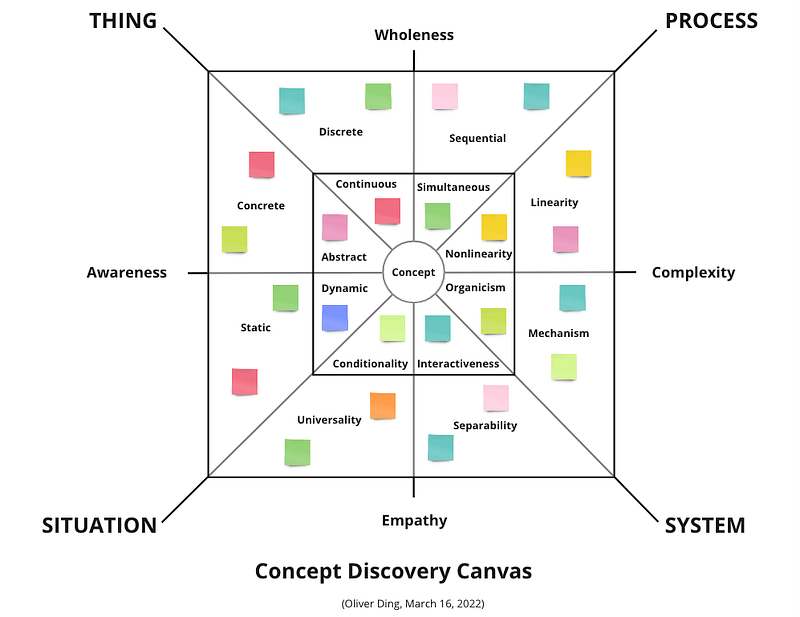
The Concept Discovery Canvas is inspired by Paul Feltovich, Rand Spiro, and Richard Coulson’s 1993 paper Learning, Teaching, and Testing for Complex Conceptual Understanding. Though the original paper is about educational psychology research, I think it is also useful for adult learning and life discovery in general.
You can find more details in the original article: Slow Cognition: The Concept Discovery Canvas.
A Live Discussion on Linkedin
Yesterday I shared the Concept Discovery Canvas (v1.0) on Linkedin. I mentioned Daiana Zavate who is the Concept Lead at Owtcome in the comment area of the post.
To my surprise, she made a new version of the canvas and called it Concept Discovery Activity. Then we had a lively discussion in the comment area of her post.
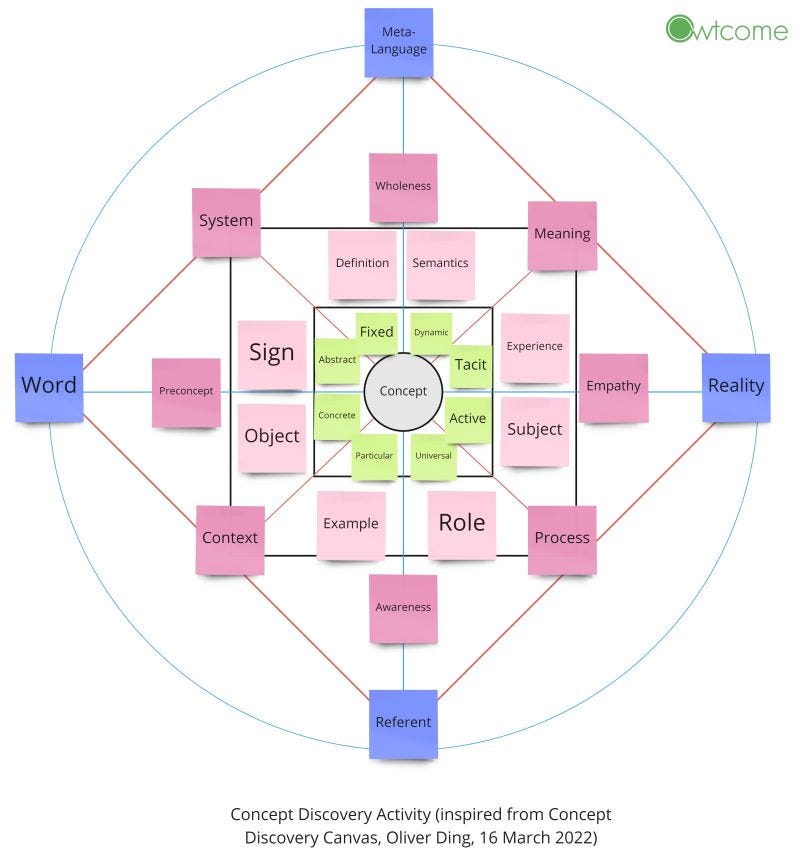
Following up on Oliver’s Concept Discovery Canvas (link below), I thought about what I would prioritize in a Concept Discovery Activity that could prove useful in mapping concepts. While the CDC is a fitting practice for observing the complex ties of theory to practice and a great starting point for curation practices, I was curious if there can be more points of convergence to show the irregularity of some concepts, especially when we don’t know (yet) what that concept could be.
This framework is just an experimental playground and by no means complete, but it was a nice introspection to visualize my thoughts on some concepts and their ambiguity.
Daiana Zavate
Her canvas encourages me to reflect on the name “Concept Discovery” of my original version. Below are my comments:
Daiana Zavate I think you are developing a real canvas for “Concept Discovery”. My original canvas should rename as something else.
A simple starting point about Concept is the distinction between word/name and meaning. For example, the word “Concept Discovery” is not a perfect name for my original canvas. That’s the reason you can use the word “Concept Discovery” to develop a new canvas.
Then, we can pay attention to the “Activity” part of “Concept Discovery Activity”. From the perspective of Activity Theory, we can consider the following two ideas:
1. The Means-End Spectrum This is inspired by traditional Activity Theory’s “tool mediation” principle.
More details: a. https://readmedium.com/diagramming-3a-3baaa78bea89 b. https://readmedium.com/means-end-ed457427c7e
How to apply this idea to Concept Discovery Activity?
Sociologists tend to use “sensitizing concepts”, “background concepts”, or “orienting concepts” to describe the initial themes for the journey of field research work. These initial themes are found in the disciples. For example, “career” is a great orienting concept for a social study project.
I use the “Working concept” to refer to researchers’ own creations.
The “Orienting — Working” dimension echoes the Means-End Spectrum.
2. The Initiate — Repurpose Dimension
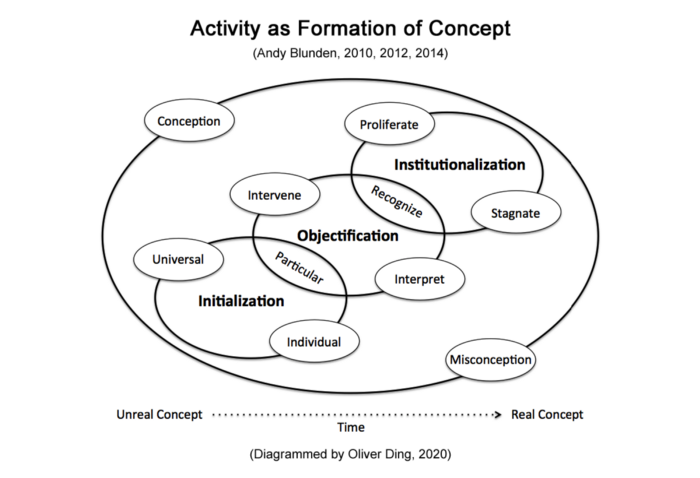
The Initiate — Repurpose Dimension is inspired by Project-oriented Activity Theory that considers an activity of formation of a concept as a project. This approach is quite innovative.
More details: https://readmedium.com/af5bf712bf7b
There are three phases of the formation of a concept:
Phase 1: Initialization; Phase 2: Objectification; Phase 3: Institutionalization.
In Phase 3, many people will join the movement and repurpose the original concept. They may rebrand the concept with a new name, or they may use the name of the original concept to refer to a new meaning.
3. Three dimensions for Concept Discovery Activity
So far, we have the following three dimensions:
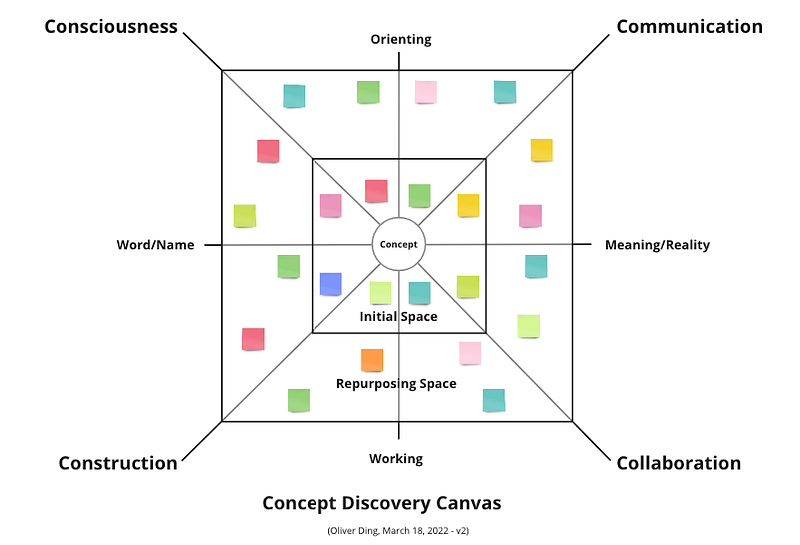
a. The Word/name — Meaning/reality dimension b. The Orienting — Working dimension c. The Initiate — Repurpose dimension
I’d like to use the Initiate — Repurpose dimension to define the Inner Space and Outer Space of the Concept Discovery Canvas.
More details about the meta-canvas behind the Concept Discovery Canvas:
Finally, we need to define Four Areas for the canvas. We can adopt Buchanan’s four orders of design for this task.
- The first-order (signs) deals with problems of communication - The second (things) deals with problems of construction - The third (actions) deals with problems of action - The fourth (thought) deals with problems of integration
reference: http://revistas.unisinos.br/index.php/sdrj/article/view/sdrj.2021.141.06/60748456
I think we can use the following words to name our four areas: - Communication (refers to Signs) - Construction (refers to Things) - Collaboration (refers to Activity) - Consciousness (refers to Thought)
These four areas define different contexts of concept discovery.
These comments led to a new version of Concept Discovery Canvas (v2.0). See the canvas below.
Daiana Zavate responds to the new version of canvas with the following comment:
Thanks so much for this, Oliver! This is really helpful to put into perspective the concept development across multiple dimensions of activity. I think for a concept to be “declared”, you’re right, it must go through the three phases: Initialization — Objectification — Institutionalization. That gives a concept enough autonomy to function as part of a language and we don’t have to redefine it every time we use it.
I have to dig deeper into Buchanan’s work to understand the four orders of design before I derive from it, but everything you’ve brought out here it’s very valuable and intricate, so I’ll take my time digesting :)
Also for the framework, I agree that we don’t have to name all blocks as some concepts don’t cover all areas, nor they need to, but it’s a good visual representation to identify what the concept is “not” and which conceptual category they belong to (that is if we intend to build a library of sorts)
Later, I reproduced her canvas on a Miro board and made the following comments with several questions.
Daiana Zavate I just now reproduced your canvas on Miro, your version is pretty awesome. It seems that I can understand most of your ideas. I really like your whole framework and each pair of concepts.
I have the following questions:
1. What’s the purpose of adding the circle of “Word, Reality, Referent, Meta-Language”? 2. What does “Meta-Language” mean? 3. What does “Referent” mean? 4. There is a link between “Word”, “Sign”, “Semantics” and “Meaning”. From your perspective, what’s the difference between “word” and “Semantics/Meaning”? 5. What’s the difference between “Meaning” and “Reality”?
I’d like to just use our collaboration as an example. As mentioned in the first comment, I used “Concept Discovery” to name my original canvas. There is a “Sign” relationship between the word “Concept Discovery”(word/name) and my original canvas (meaning/reality).
Here I use “Meaning” to refer to my purpose of using the word “Concept Discovery”. So, the “meaning/reality” is the same thing for my case. They are all about my original canvas.
However, the word “Concept Discovery” has a new meaning for you. So, you detached it from the original Sign relationship and attached it to a new Sign relationship which also means a new creative space.
Your canvas creates a new Reality that is more close to the Semantic Meaning of the word Concept Discovery.
It seems we need to consider two types of meanings: Ecological Meaning (what I really want to communicate), and Semantics Meaning (what the word means). The difference between this two is about the skill of using language.
Would you mind joining the Miro board and we can work together for the next version?
Daiana Zavate answered my questions in the following comments:
- I’d love to join! In the meantime I’ll try to answer some of your questions:
- The circle is meant to create a sense of completion for the ones engaged in the activity.
- The 4 poles Word-Reality-Referent-Meta-Language are not exactly cover what makes a concept whole, but it provides means for acceptance of the known space, along with what cannot be yet known.
- The Meta-Language plays more of a pivotal role, overseeing the formation of the concept through the mix of (specialty) languages brought together.
- I think together they create a Narrative: The Word is the “name of the concept” in a given Reality, that we choose to point towards a “Referent” (something like a backup word, to ensure continuity in the narrative). If we want to share our Discovery with others who will not be involved in the work, then a Narrative is necessary to convey the complexity in a purposeful manner.
- As for the Word/Semantics/Meaning distinction, I do it to point out the imperfection of our communication. In our prior conversation, you said something that struck a chord: “A typical thing is that people often use wrong words to describe their real meaning”
- I think of them roughly like this: The Word is the tipping point of communication. Semantics is the logic mediating the exchange between Meaning and the Word we choose. Meaning is the significance placed by the Subject/Agent to carry out a particular message into the world.
- Meaning and Reality — that’s a delicate relationship. If I may say that meaning comes from the Subject, then it is attributed to a Reality. I think there are multiple realities (internalized and externalized). The ones I’d consider for this activity are the social realities that converge Meaning-Empathy-Process to meet some basic requirements of social normativity: Validity-Belonging-Activity.
- Thank you for your great questions! I’m not sure if I answered them properly but I’ll think more about these nuances and how they come to the surface.
Daiana Zavate’s answer reminded me of a new idea. I should expand this canvas into a three-step flow. I replied to her with an old diagram called Diagramming for Academic Creativity.
Thanks for the reply. Now I see the difference between your framework and my framework. I didn’t consider the situation of communication for the Concept Discovery Activity.
In an article about diagramming and knowledge building, I use the following diagram to roughly describe three phases of knowledge building. Though it is about diagramming, I personally apply the model to concept discovery too.
1. Curating for Understanding 2. Creating for Sensemaking 3. Improving for Communicating
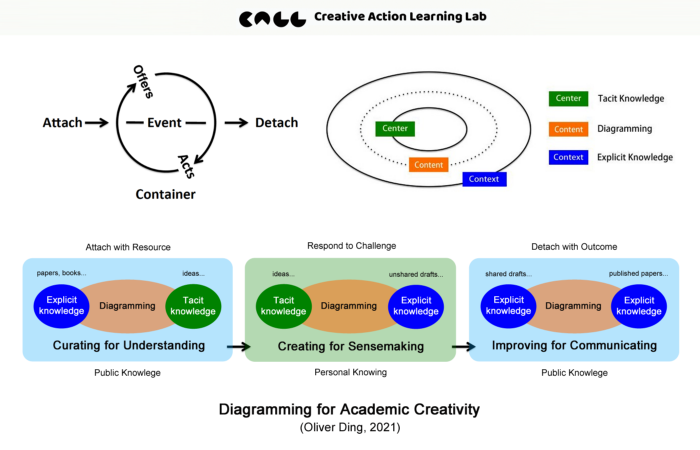
Maybe we need three canvases for the Concept Discovery Activity. Or we can define the Concept Discovery Activity as “Creating for Sensemaking” which refers to developing a new concept.
My original canvas is about dealing with Conceptually Difficult Knowlege. So, it perfectly matches phase 1 “Curating for Understanding”.
For phase 3 “improving for communicating”, we consider Communication and Contexts as the primary focus.
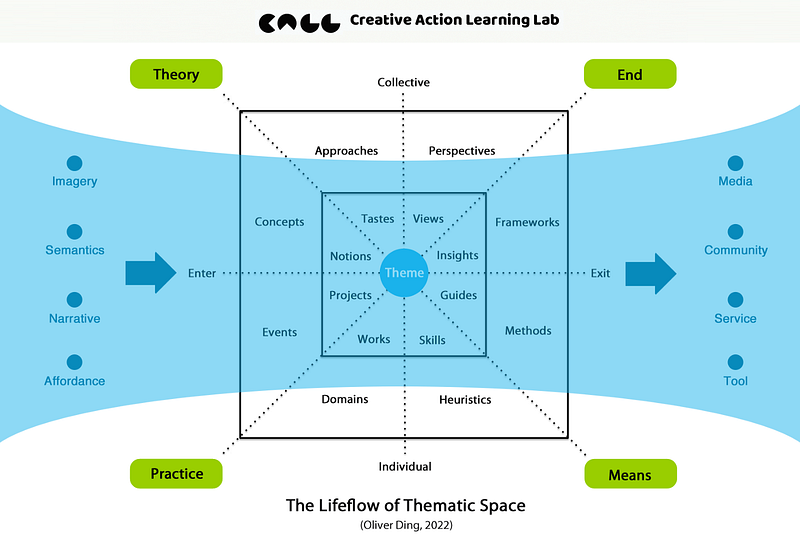
The attached canvas is called the Lifeflow of Thematic Space. It seems we can apply the same structure to Concept Discovery Activity.
Finally, we moved to the board and run a real-time collaboration of making a new canvas.
A Tiny Real-time Global Collaboration on Miro
Daiana Zavate was in Rome while I was in Houston. We started our tiny real-time global collaboration on Miro at 1:30 pm.
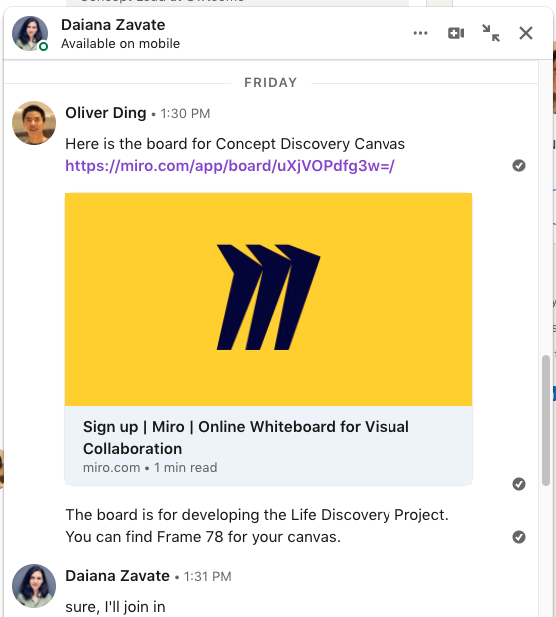
Daiana Zavate has been following my writing for several months. After reading and reproducing her version of the canvas, I was sure that she is understood the spatial structure of the Thematic Space Canvas. I also read her creations of concept development about strategic design thinking. I believe she is a talent for conceptual thinking.
Since we share the same knowledge about Thematic Space Canvas and Concept Development, our first collaboration went quite well.
Our first task is setting a new framework that frames the three-step flow for our three diagrams.
- Phase 1 — Curating for Understanding > my original Concept Discovery Canvas (v1.0)
- Phase 2 — Creating for Sensemaking > my second version of Concept Discovery Canvas (v2.0)
- Phase 3 — Improving for Communicating > Daiana’s version of Concept Discovery Activity
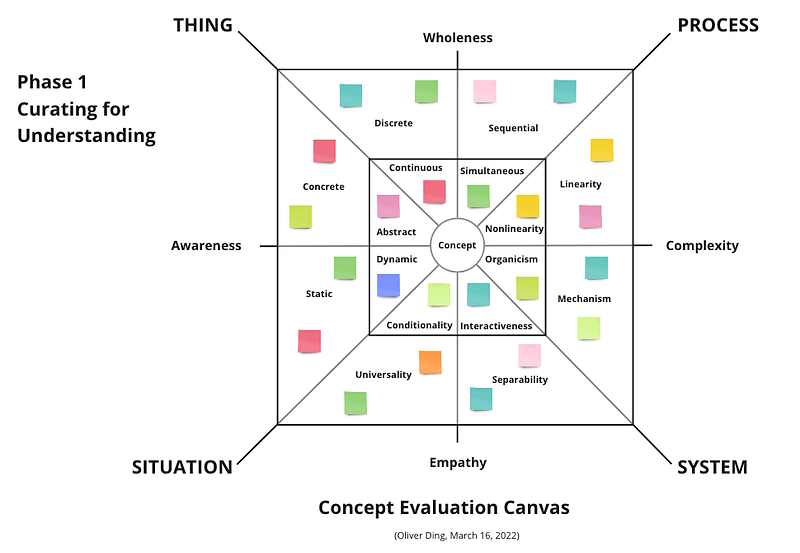
Phase 1 is defining for learning and understanding Others’ concepts. It’s for building a knowledge base for a particular topic or an issue. We directly used my original Concept Discovery Canvas (v1.0) for it and didn’t make any change. Today I renamed it Concept Evaluation Canvas.
Phase 2 is about creating a brand new concept. This is the core of the whole flow. So we decided that we use Concept Discovery as a name for this phase. Since we can use the third canvas for communication, I removed “four orders of design” from the Concept Discovery Canvas. I thought we can emphasize Concept Creation Strategies for this canvas, we can use Four Types of Strategies to define four areas. However, we don’t have enough time to find and decide the content of the Four Types of Strategies.
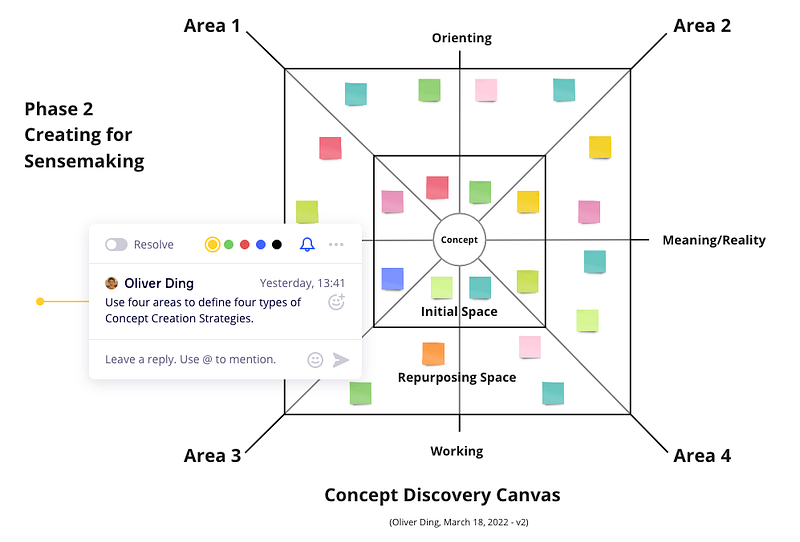
Thus, the major task of the collaboration is redesigning the third canvas. We had several discussions on different issues. The Thematic Space Canvas requires the following settings:
- Four Areas
- Four Dimensions
- Two Subspaces: Inner Space and Outer Space
- Eight Blocks for Inner Space
- Eight Blocks for Outer Space
We moved “Four Orders of Design” (Consciousness, Communication, Construction, Collaboration) from the second canvas to the third canvas and used it to define the four areas.
We also kept “Four Dimensions” (Preconcept, Empathy, Awareness, Wholeness) from Daiana’s canvas for the third canvas.
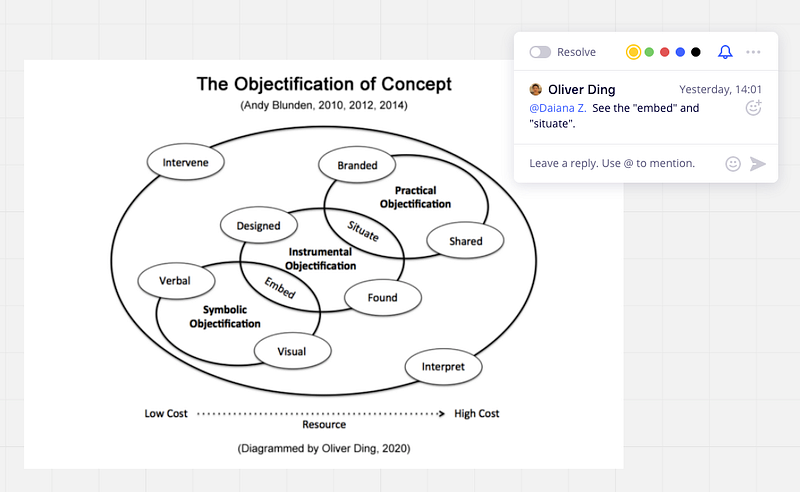
The “Two Subspaces” is a major challenge for us. I decided to use the notion of “Objectification of Concept” from my book Project-oriented Activity Theory for the foundation. Since she was not familiar with the notion and my book. I pasted the diagram about “Objectification of Concept” on the board and discussed the idea with her. Later, we decided to use Material Space for Inner Space while Outer Space was named Situated Space.
After defining Inner Space and Outer Space, we started working on 16 blocks. The screenshot below was made around 2:30 p.m. At that moment, I just finished the Inner Space while Danina was working the Outer Space.
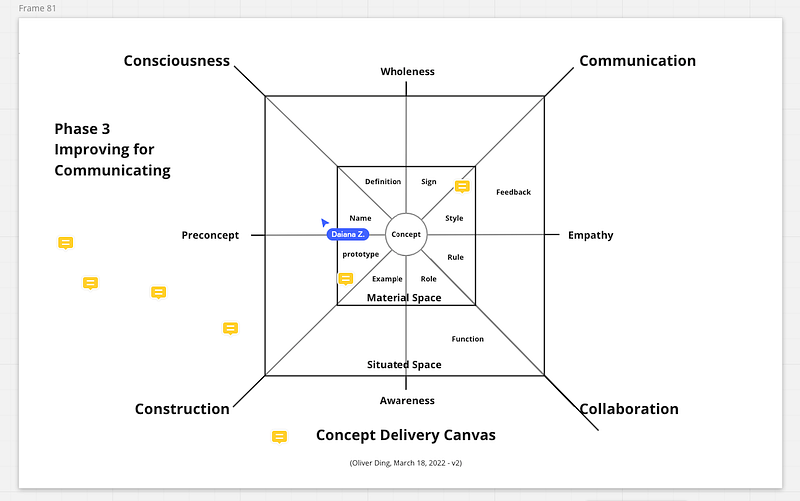
Danian’s original canvas provided initial inspirations for Inner Space. Also, the new structure of the canvas guided our creations. For example, Four Orders of Design and Four Dimensions defined different conceptual spaces for each block. We can follow the direction to search and find suitable ideas for these blocks.
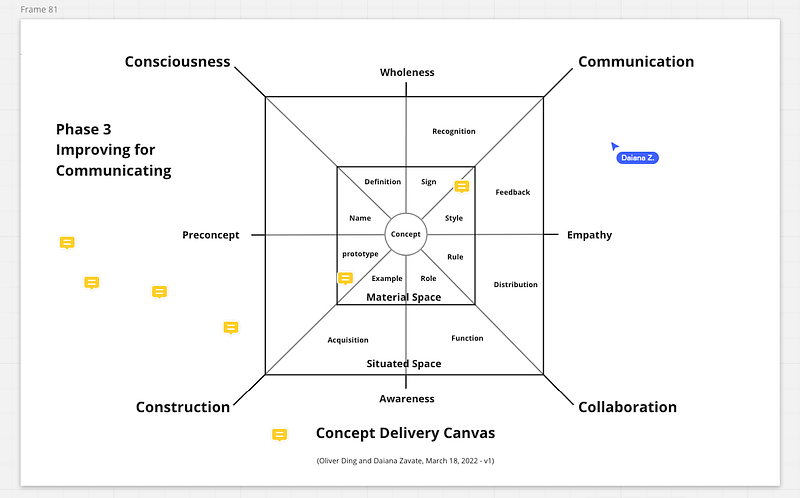
The above screenshot shows the process of working on Outer Space. At that time, I added Daina as a co-author of the canvas.
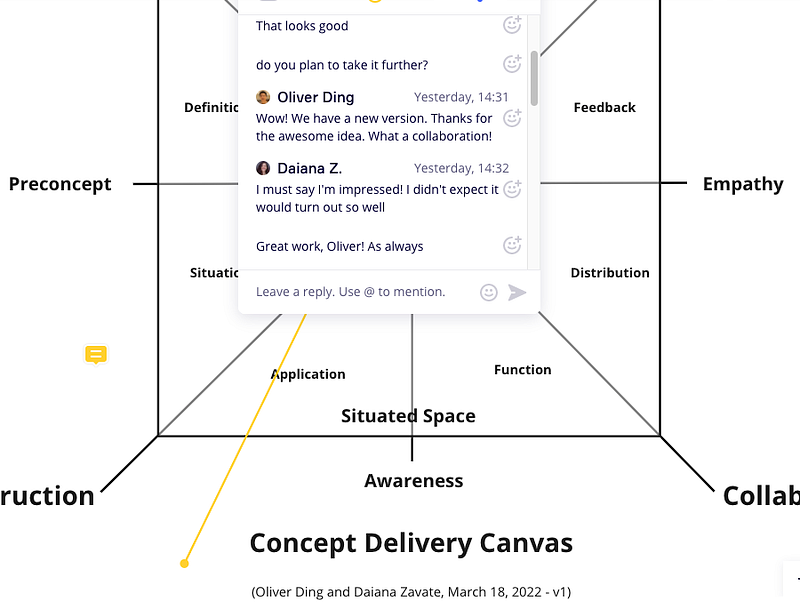
At 2:30 p.m., we completed the whole canvas. This is an awesome collaboration. We did it in just an hour!!!
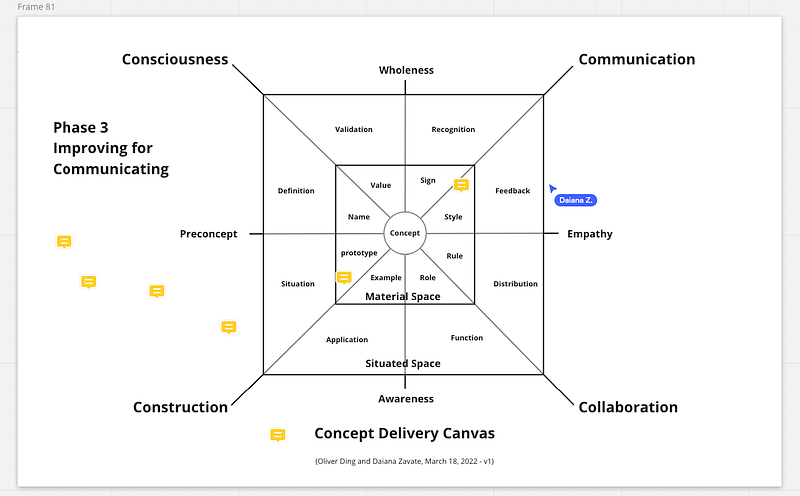
The above canvas is our final draft of the third canvas. It was renamed Concept Delivery Canvas.
The Frist Thematic Spirit
This is an awesome improvised collaboration. I was so excited that we can do such a creation.
After six hours, I realized that we also created a new activity about the Thematic Space Canvas. I’d like to call it Thematic Spirit.
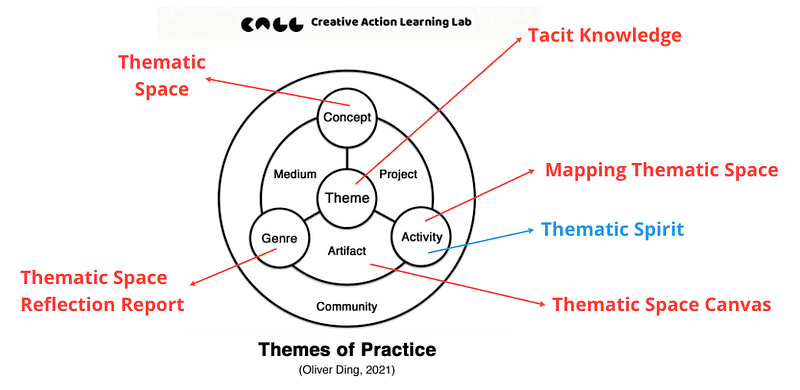
One month ago, I reviewed the Developing Tacit Knowledge project and used the above diagram to curate my creations about Thematic Space. Now I can add “Thematic Spirit” to the diagram.
What a wonderful experience of collaboration!
You are most welcome to connect via the following social platforms:
Linkedin: https://www.linkedin.com/in/oliverding Twitter: https://twitter.com/oliverding Polywork: https://www.polywork.com/oliverding Boardle: https://www.boardle.io/users/oliver-ding


